
|
|
|
Menu |
Merry Meet and Welcome to The Paganus Website |
|
�Home |
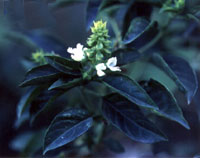
Basil (Ocimum basilicum) Common Names: Sweet Basil, garden Basil, The Herb of Kings. Occurrence: As a garden plant throughout Britain. Parts used: The herb, which contains a volatile, camphoraceous oil. Magick/Lore: In its original soil, it was revered as a Religious Herb, sacred to deities of the Hindu faith and interwoven in the everyday life as a Funeral Herb. Areas of Europe, even though removed from knowledge of each other, all found Basil as a symbol of love. Grieve tells us of customs among the Moldavians, the Cretes, and the Italians in which Basil is strongly linked with romance. Basil is used today as a Magickal Herb associated with the rites of initiation; with the need for courage in times of great difficulty, and in aiding the soul on its journey to the next place of being. It is of delightful value in bringing compassion to those who share a meal, and is an herb which can bring kitchen magick to the cook. Remedial/Medicinal: One of Basil's medicinal properties is it can be used to draw out poison from insect bites. It also ecellent for minor wounds, scratches and abrasions. The volatile oil of Basil is very soothing and promotes quick healing Basil is valued for aiding digestion, and it is anti-bacterial. It's also used for ringworm and internal parasites. It also prevents peptic ulcers and other stress related conditions like hypertension, colitis and asthma. Basil is also used to treat cold and reduce fever, congestion and joint pain. Due to its anti-bacterial and fungicide action, Basil leaves are used on itching skin. It's said it has the ability to reduce blood sugar levels. It is also great for treating irritable nerves and for stopping vomiting and nausea via drinking an infusion. Using dried Basil as a snuff is said to relive headaches. Administer as: A flavouring in food, dried leaves or an infusion. Basil is a: Aroamtic, carmative, tonic, anodyne, antiseptic. |