 |
 |
 |
 |
 |
 |
 |
 |
 |
 |
|
 |
 |
 |
 |
 |
 |
 |
 |
 |
 |
 |
 |
 |
 |
 |
 |
 |
 |
 |
 |
 |
 |
 |
 |
 |
 |
 |
 |
 |
 |
 |
 |
 |
 |
 |
 |
 |
 |
 |
| Holy wells in Wales(ffynnon is the Welsh word for well) |
| Holy wells were once very important to the Welsh people and that they existed in quite large numbers.Our pagan ancestors regarded wells, springs, lakes and rivers as the abodes of gods. No doubt a range of ceremonies were associated with them and they remained dear to the populace. In the year 601 Pope Gregory instructed missionaries to destroy the idols of Britain but to purify existing temples. Ancient pagan sites, including wells, gradually came to be associated with the early missionary saints. Many of the wells were roofed and acquired small chapels with niches for statues of saints but over the centuries the upheavals in the religious life of Britain led to the desecration and destruction of many old shrines and the majority of the old well chapels disappeared. Ffynnon Fair Penrhys was a south Wales well belonging to Llantarnam Abbey at the time of the dissolution of the monasteries. In 1538 Thomas Cromwell, vicar-general to King Henry VIII, ordered that the effigy of the Virgin Mary be removed "as secretly as may be" and the "Image and her apparel" were sent to London to be burned. The country folk were not easily swayed by the reformers and intellectuals of London, however, and pilgrimages to holy wells continued. In 1595 a large number of people were apprehended at Ffynnon Gwyddfaen in Carmarthenshire and brought before the local magistrate Morgan Jones of Tregib (a descendant of the ancient Welsh prince Urien Rheged). The squire refused to examine or imprison them and later referred to them as poor sickly persons who had wished to wash at the well "hoping by the help of God thereby to have their health".St. Winifred's well at Holywell has survived with associated buildings intact. The well and chapel were granted by the Countess of Chester to the monastery of St. Werburg in 1093. Later, possession reverted to the Welsh lords and in 1240 Dafydd ap Llewelyn granted it to Basingwerk Abbey. Kings Richard I and Edward IV are said to have made pilgrimages there and in 1439 the Countess of Warwick presented her "russet velvet gown" to the chapel (an early example of the present trend in which famous people donate garments for the benefit of favourite charities). Richard III met the cost of maintaining a priest at the well. The present architectural remains resulted from the largesse of Lady Margaret Beaufort, the mother of the future King Henry VII. It is possible that she prayed there for his success and when he was indeed victorious at the Battle of Bosworth Field in 1485, the Tudor dynasty attained the throne. The Tudors were proud of their Welsh ancestry and the royal connection seems to have accounted for the survival at Holywell. some of the wells retained their ancient associations despite the religious and social upheavals of the centuries. Francis Jones notes the way in which wells often figure in the "Lives" of the saints. The surviving manuscripts date from around 1100 to 1400 and the theme of a saint's battle with dark forces at the site of a well is commonly encountered. Giants, demons (and sometimes women!) slew or were slain by saintly figures and the Lives confirm that even after the many hundreds of years in which Christianity had been the state religion, the wells were still associated with the ancient pagan beliefs of the Celts. It is remarkable that at least two wells appear to have retained, in their names, a connection with the Celtic gods. Ffynnon Gwenhudw seems to refer to a female water deity, the prefix Gwen "evidently represents an effort in Christian times to disguise the true origin of the goddess". |
| If you are interested in this facet of Welsh history and are planning travel in Wales, you might like to know that these sites are especially prolific in north Wales and the Isle of Anglesey and in the western county of Pembrokeshire. Local libraries and museums will have further information. |
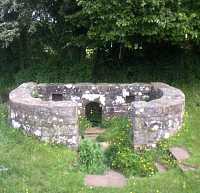
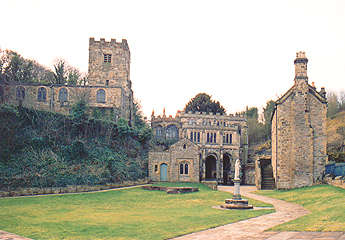
| Trellech's holy well, known as St. Anne's or The Virtuous Well, used to be a place of pilgrimage. Little is known about the present structure but an inscription on the sundial in the church (dated 1689) seems to indicate that Lady Magdalene Probert was responsible for this. It can safely be assumed that the well had been a significant religious site for many centuries before 1689. Interestingly, the tree at the rear of the well is festooned with strips of rag. It is well known that this custom was common in medieval times. Pilgrims to holy wells would tie strips of cloth to nearby trees or throw bent pins into the water. One cannot help wondering how this tradition has survived to the present day |
 |
| Eluned: Celtic Saint of Wales Eluned was believed to be one of the twenty-four daughters of Brychan Brycheiniog, a fifth century king, who had embraced the new faith of Christianity. Eluned became a Christian at a young age, but was pursued by a pagan prince. She did not want his advances and, like many women of her time, she ran away to keep from being forced into the relationship. She traveled to Llanddew, where she was rejected by the inhabitants. Wanting to rely on the protection of Brychan, she traveled to Llanfilo, which was much closer to his territories. Here again, however, she was ousted by the inhabitants, this time on the pretext of thievery. She then traveled to Llechfaen (Llechen), where she was again thrown out of the community. She would not find peace until her arrival at Slwch Tump, where the local lord gave her protection. It is said that after finding protection, Eluned made a prophecy that Llanddwer would be chastised for what they had done to her, that Llanfilo would be plagued by thieves, and that Llechfaen would be best with envy. In the seventeenth century, Hugh Thomas, the Breconshire Herald, suggested that these prophecies had indeed all come true! Despite having found protection, Eluned's old pursuer found her. When she ran from him, he chased her down the hill and beheaded her. Her head rolled down the hill and hit a stone. In that spot, a spring arose. Unlike St. Winifred whose head was miraculously restored to her body, Eluned remained decapitated, but her cult flourished and was still prominent when the Normans arrived in Breconshire in the eleventh century. The well at Slwch was associated with healing and other miracles. William of Worcester records that in the fifteenth century, one who drank the water there in honor of that saint was likely to be blessed with the finding of one of her hairs. Her feast day is August 1, which was also the date a pagan harvest festival was celebrated. Gerald of Wales in the twelfth century wrote that large throngs flocked to her chapel and well. Gerald wrote that the pilgrims were often taken by some sort of "frenzy,": in which they would jump in the air and them mime any sinful activities they had performed on the Sabbath. These activities were similar to those reputed to have been performed for the pagan festival. This link suggests that Eluned's travels might have been in an effort to sanctify pagan sites, such as the wells now associated with her journey, and to bring Christianity into the pagan countryside. Like so many other holy sites, Eluned's well and chapel were destroyed in the Reformation. The chapel was used as a barn in the seventeenth century. All that is left today of the chapel is the ground on which it stood,which is marked by an ash tree. The well itself was filled in during our own century. |
| The Well at Coleg Trefaca: St. Anne's Well Eluned would have passed through Trefaca after leaving Castell Dinas, the probable home of her father Brychan Brycheinoig.,in the grounds of Coleg Trefaca.in Wales, the center of the Welsh Methodist movement. |
 |
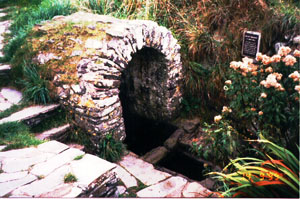
| St. Non`s Well one of many Holy Wells in Wales and the Celtic lands. The water here is said to have remarkable curative powers. |
 |
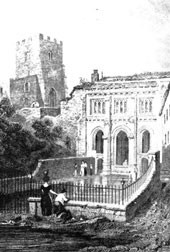
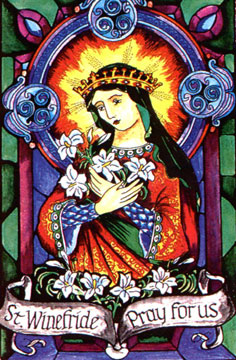
| St. Winefride's Holy Well In 1415 King Henry V made a forty-five mile pilgrimage on foot to St. Winefride's Well from Shrewsbury to give thanks for his victory at Agincourt. The well had even then been a centre of Pilgrimage, Healing and Prayer for over seven hundred years. When the Pilgrim Fathers left for America, St. Winefride's Well had been a centre of Pilgrimage, Healing and Prayer for nearly a thousand years. When The Blessed Virgin Mary appeared to St. Bernadette at Lourdes, St. Winefride's Well had been a centre of Pilgrimage, Healing and Prayer for some twelve hundred years. St. Winefride's Well is still there today and is the only shrine in the British Isles to have survived the Reformation with an unbroken record of Pilgrimage, Healing and Prayer. And this goes back to the seventh century, which is to say not long after the days of King Arthur! Furthermore it remains remarkably untouched by commercialism and is still a place where many regularly bathe (three times is recommended) in the waters of the well and pray for their spiritual and physical needs. |
 |
 |
 |
| Carreg Cennen or Caer Cynan as it was once known, is perched like an eagle's nest on an isolated and precipitous crag 300 feet above sea level, above the Cennen Valley, lying off the A483 road from Llandeilo to Ammanford. This was undoubtedly a Celtic tribal settlement before the building of the castle. The earliest record of the castle occurs in the Welsh Chronicles of 1248. There is a vaulted passage leading along the top edge of a sheer cliff face, which was built specifically to lead from the castle down to a natural limestone passage. At the bottom of this steep passage, which is about 50 yards long, the visitor encounters this unusual and beautiful well, which mysteriously is found to be on a ledge several feet above the passage floor, in a wall niche. The whole cave in which the well is situated forms a natural grotto. For a minimal fee of 50 pence, a torch can be hired to light the clamber down the passageway. The well has a tradition as a wishing well and bent pins would be thrown in as offerings to the guardians. Many casual visitors comment on the 'spooky' atmosphere of the passage and cave. To a more psychic type this is obviously a very powerful site and the well was clearly once revered as a sacred place. |
| Five miles from Moylegrove is to be found the medieval township of Newport, perching on the side of the sacred mountain of Carningli, which translates as Mountain of Angels, and here St Brynach, an Irish saint, lived on its peak. He ate no physical sustenance for 40 years, or so the local legend has it. He did however take water from a holy well sited in the nearby Nevern Valley. The well is actually to be found above the spring head of a stream. It is extremely difficult to find and overgrown. |
| The most famous well in the Dyfed area is sited at the ancient religious centre of St David's, with its impressive Cathedral and surprisingly small village. The well is a little outside of the village and is signposted. It is to be found on the cliff tops overlooking St Bride's Bay, or more properly St Bridget's Bay. The remains of a stone circle are to be found next to it. This implies that the well pre-dates its dedication to St Non, the reputed mother of St David. This has long been a pilgrimage centre and has connections with the healing of eyesight especially. |
| To the modern, rational mind, the idea of miraculous cures from holy wells may seem illogical, but with so many people saying they've felt the power of water, it's narrow-minded to ignore the evidence.The waters of Lourdes in France attract more than one million pilgrims each year, and over 2,500 healings have been claimed since 1858, with 65 of them recognized by the Roman Catholic church as 'official miracles'. The most visited holy well in Britain is Saint Winifrid's Well in Holywell, Wales. |