 |
 |
 |
 |
 |
 |
 |
 |
 |
 |
 |
 |
|
 |
 |
 |
 |
 |
 |
 |
 |
 |
 |
 |
 |
 |
 |
 |
 |
 |
 |
 |
 |
 |
 |
 |
 |
 |
 |
 |
 |
 |
| The age of Castles The great age of castles began almost 1,000 years ago and lasted for nearly 500 years. During this time, over 15,000 castles stretched across the lands of Europe and the near east. The towered over the valleys of the River Rhine in Germany, and the Seine in France. They guarded lonely mountain passes in Scotland and Wales, and they were battered and besieged in the scorching heat of Spain, Sicily and Syria. |
| Castles were built in an age of war. These powerful strongholds were used to control and defend large areas of the surrounding countryside. They were a base from which a Lord and his soldiers could launch attacks on their enemies. With their high towers and their thick walls, castles also provided protection against the fiercest of enemy assaults. But the castle was much more than a fortress. Inside its walls there might be a magnificent hall, comfortable chambers and a beautiful chapel. A castle was the home of its Lord, his family and his followers. |
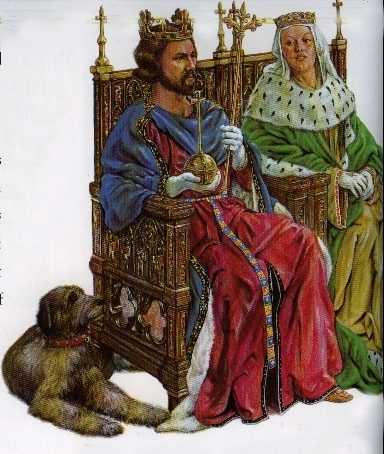
| People and Power In the middle ages, land was the key to power and wealth, and the land was controlled from castles. The most powerful person in the kingdom was the king. He allowed his nobles to hold land if they promised to support him against his enemies. In turn, the nobles gave parts of their land to other knights who promised to fight for them. This arrangement of giving land in return for loyalty or service is called the feudal system, or feudalism. |
| Turbulent times The middle ages started when the Roman Empire, which had united most of Europe, broke up in the 1470,s. Fierce fighting followed and Europe became a land of small warring kingdoms. Over the years, some of the kingdoms became very powerful and took over the weaker ones. By the 1450,s, when the middle ages ended, some of the countries we know today were beginning to take shape. |
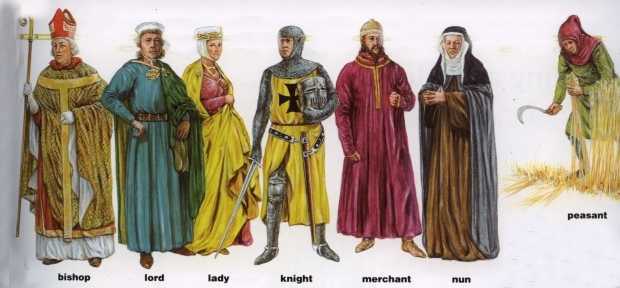
| Three classes In the middle ages, society was strictly divided into three groups. People fought, prayed or worked for their living. Everyone knew their place. The king gave orders to his lords, the lords gave orders to the knights, and everyone gave orders to the poor peasants! |
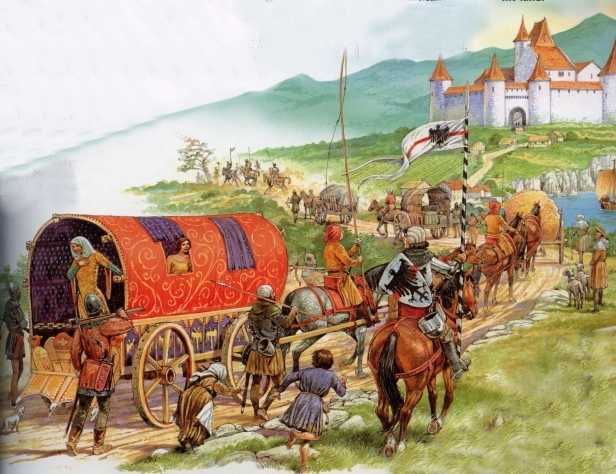
| On the move Kings and wealthy lords had more than one castle. King John had more than one hundred ! They travelled from one to another with their soldiers, servants and wagons. |
| Fighting men The lords and the knights defended the king from his enemies. From the 1200,s however the king often accepted money from them rather than make them fight. Religious life In Europe, most people were Christians. Many churches and cathedrals were built and most castles had their own chapel. Working life Workers included craftsmen, such as blacksmiths, merchants, who bought and sold goods, and peasants who worked the land. |
 |
 |
 |
 |
| A mason was hired to design the castle and take charge of its building. Under him were the freemasons who cut and carved the stone, and roughmasons who built the walls |
| Scaffolding was made of wood. It was slotted into openings in the stonework called putlog holes. For extra strength, a castles main walls were packed with rubble and flints mixed with mortar. Walls could be between 2 and 5 metres thick. |
| Ropes and pulleys were used to lift full buckets and beams. Heavy stones were raised by a treadwheel crane, turned by a man walking inside a giant wheel |
| Building a castle was hard work. There are no power drills or bulldozers as there are on a modern building site. Most of the work is done by muscle power. Carpenters saw wood and assemble the scaffolding. Blacksmiths make and mend tools. Masons shape stone, and labourers curse and sweat as they haul heavy loads, mix up mortar for the walls and dig trenches. About 1,000 years ago, castles were made of wood. This was soon replaced by stone, which was stronger and could not be burned down by an enemy. Planning these stone castles was a difficult job. Building supplies and materials had to be brought in by river, sea or land. Masons had to be hired and labourers organized. A castle could take 10 or sometimes even 20 years to complete, and it might cost, in todays money, many millions of pounds. |
 |
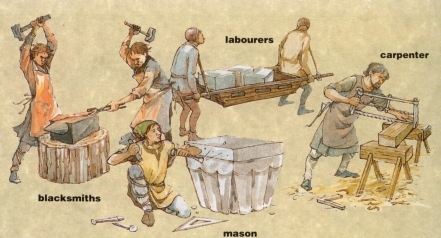 |
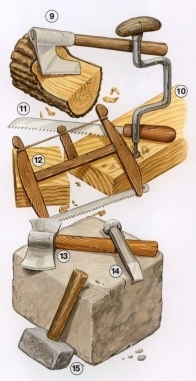
| An army of workers was needed to build a castle. In 1295, 30 blacksmiths, 400 masons and 2,000 labourers including stone-breakers and well-diggers were hired to build Beaumaris castle on Anglesey. Right Tools of the trade A carpenter used an axe(9) an awl (10) a saw (11) and a handsaw (12). A mason used a masons axe (13) a chisel (14) and a mallet (15). |
 |
 |
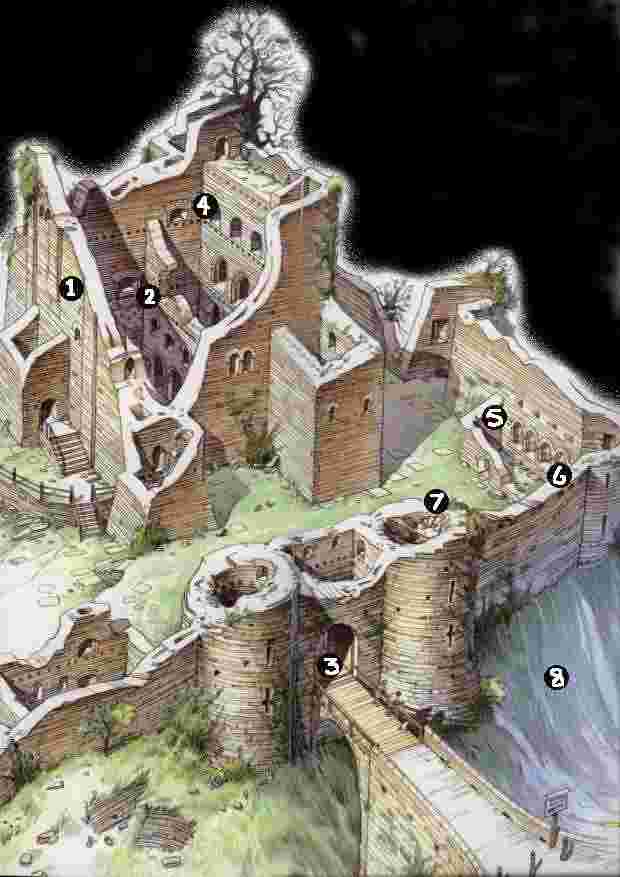
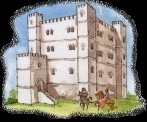
| 1,THE KEEP, the largest building standing in the heart of the castle. Its walls would have once been whitened with lime to dazzle the eyes. |
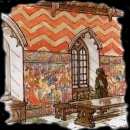
| 2. STONE WALLS, In some castles, you may be able to see traces of faint coloured plaster, which was once panted with bright patterns, or hung with tapestries |
| 3. THE GATEHOUSE. Grooves in the wall show where the portcullis was raised and lowered. The portcullis slid down the grooves to close the gate, behind which were two heavy doors. |
 |
 |
 |
| 4.FIREPLACES, High up in the walls are the remains of fireplaces. Look for rows of small holes beneath them.These once held the joists that supported the floor |
 |
| 5.THE CHAPEL. Look out for rows of arched windows, and a stone basin in one of the walls. |
| 6.WALL DEFENCES.Can you see holes in the outer walls? These supported the beams of wooden platforms called hourds |
 |
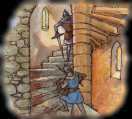
| 7.SPIRAL STAIRS. In the towers see how the stairs wind up to the right. This would mean an enemy fighting his way up would be at a disadvantage with his sword arm |
| 8. THE MOAT. Is there a dry,grassy ditch? This would have been filled with water to keep the enemy out. |
| So why did so many castles become ruins? By the end of the 1400s, wars were fought in open country, not around castles, and kings and nobles no longer needed to live in fortified homes. Plus the arrival of gunpowder made the walls of a castle obselete. |
| Invasion After Edward I of England invaded Wales in 1277, he built eight new castles around the coast. Five of these castles had fortified towns built with them. One of the best known of these castle towns is Conwy, which was begun in 1283 and completed in just four years. Fire In 1401 Conwy town was burnt down by the Welsh, but the castle and town walls still stand today. |
 |
 |
 |
 |
 |
 |
| In times of trouble, the gatehouse of a castle town would have been well guarded, with soldiers on sentry duty day and night. The sentries would search carts and baskets and ask strangers lots of questions. Traders on their way to market would probably slip the guard a bribe, a jug of ale, a pie, or perhaps a silver coin.Curfew At night, a bell rung and the doors of the town were shut and barred. No one was then allowed to enter or leave until daybreak. The bell was also the signal for the townsfolk to cover their fires with a dome shaped clay pot before going to bed. The pots were called curfews (from the French word couvrefeu meaning to cover fire). |
| As there wasnt enough land inside a towns walls for growing crops or keeping animals, the townsfolk had to buy their food from local farmers. |
| Town defences In times of trouble, an enemy attacker would have to get through the towns defences before reaching the castle itself. As towns had exactly the same kind of defences as the castle itself, this was no easy task. Armed soldiers protected the towns long walls and the gatehouse would be sealed off by heavy timber framed portcullis, studded with iron. The soldiers fired arrows through slits called "loops" built into the walls. |
 |
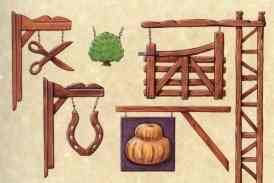 |
| Street signs Few people could read, so special signs were hung outside shops. For example a horseshoe hung outside a farriers and a green bush was the sign for an inn |
| Town houses >>>>>>> Many town houses had wooden frames. The spaces between were filled with wattle and daub-criss crossed sticks plastered with clay. |
| Streets were very muddy and dirty as there were no proper drains, just open ditches where water and rubbish collected. They were also very smelly, rubbish was simply thrown out of the windows |
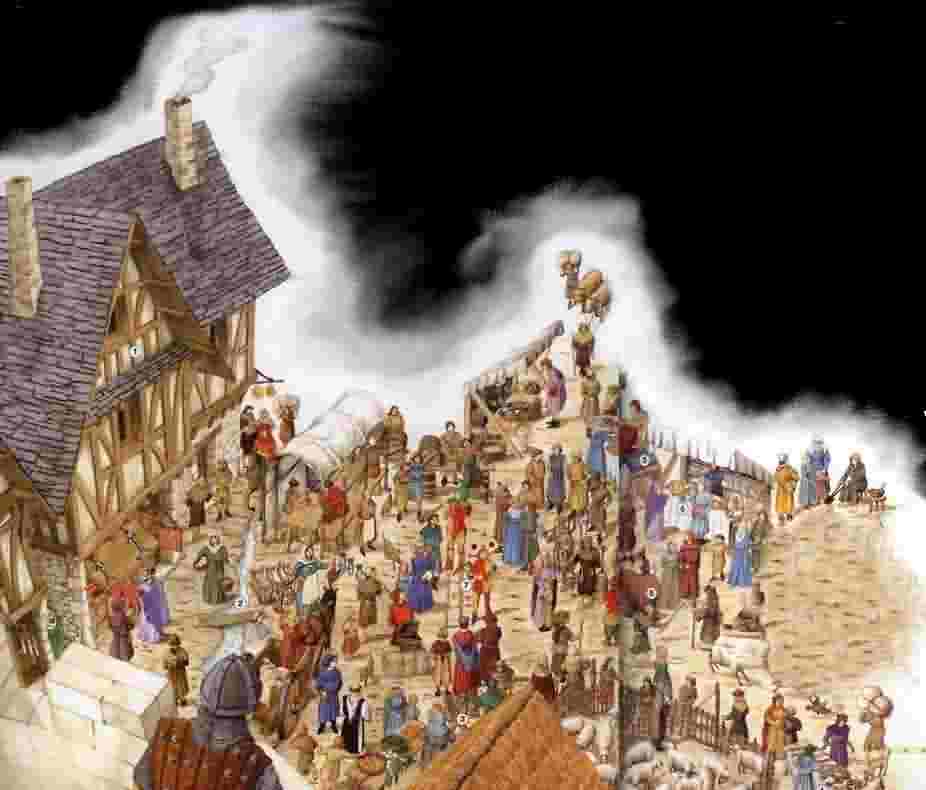
| Market day Most castle towns had a market once or twice a week. On market day the town square would fill up with bustling crowds and traders shouting their wares. |
| Visitors could buy anything from candles, shoes and knives to a refereshing draught of ale. A couple of times a year there was also a fair, which was bigger than a market and sold many more goods. Goods produced locally, such as pottery, purses and belts, were sold by the craftsmen who made them. Luxury items, finely woven cloth or decorated jugs and bowls from Italy, were brought to market by merchants. |
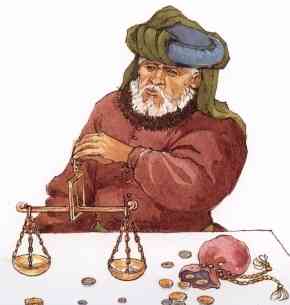
| Money lenders Nobles and even kings sometimes needed to borrow money, to pay craftsmen or fight wars. Some money lenders, therefore became very rich. Sounds a little like my bank ! |
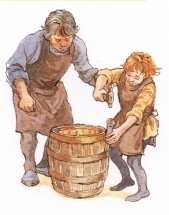
| Learning a trade Many young lads in the town became apprentices. They were sent to live with the family of a master craftsman and learned his skills. After seven years they were free to leave and set up on their own |
| In many towns, craftsmen and merchants belonged to societies called guilds. The guild controlled the prices, organized training, and made sure their goods were of a high standard. Often, craftsmens workshops were found in one street or area of town. Some streets still carry the name of the traders who worked there, such as "Threadneedle street" or " Ironmongers lane". |
| Entertainers Even if you couldnt afford the fine goods on sale, it would only cost a farthing or a halfpenny to watch stilt walkers and jugglers or perhaps a dancing bear. |
| Jpeg intensive,please be patient |
| Click the forward button to visit the kitchens in a castle or the back button to return to castles. |
 |