 |
 |
 |
 |
 |
 |
 |
 |
 |
 |
|
 |
 |
 |
| The questions most asked about Wales are `Why the Red Dragon`, Why the Leek as a national emblem, `Why the Daffodil`, and where did your national costume come from. In this section I will try and give you both the Folklore behind them, and the Facts. |
| Wales is one of the newest democracies in Europe but with the oldest national flag - a red dragon set against a green and white background. The most famous emblems of Wales are the dragon, "Ich Dien"the leek and the daffodil. |
| The Red Dragon You will already know the legendary tale of the Red Dragon from my other pages, The ancient poets Aneirin and Taliesin use the Welsh word for dragon "draig" in the sense of "warrior" or "leader" and this usage remained to the middle Ages. In the Historian Brittonum (ascribed to Nennius) of around 800 A.D. the dragon is seen as a symbol of national independence in the story of the red dragon battling with the white dragon of the Saxon enemy.Here is the "truth" behind the myth. |
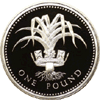
| At the time of the Norman invasion of England in 1066, the dragon symbol seems to have been used by both sides. The Bayeux tapestry shows king Harold close to a dragon standard as he falls and the dragon also appears on the pennant of one of duke William's messengers. Despite its occasional use by other figures famous in Welsh history, the red dragon became the symbol of the Welsh nation through its adoption by the Tudor ancestors of king Henry VII. Edmund and Jasper Tudor had a dragon as crest and supporter to the arms granted them by Henry VI. When Henry Tudor faced king Richard III at the battle of Bosworth in 1485 his battle standards numbered three. One of these carried the arms of St. George of England, one the arms of the house of Beaufort and on one was a "Red ffyry dragon peyntid upon white and Grene Sarcenet". It is held that this dragon banner represented Henry Tudor's claim to be a true representative of the ancient kings of Britain and served as his tribute to the Welsh people who had made his victory possible.An "englyn" written at the time refers to Llywelyn and his army, "There is my lord Llywelyn and tall warriors follow him; a thousand, a host in green and white." "These are the colours in which the Black Prince, Edward of Woodstock, was to dress his Welsh contingent at Cr�cy in 1346: these men were, as D.L. Evans remarked, 'the first troops to appear on a continental battlefield in national uniform.' Thus, by the middle of the fourteenth century, green and white appear to have been understood as the national colours of Wales; they were to be used later by Henry Tudor as the field for the Red Dragon, and they remain to this day the colours of the national flag, upon which the Red Dragon is set." There is no "standard" Welsh dragon, the dragon on the flag must, however, face to the left, be sited centrally and cover equal parts of the white and green panels. It has always been associated with Wales and Henry the seventh used it as his banner at the Battle of Bosworth when he gained the English throne in 1485. Henry was also the first to use the Dragon on his coins, an emblem of Wales, which has recently been reinstated on pound coins today. |
| The Leek On the evidence of Shakespeare, the leek was the recognised emblem of his day, and there is written evidence that it became the Welsh emblem considerably earlier. Entries in the household accounts of the Tudor Kings include payments for leeks worn by the household guards on St. David's Day. According to one legend, the leek is linked to St. David because he ordered his soldiers to wear them on their helmets when they fought a victorious battle against the pagan Saxons in a field full of leeks. It was more likely, however, that the leek was linked with St. David and adopted as a national symbol because of its importance to the national diet in days of old, particularly in Lent." |
| The Daffodil The Story behind the daffodil is a charming one and representative of the Welsh characteristics of humour and pragmatism. The Welsh for leek is Cenhinen and the Welsh for Daffodil is Cenhinen Pedr. Over the years they became confused and so the Daffodil along with the Leek was adopted as another emblem of Wales. It has become the more favoured emblem of late, however, since some people find that it makes a more attractive buttonhole on St. David's day. Daffodils and newborn lambs herald the summer in Wales. |
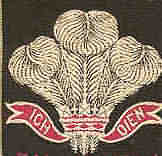
| "The crest of three ostrich plumes and the motto of "Ich Dien" This has been the motto of the Prince of Wales since 1346 when Edward the Black Prince adopted it as his motto in tribute to the blind king of Bohemia who led the cavalry charges against the English. |
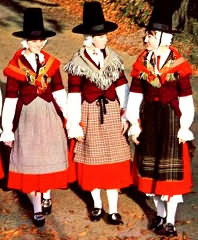
| National Dress The popular image of Welsh "national" dress, of a woman in a red cloak and tall black hat is one, which has developed as a result of various influences, which arose in the nineteenth century. The costume regarded as national dress is based on clothing worn by Welsh countrywomen during the early nineteenth century, namely a striped flannel petticoat, worn under a flannel open-fronted bed gown, with an apron, shawl and kerchief or cap. The hats generally worn were the same as hats worn by men at the period. The tall "chimney" hat did not appear until the late 1840's and seems to be based on an amalgamation of men's top hats and a form of high hat worn during the 1790 - 1820 period in country areas. Lady Llanover, the wife of an ironmaster in Gwent, was very influential in encouraging the wearing of "national dress", both in her own home and at eisteddfodau. She considered it important to encourage the use of the Welsh language and the wearing of an identifiable Welsh costume. She succeeded in her aim mainly because people felt that their national identity was under threat and the wearing of a national costume was one way to declare that identity. |
| WELSH NATIONAL ANTHEM (HEN WLAD FY NHADAU) The words of the Welsh National Anthem date from January 1856 and were printed two years later, in 1858. Until then Wales had no National Anthem. The words are attributed to Evan James from Pontypridd and his son, James James, inspired by an old melody composed for the harp, set the words to music. The Anthem was sung at the National Eisteddfod in 1874 and since then has been recognised as a true expression of Welsh national sentiment. It is uncertain when the piece was adopted as the Welsh National Anthem. It should be sung in Welsh only, the language, of course, being an integral part of Welsh national identity. The difficulties encountered in translating the Welsh accounts for a variety of renderings in English. Caerphilly can lay some claim to the Welsh National Anthem. The words to �Hen Wlad Fy Nhadau�/�The Land of My Fathers� were written by Evan James in 1856 - James was born in the Parish of Eglwysilan, near Caerphilly, in 1809. His son James James (1833-1902) composed the music to accompany the words and in 1858 the work was entered in the National Eisteddfod at Llangollen as �Glanrhondda�. The original Welsh is difficult to translate literally and many attempts have been made to produce an English version which mirrors the sentiment of the anthem. The original Welsh of the first verse is set out below and is followed by a translation by Ebenezer Thomas (1802-1863) whose Bardic name was Eben Fardd. |
 |
 |
 |
 |
 |
 |
 |
| Mae hen wlad fy nhadau yn annwyl i mi, Gwlad beirdd a chantorion, enwogion o fri; Ei gwrol ryfelwyr, gwladgarwyr tra mad, Dros ryddid gollasant eu gwaed. Gwlad, gwlad, pleidiol wyf i�m gwlad; Tra m�r yn fur i�r bur hoff bau, O bydded i�r hen iaith barhau. |
| The land of my fathers, the land of my choice, The land in which poets and minstrels rejoice; Whose stern warriors were true to the core While bleeding for freedome of yore. Wales! Wales! favourite land of Wales! While sea her wall, may nought befall To mar the old language of Wales. |
| The land of my fathers is dear unto me, Old land where the minstrels are honoured and free: It's warring defenders, so gallant and brave, For freedom their life's blood they gave. Country, Country, true am i to my Country, While seas secure this land so pure, O may our old language endure. |
| The ancient land of my fathers is dear to me, A land of poets and minstrels, famed men; Her brave warriors, patriots much blessed, It was for freedom that they lost their blood Chorus: Homeland! I am devoted to my country: So long as the sea is a wall to this fair beautiful land, May the ancient language remain. |
| And to give you an example on how problematic it is to translate, here are two other popular examples |
 |
 |
 |
 |
 |
 |
 |
 |
 |
 |
 |
 |
 |
 |
 |
 |
 |
 |
 |
 |
 |
 |
 |
 |
 |