1. Welcome
1.1 For Sunfoods
1.2 For the Academic Reader
2. The Abstract
3. Thesis Introduction
3.1. The Aim
3.2. Research Background
3.3. The Research Topics
3.4. The Targeted Audience
3.5. Disposition
4. Research Method
4.1. The Constructive Research Method
4.2. The Research Process
4.3. Information Gathering
4.4. Export Guide and Questionnaire Construction
4.5. Analysis Method, Conclusions and Thesis Presentation
4.6. The Broad Scope of the Thesis
5. The Export Guide
5.1 Export Guide Presentation
-page 1
-page 2
5.2. Export Readiness
5.3. Trade Condition
5.4. Foreign Market Analysis
6. Questionnaire
6.1. Questionnaire Presentation
6.2. Export Readiness
6.3. Trade Condition
6.4. Foreign Market Analysis
7. Research Results
7.1. Export Readiness
7.2. Trade Condition
7.3. Foreign Market Analysis
8. Discussion
8.1. Export Readiness
8.2. Trade Condition
8.3. Foreign Market Analysis
9. Conclusions
9.1. Export Readiness
9.2. Trade Condition
9.3. Foreign Market Analysis
9.4. The Next Step
10. Supplements
10.1. Site Map
10.2. Glossary
10.3. The Complete Interview
10.4. Acknowledgements
10.5. Sources

5.1 Export Guide Presentation (page 1)
5.1.1 Introduction to the Export Guide
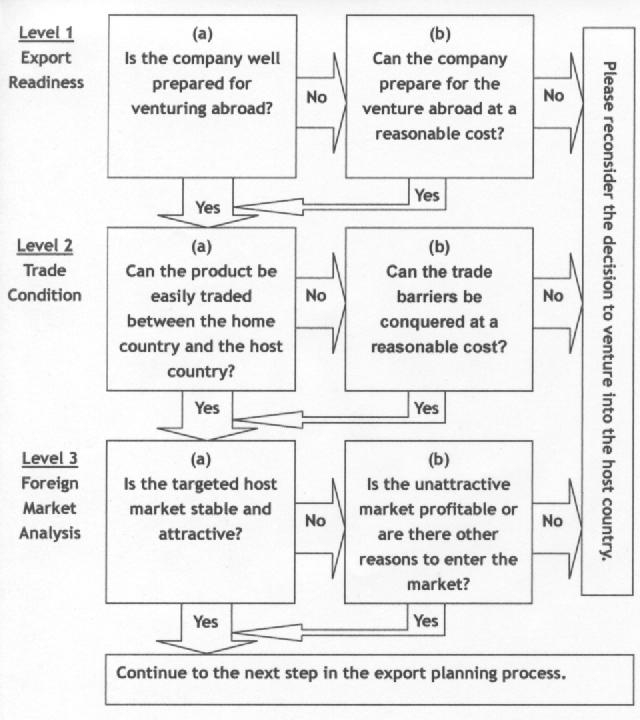
�-I have this product which I am thinking about exporting to a foreign market that I think may be suitable. How can I evaluate the export venture, what do I need to consider and where should I start?� The managers who ask themselves these questions may find the Export Guide supportive. The Export Guide corresponds to the fourth step of the constructive research process and the guide can thus be said to be a research tool that is used to solve the problem of the paper. In other words, the Export Guide can be considered to be a problem solving construction which is used to determine whether Konnyaku-Chips should be exported from Japan to Sweden.
5.1.2 The Export Guide Model