
1. Welcome
1.1 For Sunfoods
1.2 For the Academic Reader
2. The Abstract
3. Thesis Introduction
3.1. The Aim
3.2. Research Background
3.3. The Research Topics
3.4. The Targeted Audience
3.5. Disposition
4. Research Method
4.1. The Constructive Research Method
4.2. The Research Process
4.3. Information Gathering
4.4. Export Guide and Questionnaire Construction
4.5. Analysis Method, Conclusions and Thesis Presentation
4.6. The Broad Scope of the Thesis
5. The Export Guide
5.1. Export Guide Presentation
5.2. Export Readiness
5.3. Trade Condition
5.4. Foreign Market Analysis
6. Questionnaire
6.1. Questionnaire Presentation
6.2. Export Readiness
6.3. Trade Condition
6.4. Foreign Market Analysis
7. Research Results
7.1. Export Readiness
7.2. Trade Condition
7.3. Foreign Market Analysis
8. Discussion
8.1. Export Readiness
8.2. Trade Condition
8.3. Foreign Market Analysis
9. Conclusions
9.1. Export Readiness
9.2. Trade Condition
9.3. Foreign Market Analysis
9.4. The Next Step
10. Supplements
10.1. Site Map
10.2. Glossary
10.3. The Complete Interview
10.4. Acknowledgements
10.5. Sources

4.2 The Research Process
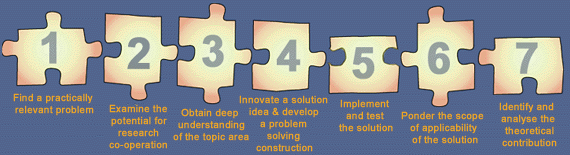
The Constructive Research Method involves seven research steps which are described by the picture below (www.metodic.com/showres.dll/en/enindex 2003-06-30). Each step of the thesis� research process is thereafter discussed.
4.2.1 Step one: Find a Practically Relevant Problem
Initially in the research, a field study was conducted in Japanese shops and stores. The aim of the field study was to find an interesting, innovative, preferably unique product with a perceived potential market in Sweden. The looked for product further needed to be relatively uncomplicated and easy to understand as the researcher believed that this might give less trade problems. The focus of the research was meant to be on the process of exporting as a whole. The fear was that a complicated product might shift the focus towards trade restrictions only. Sweden was chosen as a host market because it was believed that the researchers personal experience of Sweden and Swedish language knowledge might facilitate the research. Moreover, Sweden is a small market but as a member of the EU it is a part of a potentially much larger market. The problem of how to evaluate and plan an export venture came forward as practically relevant problem which, also may add to existing international marketing theories. Thus, determining whether Sunfoods� product �Konnyaku-Chips� should be exported from Japan to Sweden was chosen as the aim of the research.
4.2.2 Step two: Examine the potential for long-term research co-operation
In the next step of the research process Sunfoods was contacted by e-mail and the potential for research co-operation was examined. Sunfoods� reaction to the straight forward request of this foreign student was surprised but very encouraging. Sunfoods was extremely positive towards the research project and the co-operation went smoothly throughout the research project. All communication was conducted in Japanese in order to ensure that the co-operation of the company would not be endangered by their reluctance to communicate in a foreign language. Another door-opener, according to Sunfoods, was the fact that the researcher was an exchange student at Kyoto University, one of Japan�s most well renowned universities. A further reason behind the co-operation of Sunfoods could be the fact that they currently plan to increase their export activities and they were thus open minded towards research that they might contribute from.
4.2.3 Step three: Obtain deep understanding of the topic area
In order to obtain a deep understanding of the topic area, existing writings within the international marketing area were studied. This included existing guides to export, international marketing literature and information about Sunfoods and Sweden. In particular Internet sources were studied.
4.2.4 Step four: Innovate a solution idea and develop a problem solving construction
In the fourth step of the research process it was time to deeper consider how an export venture idea can be evaluated. In other words, it was time to develop a problem solving construction. In the thesis this construction is referred to as the �Export Guide�. The method used to construct the Export Guide is further described in the section �Export Guide Construction�.
4.2.5 Step five: Implement the solution
In the fifth stage of the research process the Export Guide is implemented and tested. Information about Sunfoods, Japan and Sweden was collected and analysed with the support of the Export Guide. Eventually conclusions, based on the analysis, were drawn.
4.2.6 Step six & seven: Ponder the scope of applicability of the solution and Analyse the theoretical contribution
In the sixth step of the typical constructive research process the scope of applicability of the solution, is to be discussed. In the seventh step of the standard process, the theoretical contribution is identified and analysed. However, these steps cannot be seen as major parts of the thesis. The section �The Export Guide in Context� gives a brief picture of the applicability of the problem solving construction of the thesis. However the Export Guide, is not claimed to be applicable to any export venture other than Sunfoods� studied example and the possible theoretical contribution the paper makes is not identified or analysed. This does not mean that the thesis cannot be applied to any other export venture. What is more, it is possible to claim that the Export Guide gives some theoretical contribution. However it is left to the reader to ponder the scope of applicability of the Export Guide and to consider whether it may contribute to his or her research in any way.

