Competency 10
Selects appropriately from a variety of assessment strategies to evaluate student learning and to use this information to improve one’s own instruction. Multiple examples of assessment strategies, i.e. rubrics, checklists, teacher-constructed tests.
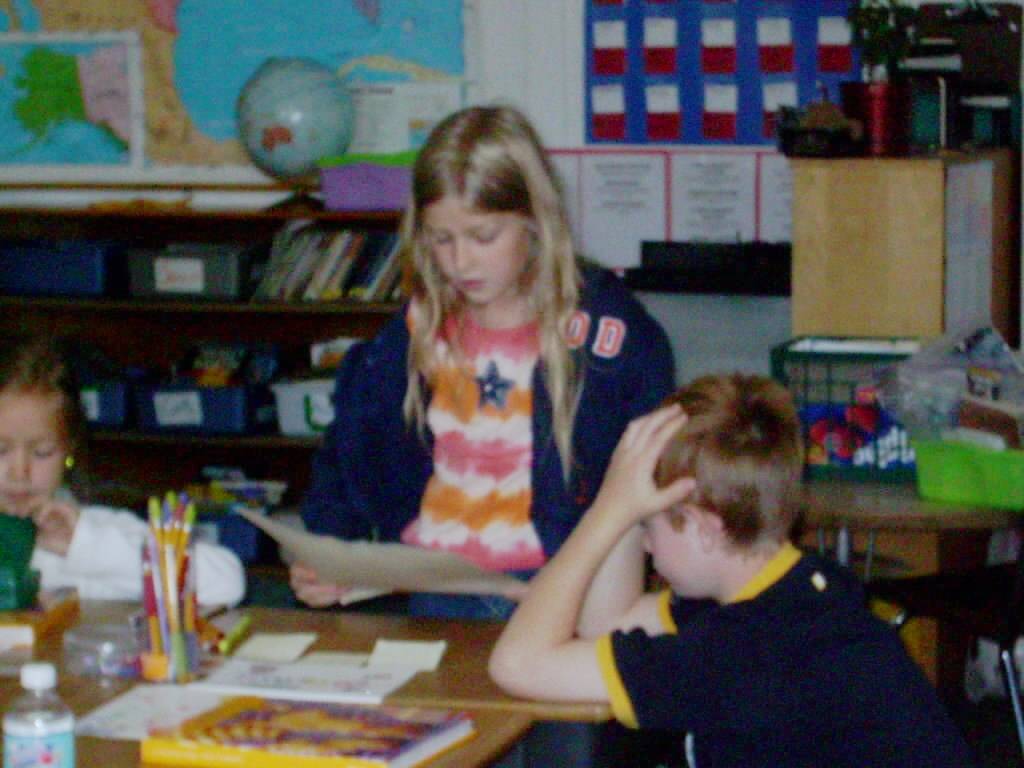
This student is giving an oral report for a project her group worked on.
 | I incorporated many different assessment strategies during my student teaching experience. I used oral reports, rubrics, homework, class discussions, observing, teacher created tests, text book tests. |
|
During our community unit, I used a rubric to assess the final project that the students created at home. I felt this was an effective tool to use so the children and parents could see exactly what the students would be evaluated on. The rubric gave the students a direct feedback on where their weaknesses and strengths were at. |
|
Each week the students were given a pretest of the spelling words for the week. This was given orally and students responded by writing their answer on a piece of paper. This tool was effective in more than one way. They were able to listen and then write, they heard the word so they could gain some understanding of the way to pronounce the word. There was always a sentence to go with the word so the students were able to gather some meaning of the word in the context of a sentence. |
| As an integral part of our math curriculum, the Addison Wesley math is used as an independent study. Students are assessed in this program by first pre-testing each chapter to help them see where their weaknesses are, then they take a post test at the end of each chapter. |
| The students did oral presentations for more than one of the lessons I taught. During the communities project, they presented their county posters they made as a group and their end of the unit community projects they did individually. |
Go to competency |1| |2| |3| |4| |5| |6| |7| |8| |9| |10| |11| |12| (home)