Bis'Millah'ir
Rahman'ir Raheem (In the Name of Allah, the Most Gracious,
the Most Merciful)
As'Salam'u Alaikum
Wa Rah Matullah Wa Barakatuh (Peace be upon you and the mercy of
Allah(swt)and his blessings)
Welcome to, Islam
in me
Being a Religious is both wonderful and
challenging. In our life there is too much
to do and not enough time to work for the
religion, like we have school, homework,
job, friends, parties, and
family on top of everything,
but what about GOD? I love to take interest
in Religious studies and I'm sure, you feel
the same when you step-in :)
So, we invite you to come over here and read
about Islam. Feel free to ask Question(s).
Join-hands with me to understand eachother
beliefs as we are in Family, so we should
care.
Muhammad
(peace be upon him) was born in Makkah in
the year 570. Since his father died before
his birth and his mother died shortly
thereafter, he was raised by his uncle who
was from the respected tribe of Quraysh. He
was raised illiterate, unable to read or
write, and remained so till his death. His
people, before his mission as a prophet,
were ignorant of science and most of them
were illiterate. As he grew up, he became
known to be
truthful,
honest, trustworthy, generous, and sincere.
He was so trustworthy that they called him
the Trustworthy. Muhammad (peace be upon
him) was very religious, and he had long
detested the decadence and idolatry of his
society.
At the age of forty, Muhammad (peace be upon
him) received his first revelation from God
through the Angel Gabriel. The revelations
continued for twenty-three years, and they
are collectively known as the Quran.
As soon as he began to recite the Quran and
to preach the truth which God had revealed
to him, he and his small group of followers
suffered persecution from unbelievers. The
persecution grew so fierce that in the year
622 God gave them the command to emigrate.
This emigration from Makkah to the city of
Madinah, some 260 miles to the north, marks
the beginning of the Muslim calendar.
After several years, Muhammad (peace be upon
him) and his followers were able to return
to Makkah, where they forgave their enemies.
Before Muhammad (peace be upon him) died, at
the age of sixty-three, the greater part of
the Arabian Peninsula had become Muslim, and
within a century of his death, Islam had
spread to Spain in the West and as far East
as China. Among the reasons for the rapid
and peaceful spread of Islam was the truth
and clarity of its doctrine. Islam calls for
faith in only one God, Who is the only one
worthy of worship.< Continue >
The
well-known difference between a Prophet and
a Messenger is that a Messenger is one to
whom a law is revealed and he is commanded
to convey it, whilst a Prophet is one to
whom a law is revealed but he is not
commanded to convey it. But this distinction
is not free of problems, because a Prophet
is also commanded to call people, convey the
Message and judge among the people.
Hence Shaykh al-Islam Ibn Taymiyah said: The
correct view is that the Messenger is one
who is sent to a disbelieving people, and
the Prophet is one who is sent to a
believing people with the sharee’ah of the
Messenger who came before him, to teach them
and judge between them, as Allaah says
(interpretation of the meaning):
“Verily, We did send down the Tawraat
(Torah) [to Moosa (Moses)], therein was
guidance and light, by which the Prophets,
who submitted themselves to Allaah’s Will,
judged for the Jews” [al-Maa’idah 5:44]
So the Prophets of the Children of Israel
judged by the Tawraat which Allaah had
revealed to Moosa.
With regard to the aayah,
“but he is the Messenger of Allaah and the
last (end) of the Prophets” [al-Ahzaab
33:40]
and why it did not say the last of the
Messengers – the end of the Message does not
mean the end of Prophethood, but the end of
Prophethood does mean the end of the
Message. Hence the Prophet (peace and
blessings of Allaah be upon him) said:
“There will be no Prophet after me,” and he
did not say, there will be no Messenger
after me.
Thus we know that there is no Messenger and
no Prophet after him (peace and blessings of
Allaah be upon him); he was the last of the
Prophets and of the Messengers, (peace and
blessings of Allaah be upon him).
The Israelites had settled in the blessed
land, Palestine. They ruled for a long time.
They had a vast kingdom. Allah, the Almighty
chose many prophets from among them. They
followed the Holy Book, the Torah. The
Prophet Dawud (peace be upon him) and his
son Prophet Sulaiman (peace be upon him) won
great popularity as kings and commanded high
respect. Their followers believed in God and
led noble lives. As the time passed by, they
began to pay less attention to the teachings
of God. They forgot the Divine favours. They
made alterations in the Holy Book according
to their own tastes. Most of the Israelites
adopted indecent ways of life and committed
major sins. At that time there existed a
powerful kingdom in the world. It was called
the kingdom of Romans. They were polytheists
and pagans. They did not worship one God and
prayed to many idols made of stones. The
Roman society was divided into two factions.
The ruling class was very strong and
arrogant whereas the ordinary people lived
in misery. They were ill-treated as slaves.
The female sex enjoyed no privilege in that
era. Palestine, the blessed land was ruled
by Herod, a cruel king. The people disliked
him. They were scared stiff of him. They
could not utter a word of complaint against
him lest they should be put to sword.
Allah, the Beneficent, showed His favours
and wanted to guide the depraved humanity to
the right oath. He desired to make the
people believe in Allah through miracles.
Maryam (Mary) was a beautiful maiden. She
was virtuous, abstemious and chaste. She
used to pray to Allah frequently. Site grew
up in the house of prophet Zakariyya (peace
be upon him) and learnt a good deal about
Allah and His religion.
One night Maryam was engaged in glorifying
the Almighty, Allah. Suddenly she saw a
handsome looking young man. She got
embarrassed and her face turned pale. She
felt jittery and had goose pimples on her
skin. Soon after she got tranquillity of
mind. She heard a voice from the invisible
world:
"I am an angel of Allah. He has sent me to
inform you that you are going to have a
baby."
Maryam was much perplexed. As she was a
virgin, it was quite impossible for her to
give birth to baby without entering into
matrimonial allegiance with an opposite sex......................< Continue >
The Five Pillars of Islam are the framework
of the Muslim life. They are the testimony
of faith, prayer, giving zakat (support of
the needy), fasting during the month of
Ramadan, and the pilgrimage to Makkah once
in a lifetime for those who are able.
1) The Testimony of Faith
The testimony of faith is saying with
conviction, “La ilaha illa Allah, Muhammadur
rasoolu Allah.”This saying means “There is
no true god but God (Allah),*1 and Muhammad
(PBUH) is the Messenger (Prophet) of God.”
The first part, “There is no true god but
God,” means that none has the right to be
worshipped but God alone, and that God has
neither partner nor son. This testimony of
faith is called the Shahada, a simple
formula which should be said with conviction
in order to convert to Islam (as explained
previously on this page). The testimony of
faith is the most important pillar of Islam.
2) Prayer
Muslims perform five prayers a day. Each
prayer does not take more than a few minutes
to perform. Prayer in Islam is a direct link
between the worshipper and God. There are no
intermediaries between God and the
worshipper.
In prayer, a person feels inner happiness,
peace, and comfort, and that God is pleased
with him or her. The Prophet Muhammad (PBUH)
said: {Bilal, call (the people) to prayer,
let us be comforted by it.}*2 Bilal was one
of Muhammad (PBUH)’s companions who was
charged to call the people to prayers.
Prayers are performed at dawn, noon,
mid-afternoon, sunset, and night. A Muslim
may pray almost anywhere, such as in fields,
offices, factories, or universities.
3) Giving Zakat (Support of the Needy)
All things belong to God, and wealth is
therefore held by human beings in trust. The
original meaning of the word zakat is both
‘purification’ and ‘growth.’ Giving zakat
means ‘giving a specified percentage on
certain properties to certain classes of
needy people.’ The percentage which is due
on gold, silver, and cash funds that have
reached the amount of about 85 grams of gold
and held in
possession for one lunar year is two and a
half percent. Our possessions are purified
by setting aside a small portion for those
in need, and, like the pruning of plants,
this cutting back balances and encourages
new growth.
A person may also give as much as he or she
pleases as voluntary alms or charity.
4) Fasting the Month of Ramadan
Every year in the month of Ramadan,*3 all
Muslims fast from dawn until sundown,
abstaining from food, drink, and sexual
relations.
Although the fast is beneficial to health,
it is regarded principally as a method of
spiritual self-purification. By cutting
oneself off from worldly comforts, even for
a short time, a fasting person gains true
sympathy with those who go hungry, as well
as growth in his or her spiritual life.
5) HAJJ: The Pilgrimage to Makkah
The annual pilgrimage (Hajj) to Makkah is an
obligation once in a lifetime for those who
are physically and financially able to
perform it. About two million people go to
Makkah each year from every corner of the
globe. Although Makkah is always filled with
visitors, the annual Hajj is performed in
the twelfth month of the Islamic calendar.
Male pilgrims wear special simple clothes
which strip away distinctions of class and
culture so that all stand equal before God.
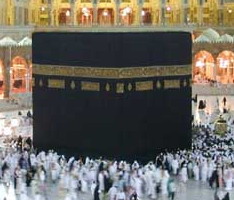
Pilgrims praying at the Haram mosque in
Makkah. In this mosque is the Kaaba (the
black building in the picture) which Muslims
turn toward when praying. The Kaaba is the
place of worship which God commanded the
Prophets Abraham and his son, Ishmael, to
build.
The rites of the Hajj include circling the
Kaaba seven times and going seven times
between the hillocks of Safa and Marwa, as
Hagar did during her search for water. Then
the pilgrims stand together in Arafa*4 and
ask God for what they wish and for His
forgiveness, in what is often thought of as
a preview of the Day of Judgment.
The end of the Hajj is marked by a festival,
Eid Al-Azha, which is celebrated with
prayers. This, and Eid Al-Fitr, a feast-day
commemorating the end of Ramadan, are the
two annual ......................< Continue >
Salat,
sometimes translated as prayer, is the 2nd
pillar of Islam. Salat is the foundation of
Islam and is a gift from ALLAH (Subhanahu wa
ta'ala). Salat was prescribed by ALLAH (Subhanahu
wa ta'ala) during the Prophet (salla ALLAHu
alaihi wa sallam)'s Night Journey and
Ascension, when he went from Makkah to
Jerusalem, led all the Prophets in Salat,
and then ascended through the 7 Heavens. At
the final stop, he received the 5 daily
Salawat (plural of Salat) from ALLAH (Subhanahu
wa ta'ala). Muslims are required to perform
Salat 5 times everyday at prescribed times.
These times are referred to as Fajr, Thuhr,
'Asr, Maghrib, and 'Isha. (see the salat
timing below)
Before Salat is performed, one must be in a
state of purity and cleanliness. This
requires performing Wudu, Ablution, in a
specific manner and may require a full
shower or bath. Salat can be performed
individually, but the reward is greater if
it is performed in a group, referred to as a
Jama'ah, with an Imam leading the group.
Normally, the Jama'ah performs their Salat
in a Masjid, or Mosque, referred to as a
House of ALLAH (Subhanahu wa ta'ala). In
addition, Muslims are encouraged to offer
voluntary Salat at most times during the day
and night. (There are some times when Salat
is not allowed.) The voluntary Salat are
offered in the same manner as the required 5
daily Salawat and can be offered in Jama'ah,
but usually are offered individually.
Salat combines recitations from the Quran,
Glorifying ALLAH (Subhanahu wa ta'ala), hand
movements, bowing, prostrating and head
movements. For more information on Salat or
any other aspect of Islam, please contact
the Islamic Foundation at (314)-394-7878.
SALAT TiMiNGS
The Fajr Salat time begins at dawn, about 90
minutes before sunrise and ends at sunrise.
The Thuhr Salat time begins as the sun
passes through the zenith, the highest point
in the sky, and ends when an object's shadow
becomes equal in length to the object. (Some
schools of thought believe the time ends
when the object's shadow is twice the length
of the object.)
The Asr Salat time begins at the end of the
Thuhr Salat time, and ends at sunset.
The Maghrib Salat time begins at sunset and
ends when the redness of the sunset has
dissipated.
The Isha Salat time begins at the end of the
Maghrib Salat and ends at midnight.
Islam is an Arabic word which means
Submission or to Submit to The Supreme
Being, The Creator, whose proper name is
ALLAH (Subhanahu wa ta'ala). The Oneness of
ALLAH (Subhanahu wa ta'ala) is the basic
principle of Islam, and is called Tawheed.
Muslims are those who submit, totally, to
The Creator, ALLAH (Subhanahu wa ta'ala).
The guidance for Muslims comes from two
primary sources, the Noble Quran, which is
the Divine Scripture of Islam, and the
Hadith, which is the recorded deeds and
teachings of Prophet Muhammad (salla ALLAHu
alaihi wa sallam), the final Messenger of
ALLAH (Subhanahu wa ta'ala). The Quran was
revealed to Prophet Muhammad (salla ALLAHu
alaihi wa sallam) over a period of 23 years,
through the angel Jibreel (alaihis salaam),
Gabriel. The Quran contains the words of
ALLAH (Subhanahu wa ta'ala). Since its
initial revelation, over 1400 years ago, the
entire book has been committed to memory by
many Muslims. It will continue to be
memorized by many Muslims until the end of
life on earth. The Prophet (salla ALLAHu
alaihi wa sallam) practiced the guidance of
the Quran to the point where he is said to
have 'lived the Quran'. His actions and
teachings, which helped explain the wisdom
and guidance of the Quran, have also been
recorded in what is referred to as the
Hadith or the Sunnah of the Prophet (salla
ALLAHu alaihi wa sallam). This too has been
committed to memory by numerous Muslims. The
science of recording and authenticating the
Hadith is one of the most precise sciences
known to man. Every Hadith must have an
authentic chain of narrators which leads
back to the Prophet (salla ALLAHu alaihi wa
sallam). Muslims worship ALLAH (Subhanahu wa
ta'ala), The Creator and Sustainer. As part
of this worship, Muslims are required to
believe in :
* The Oneness of the Creator
* The Creator's Angels
* All the Divine Scriptures, including the
Books of Ibrahim (Abraham, alaihis salaam),
the Torah revealed to Musa (Moses, alaihis
salaam), the Injeel revealed to 'Issa
(Jesus, alaihis salaam), the Scriptures of
Dawoud (David, alaihis salaam) and all other
Divine Scriptures.
* All the Prophets and Messengers (alaihim
assalaam) from Adam (alaihis salaam) through
Muhammad (salla ALLAHu alaihi wa sallam).
These include Adam, Idris, Nuh (Noah), Hud,
Salih, Ibrahim (Abraham), Isma'eel
(Ishmael), Is-haaq (Isaac), Ya'qoub (Jacob),
Lut (Lot), Yusuf (Joseph), Ayoub (Job),
Thil-Kifl, Yunus (Jonah), Musa (Moses),
Haroon (Aaron), Ilyas-sa' (Elisha), Ilyas
(Elijah), Dawoud (David), Sulaiman
(Solomon), Zakaria, Yahya (John), 'Issa
(Jesus), alaihim assalaam, and Muhammad (salla
ALLAHu alaihi wa sallam), as well as the
over 124,000 others whose names have not
been revealed.
* The Day of Judgement or Day of Reckoning,
when all human beings will be evaluated
based on their own deeds and will be
rewarded a place in Paradise or a place in
hellfire.........< Continue >
September, 2007
~ 00:00 PM
| Post
Your
Introduction & Translation
of Holy Qu'ran in English