Tuesday, August 12, 2008

Terminal disappointment

In the final scene of Love, Actually, hordes of hot, smiling people swathed in flattering lighting and fresh makeup come bouncing off planes into Heathrow, and it makes you think, "Damn, international travel is sexy!"

In Rome, Dublin, London, Singapore, Tokyo, Vancouver, and even Paris, I've never had problems figuring out where I need to go. The arrivals halls are usually well designed, with clear, well placed signs. Passport control (a more civilized term than Immigration) is well managed, except at Charles de Gaulle, where queueing is optional, and agents are usually helpful and courteous. ATMs, restrooms, food, and transportation options within sight.

And then there's JFK.
Compared with other international airports, arriving on an overseas flight at JFK is like being on the Dating Game. When you get to the other side of the wall, it can be highly disappointing. Whenever I come back from somewhere else, I brace myself for unhelpful employees, surly customs agents, and confusing signs. I'm not surprised, but I expect better.

The BA departures hall is all right, but the arrivals hall is dismal. Imagine it's your first time jetting in to New York and you're looking forward to bright lights, big city. Instead you enter what looks like a prison waiting room, or worse, the department of motor vehicles. The waiting area looks like an afterthought. If, like we did, you have to wait over an hour for your party to arrive, there aren't a lot of options. You need bionic vision to figure out where the restrooms are. And let's not even talk about what those are like, shall we? There's little thought given to what people might expect once they arrive. After enduring the trifecta of endurance--Immigration, Baggage Claim, and Customs--you'd think you'd get a cheery welcome. Oh, you get a cheer all right--a Bronx cheer. Sucker!

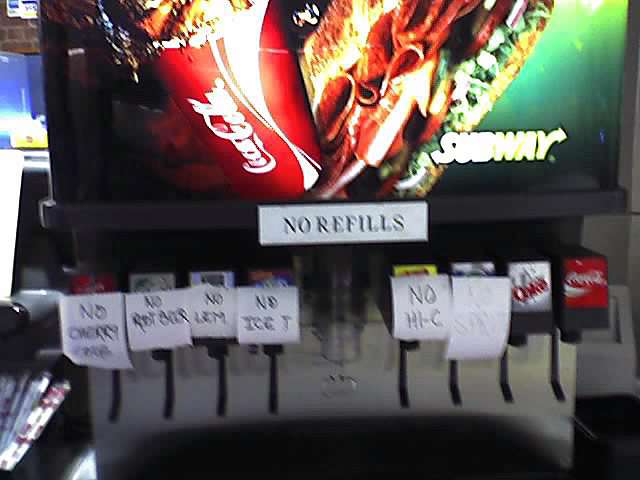
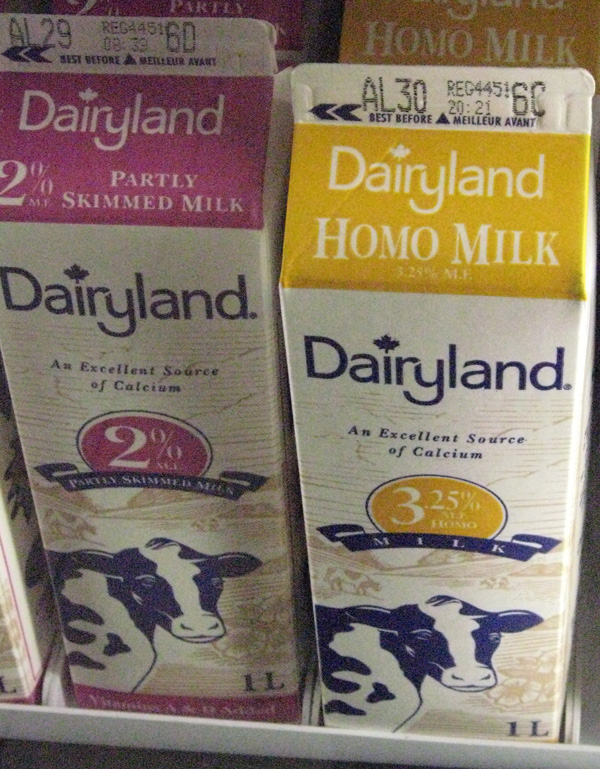
The only kiosk open when we were there was a Subway. I took a picture of the signs on the soda machine, which exemplified JFK's commitment to quality of service: No Cherry Coke, No Root Beer, No Lem., No Ice T, No Hi-C, No Sprite. NO REFILLS. Only Coke or Diet Coke. You don't want that? Fuhgeddaboudit! Welcome to New Yawk.

Next!

Labels: , , ,


Continue reading...

Monday, June 23, 2008

Back to reality

We started getting a little weepy as we had our last glass of Prosecco at a wine bar at Fiumicino Airport. The last 2 weeks of vacation seemed like a dream, and the 9-hour flight ahead was a little too jarring a dose of reality. Usually after a vacation I'm content to return to my familiar surroundings. But in the past year or so, I have becoming increasingly restless and discontent with living in the US. This is not a new feeling--more like the reopening of an old wound from my 20s. I have always wanted to live abroad, but I never pursued opportunities, he said bitterly.

This trip was far beyond what I'd hoped for and once again reinforced my desire to live in Europe. I thought the trip would be a nice getaway, but I didn't think it would be so spectacular, so--I hate to use this word, but--magical. What made it great was, of course, having a companion with the same attitude to share things with. I'd done a lot of research on places to go and things to see, but in the end it was always the last-minute decision, the discovery of a new place, the adventure that made the lasting impression. Until a few years ago, I had never taken a 2-week vacation. I don't know why I waited so long.

The flight ended up being delayed an hour, and since there was sunlight all the way home, it was difficult to sleep. The seat was cramped, the food was fairly bad, and the loud, annoying Italian woman behind me accidentally dug her nail into my head as I slept. The plane finally arrived at JFK a little before 6:00 p.m. The immediate rush of people, noise, and smells was jarring, as it always is when I return to this frenetic beehive from elsewhere.

I got to Passport Control and was immediately yelled at by a Hispanic woman with impossible hair for not understanding which line I was supposed to be on. Once I found the line, I further annoyed her by not standing behind the yellow line to wait for the next agent. Welcome to New York.

I made it to baggage claim and waited for our bags. I looked over at Luis, who was with an Immigration agent. He seemed to be there for longer than the usual stamp and run. A few minutes later, the Immigration official shut down his station and escorted Luis to the Immigration office. I'd seen people being taken there in other places, and I always wondered what happened to them. Sometimes I even assumed they must have done something wrong. But in this case it was my partner being taken away, and I watched him go in that kind of slow-motion sort of way when your brain can't quite process what's happening.

As I waited for our bags, my knees started shaking a little. I hadn't eaten much in the past 12 hours, and I was very tired. Now my adrenaline started kicking in. Why on earth was Luis, a U.S. citizen, was being held by Immigration? I watched him the whole time as he sat there waiting. I didn't want to let him out of my sight. I've seen Sissy Spacek in "Missing"--I know how these things happen.

I finally got our bags off the carousel and looked for progress. Luis was still sitting there after half an hour. I was the only person left from our flight, and I was starting to get anxious. Luis kept looking at me and shrugging. He didn't know what was going on either.

I stood on the other side of the partition from Immigration and shook my head and muttered to myself about how much I hate this country. Just the kind of thing that would get me arrested as an enemy combatant. About an hour into his detention, Luis sent me a text message: "Watch me get deported to Mexico or arrested." I didn't know what he meant at the time, but I guess my muttering and glaring at the immigration officers wasn't helping matters.

Almost 90 minutes after we had arrived, Luis called me on his cell and said that I should go home because he'd been told it might be several hours or even overnight before he was released. Someone with his exact name and birth date, he said, was wanted for committing some violent crime, and Washington had to clear his name.

While being concerned for Luis, I started getting a little paranoid. What if the bureaucrats didn't clear him or shuffled their feet and decided to wait until Monday? Should I wait around, or should I go home and try to figure out what to do? I probably wasn't helping the situation by pacing around trying to get an answer out of anyone.

I went to the soda machine to get a water. The machine returned some cryptic error and gave me nothing. I hit the button hard and nothing came out.

"What's a matter? It won't give you anything?" I heard a voice say behind me. I turned around, and the Hispanic immigration lady with the impossible hair stood there. "Here, let me try." She slammed her fist against the button and the water came out.

"I'm just upset because my friend, who's a U.S. citizen, is being detained," I said.

"You were traveling together, right?" I nodded. "Don't worry," she said sympathetically, "he'll be out soon."

"I think they mistook him for someone else. He has a very common name." When I said his name, the woman looked at me as if to say "racist."

Almost 2 hours had passed, and I was still torn between staying and leaving. I decided that in the interest of preserving order it was best for me to leave. I saw the poster-size photo of George Bush hanging outside the Immigration office and started getting angry. It's all his fault, I thought, even if somewhat irrationally. I text-messaged Luis that I was going to take a taxi home, and he said that was probably a good idea. Still, I waited around a little bit before finally clearing Customs and getting in the taxi queue.

The taxi had just pulled out of the airport when I got a call from Luis saying he had been released. The official at JFK had just gotten clearance from Washington.

"The officer was very nice," he said. "She was yelling at everyone else in there, so I wasn't very hopeful, but she was apologetic that this had happened to me. She said she'd put a note in my file so that it doesn't happen again."

I'm not so sure it won't.

Labels: , ,


Continue reading...

Thursday, June 19, 2008

Three things that don't count while on vacation

  • Money
  • Time
  • Calories


In the real world, the first two would just about have run out, and the last one would have multiplied exponentially.

But that's only if they counted, which they don't.

Labels: , ,


Continue reading...

Wednesday, June 18, 2008

Che bellezza!

Sunday, June 15, 2008

Half over

I realized that blogging on this trip was an ambitious idea. There aren't enough hours in the day to write and experience all this beauty. This is our last day in Furore. Today we're going to Pompei and then on to Luis's mom's in Umbria. Not sure how many wireless opportunities there will be, but keep checking!

Labels: , , ,


Continue reading...

Friday, June 13, 2008

In living color

Photos of the trip so far:

Rome
Amalfi Coast 1
Amalfi Coast 2

Off to Capri today!

Labels: , , ,


Continue reading...

Sunday, June 08, 2008

Buon giorno

Rome has many virtues, but efficiency is not one of them. Our flight arrived without a hitch, but the pilot landed at the wrong gate ("I misunderstood," he announced) and our bags took almost 2 hours to appear at baggage claim. Our host at the bed and breakfast, Giampaolo, called us twice to make sure we hadn't missed our driver, Dario.

Dario is a native Roman, in his late 20s, very cute, shaved head, soul patch, slim. We were smitten with him instantly. He spoke English in spurts, but it was clear he wanted to practice. Whenever he didn't understand something, I translated in Italian. He said he had picked up English only from guests to the B&B. Unlike other countries that subtitle American shows, Italy dubs everything, so it's not a good way for Italians to learn English.

"What music do you like?" Dario asked. Luis said Latin; I said pretty much anything. He asked us what Italian artists we knew, and sadly, all I knew were Eros Ramazzotti, Laura Pausini, and Zucchero. Dario shook his head a little, and I figured it best to not say Umberto Tozzi. He was more approving of my film choices when I said I liked Pasolini, Fellini, and Sergio Leone.

Dario has never been to the US, but he loves American culture. "I love Bruce Springsteen." Here we had common ground. Dario loves Bruce so much that in a few weeks he's riding 5 hours by train to Milan to see him.

We asked Dario what he did for a living. "It is hard to say," he said. He makes violins, and tries to use found wood when possible. "I am very ecological," he said.

The B&B we stayed at is called I Tetti di Roma (the roofs of Rome). It's on the 8th floor of a condo in southern Rome, two blocks south of Piazza Re di Roma. The area is residential, which is what we liked about it. The Metro station is less than a 5-minute walk. Dario showed us around the neighborhood, pointing out the best places to have pizza, gelato, and supplì (rice balls). He also told us other places throughout the city that were clearly not touristy and had good food.

The door to the building elevator looks like the door to an apartment, so it's easy to miss. You pull the outer door and then push two swinging doors to enter. The cabin is no more than about 4 ft by 4 ft. We could barely get our luggage and ourselves in and close the swinging doors.

Our room is cleanly furnished, with a queen-sized bed, an armoire, two nightstands, a few chairs, and a TV. The balcony, shared by the room next door, faces northwest. Past the bougainvillea is a spectacular view of San Giovanni in Laterano, one of the major basilicas of Rome. No other landmarks are visible, but you get a nice vista of terra cotta and sand spreading across the city.

We were settled in around 3:00 and called Andrea. We were so excited to be in Rome at the same time. Andrea and I have been friends since high school, and she and her boyfriend Jim had already been in Rome for 3 days. Jim is a chef at a restaurant in Brooklyn, and he was in charge of finding us a good restaurant. We had 8:30 dinner reservations at Checchino dal 1887, a traditional Roman restaurant in the Testaccio area of rome. Testaccio used to be the slaughterhouse district, equivalent to the Meatpacking District in Manhattan. Similarly, many of its old warehouses and butcheries have been converted to clubs.

Despite having slept for only about 40 minutes in the last 24 hours, we were both surprisingly energetic. At JFK we'd had a couple of drinks and took some sleeping aids that did help us relax. I prefer taking the redeye because at least it allows me to adjust to the local time, provided I can stay up that long.

Luis and I were hungry and went looking for a bar or trattoria that served panini. Unfortunately siesta was not quite over and most places were closed. We made our way up to Via Merulana, a street made famous by Alberto Moravia ("Quer pasticciaio brutto in Via Merulana"), and found a snack bar run by an Italian-speaking Chinese woman. We ate a huge prosciutto and cheese panino and sat outside watching people. An older Roman man sat next to us, leisurely drinking a Peroni and smoking while he did his crossword puzzle. Like other areas of Rome, graffiti is everywhere. Some of it is fun and artistic, but most of it reminds me of decayed New York in the 1980s.

We heard the weather had not been so great before we arrived--chilly and rainy. But today it was warm and a little humid. i wore a long-sleeve shirts and chinos (since we were going to dinner somewhere nice) and I was a little too warm.

As we neared Termini station we heard the pulsating rhythm of disco and saw lots of color and knew we must be near our people. The Roma Pride festival was just nearing its end, and we happened to catch the last few floats. One beefy go-go boy caught the camera's eye. The drag queens gave lots of shade. But the most interesting thing was the long cordon of carabinieri lined up at the end of the parade, followed by two armored cars and then a cleaning crew that sucked up all the confetti and litter from the streets. The Pride committee was up in arms this year because the parade was supposed to end at San Giovanni, but at the last minute the city changed its mind and said it was not allowed, so the route was changed to end at Piazza del Popolo. I suspect the Catholic church had something to do with the ban.

We met Andrea and Jim at their hotel, Domus Aurea, about three blocks from Termini. My friend Joe and I had stayed right around the corner 25 years ago when we visited Rome. We stayed in a pensione called Papa Germano that 's still there. I remember the Termini area being much seedier than it is now.

We went to a wine bar around the corner on Via Cernaia called Trimani. It's family owned and sells something like 4,000 wines at its companion shop next door. Jim picked out a nice nebbiolo di Alba, our first bottle of wine in Rome. About an hour later we hopped on the Metro at Termini. I'm the first person to talk about how dirty New York is, but it's nothing compared to Rome. Litter is everywhere, and the stations and trains, except for the daily hosing, are pretty shabby and graffiti-ridden and need a big makeover.

Rome has two train lines that criss-cross. They don't go to the Centro Storico, but they do go to places like the Colosseo and Piazza di Spagna, so you can easily walk from there. From Termini we rode a few stops to Piramide, where the restaurant is. Jim and Andrea took us to an amazing deli called Volpetti, revered by gastronomes, and with good reason. I started drooling the minute I walked in, and not just over the cheese. The guy who gives out free samples of cheese and salami is adorable. I tried a few samples--of cheese and salami, that is. The shop sells a prosciutto for more than $100 a pound. If I lived anywhere near Volpetti, I would renounce junk food forever.

Checchino was a few blocks down from Volpetti. We arrived early; in fact, we were the first diners to arrive. It was great to share our first meal in Rome with Andrea and Jim. Luis and I had anticipated this trip for so long, and now it was finally here.

Roman cooking is heavy on offal: pancreas, intestines, brains. I wasn't in an adventurous mood, but I did have a Roman specialty, vaccinaria di coda (stewed oxtail in gravy), and a popular Lazian pasta dish, bucatini all'Amatriciana. Jim chose another delicious wine, a 2002 pinot nero. Dessert was a not-too-sweet pear tart that I really didn't have room for. For me, on vacation there are two things that don't count: money and calories. I'll deal with the consequences later.

After dinner we took the Metro back to Andrea and Jim's hotel to say our goodnights. As we stood on the platform we heard someone say, "I thought I heard American accents." A sort of cute Aussie guy wearing tight jeans started chatting us up, particularly Luis. He said he'd gone to college in Lynchburg, Virginia, for a semester and was in Italy to "learn the language." Lynchburg is Jerry Falwell country, so I thought it was odd that he would travel halfway around the world to go there. He was planning to go to England for his master's, he said. The train came and we all got on. The Aussie said he was only going one stop, but he ended up riding the whole way with us. He was a bit fixated on Luis. He was glib and overly chatty, and we wondered what was up. As we got off at Termini, he said, "It's very difficult to get Italian women into bed. A man's got to eat." When we all parted ways I said, "What was that all about?" Luis said, "My money's on male escort."

The A line on the Metro had closed at 10 and it was now 11:30. We walked back to the B&B, which took about half an hour, passing alleys and streets where people were just beginning their evenings. I wondered if the Aussie guy found what he was looking for. All I could think about was getting some sleep and waking up in one of the most romantic cities in the world.

Labels: , , , , ,


Continue reading...

Friday, June 06, 2008

Al di là

We're sitting in the Martini Bar at JFK, having cocktails and eating bad sandwiches before our flight. Before our car even arrived we had a glass of wine at the corner bistro. It's important to be relaxed before starting vacation. The car arrived on time, and we hit no traffic on the way. We got to the airport in 45 minutes. No waiting line. We zipped through security. No drama. It's still almost 2 hours until flight time, and we're happy. Time normally moves so quickly, but the days leading up to this have seemed to crawl. We're giddy with excitement. Avanti, Roma!

Labels: , ,


Continue reading...

Friday, May 30, 2008

Roman holiday

Exactly one week from tonight the bf and I will be boarding a redeye to Rome. Thankfully the euro is beginning to slip a little. That means a Coke will cost $3.00 instead of $3.25.

The last time we were in Rome was about 5 years ago, for only one night after a trip to Siena before we flew home. We got lost driving and went 40 miles before stopping at a gas station and finding out we were going in the wrong direction. It was a rainy night, and Roman traffic really is the horror everyone says it is. All we got to see were Trevi Fountain and Piazza di Spagna.

As a college student in 1983 I spent a week in Rome with my friend Joe. We stayed in a hostel near Termini train station run by a guidette who punctuated all her sentences with a loud "OK?": "Quest'é la chiave, OK?" "Quest'é il bagno, OK?" Our roommates were Canucks who spent most of their time playing a drinking game called "Bunny." Neither Joe nor I had any money, so we ate lots of fruit and chocolate bars. We were almost arrested by a carabiniere for jumping off a train.

This time around we'll be staying at bed and breakfast in southern Rome called I Tetti di Roma (which means "The Roofs of Rome"). It's inexpensive, and I've read glowing reviews of it. We thought it would be nice to stay with a local. The B&B is two blocks from a Metro stop. We're arriving on Gay Pride Day in Rome. It will be interesting to see the parade in a country where homosexuality is legal.

We're meeting up with our friends Andrea and Jim, who will arrive a few days before us. Jim is a chef and has lined up a good restaurant for us to eat at. The nice thing about Rome is that most of the sights are outdoors. There are churches and museums, but the most spectacular sights are the hills, like Campidoglio and Palatino, the Colosseum and Forum, and Piazza Navona (my personal favorite). I'm also looking forward to seeing again the chapel made of the skulls and bones of Capuchin monks.

We'll be in Rome for three nights before driving down to the Amalfi Coast in our rented Alfa Romeo wagon. For five nights we'll be staying at a five-star resort in Furore, not far from Positano. Luis and I watched Under the Tuscan Sun, a sappy movie that makes both of us weepy, to get us in the mood. Even if you hate the movie, you can watch it with the sound off just so you can see the views of Italy.

After Furore we plan to go to Pompei and Vesuvius for a day. We both want to go to Capri even though everyone tells us how touristy it is. I just want to visit the place that brought us those ridiculous "pants."

Our last leg will be driving to Florence to meet our friends Jenn and Steve, and then from there to Luis's mom's in Umbria for a few days. That's where all the effects of our spa treatments in Furore will be reversed.

I found a great podcast series called ItalianPod101.com, which offers beginner, intermediate, and advanced lessons. I've been listening to the advanced podcasts, which are completely in Italian, and I'm pleasantly surprised that I understand every word. I taught myself Italian in college and worked at an Italian book importer where everyone spoke Italian, so I learned a lot, it seems, by osmosis. When we went to Tuscany a few years ago, my Italian came in handy when the owners of our villa had to explain how to change a fuse in the back shed in case of a blackout.

The nice thing about the resort package is that we paid for it last year, when the euro exchange rate wasn't quite so heinous. We can float away in peace and enjoy our "slow travel" experience.

Labels: , , , ,


Continue reading...

Saturday, December 29, 2007

Bellissima too!

Thursday, December 27, 2007

A bad way to diet

This is only the second day since our arrival that it's rained. It hardly ever rains when I come to London, so I don't know why there's such a hoo-ha about London being rainy. I suspect it's a myth Londoners like to perpetuate to keep tourists away.

It's been 12 days since my last workout, and my new diet of alcohol, tea, meat, and chocolate is working just fine. I feel lighter than when I left and know it's just a matter of time before the scales start to tip the other way.

One of my favorite places to eat in London is Giraffe, conveniently located downstairs from our friends' flat. Their motto is "Love Eat Live." I decided I should eat something healthful. I always order the same "brekkie" item, smoked salmon and scrambled eggs. Giraffe has a funky vibe; some Putumayo compilation is always playing in the background. I've already had two cups of tea this morning, which is already more than I ever drink at home. Tea is a way of life here. On a previous trip to London I worked out at a boxing gym and the trainer served me a cup of tea afterwards.

After lunch we took the DLR (the New York equivalent of Long Island Railroad) to the quiet Maida Vale section of London to meet my relatives at the Queen's Arms Pub: Jackie and her friend Billy, Sandra and her daughter Sandy (the ones who visited New York in October), Shonette and Jim and their son James, and Aunt Gladys. Willie and his son William (one of the boxing brothers) came later.

It's early, about 2:00, and I'm already having a Guinness. At home I would never drink before 5, but with the time difference I feel like it's OK. The pub menu has a cheese and tomato sandwich that looks tempting. When it comes, it is literally some hunks of cheese and a slice of tomato shoved between two pieces of white bread--no other condiments. Even my cousins are horrified.

It's strange how at ease I feel with them, as if I've known them all my life. I wonder if my grandmother would have approved of our meeting. But, as I've written before, I feel that she had a hand in this meeting from the great beyond.

Cousin Sandra is already giving me a hard time for not seeing them more often during the trip. Yes, we're definitely family.

"I'm trying to find a pantomime for us to go to on New Year's Eve," Sandra said.

"Great," I said, thinking, oh my God, is this what the English do for fun? And isn't Marcel Marceau dead? I figured I'd better ask, since I had no clue what a pantomime was.

"Well, it's like a fairy story, really," Sandra said. I looked puzzled.

"Like a gay story?" I said.

"No, silly, like Cinderella or Peter Pan."

"Oh, that kind of fairy story."

Shonette added, "All the female roles are played by males."

"Like a drag show?" I said.

"No, not really," Shonette said.

In the US, pantomime conjures up images of slim, white-faced clowns in berets and suspenders who play charades for a living. In th UK, pantomime has an entirely different meaning in the US. In the UK, a pantomime (or panto) is a holiday theatrical performance of a fairy tale (or fairy story, as my cousins call it). It's geared toward both adults and children, so innuendo and double entendre work much like in a Bugs Bunny cartoon. Female roles are played by men, not for camp value (allegedly) but in the Shakespearean or commedia dell'arte tradition. There's slapstick and audience participation (for instance, "Look out! The villain is behind you!") The pantomime is more desirable if a B celebrity (like Gavin McLeod or Joyce DeWitt in the US) is in it. The hot ticket this year is Stephen Fry's adaptation of Cinderella at the Old Vic Theatre (which is now under the direction of Kevin Spacey).

On the way back, Luis got a text message from Niamh saying there had been a murder in Islington, either on the Tube or near it. When we get out at Angel station, the whole area is cordoned off. The mist-filled streets are eerily quiet, and people line the streets to watch the forensics experts in hazmat suits look for clues. They look overdressed. I mean, Khandi Alexander on CSI: Miami just throws on some Prada when she examines dead bodies.

More sad news as we return to the flat: Benazir Bhutto has been assassinated. The murder scene we just passed was a double stabbing of two teens. London has been having a wave of gang-related killings, and no one knows what to do about it.

All four of us are off to bed early tonight. We have a 7:30 a.m. flight to Perugia to visit Luis's mom and stepdad at their new pied-à-terre. We have to get up at 4:00 a.m. That should be fun.

In Italy my new diet will be challenged by the easy availability of pasta and wine. The scales are sure to tip the other way, but I won't mind. Abbondanza!

Labels: , , , , , , , , , ,


Continue reading...

Sunday, December 23, 2007

City mouse, country mouse

According to a recent report, more people in the world now live in urban instead of rural areas. For me, the thought of living in a rural area holds little appeal, but it's nice to visit every once in a while.

Saturday morning we drove out to Niamh and Jan's country house in Barningham, about 90 miles northeast of London. Traffic within London was jammed as people sought to escape or do holiday shopping. Once we got on the M11 motorway the lanes cleared up. On the way we passed Stratford, where many of the 2012 Olympics venues will be built. The country expects to sink some £9.3 billion (about $18 billion) into the event.

Amid news reports of Gordon Brown's tax dilemma, suddenly on the car radio, a newscaster's sanguine voice delivered breaking news: "Tony Blair has converted to Catholicism."

I laughed at this "revelation," but the Brits didn't. Catholics are unloved as much in the US as they are in the UK, but in the US this would never be considered "breaking news." For the first time in 500 years, though, Catholics reportedly outnumber Anglicans in the UK, and Tony Blair, whose wife is Catholic, is one more validation of that.

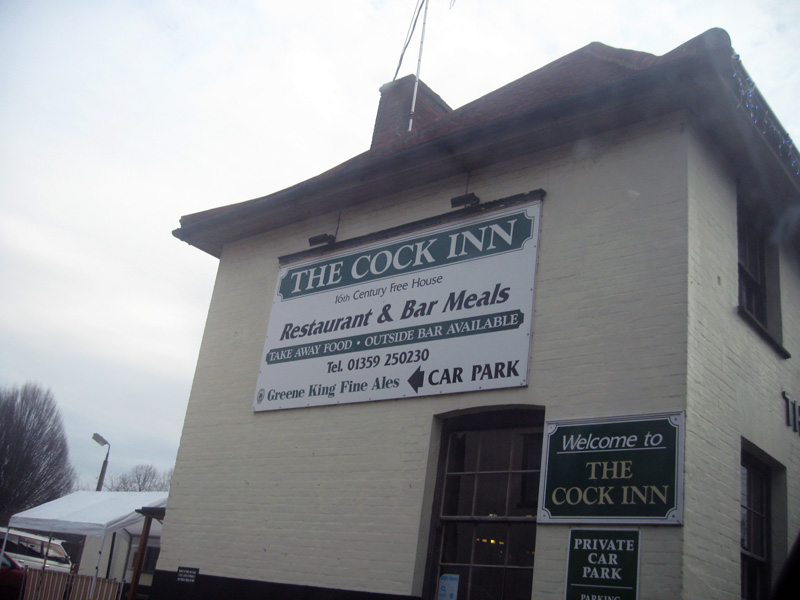
More amusement as we passed the Cock Inn. You see "Cock" everywhere in Britain, as well as "Balls," "Gay," and "Bottom." Britain has lots of hilarious place names.

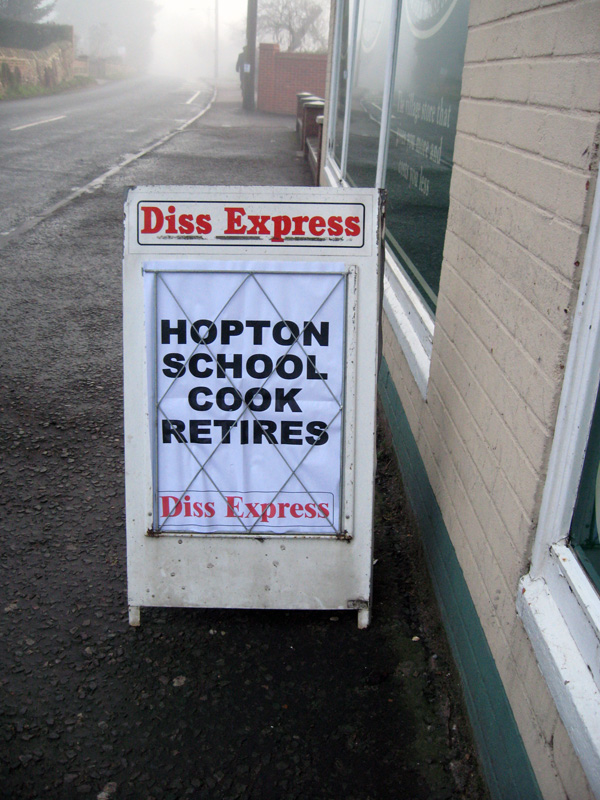
Barningham has an excitement all its own. The local paper blares some of the most sensational headlines this side of The New York Post. When discussion is not centered on the installation, maintenance, closure, feasibility, and ownership of public toilets in the market square, it is focused on real cliffhangers, like "Hopton School Cook Retires".

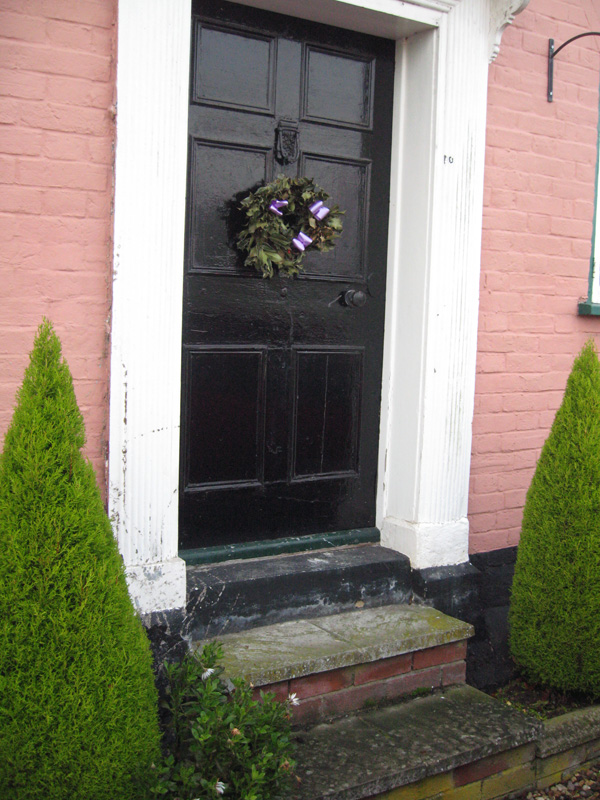
Our friends' retreat is a cute 19th-century cottage painted "Suffolk pink," a color unique to the area that ranges from light rose to pale brownish-red. Theirs is on the rose-to-salmon side. The only establishments within walking distance are Spar, the British version of 7-11, and the Royal George, the local pub.

There aren't many places to eat around Barningham. One Chinese restaurant was closed, and the only other one within driving distance didn't deliver. Niamh and Luis had to drive to the local air force base to pick it up. The dishes were quite different from what we'd get in New York and quite tasty.

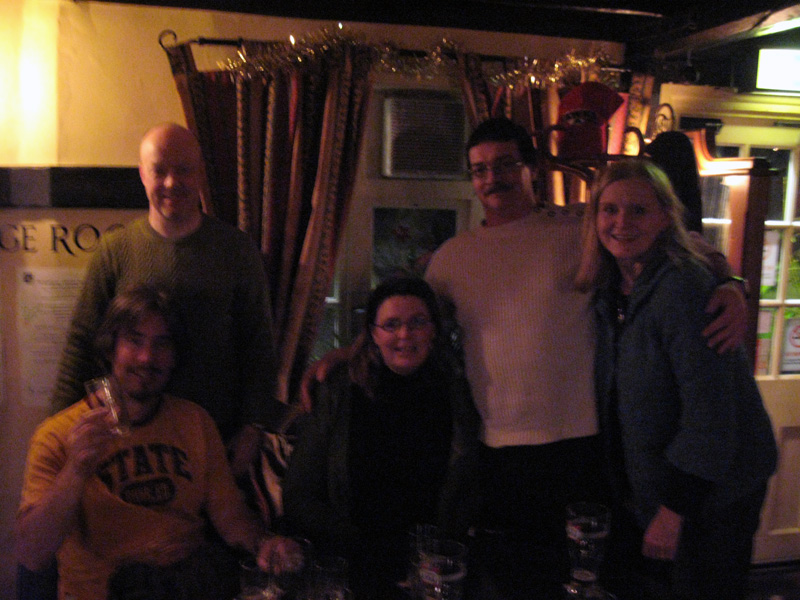
In the evening we went to the Royal George to meet Niamh and Jan's friends Simon and Jay and have a few pints. Jay has become a casual reader of my blog. She has increased my readership by 8 percent, from 12 to 13 readers! Kayo Kid is now read on four continents. After 4 years of blogging, this is very exciting news indeed! Welcome, Jay!

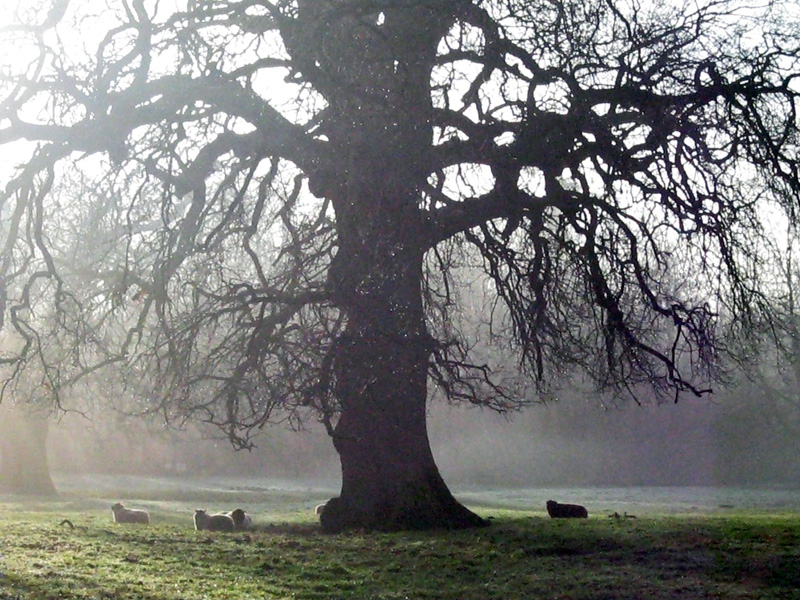
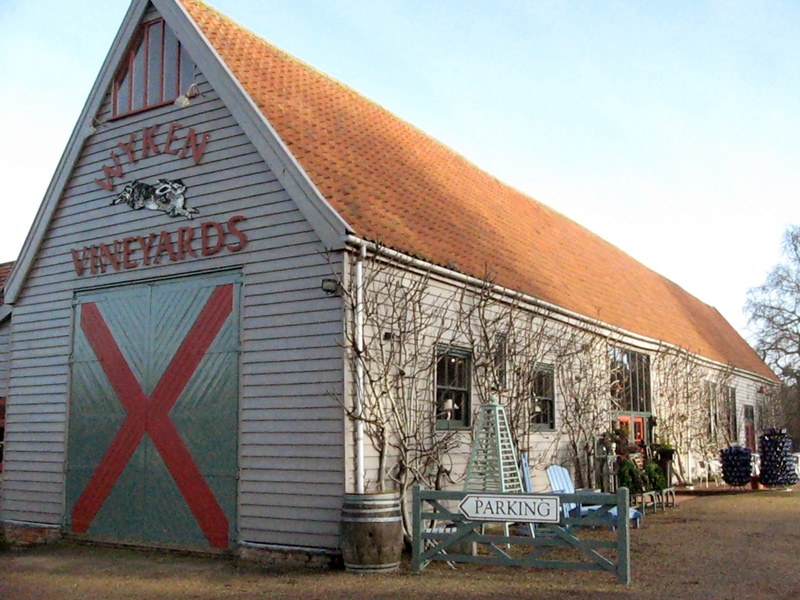
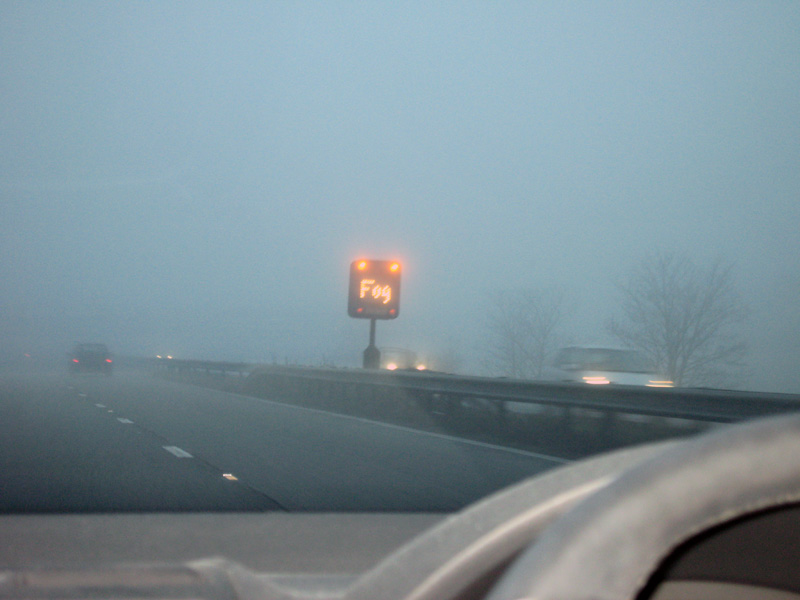
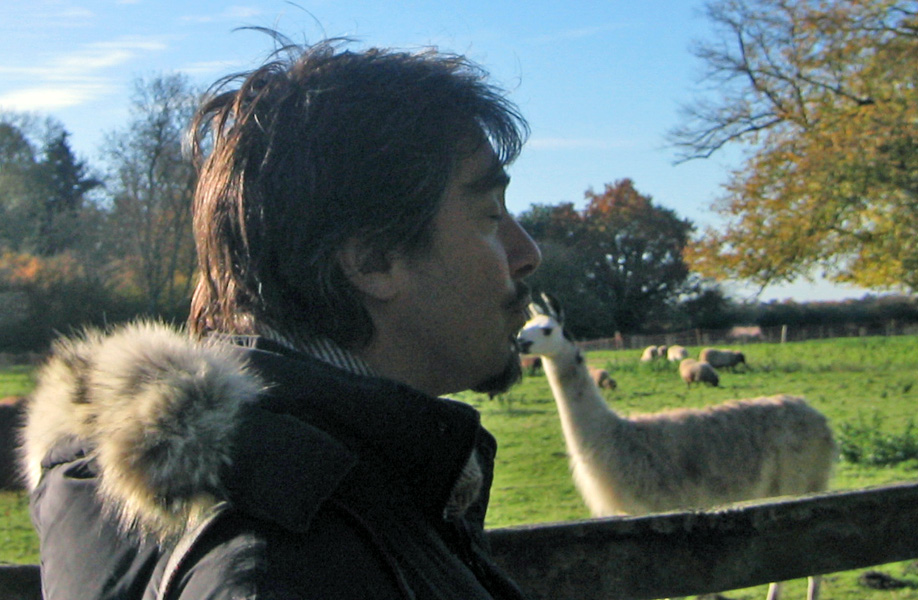
On Sunday morning we had breakfast at The Leaping Hare at Wyken Vineyards, a working farm run by married couple, a Brit and an American. The food is fresh and delicious. Llamas, sheep, and horses roam the pasture. We woke to fog, and everyone thought it might burn off, but it lasted all day. It was so thick that more than 100 flights from Heathrow were canceled.

After breakfast we visited Simon and Jay and their two sons. Jay had just made sausage rolls, which were delicious, and she took us out to see the chickens, one of which was a prized variety she'd won on eBay! Each chicken lays an egg a day. I was fascinated by the chickens and realized that, despite being descended from a long line of dairy farmers, I had no clue about farm animals.

video


On the way back to London in the afternoon the fog was very thick, and traffic was bumper to bumper almost all the way. To assist drivers, there signs appeared all over the road as reminders.

While visiting my cousin in Essex in college, he said it was a pity that I wasn't staying longer so I could see the cow give birth. I said I had never seen such a thing, and he seemed incredulous. I reminded him that I lived in New York City and we didn't have many cows there.

The country mouse, as we know, was perfectly content in his humble little abode until the city mouse visited, saw his wretched conditions, and invited the country mouse to the city. The country mouse loved all the new things in the city, but being chased by a cat was the final straw that led him back to rural safety. I don't mind the cooks and the cats and the mousetraps. Every now and then it's nice to get away, but I'm a city mouse all the way.

Labels: , , , , , , , , , , , ,


Continue reading...

Friday, December 21, 2007

What's done is Dunne

On the way back to the guesthouse last night I lamented my lost opportunity to meet my cousin Eileen Dunne. I don't know why it nagged at me so much, but I had convinced myself it was better not to. Then, I thought, well, Billy Splatts! introduced himself to both Keira Knightley and Natalie Portman--and they were perfectly nice about it. I wanted to be that guy.

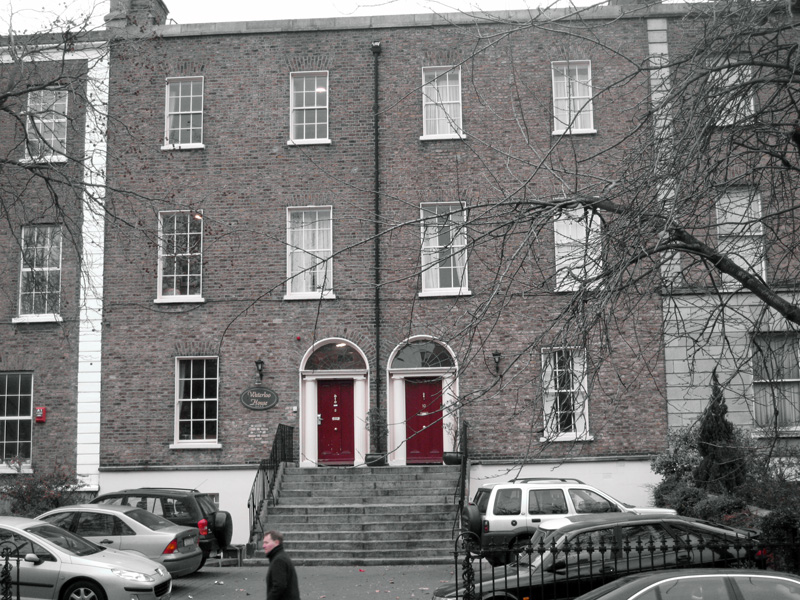
Today was the most beautiful of the three days I spent in Dublin. After a full Irish breakfast (also known as Atkins Delight), I checked out of Waterloo House. I highly recommend this place if you're looking for lodging close to the center in a quiet neighborhood. The lovely proprietor, Evelyn, has spent much of life living between Dublin and San Francisco. The guesthouse is a converted Georgian mansion. The rooms are spotless, with heat and hot water and a great breakfast. I'd read some negative reviews on Trip Advisor and, really, some people just suck, because I don't know what they could possibly complain about.

Dublin is still in the middle of a boom. Construction sites abound, and the face of architecture is due for change, with buildings like Bono's controversial expansion of the Clarence Hotel near Temple Bar, which will feature a dome hanging off the side. A taxi driver said that Dublin is going to get its first 7-star hotel (currently there is only one in the world), but I couldn't find anything about it.

The records office was fairly empty today. The staff was itchy to leave early, but overzealous Yanks bent on finding that one record held them back. I had planned to do only an hour's worth of work but got sucked in and ended up spending the afternoon. I'm at a point where research is getting harder. The further back I go, the fewer sources I have to validate the information. I end up using superpowers like Deduction and Reasoning, when often Guessing is just as effective. My biggest score was the death record of my great-great grandfather. He died in 1937 (the year my father was born) at 93. His cause of death: old age.

By 4:15 I was the only person left, and the office closes at 4:30. The manager said, "We're not trying to rush you..." So I got my last few records and packed up to go. One of the clerks said that vital records are due to go online in the next 5 years, adding "but they said that 5 years ago." That would be a big deal. In the US my only hope is poring over microfilm at Mormon houses and then ordering certificates from Ireland. It's hit or miss if you don't know what you're looking for.

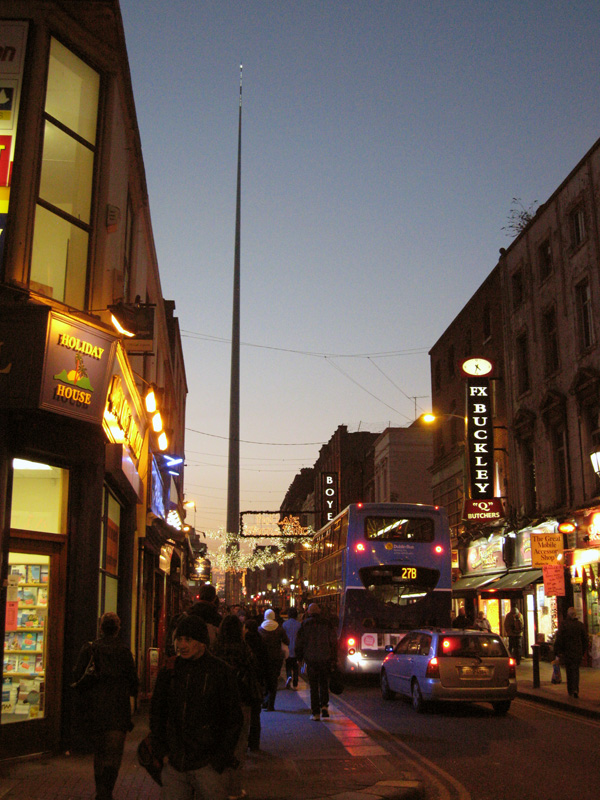
I collected my things and walked to Talbot Street. The street was teeming with shoppers and workers on their way home. I struggled against the crowd while looking for a place to eat. Dubliners seem to have no pattern to their walking. They walk on the right, or on the left, or on the right and the left, or diagonally, or in the middle--and most of it is not attributable to drunkenness. There's just no pattern at all.

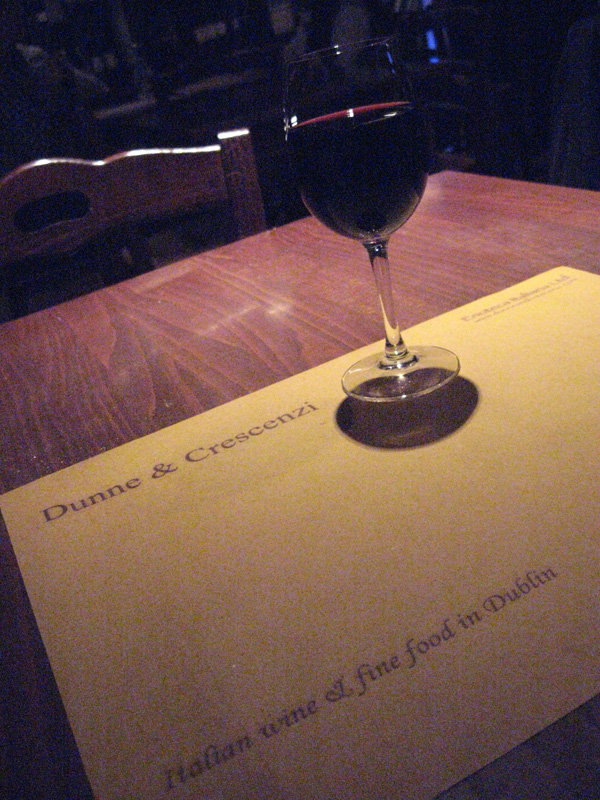
I had 3 hours to kill before my flight. I walked up to Grafton Street and thought about eating at Bewley's. Maybe I could go to a pub and have a nice fish and chips. The crowd was much thicker here, and I was dizzy with hunger and carrying all my belongings. I ended up moving with the flow just to avoid being run down. And then, like being on a Ouija board, I found myself on South Frederick Street, home to Dunne & Crescenzi.

Ah, what the hell, I thought. My conscience obviously dragged me here. I might as well go through with it.

As I mentioned in my last post, Eileen Dunne and I are second cousins. My aunt Eileen is named after her grandmother Eileen. Younger Eileen's father and my grandfather were both named Fred. For many years, my Aunt Eileen said that her father's sister Eileen was the only sibling she knew her father to have and that she had spoken to her as a child once on the phone. My aunt and mother thought, for some reason, that she was a nurse on Ward's Island in New York City, but that has since been debunked. Last March, Aunt Gladys had given me Eileen and Billy Dunne's wedding picture, which was a treasure because it showed my grandfather as well as both my great-grandparents. Aunt Gladys had also told me the names of the Dunne children, all of whom had the same names as my grandfather's siblings. So I was already quite armed with a lot of information about Eileen Dunne the proprietor's family. The trick was to not scare her away.

I walked into the restaurant about 5:00. It was already mostly full. The Italian waiter from last night remembered me from the previous evening and shook my hand. He led me to a table in the back, away from the crowd. Perfect. As he seated me, I asked if the owner, Eileen Dunne, was around and if I could have a word with her.

He gestured to a ginger-blonde woman standing at the bar. She was not the same ginger-blonde woman I'd seen last night, so good thing I had been spared the embarrassment of accosting the other woman. She came over to my table and with a smile said, "Someone said you asked to see me?"

I used the Alison strategy, starting with how much I enjoyed the food, that I was doing my family research and had discovered the Dunne connection and the sibling relationship between Eileen and Fred. I wasn't sure if she believed me, but when I mentioned their common last name, her eyes lit up and I knew she knew I was for real.

She was very warm and listened intently as I mentioned the family in London, that she knew about Gladys but not much else. It seems her grandmother Eileen, Fred's sister, was disowned by the family for marrying a Catholic. (Our great-grandparents were Presbyterian.) I said that my grandfather outdid her by marrying two Catholics. We chatted for about 15 minutes. I told her that I had been hesitant about approaching her with this information in case she thought it was creepy. She laughed and said, "Not at all."

She introduced me to her son, who looks in his early 20s. She asked for my e-mail address and gave me hers and said she would love to hear all about the family history. We shook hands, and they left. It was then I noticed that the card she'd given me was blank, so I have to hope she contacts me and that in the end I didn't scare her off.

But if I don't hear from Eileen again, it's OK. The enoteca's reputation as one of Dublin's finest is well earned. The Italian philosophy of "slow travel" is that to truly experience a place, you must immerse yourself in it. As I savored every bite of my delicious stew of borlotti beans and every sip of red wine there, it felt like the perfect moment to me. And then too soon it was time to go to the airport. It was time to move on.

Labels: , , , , , , , , , ,


Continue reading...

Thursday, December 20, 2007

Another journey

It didn't rain today, but it felt cold, even though it was in the low 40s (or 6 if you're not American). Dublin cold, though, is not the same as New York cold, which can make you cry. Without the Gulf Stream, Ireland would be around 15 degrees cooler. And days are much shorter here: today there was only 9 hours of light, and much of that was dimmed.
Still, though, it was a great day for walking, and since the guesthouse where I'm staying (which by the way, is fantastic) is a block from the Grand Canal, I walked along it to the quays. The Grand Canal connects the River Liffey in Dublin and the River Shannon in the west. Were it not for the canal, Arthur Guinness would have had a tougher time transporting his delicious brew to other parts, since roads (and trucks) were not yet common. Like the Gowanus Canal in Brooklyn, near the site of our new building, the Grand Canal was heavily used for industry, then fell into disuse and became a sewage dump. Now it is being revived through government efforts.

It took me about half an hour to get to the Research Office at the Irish Life Centre. I spent the better part of the day there. When I started my family tree 2 years ago, it had about 35 people; now it has 620. The hard part is going back before the 1860s. Ireland didn't institute civil registration until 1864, so if someone was born before that you have to go to the National Library of Ireland and look at parish registers. Some dioceses, including Cashel and Emly, where my dad's mom's family is from, require written permission from the bishop to view the registers. I'm not sure if this is a ploy to make money or if there's some reason to hide the information, but I can tell you that it's excruciating to pore over hundreds of handwritten, faded documents written in Church Latin (on microfilm), so it's not like people are breaking down doors to view them. I did manage find some records in Limerick for the O'Leary family. Knowing what townlands your ancestors came from is critical. I found this out when researching my mom's mom's Boyle family. Just when you think you've found a match, you see several other people with the same name, in the same place, with the same birth date. The degree of consanguinity in some of these places makes you think about the Habsburgs.

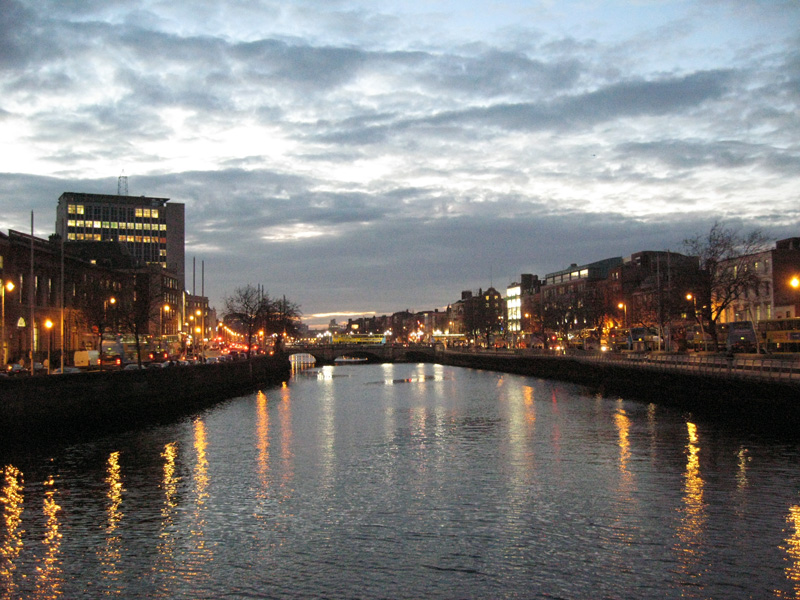
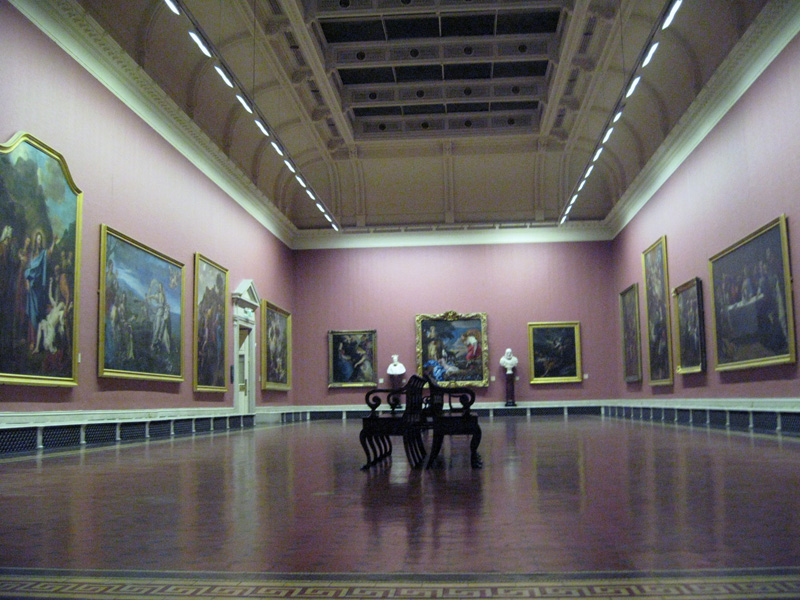
By about 4:00 I'd had enough research for the day. It was already dusk. The Liffey looked spectacular all lit up. People were already geared up for the holidays. The pubs were already filling up. I had some time to kill before meeting my friend Alison, so I went to the National Gallery of Ireland. I'm a huge fan of 16th and 17th century masters such as Rubens, Titian, and my all-time favorite, Caravaggio. The National Gallery has one Caravaggio, The Taking of Christ, which for centuries was thought to be lost but was found hanging in a Jesuit house of studies in Dublin a little over a decade ago. To get to the painting, you have to walk through about 10 rooms of Flemish and Italian paintings. As you walk through the rooms you can see the Caravaggio waiting for you at the other end. I wasn't disappointed.

Alison and I met up around 8:30 and went to Dunne & Crescenzi, an Italian restaurant just south of Trinity College. The restaurant is owned by Dubliner Eileen Dunne and her husband Stefano Crescenzi. There was quite a line at the door, but it lasted only about 10 minutes. I was excited about going to the restaurant, but not only because I'd heard the food was great.

"Eileen Dunne doesn't know this," I said to Alison, "but we're cousins." She looked at me for an explanation. "Eileen's grandmother and my grandfather were brother and sister."

"Does she know you're here?" Alison said.

"She doesn't have any clue who I am. I've been debating whether to introduce myself to her. I don't know whether she'd be freaked out or what."

"Yeah," Alison said, "you'd have to really ease into it."

"Well, this is a good question, then," I said. "Since you're Irish, what would be the best way to approach her?"

Just then, I looked to my right and saw a blonde-ginger haired woman smoking a cigarette outside and tapping on the window to say hello to someone. She looked to be in her 50s.

"Oh my God," I said. "I think that's her."

"Jesus," Alison said. "The family resemblance is unmistakable."

I looked up at a review of the restaurant posted on the window. The woman in the photo looked exactly like the woman outside.

"What are you gonna do?" asked Alison.

"I don't know," I said. I really had thought about it, but now I was having second thoughts.

"Well, look," Alison said, "you have to be cool about it. You start with how much you heard about the place and decided to come try it. You say that you have family in Dublin and that while doing your family research you found that one of your aunts was named Dunne and that you think there might be some relationship."

"I know, but I KNOW there's a relationship."

"Well, if you start pulling out photos of her family and trees and stuff..."

"Yeah, she'll just call a garda and have me arrested."

"Right."

Before I could do anything, the woman disappeared inside the restaurant. We were seated next. The place was noisy and crowded but pleasant. We sat right near the door.

"This must be good," Alison said, "or there wouldn't be a queue. Usually in Dublin if a place is full people just go elsewhere."

We ordered two glasses of prosecco and a special pasta dish of cannaroni with eggplant, tomatoes, and peppers. When our orders came, they looked like orecchiette.

"I don't think this is the cannaroni," I said.

We sent the dishes back and the waiter, who was Italian, was very apologetic. The cannaroni arrived, and it was quite delicious.

"Maybe after dinner you can go up to the bar and ask if an Eileen Dunne works here," Alison said.

"She's not an Eileen Dunne, she's the Eileen Dunne."

"Do you know what you're going to say to her?"

"Well, now I'm not so sure," I said. "Maybe this isn't the right time."

At the end of the meal, I finally got the courage to ask the Italian waiter if Eileen Dunne were here tonight.

"She was here earlier in the evening," he said, "but she's gone now."

My heart sank. Oh well, perhaps another time. Knowing too much about one's family may be one of the pitfalls of doing genealogy.

At least the pasta was delicious.

Labels: , , , , , , ,


Continue reading...

Wednesday, December 19, 2007

Getting into the spirit

People ask why I'm delving so deeply into my family history. The simple answer is, "Because I like it." But it's really deeper than that. I've learned more about myself, and unearthing family history is far more entertaining than watching a telenovela.

At Heathrow today I sat across from an Irish-American family from one of the red states waiting to board a plane to Dublin. They wore excessive amounts of kelly green and shamrocks and harps and the word "Ireland." I'm sure they had no idea of the drubbing awaiting them in the motherland.

Displays of ethnic pride like this was one reason I distanced myself from being Irish--oh, and having a family of raging alcoholics. If singing "Danny Boy" and eating Lucky Charms best represented Irish culture, then kill me with a shillelagh. So that's why I've embarked on this journey, to find out what my grandmother meant when she said, "What's bred in the bone comes out in the marrow."

After checking in at Waterloo House, a wonderful guesthouse in a converted Georgian mansion in Ballsbridge, I had lunch at Eddie Rocket's, the Dublin cousin of American 50s retro diner chain Johnny Rocket's. The place looks and the food tastes pretty much like it does in the States, except all the wait staff are Eastern European.

With about an hour before closing, I headed to the General Register Office on East Lombard Street, only to find that it had moved two weeks ago. The new office is in the Irish Life Centre, around the corner from where we stayed in 2006. I hurried over there, but still I was almost trampled. Dubliners walk as though they are on fire. They walk like New Yorkers used to walk before they got lazy and large.

I had only 15 minutes to do research but didn't get far. The office was closing, and I headed over to the National Library of Ireland, which was open until 9. I had plans to meet my half-cousins Val, Sean, and Stephen at a local pub. But first I had to go to a touristy souvenir store to buy my mother a set of mugs that say "Himself" and Herself" for the woman she babysits for. I asked one of the Eastern European store clerks if they had such a thing, but she had no idea what I was talking about. Such is the changing character of Ireland.

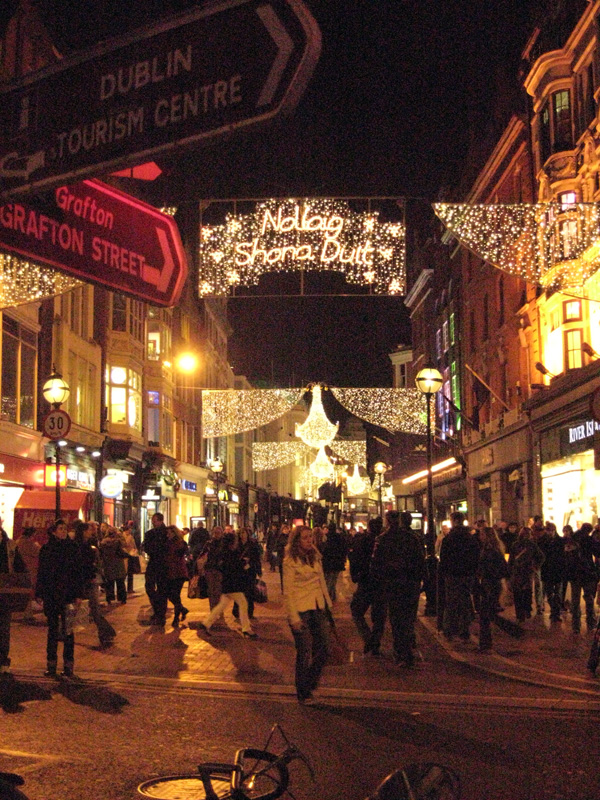
I walked over to Grafton Street, the main shopping area, which was all lit for Christmas, with "Nollaig shona duit" displayed everywhere.

I met the cousins at Fitzgerald's, in the heart of Dublin at Aston Quay and Westmoreland Street. As I had never met them before, I asked Val how I would find him. He said, "I know what you look like from your Web site." Chalk up another reason to keep a blog.

Val and Sean are brothers, and they are related to me in the same way that my British cousins who came to New York are related, only through a different branch. I've corresponded with Val and Sean's son Stephen, nicknamed Chucky, for a few months. They were great fun, and I was worried because at first I had a hard time understanding their accents. But after several rounds of Guinness, that problem cleared right up.

Val had read a lot of the blog and knew quite a bit. I forget I sometimes have more than 11 die-hard readers. Both he and Stephen knew about Luis and my mother ("she's a ringer for Gladys"). Val had been to Las Vegas and New York last year. Sean was not much of a traveler. Stephen wants to go to the States. Next year the family is planning a trip to the Bay Area.

It was interesting hearing people I'd never met telling me what they know about me. In addition to having some mighty craic with some great guys, what I learned about myself is that I can down four pints of Guinness and still manage to find my way back to my hotel on foot at midnight in an unfamiliar part of Dublin without asking directions.

My only regret is that I didn't get a photo of us together. Happy Birthday, Sean!

Labels: , , , , , , ,


Continue reading...

Tuesday, December 18, 2007

Top it off

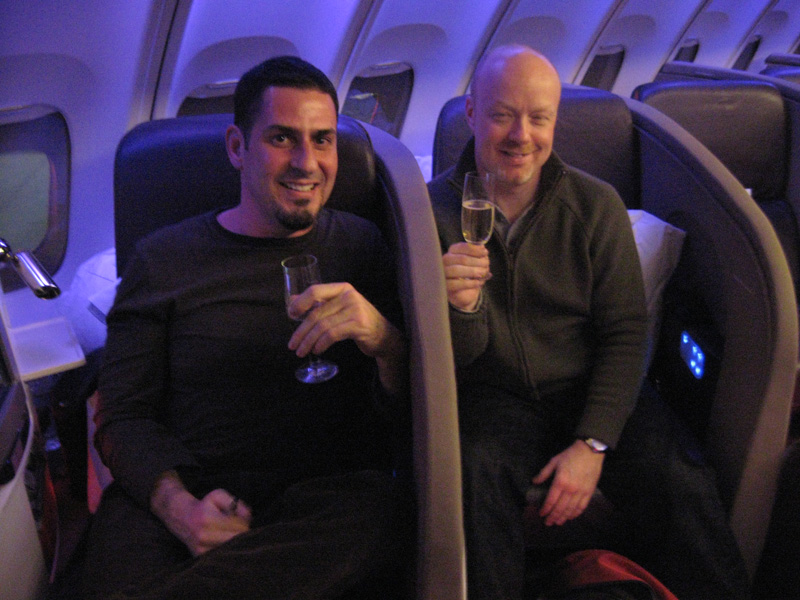
After chowing down a dozen dubious wings at the airport bar (Luis: "I think this one is made of cat"), we were whisked away to the Upper Class cabin, where the other half really lives.

I looked around to make sure Karen Black wasn't on board. That would have been ominous. Luis was in seat 1K. Where was I? Why, 2K! Right behind the pilot and the lavatory.

The attendants wasted no time in offering us drinks. We both had champagne. "I also took the liberty of putting a bottle of water next to you," the attendant said. Well done.

Clare, the chef, came around to each of us to ask whether we would like to be served breakfast in bed 90 minutes before landing. Why, I couldn't possibly...well, all right then.

Another attendant asked us if we would like to have massages or beauty treatments. I said I would prefer to sleep. Before takeoff yet another attendant came by: "May I make your bed up?" Why, yes you may!

I took something called No-Jet-Lag, a homeopathic remedy consisting of Arnica Montana (the evil twin of Hannah Montana) and several other witches' brew ingredients. I took one every 2 hours, according to the directions. The label warned that consumption of alcohol may impair its effectiveness. Yeah, whatever.

I actually fell asleep for about an hour and a half but was awakened by Wizard-of-Oz-house-pitching turbulence. Luis said later that he thought we were going to die, but at least he'd die happy. I almost never get queasy in turbulence, but this was prolonged, and the alcohol didn't help.

Breakfast was served on schedule, and we landed safely, about 90 minutes later than planned. UK immigration is divided into "Fast Track" (i.e., rich people), "European Union," and "Rest of the World," which is pretty much how the real world divides. Luis went through Fast Track, whilst I used my newly minted Irish passport to speed through the EU line. No stamp, but that's OK.

We took the Tube into Islington, about an hour's ride. It's amusing to hear a calm British female at every stop say, "This is a Piccadilly line train headed in the direction of COCKfosters." I never get tired of that.

Labels: , , , , , ,


Continue reading...

Monday, December 17, 2007

Upper Class travel

A few weeks ago I decided, well, our tickets were so inexpensive, why don't I upgrade our seats from Economy to Premium Economy. The difference? A little more legroom, a little more oxygen. But the travel gods were extra generous, and when dropped off our bags at check-in, we were told the flight was oversold, and we were upgraded to Upper Class. Immediately we were greeted by lovely, chatty attendants, given champagne, and asked if we wanted a massage.

The attendant even asked if I wanted pajamas! Now this is living! After takeoff I'm going to lie down and sleep, and in the morning awaken to croissants and tea.

Our only hope is that this is not the pinnacle of the trip.

A lovely way to start a vacation.

Labels: , , ,


Continue reading...

Saturday, December 15, 2007

Vacation, all I ever wanted

Today was my last work day of the year.

The countdown begins.

Labels: , , , , ,


Continue reading...

Thursday, November 22, 2007

A lot to Bear

When people asked me what I was doing for Thanksgiving this year, I matter-of-factly said, "Nothing." That was the truth. Every year since I turned 21 I've done something different. Last Thanksgiving I spent in London with Andrea while Luis was at his brother's wedding in El Salvador. Nothing, however, compared to the year it took me 9 hours to drive from DC to New York. I have nothing against my family. We see each other often. We're just not big on the forced holidays. I like having the option to do my own thing. It leaves the door open for spontaneity.

Sometimes, however, spontaneity doesn't like having the door swing open too wide.

With temperatures in the 60s, it was a balmy fall day. Luis called me from the gym around 9 and said we should take a drive somewhere, maybe Upstate. I had thought the same thing even before he called. The question was how to find someplace to go.

I Googled "thanksgiving dinner upstate new york" and got a lot of personal Web sites about turkey dinners. I narrowed the search down to "thanksgiving hudson valley" and found some inns and hotels serving dinner, but nothing appealing. Then I noticed a link to OpenTable.com, a site where you can reserve a table at a decent restaurant at the last minute. I've been using it for years.

I looked up Hudson Valley and found a place called Monteverde at Oldstone Manor, right across from Bear Mountain. Bear is a big ski resort in the winter, hugging the western shoreline of the Hudson River. The restaurant, at an 18th century manor house near Peekskill, was right acros the river on the east side. We thought we might drive the '72 Mercedes to New Jersey, up the Palisades Parkway to take in the rich fall foliage, stop in little towns along the way, and make our way to the restaurant. It was a very romantic idea, and we were both excited about spending the day together, which is rare, and relaxing amid the scenery. Monteverde was written up in the New York Times this past Sunday, to rave reviews. Neil Ferguson, a former chef at Gordon Ramsay's New York restaurant The London, had taken over the helm of Monteverde and had turned it into a stellar dining experience.

I made the reservation at Monteverde for the only available slot: 7 pm. That would give us plenty of time to leisurely make our way up to Peekskill. According to MapQuest, the ride should take less than 90 minutes. Even with heavy traffic the worse estimate was 160 minutes. After making the reservation, I realized I hadn't looked for any user reviews. Zagat's had several negative reviews about the service, how inattentive and unresponsive the wait staff were. I don't take such reviews to heart, because when reviewers say things like "the least they could have done was offer us free drinks" I peg them as problem people.

We left Brooklyn in the Mercedes around 12:30, plenty of time to enjoy the scenery before dark. Traffic through the Brooklyn-Battery Tunnel was a breeze. I love driving in the Mercedes. People stare at car like they're cruising Angelina Jolie. Older men, especially Italian and black guys, give thumbs up or say things like, "She is SO byoo-tee-ful!" We were hot stuff as we headed toward the West Side Highway.

An hour later, we had moved four whole blocks.

Luis was visibly nervous. The Mercedes had been acting up lately, unpredictably, especially while idling. He was afraid we might get stuck in the boondocks on a holiday with no recourse. It was about 1:30 when we turned back to Brooklyn, sailing over the Brooklyn Bridge, and made it home less than 20 minutes later. Thankfully we have another car, an '88 Volvo wagon, which has also had major surgery but is far more reliable than the Mercedes. Around 2:00 we got back on the road to Manhattan. I checked the traffic reports, and every major thoroughfare was jammed for miles. Much of it was due to the Macy's parade, which shuts off Midtown from the rest of the city. The rest was local traffic, people trying to get to and from New Jersey, Long Island, Westchester. Luis was convinced that the West Side Highway had to have cleared up.

He was wrong.

Traffic was even worse than the first time, backing almost into the Battery Tunnel. We spent the next 2 hours, zig-zagging our way through streets, trying to outsmart other drivers who knew faster ways, but we weren't that smart. Finally we ended up on the FDR Drive, which was virtually clear...all the way to the Bronx at least.

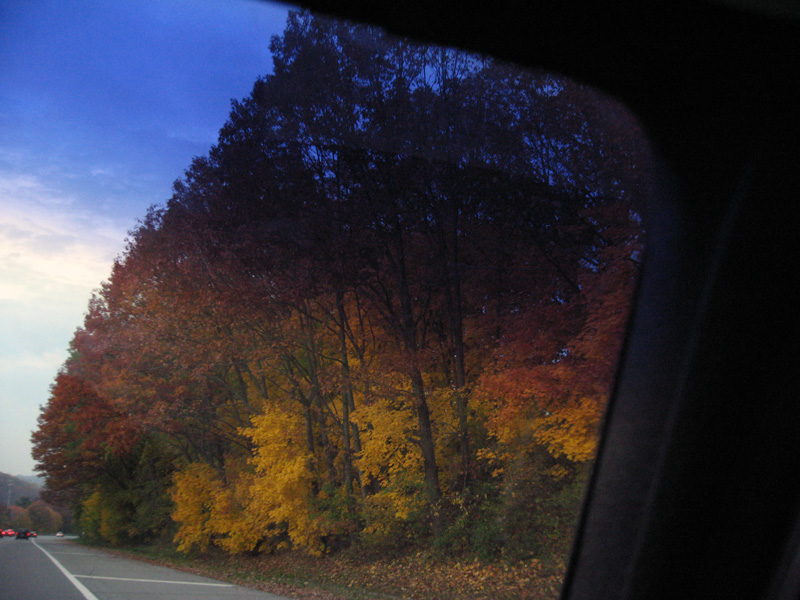
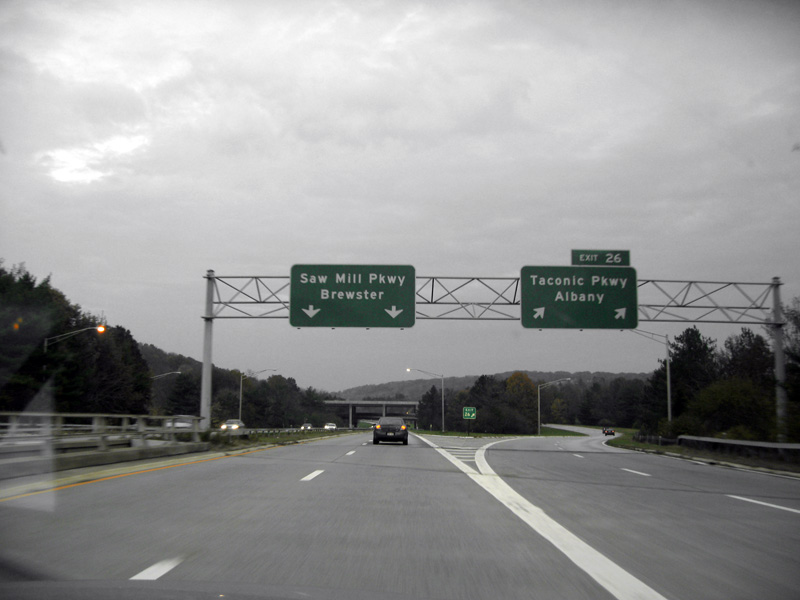
At last we made it out of Manhattan and into Westchester. It was a little after 4:00. Ah well, at least we had 3 hours, but our hopes at viewing the brilliant hues of sugar maple, pine, spruce autumn were waning. The clouds were rolling in, and the temperature had fallen a good 20 degrees. We didn't make it to New Jersey, but the Saw Mill River Parkway, which we drove on, had a nice blend of yellow, orange, red, and green to keep us engaged.

The drive got more relaxing as we went on. I had my iPod playing, and I tried snapping photos of the leaves with my camera. We were certainly making good time. It was about 4:30 now. We I checked the map to see how far away we were.

Now, even with my 20/15 Lasik-corrected vision, I can't see up close very well, and I haven't yet invested in a pair of drugstore glasses. The New York State maps we had didn't show Westchester roads very well. They were mainly concerned with real upstate places like Buffalo and Schenectady. Plus the maps had been from the Mercedes, when Luis's elderly aunt owned it, so the roads stopped at about 1970. When I looked up at road signs and saw Katonah, I knew we were in trouble.

We were only about 20 miles east of where we needed to go, but neither of us was familiar enough with the ares to figure out which westbound road to take. I pulled out my cell phone and started the navigation program, and just as I was about to get the map, my battery died.

It was getting pretty dark now, at around 5:00, and we had to pull over and try to figure out between us the nearest route to take. We finally figured it out and headed on the road. My original MapQuest directions had long since become useless since we hadn't followed any of the roads. (Later, when I looked at the photos I'd taken on the road, I'd inadvertently snapped a picture of the split where we should have gotten off.) By some miracle we ended up on Route 202, which would take us straight to the restaurant.

At about 5:20 we stopped for gas. We figured we were close but decided to fill up in case things went horribly wrong. Back on the road again, we passed a diner on the left that looked open. We both looked at each other and said, "Plan B." Even though we were close and we had plenty of time, we still weren't sure what lay ahead.

Driving through the town of Peekskill, I was shocked by how run-down and seedy it looked. The only other time I'd been there was in 8th grade, when we took a class trip to the Peekskill Dude Ranch (now an orthodox Jewish seminary), and I rode a horse for the first time.

We followed the street according to our directions: a dead end.

The way things were going, we weren't sure we were going to find the restaurant. Luis remarked that even McDonald's was closed. But along the way we did pass an Art Deco-y looking diner, and I said, "Plan B."

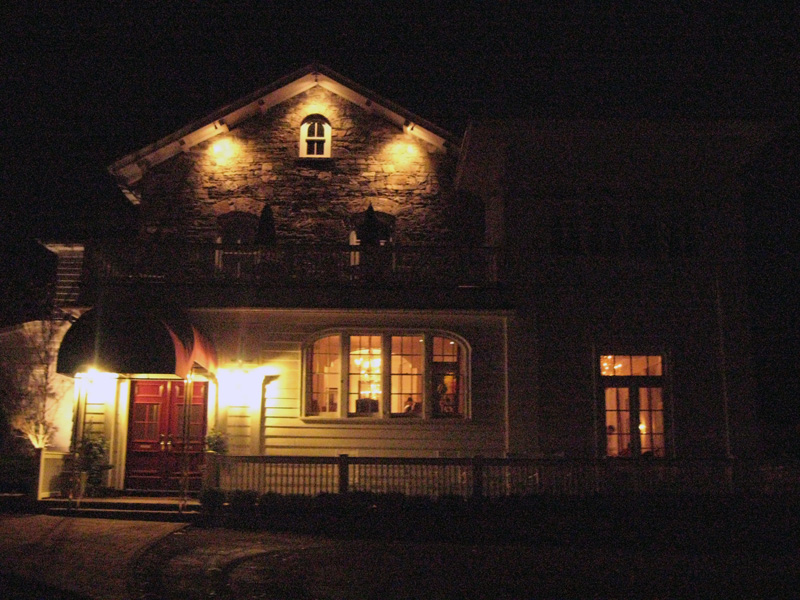
About 20 minutes later we found Monteverde. It looked really charming from the outside, and I'm sure it would have looked stunning in the daylight.

"Mmm hmmm," Luis said, "it's gonna be us a bunch of ultra-whiteys."

"Yeah," I said, "and the homos will probably be lynched."

We looked at each other and said, "Let's eat!"

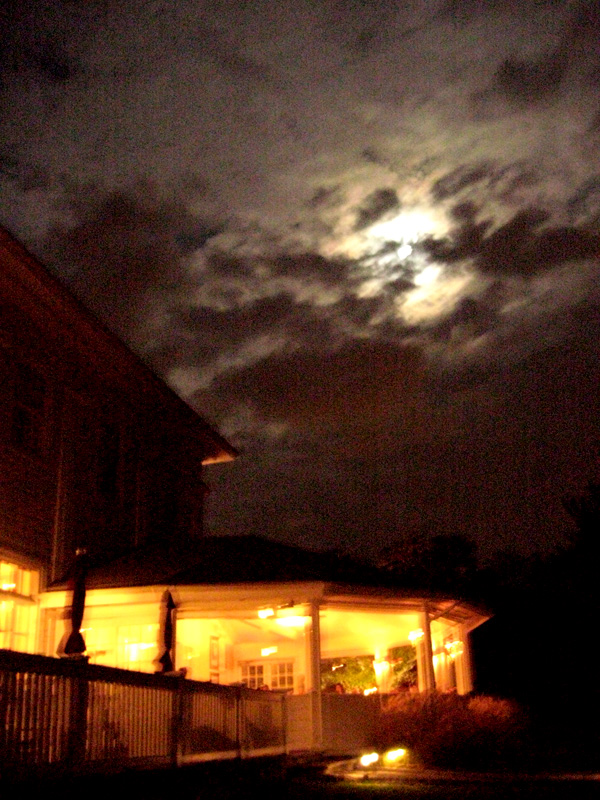
The problem now was not whether we would arrive late but that we had arrived more than an hour before our reservation. It was 5:40 and no longer balmy. We decided to walk around the grounds for a few minutes. Even in the dark we could tell it was beautiful in the daylight. A brilliant red sugar maple was illuminated against the gibbous moon. A glass-enclosed gazebo jutted out on one side of the restaurant.

It was getting cold. We decided to go to the bar and stick out the wait. We gave our names to the hostess. Before I could even tell her how awful our drive was and how early we were, she said she had a table for us. The table was in the gazebo, right by the window, overlooking the lake. We looked around at the other guests: a Chinese family, an interracial couple, a group of Hispanic friends. Two women were seated right behind me.

"Oh, look, we're in the same-sex section," Luis said.

Our waitress, Ramona, appeared a few minutes after we were seated. She was quite pretty, a cross between Paula Abdul and Phylicia Rashad. I explained to her, as I had to the hostess, that it had taken us 4 hours to get here. I'm sure I'll be a joy as an old man.

We got drinks and looked at the three-course prix-fixe menu, which read like this:

Appetizers

Terrine of smoked ham knuckle, chicken and foie gras, pickled beet salad
Garden salad of seasonal fruits, vegetables, herbs and pickles
Butternut squash soup, wild mushrooms and parmigiano reggiano
Smoked trout fillet with a salad of avocado and green apple, crème fraiche

Entrées
Butter poached turkey,confit leg,potato puree,cranberry compote and cooking juices
Potroasted, glazed ham, spiced red cabbage, parslied, honey carrots, port sauce
Roast salmon fillet, sage gnocchi, chestnuts, wild mushrooms and shaved pecorino cheese

Desserts
Pecan pie, maple ice cream
Chestnut parfait, milk chocolate and pear
Slow roasted gala apple, rum and raisin ice cream and golden puff pastry
Artisanal domestic cheeses

Chef Neil Ferguson

We were just the right amount of starving. We finally got a chance to relax and absorb the atmosphere. It was a pity we hadn't seen the grounds in the daylight, but it was still beautiful.

I ordered the terrine, Luis got the butternut squash soup. Portions were just right, and both were delicious.

For the second course we had the traditional turkey dinner, and for dessert the chestnut parfait.

What Gordon Ramsay lost Monteverde gained. The food was wonderful, the service attentive, and the venue beautiful.

We drove back to the highway, passing the Deco-y diner we'd passed earlier. We were both glad we didn't have to resort to Plan B. Traffic home was a breeze. We made it home in an hour and 20 minutes. Congestion aside, the day was exactly what we had both wanted. It had not gone quite as we had expected, but the destination was worth the journey. And we were thankful for the beautiful meal and for having each other.

Labels: , , , , , , , ,


Continue reading...

Tuesday, September 04, 2007

Playing catchup

I watched the Manhattan skyline fade as we made our way to the New Jersey Turnpike. After a highly stressful work week, I needed to melt away like the sky. As a kid I always enjoyed my hiatus from school, when I could truly do nothing but lie in bed and play with my friends until late in the evening. But there are no such rites of passages anymore. The further away from school I get, the more I forget how it used to be, when Memorial Day and Labor Day bookended my golden days of leisure and time seemed a vast stretch of desert before me.

A hint of summer's leave was evident in the long shadows of afternoon. The sun seemed fixed in the sky as the silver Volvo with me, Andrea, and Luis sped south. The antidote to my stress was a trip to Luis's mom's house in Maryland, an 1830s farmhouse, set on 13 acres of foliage and pasture, complete with horses, deer, and snapping turtles. Enticed by the fortuitously stunning weather, the absence of Luis's family, cocktails, and a pool, we really had no reason not to go.

I hadn't been to the house in at least a year and a half. In fact, I hadn't been in the DC area in quite a long time. I had lived there for 13 years and still remember my way around, but in the end my life there was rather unmemorable, except, of course, for meeting Luis.

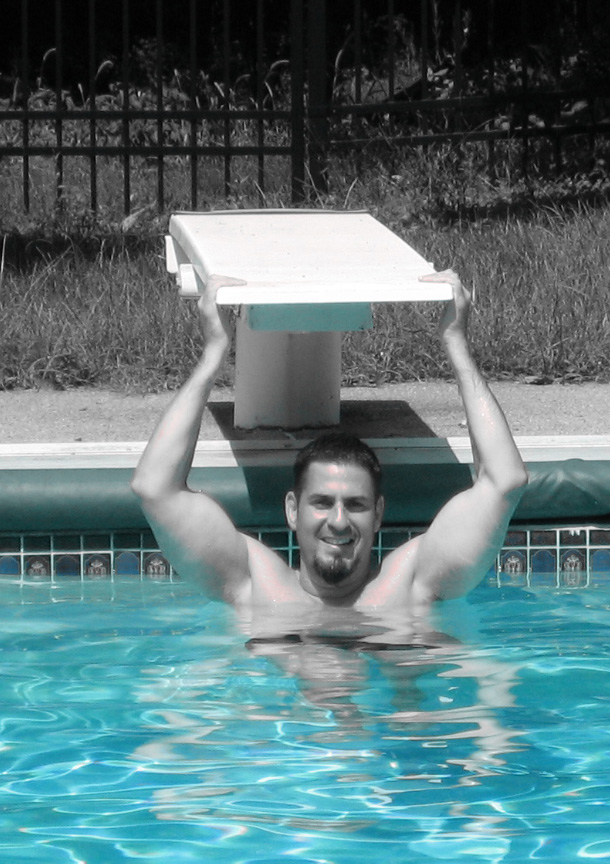
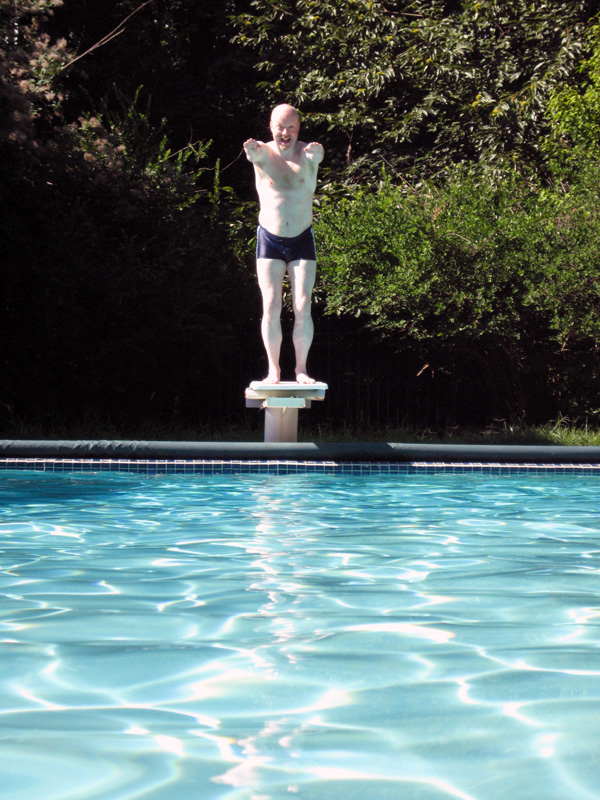
As soon as we unpacked we raced toward the pool, cocktails in hand, the sun blazing overhead. I doused myself in SPF 30 sunblock and set up my iPod boombox on the pool's edge and put on a playlist of summer songs, starting with Jan and Dean's "Surf City." I couldn't wait to get on the diving board. I can't remember the last time I went swimming. I hopped up on the board and felt like a giddy little kid.

All traces of stress dissolved as I plunged into the warm blue water. As I swam I realized that with my eyes open it was the first time I could see clearly underwater. Before my LASIK surgery I had to wear goggles or keep my eyes closed with my contacts in.

Maybe it was the chlorine waterlogging my brain. I felt exhilarated, there among the gingko trees and butterfly bushes, and started dancing around in the water. Luis was playing real estate agent, and Andrea periodically looked up from her Vanity Fair to shake her head. The Ketchup Song, a summer hit for Spanish girl group Las Ketchup a few years ago, came on, and my inner 13-year-old girl took over. I started doing The Ketchup Dance to the scorn of Andrea and Luis, who didn't know what to make of it. I got up on the diving board and did a little shimmy, then cartwheeled into the water.

In the evening, after a siesta, we drove into DC and had Thai food with Carole and Carl. They live about two blocks from my first apartment in DC. It was strange to see the old neighborhood, where the winos, brawling dykes, and welfare mothers had been supplanted by Starbucks, doggie day care, and art galleries. After dinner we walked to Eastern Market, where I spent much of my first year in DC. Sadly, the market had burned down several months ago, and it is now being rebuilt with community support.

One phenomenon I don't find much of in New York is the 7-Eleven. The suburban ones are always full of half-living people who buy lots of beer and lottery tickets and then vanish God-knows-where into the night. I think it was one of the few times that Andrea and I felt like hipsters as we bought groceries for the house.

That night I slept like a baby. The next morning I could barely lift my head off the pillow. My neck felt like it was in a vise, and my left shoulder was very sore. I guess I'd gotten carried away with the Ketchup dancing and cartwheeling.

Sunday was a repeat of Saturday. More drinks, more pool, more relaxing. Carole and Carl came to the house for a visit. Later we drove into DC to have dinner with our friend Johnny in Adams Morgan. After dinner we went down Luis's old block to see the apartment he owned when we met, then to some of the places in Georgetown where he grew up. Like New York, Washington is in the midst of a big housing boom. New construction is popping up everywhere.

I was dreading Monday, but more than Monday I was dreading Tuesday and going back to work. These three days of relaxation were relaxing, rehabilitating, and reflective. I wish I could have had more time. It was important to savor them and hold them as snapshots in my mind. I remember something I read that Paul Bowles wrote...

... we get to think of life as an inexhaustible well. Yet everything happens only a certain number of times, and a very small number, really. How many more times will you remember a certain afternoon of your childhood, some afternoon that's so deeply a part of your being that you can't even conceive of your life without it? Perhaps four or five times more. perhaps not even that. How many more times will you watch the full moon rise? Perhaps twenty. And yet it all seems limitless.

Labels: , , , , , , ,


Continue reading...

Sunday, June 24, 2007

When it's time to change...

I always thought it would be an affair, or a Maserati, or a wacky new interest, like skydiving, that would jolt me into a midlife crisis. I thought I had gone through one a few years ago, when I started hanging out with The Young, people 10 or more years younger than I who liked to stay out late and party. I went disco roller skating and ate hash brownies. I even bought some White Stripes albums for the occasion. But that was nothing compared to what I'm going through now.

In the past few weeks, I've gotten the sinking feeling that my real midlife crisis has been simmering for some time, like an unwatched pot, waiting to boil over. I can trace it back to my trip to Ireland last summer. For someone who had mocked his Irish heritage for pretty much 40-something years, finding my roots had an unexpectedly profound effect on me. A few months later, on my fifth visit to the UK, I spent 10 days in London with Andrea. It was like being in love again. In part my romantic notions had to do with discovering more about my identity. Getting my Irish citizenship in January opened a treasure chest of possibilities: Luis and I could get married, have free health care, get jobs, buy a house, travel. On my trip to London and Edinburgh in March, I met family I never knew I had. Pieces of the puzzle were starting to fall into place. I felt even more like I belong there. I felt connected. Since then, I haven't been able to shake the feeling that I want to be there. The trouble is, I don't know what to do about it. All I know is that the whole idea is weighing heavily on me.

I've always liked the Robert Frost poem "The Road Not Taken." When I was younger, I saw no urgency in it. If I started down one road and didn't like it, I figured I could always turn back and go the other way. When I was younger, time stretched out endlessly before me. I was in full control of it. I don't feel that way anymore. Time is in full control of me. Songs run through my head, like time won't give me time,, time keeps flowing like a river to the sea, and time won't let me wait that long.

I realize now when I read Frost's poem that there are actually many roads and many forks. Which ones you take depends on how much risk you're willing to face. Complacency and inertia are comforting friends once you're on the road. You get settled into your routine, you lead a comfortable life, everything becomes familiar and safe. Why shake things up? Why not continue along the road you're on and see where it ends? But what if that road leads you nowhere?

Last week I took a class called "Mastering Priorities," taught by Dr. Rick Brinkman. He's an Anthony Robbins type, a motivational speaker who gives strategies for coping with everyone's number one enemy: time. At first I thought the seminar would be platitudinous, but it was quite the opposite. Dr. Brinkman asserts that the key to mastering our priorities is understanding our values, like family, career, fun, friendship. Our values drive our goals, and our goals drive our priorities. If something is a priority and conflicts with your values, Dr. Rick says, it causes internal stress and you need to rethink it.

Coincidentally, this last point was raised almost verbatim in a tarot card reading I had last week, after I took the class. The reader, a stranger, said the cards showed me to be in a state of major change and upheaval. As a result, he said, I am experiencing a high level of internal stress, which is caused by my fear of what might happen if I make the change. The change, which will continue until next spring, will have a positive outcome, with a pleasant surprise involving my relationship. In the light of the inner turmoil I've been going through the past few months, the reading was as clear as day to me. Then why don't I feel any better?

I'm still looking into going to grad school, but I'm not convinced that's the answer to my angst. I have so many things to consider about my life in New York: Luis, my family, my friends, our building project. What would I lose? What would I gain?

I don't have the answers yet, but the weight of this feeling is as oppressive as humidity in July. Eventually something will give. I keep going back to the last lines of that Frost poem: "Two roads diverged in a wood, and I, I took the one less traveled by, And that has made all the difference." Maybe I need to go back to listening to The White Stripes.

Labels: , , , , , ,


Continue reading...

Tuesday, April 17, 2007

The glass of absinthe is half full

I arrived in Vancouver a day before I'm scheduled to attend a 4-day training and documentation conference. When my boss asked me if I wanted to go, I jumped at the chance. I was itching to find out what makes Vancouver consistently rank among the world's three most livable cities. And equally, I was itching to find out exactly what it is I do for a living.

Beauty is in the eye of the beholder, but I think you'd have to be pretty jaded to not consider the view from Coal Harbour spectacular. Because I registered late for the conference, I couldn't get the conference rate at the Marriott, where the conference is being held. After talking to a fellow attendee, I'm glad I was late.

"I'm on the 6th floor," she said.

"Oh," I said sympathetically, "I'm on the 23rd floor, with a waterfront view." So much for diplomacy.

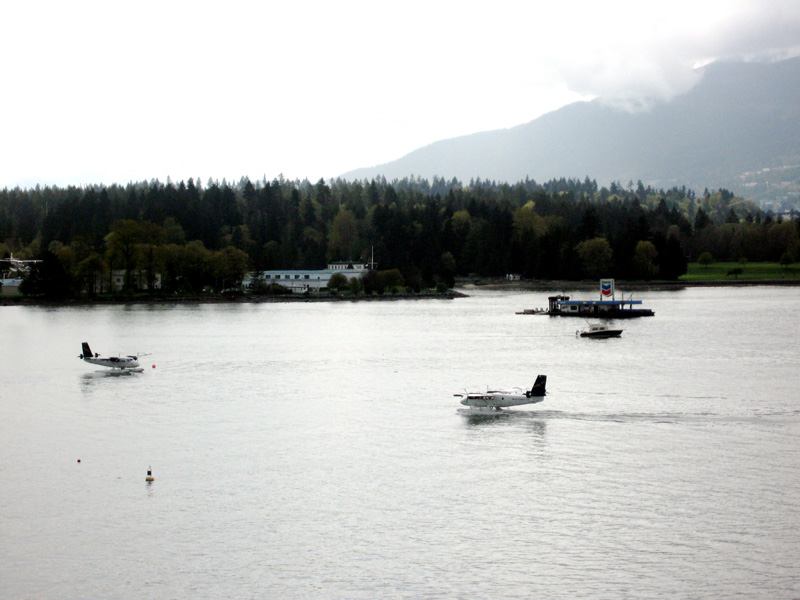
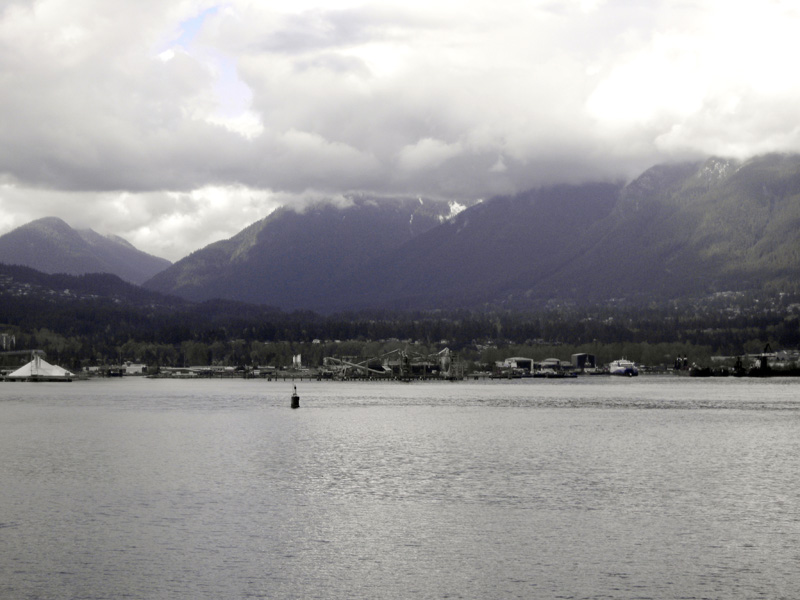
When I walked into my room and looked out the 15-foot wide window at the panoramic view of Coal Harbour, Stanley Park (which is slightly larger than Central Park), and the six peaks behind the North Shore across the water, I had a Helen-Mirren-meets-the-stag moment and uttered, to no one in particular, "You are beautiful!" The clouds lingering over Black Mountain emitted a dramatic light that would have pleased Caravaggio.

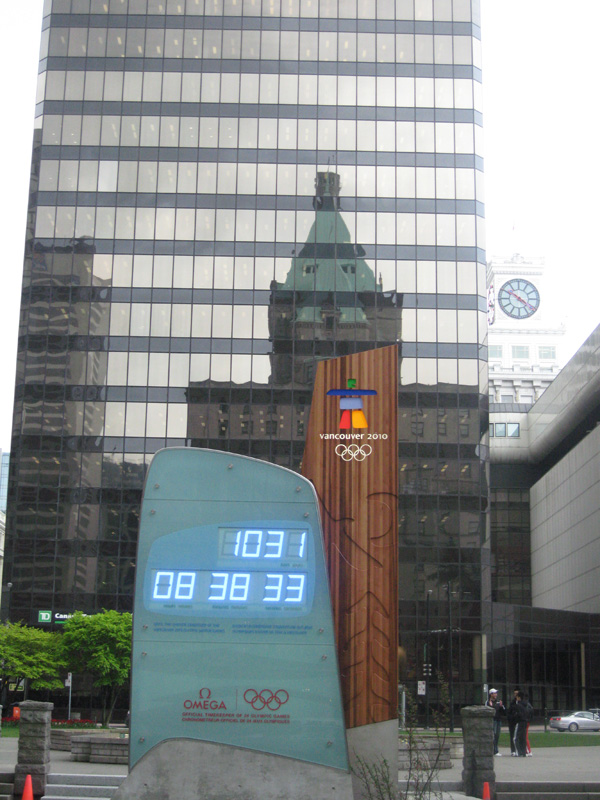
Vancouver is gearing up to host the 2010 Winter Olympics, a fact emphasized by the presence of tower cranes and hardhats throughout the downtown area. Robson Square has a clock counting down to the day. Downtown and the West End are where it all happens--shopping, dining, clubbing, tourism--if you're a city boy like me. If you're outdoorsy, look beyond at the vast expanse of mountains and forests. This is the place for you. Skiing, snowshoeing, hiking, sailing, hunting, climbing--the list is endless. For me, hunting means rummaging through sale racks, and climbing means going up stairs. After laying down my bags, I just happily walked around town.

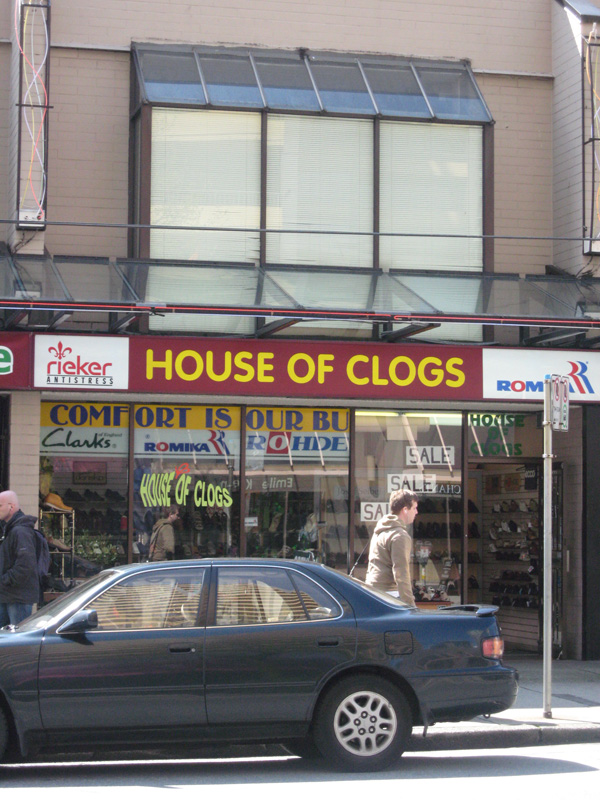
Robson Street is the high-end retail street, equivalent to NYC's West Broadway or Madison Avenue, but a place like House of Clogs manages to co-exist with Armani and Escada. If you're in the market for bubble tea, dim sum, or karaoke, the Asian community here offers plenty of all for everyone.

As a relatively new city, incorporated in 1886, Vancouver has a small amount of "old" architecture. Old here means Victorian, and there's not much of that left. Modern architecture rules: the skyline is framed by steel and glass. The scale seems sensible, unlike in New York. Sunlight, when it appears, penetrates the street, aided by the reflection off glass buildings. It was overcast most of the day, but then it was sunny, then cloudy, sunny, rainy, sunny, cloudy, rainy, cloudy, sunny--rather a bipolar personality.

One of my goals on the trip is to eat as much salmon as possible. Salmon is one of my favorite foods--smoked, grilled, tartared, doesn't matter. Sockeye salmon is the premium salmon here. I went to a little place off Bute and Melville called Citrus Cafe, a crunchy little joint that had--aha!--a smoked sockeye salmon sandwich and a bowl of veggie lentil soup. It was a nice start.

Few people are on cell phones, wear headphones, or jaywalk. Drivers stop pretty much anywhere to let pedestrians cross. As in Edinburgh, you need a pretty good set of lungs and legs to climb the hills. If you have bad knees, forget it. I like that I could walk to everything. I walked along Robson Street and just sort of turned wherever I felt like going. But once I crossed over Abbott Street, the tenor of the neighborhood grew more gritty. I had my New York Danger Detection system on, since I'd read in numerous places that the dividing line between "good" and "bad" is Main Street. But of course I was curious, so I headed that way. After passing several soup kitchens, missions, and a halfway house and being accosted by two homeless women begging--politely I might add--I figured I shouldn't go any further.

On the way back to the center I passed a Starbucks. I had passed one earlier and wondered if it was the same one. No, that one was in a Victorian-looking building; this one was in a bank lobby. On the next corner was another Starbucks, and diagonal to that was another. Pretty soon, I noticed Starbucks everywhere, in every hotel lobby--there were even Starbucks within Starbucks. I wondered if King Minos had a hand in this (at the end of the Starbucks labyrinth is the dreaded Macchiatotaur). Later, I chuckled when I saw a coffee shop across from my hotel, which itself was across from a Starbucks, called Moonpennies (get it?). I went there just because it was amusing.

Whenever I go to someplace, I like to go to drugstores and supermarkets. I needed toothpaste, so PharmaSave was the perfect opportunity. The lines at PharmaSave were very long. After a while I realized that the long line was for Canada Post (the Canadian mail service) and not for checkout. Aside from the bilingual packaging, most of the products were what you'd find in the US. I was very excited, though, to see Strepsils throat lozenges, which Luis and I lived on in Dublin. They're a British product we can't get in the States.

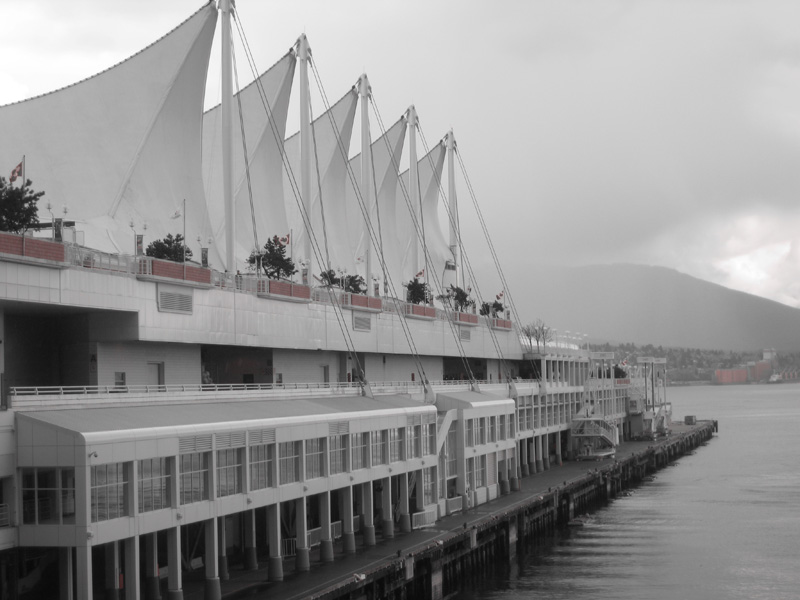
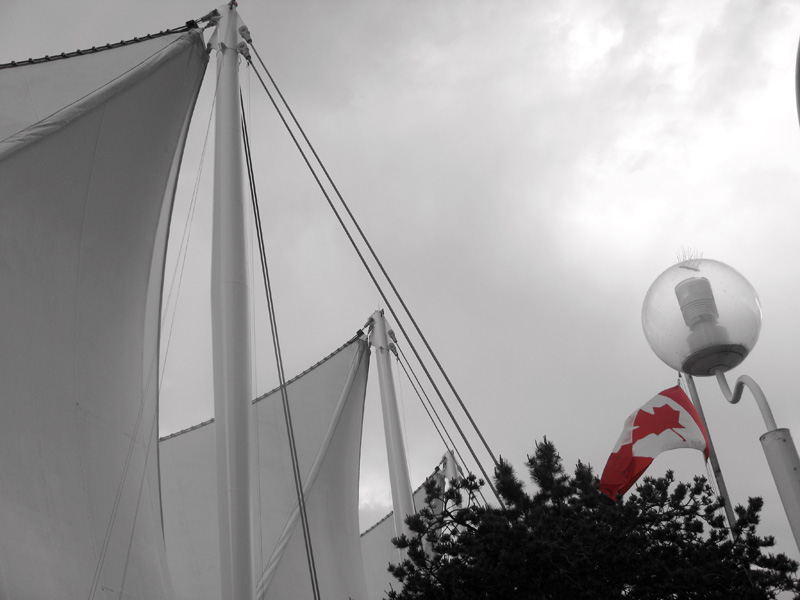
When I left the drugstore it was raining. I walked up to Canada Place, designed not-so-accidentally like the Sydney Opera House. The complex houses an IMAX theater (currently showing dinosaurs, lions, and deep sea creatures) and an exhibition center and affords a spectacular view of North Vancouver. It was windy and chilly, but no one else was around, and I felt like I had the waterfront to myself. I thought about seeing an IMAX movie, but the theater wasn't reopening until later.

I also toyed with the idea of seeing the Montreal Symphony Orchestra at the Orpheum Theatre, but I didn't know if I'd stay awake through the whole performance, even though one of the pieces was Rossini's rousing "William Tell Overture."

For dinner I decided to go to Cardero's, a seafood place on the waterfront. I have a hard time dining alone. It reminds me of Degas's "A Glass of Absinthe." Cardero's was loud and crowded, and I was spared from having to endure it by lacking a reservation. I did, though, manage to capture a rainbow on the marina.

I passed to Kitty Carlisle and walked to the West End (not to be confused with the West Side), until I came to Davie Street, the central gay section. It's a pretty compact area, with some bars and clubs, both obscured and made obvious by blackened windows. The only dead giveaway that I was in the gay area were the rainbow flags. Everyone calls Vancouver an accepting place, but I had a moment of doubt when what seemed to be drunk frat boys were leaning over an apartment building balcony catcalling at two guys holding hands. A guy I know who lives in Vancouver said that was pretty unusual. Later I stopped to buy some milk and saw that Vancouver is, indeed, gay friendly when it comes to dairy products.

I settled on a diner called Hamburger Mary's, recommended by Time Out. The special of the day was an "Arctic burger of free-range buffalo, venison, and musk ox, with hickory bacon and creamy blue cheese." I briefly thought of giving it a try, but I wasn't that hungry, plus, the musk ox threw me off. So I ordered halibut and chips (had there been salmon on the menu I would have tried it). The diner had a 50s theme, with pictures of Marilyn Monroe and James Dean. The jukebox played tunes like The Proclaimers' "500 Miles."

While I was eating I noticed it getting progressively darker. I looked at my watch. It was 8:30. On the way back to my hotel I saw a large crowd carrying banners, blowing whistles, and shouting. I thought, how odd to have a protest at 9:00 at night. As I got closer I saw it was a group of young Asian men and women whooping and hollering. The banners said "Go Canucks!" Wacky Canadians.

I stopped into HMV to see if there was anything of interest. It looked just like any other HMV in the world, except for one thing: markers with maple leafs indicating Canadian artists. There are a lot, among the more famous (in the US) being Bryan Adams, Paul Anka, Barenaked Ladies, Michael Bublé, Leonard Cohen, Burton Cummings, Nelly Furtado, Guess Who, Dan Hill, Diana Krall, k.d. lang, Avril Lavigne, Gordon Lightfoot, Loverboy, Sarah McLachlan, Joni Mitchell, Alanis Morissette, Anne Murray, Rush, Steppenwolf, Shania Twain, Gino Vanelli, Rufus Wainwright, and Neil Young. Who am I forgetting? Oh right. Celine.

Back at the hotel I stood at the window for quite a while, watching the light from the downtown buildings shimmering on the water. Vancouver, you are, indeed, beautiful.

Labels: , , , , , ,


Continue reading...

Flying like an eagle above turkeys

In the past 3 years I have flown almost 30,000 miles on a bunch of different airlines. I'm on my way to Vancouver and will have flown another 5,000 miles upon my return. You'd think I'd have a nice stash of frequent flyer miles by now. But I don't.

I always forget to enroll in mileage programs, and when I do I can never figure out how to claim my miles, or else I can't find my e-ticket or boarding pass. On my latest trip to London, though, I was determined to claim the miles. I went online and tried to join the BA Executive Club. I input my ticket number and got an error message saying it was not a qualifying flight. I surmised that the ticket number was not valid because my flight had been canceled and I had to fly out the next day.

"You're gonna have to make a phone call," Luis said. Luis knows how much I hate dealing with anyone in customer service. Online is the only way for me. I was so happy a few years ago, when I owned a car, that I was able to get an insurance quote online without having to talk to anyone. But this time, I couldn't get mileage credit online. So I called British Airways. It appears that British Airways doesn't want to talk to me, either. While on hold, a lovely British voice politely informed me that I could do just about anything on the company's Web site. If you insist on waiting, the message implied, we will keep you on hold until an American Southern black woman answers the call. And that's just what happened.

After explaining that I had, indeed, gone to the BA.com Web site and tried repeatedly, and in different ways, and at different times, to input my ticket number, I always got an error message saying mine was not a "qualifying" flight. Maybe the flight cancellation had something to do with it, I offered. No, the agent said, it was because my economy-class flight was not eligible for points.

I told her I was still confused. "Well, your flight was H class," she said. "To qualify, it has to be higher."

"Can you explain what that means?" I asked.

She talked about different classes of letters, none of which meant anything to me. Hopeful, I said that my original flight was H class, but that I was upgraded to J class and wasn't that higher than H? "Oh no," she said, "You get points only if you paid for it." Great. Cancel my non-qualifying flight, then tell me I get nothing.

Finally, I got to the ugly truth: there was only way to claim the miles. Within 90 days after taking this last trip, I'll need to book a flight in a higher class, then call British Airways and enroll in the Executive Club. Then I can retroactively claim the miles from the previous flight. However, because I would be at the "blue" tier level, I could claim only a third of the points, or 865 miles out of a possible 2595.

I got such a headache from trying to figure out how any of this was a benefit, I decided my strategy of "online or nothing" was the best one for me.

However, this strategy does have its drawbacks.

I'm flying to Vancouver on Air Canada through United. United sent me an e-ticket with a confirmation number within seconds after I booked. In the e-ticket was a link to Easy Check-in Online. So, the day before my flight I clicked on the link and went to the United site to check in. I got an error message that my flight did not qualify for Easy Check-in Online because I was flying on a partner airline and I needed to go to the operating carrier's site to check in.

So off I went to the Air Canada site. First off, I got an unsupport browser error message. I usually ignore these messages because Safari, which I use, can handle most things. So I clicked on the check-in from selected U.S. airports option, and to my surprise, New York JFK, my departure airport, was not on the list, but New York Laguardia and New York Newark were.

I knew that I could check in at a kiosk at JFK, but my flight was so early (7:20 a.m.) I didn't want to take any chances, especially since I was uncaffeinated. But I did easily check in at kiosk, somehow bypassed the giant line of people who had not checked themselves in beforehand, and got my bag dropped off in about 10 minutes and whisked through security with an hour to spare.

Even after suffering the indignity of having to pay for my food on the flight, I forgot all about unclaimed miles and bad Web navigation as the plane and I drifted off to somewhere else.

Labels: , , , , ,


Continue reading...

Monday, March 26, 2007

High anxiety

My friend Hal, who lives in London, is acrophobic. He has been to Machu Picchu (the bottom), the Tower of Pisa (the base), and the Empire State Building (the lobby). He's making progress, though. Recently, on a trip to India, he bravely sat atop an elephant.

Rather than face the dizzying prospect of riding down a moving staircase and being paralyzed by fear, Hal bikes to work every day. It's much healthier and scenic anyway, except when England loses in the World Cup and alcohol is involved.

The Angel Tube stop, near Hal's house, has not a long and steep escalator, but the longest escalator in all of Western Europe. At 200 ft long, it takes almost 2 minutes just to stand and ride on it. You can't see the top from the bottom. I don't have the patience for standing, so I usually walk up or down it and am sweating by the end. That should qualify as a Boy Scout badge or something.

Others have taken on the Angel Tube escalator as their own personal Everest. Sure, you can ride the normal way, but wouldn't it be more fun--and faster--to ski down it, as this Norwegian chap did?

Then, of course, there are riders who go against the natural order and try to run up it, usually while drunk. Sometimes they succeed, sometimes they don't.

I'm sure all of this won't make Hal take his feet off the ground.

Labels: , , , , ,


Continue reading...

Friday, March 23, 2007

Signs in English

London is a highly walkable city, even though it is not designed for pedestrians. There's no grid to speak of, no numbered streets, and in many cases, no street signs. You just have to know where you're going. Even my cousins, who've lived in London all their lives, carry around maps with them.

I've been to the UK now enough to remember to look to the right first before crossing, but there are times when the just-in-time help "Look Left" or "Look Right" painted on a one-way road saves me from flattening by a careering lorry. I confidently went to cross one street that had a "Look Left" marking only to find out it had been converted to a two-way street. Thankfully I automatically looked to my right anyway before becoming urban roadkill. I've noticed that Brits favor walking on the left, whereas we tend to walk on the right. It makes sense, since this mirrors what drivers do. Still, plenty of people flout this convention.

Our friends live in north London, in an area called Islington, which reminds me very much of my Brooklyn neighborhood, Park Slope. Upper Street, one of the main avenues, is jam packed with restaurants--Moroccan, Afghan, Indian, Cuban, Vietnamese, Lebanese, Thai, Spanish, Turkish, Italian, Brazilian, French--and, oh yes, British. After about 7:00 it is almost impossible to get a table at any of them without a booking. One of my favorites is the S&M Cafe, which is not as sordid as it sounds. It stands for Sausage & Mash. The only thing whipped you'll find on the menu is potatoes, which go very nicely with bangers.

On my walk down to south London, I stopped in at the local supermarket Tesco. Every time I go grocery shopping I feel like Jim Carrey in "Earth Girls Are Easy," as if I have never seen food or packaging before. At the Tesco near my friends' house I kept going up and down the aisles, not to really buy anything in particular, but because I am just so intrigued by what Brits eat and what they call food. Words like "savoury," "beetroot," and "pudding" (though not together) are common. There is a whole section devoted to offal, which has things like lamb's kidney, lamb's heart, and pig's liver. In most cases, the Brits are more clear than Americans. Health food is "wellbeing food." Wine coolers are "alcopops." "Dish detergent" is "washing up liquid." But then there is the French tribute "blancmange," whose nearest relative is flan, and the false friend "conserve," which we call "preserves."

The Brits combine yogurt (or yoghurt, as it is spelled there) and juice, the sound of which made me a little vomitous at first, but actually tastes delicious. But most of all, I am delighted that in any supermarket you can buy not only beer and wine, but also champagne, hard liquor, and liqueurs. You can pick up alcopop, bangers, and crisps in one trip!

Labels: , , , , ,


Continue reading...

Thursday, March 22, 2007

The Royal Mile

Walking in Edinburgh is like being on a Stairmaster. You can build kickass legs and a killer butt (that is, if you don't already have them).

On my last day in bonnie Scotland, after breakfast on the Royal Mile, I walked toward the east end to Holyrood House, the official palace of the Queen in Scotland. You know the Mike Myers character who owns the store All Things Scottish and whose motto is "If it's not Scottish, it's crraaaap!"? Well, I'd have to submit one exception: the new Scottish Parliament building, built in 2004. Personally, I think the it looks like a 1970s train station. As I was standing in front of it, Niamh text messaged me: "Throw a rock at Parliament for me."

I replied, "I know. It's really ugly."

Later, I learned that she meant that, like many Brits, she feels the parliament (both building and legislative body) is a whole lot of nonsense and a waste of money. In 1998 the Scottish people voted for devolution, and this was what they got.

Niamh had a reason for her disdain. The issues of nationalist pride and cultural uniqueness in the UK and Ireland have recently been challenged by a discovery by geneticists that the British, the Irish, the Scots, and the Welsh all share the same DNA. The Picts, Celts, Angles, Saxons, Romans, and Normans didn't have as much of an impact genetically as once thought. The writer did point out, though, that this implication "seems likely to please no one."

I took an audio tour of Holyrood Palace, which has a stately Victorian feel to it. I'll take classical architecture any day. Many school groups were visiting the palace. I was continually trying to beat them to the next room. One of the tours had at least 50 teenagers. The boys goofed on the portraits and furniture, something I'm sure I did at that age. I could understand their goofing, since the Stewart men were not a good-looking bunch. There's a whole gallery of 89 portraits of Stewart monarchs that were commissioned by Charles II. The painter, Jacob de Wet, imagined what some of the early rulers looked like and pretty much made them all look alike to emphasize the prominence of the family. Especially after having just seen The Queen, I was interested in how the palace operates, what guests are permitted to see and how they use the grounds. The gardens are not yet open, but they are supposed to be spectacular in the late spring.

Like a delectable sticky toffee pudding, I saved the best for last: Edinburgh Castle. Walking from the palace up the steep Royal Mile (which is actually 1 mile, 110 yards) to the castle requires a good set of lungs and strong legs. I thought the Rock of Cashel in Tipperary was impressive, but I think the castle might trump it. For centuries it has served as Edinburgh's garrison and could be used at a moment's notice to protect the city from invasion. It's a self-contained city, with prisons, lodging, a chapel, and administrative headquarters. It houses a mammoth cannon called Mons Meg, which could propel a 400-pound cannonball almost 2 miles! The castle exhibits chronicle the long royal history of the Stewarts (or Stuarts if you're French) and the strategic role played by Scotland dating back way before Christ. Unlike other cities, which bury or demolish their past, Edinburgh honors it. Although some modern buildings, such as the Scottish Parliament and the new St. James shopping center, have appeared, you get a real sense of history and time by walking virtually anywhere in town. Buildings are given new identities. My cousin John said that if you buy a property in Scotland, there's little you can do to it. If the original windows, for instance, are not double glazed, you can't upgrade them.

One interesting thing I learned at the castle is that historically imprisonment was not considered a form of punishment. This was particularly true in a military prison where time not spent doing drills was considered idle. Prisoners awaited their punishment, usually torture or flogging. I wonder what happened if you liked that sort of thing.

I had lunch at Cafe Hub, located in a building that once housed offices for the Church of Scotland, designed by architect James Gillespie Graham, who also designed St. Mary's Cathedral, where my great-grandparents were married. The menu had the ubiquitous haggis with tatties and neeps . Though my friends tell me that haggis nowadays is largely oats, the idea of eating organ meats doesn't thrill me. My grandmother made haggis but never forced it on me. Whenever she and my uncle ate steak and kidney pie or calves' liver, I'd just about have to run out of the room from the stink. So I had a prawn salad instead.

I thought I'd given myself plenty of time to get to the train station, but by the time I got back to the hotel to pick up my bags, I realized I had a 15-minute walk ahead of me. My shins were already aching from the steep hills of the Royal Mile and the castle. Laden down with some overnight bags and newly acquired souvenirs, I marched up the hill to the station. It was about 40 degrees out, and I was sweating, but I made the train.

As recently as 2 years ago I had absolutely no interest in my ancestors, or where they came from, or who I am. But all that's changed. Trips like this have changed me.

Labels: , , , , , , , , ,


Continue reading...

Wednesday, March 21, 2007

What lies beneath

All along the Royal Mile in Edinburgh are a series of narrow passageways that harbor an air of mystery and intrigue. If you peer into one you are likely to see steps leading down from the main street. These streets are known as "closes," short for "enclosures." (Some are called "wynds.") Many apocryphal tales have been told about them, particularly about how for more than three centuries a secret world of prisons and vaults existed below the city. While there is some truth to the rumors, the closes were mainly practical because the terrain of Edinburgh, especially around Castle Rock, upon which Edinburgh Castle sits, is largely volcanic rock. Around the Royal Mile, the ground is sandstone, which is softer and easier to excavate. To cope with the masses of people swarming into the city after the Middle Ages, people began building up, down, around, and sideways--in whatever space was available. Much of what was built is now gone, but the closes remain, each holding the key to a different story, each with its own name: Brown's Close, Skinner's Close, Mary King's Close--but no Glenn Close.

Apparently when the five bridges of Edinburgh were built in the 17th and 18th centuries, the builders incorporated vaults underneath, as one historian said, simply because they could. When Edinburgh became overcrowded, the poor used them as dwellings, sometimes even subletting out cramped spaces to earn a few pence. I got a glimpse of one of the vaults when I met my friend David later in the evening at a pub called Bannermans. The pub, on Cowgate and Niddry Street, lies right to the east of one of the high arches of the bridge where one of the vaults is visible. The pub itself has low ceilings and uneven slabs for floors, as well as winding paths to tiny stone rooms where people may once have lived crowded together. Next time I go to Edinburgh I will definitely take a tour of this underworld.

We were at Bannermans to see Kissy Jaffa and the Minnows, a Glaswegian indie-funk band. David is a friend of (and smitten with) the lead singer, Steven Smith, who reminded me a bit of Macaulay Culkin. I was hungry and ordered the chili nachos and a pint of Guinness. I liked their music. I asked Steven if he was going to play any Bay City Rollers covers, and then I suddenly felt ancient.

Labels: , , , , , , , , ,


Continue reading...

What's afore ye canny go past ye

The Scottish sun streamed in the hotel window, gently nudging my eyes awake. I got out of bed and looked out the window as the sun rose over Edinburgh Castle. Normally at 6:30 a.m. my eyes would be sealed shut, but the castle, set on a massive bed of volcanic rock, is as inviting at daybreak as it is forbidding at night. I watched the sun rise for about 15 minutes before a car horn from the street below jolted me from my reverie.

After breakfast on The Royal Mile at Always Sunday--Scottish smoked salmon (which I can never have enough of), scrambled eggs, walnut bread, and tea--I walked over to St. Mary's RC Cathedral, where my great-grandparents James Boyle and Mary O'Donnell were married in the year 1900. When it was built in 1886 the cathedral was a sign that times had changed. Earlier Catholic chapels had had been attacked and burned down by anti-Irish, anti-Catholic mobs. With the erection of St. Mary's, Catholics could finally practice without fear of reprisal.

Cousin John picked me up at the hotel and we drove out the M8, which travels due west to Broxburn and Uphall. Broxburn is known for two things: Glenmorangie whiskey and mining, specifically, coal, iron, and shale. As we approached Broxburn, what look like a series of reddish hills rose in the distance. Those hills are called shale bings. Although they are pretty, they are nothing but a heap of waste. Before the US oil boom, in the mid-19th century Glaswegian chemist James "Paraffin" Young found a way to extract oil, or paraffin, from shale and use it in products ranging from lighting and heating to industrial lubricants. As a result of his discovery, the shale mining industry sprang up in Broxburn, and where virtually nothing existed before, a company town now lay. Rigs were installed and row upon row of miners' cottages were built. That boom was the impetus for the emigration of my grandmother's farming family, the Boyles, from Donegal to Scotland in the 1880s. Almost all of my male Boyle relatives who left Glenties, Donegal, at that time moved to Broxburn or neighboring Bathgate. My great-grandfather James Boyle was a shale miner, as was his twin brother Neal and his other brothers Dennis and Patrick, also twins. My grandmother, Nanny M, was born there in 1904. Her family and all the Boyle brothers lived in a miners' community called Holygate. Nanny attended the local church, SS John Cantius and Nicholas, and school across from her house. Shale mining was hard work, but the men earned a good living. The good times, however, didn't last forever. By the late 1920s the boom was over, falling victim to the lower cost of petroleum, and many of the Boyle men went to America to look for work. Unfortunately, their arrival coincided with the onset of the Great Depression.

Before mining, shale is blue. Once the oil is extracted, all that remains is rock, which turns reddish from the high concentration of sulfur beneath it. Ecologists have found the bings valuable as study sites for wildlife habitats and vegetation, but there are also environmental hazards. Waste materials seep into the groundwater and have the potential to ignite. Following the European trend of greening--at which Europeans are light years ahead of the US in that area--the Scots have begun reclaiming the bings. The rock, which is useful in road laying, is being blasted and shipped to countries like Germany.

As we drove down the main street into Broxburn, which stretches about half a mile, John said the area is undergoing a period of rapid growth and even expansion, as Edinburgh becomes larger and the surrounding areas become bedroom communities. Broxburn is only about 12 miles west of the city and lies on the main road into town. That makes it attractive to commuters, and since the road continues west to Glasgow, even those who work there find it a viable place to live.

"That's the house your grandmother was born in," John said. John has a strong Scottish burr that sounds just like my grandmother's. John is my mother's first cousin (or my first cousin once removed, if you like), now in his 60s and retired. He was an engineer for British Petroleum for many years and lived 10 years in Saudi Arabia. "It used to be One Society Place," he said, "but now it's a completely different road and house number." I tried to picture Nanny M and her 7 brothers and sisters living in this one modest cottage in Holygate. "See that shed?" said John, pointing to a row of recycling bins. "That was my father's garden at one time."


Without John I wouldn't have had a clue where to look. SS John Cantius and Nicholas Church is still standing after more than 100 years. Everyone in the family was baptized or married there. We went inside and had a look around. Compared with other Catholic churches it's simple.

"The school where your gran went used to be right behind the church," said John. "But that's all gone. It's all row houses now."

"Could we go to the cemetery?" I asked. I wanted to see where my great-grandfather was buried.

"Of course," he said, "but I have to tell you...there's no headstone."

"Really?" I said. "What kind of marker is there?"

"Well," he said, "there's nothing. I only discovered it recently because I got a space in the family plot and went to check it out. I'd never visited before."

At Uphall Cemetery, off East Main Street, indeed there was no headstone, only dirt.

"I don't know why there's no headstone," John said. "I just think there was no money."

Broxburn is named after a canal (Brock's Burn) that runs parallel to the main road. It's still there to this day.

John asked what else I'd like to see.

"Nanny always used to joke that she was the other Mary, Queen of Scots. Is Linlithgow Palace far?"

"Oh not at all," he said. "It's just a wee bit up the road."

We drove through Winchburgh, which also has shale bings, to Linlithgow. For many years Linlithgow was the county town. Now all the government buildings are being moved to Livingston, a new town (or planned community as it's known in the US), about 15 miles south of Broxburn.

Linlithgow Palace, where Mary, Queen of Scots was born to King James V and Marie de Guise in 1542, is a modest building for a royal residence. It now lies in ruins. Mary never saw her father, as he was across the Firth of Forth in Fyfe at the time of her birth and died 6 days later, at which time she became queen (with a regent, of course).


After Linlithgow we drove to South Queensferry, which overlooks the Firth of Forth, and is spanned by the spectacular Victorian Forth Bridge. We ate at the Hawes Inn, where Robert Louis Stevenson was inspired to write the novel Kidnapped. The inn still had the character of an 18th-century public house but is clearly a modern inn. I had a ploughman's lunch of ham, cheese, apple, tomato, and chutney.

John drove me back to Edinburgh along the busy motorway. When I was a wee lad, Nanny M always told me stories of Scotland. In my mind it was romantic, misty valleys and tall green hills with fortresses and, of course, the Loch Ness Monster. And it is, in some ways, romantic. Now, though, as elsewhere, history is being paved over. But, as Nanny M always used to say, "What's afore ye canny go past ye."

Labels: , , , , , , , , , ,


Continue reading...

Tuesday, March 20, 2007

Edinburgh doesn't rhyme with Pittsburgh

It's not cheaper or faster to take the train rather than the plane from London to Edinburgh, but it's more scenic and more pleasant. Overall, the UK is a much friendlier place for international travelers than the US, where people just assume you know where you're going. Even local New Yorkers have a hard time navigating Penn Station or Grand Central Station unless they know where they're going.

I left Kings Cross station at 10:00 a.m. I rode in the cheap seats, which were by no means cheap. Round-trip the unreserved fare was £98, almost $200. But I had a great window seat, with an outlet to plug in my laptop and use (paid) wireless access, and my cell phone got seamless reception. Along the four-and-a-half-hour route, the train passes through Quaker haven York, leisurely Darlington, coal king Newcastle, and Berwick-upon-Tweed, the northernmost town in England.


I'd considered not going to Edinburgh at all when I heard it might be snowing there. When I arrived, it was sunny and cold, but I was dressed warmly enough and it was very pleasant. I'd booked a hotel south of the Royal Mile, the main tourist drag. The Point is a modern, Ian Schrager-style hotel in what must be the lap-dancing district, judging from all the go-go clubs near it.


Edinburgh is full of medieval buildings that have largely been preserved and converted to other uses. Banks become bars, clock towers become chocolatiers, and, in the case, of The Point, department stores become hotels. I'd read mixed reviews of the hotel on Trip Advisor. It had just changed owners and the rooms were being refurbished in stages. Anyone who stayed before January seemed to have a uniformly bad experience, while those who stayed after January raved about it. I am with the latter group. My fourth-floor room was modern, with a flat-screen TV and clean lines. But the real gem was my view of Edinbugh Castle. I could almost reach out and touch it.

I was hungry from the train ride and landed at a Caffè Nero (the Starbucks of the UK) on Lothian Road. Much of the service staff in the city is Eastern European, and their accents are hard to distinguish from those of Scots. I ordered a panino. The server said she'd bring it to my table, but after about 10 minutes I could smell the ham and cheese burning in the press. I went to the counter, which now had a long line, and couldn't find my server. Finally she reappeared and I said, "My sandwich?" She turned completely pale, ran to the press, and opened it to find two little charred, smoking pieces of bread. She quickly ran and got another sandwich and this time got it right.

"Aha," I thought. "Is this how it's going to be?"

But after walking along Princes Street, the main shopping and transport drag, in step with the rush-hour bustle, I forgot about my cindered sandwich. The south side of Princes Street has spectacular public gardens that lead to the National Gallery of Scotland and the mammoth Scott Monument, while the north side has the (sadly) obligatory Gap, Disney Store, HMV, and Marks & Spencer but also the stately Victorian department store Jenners. At the end of the strip is the beautiful five-star Balmoral Hotel.

My ex-colleague David moved to Edinburgh from New York last summer. I called him to arrange a time to meet for drinks. He's been having a tough time adjusting to life in a much smaller place, and I was his first visitor since he'd moved there. We had a drink at Tiles Café Bar near St. Andrew Square and then met up with his Irish friend Alan at a bar called The Dome, a former bank. Coincidentally Alan is from the same small town in Donegal as my great-grandparents.

David and I ate dinner at The Olive Branch on Broughton, the gay district. The food was excellent. I had a cassoulet of beans and lentils and tasty Crombie's of Edinburgh sausages and for dessert a sticky toffee pudding that David approved of. ("A bit thin," he said, "but pretty good.)

When we left the restaurant it had gotten considerably chillier. I walked across North Bridge to the Royal Mile, where pubs and clubs were just getting fired up. I thought about stopping in one to have a drink, but it had been a long day and I wanted to get an early start in the morning. I found my way back to The Point and looked out the window at the magnificent castle until I got sleepy.

Labels: , , , , , , , , ,


Continue reading...

Sunday, March 18, 2007

Top it off

"May I top that off for you, sir?" said the attendant, refilling my glass with Charles Hiedsieck Brut champagne as I reclined in my business class seat, my cloth napkin spread on my lap. The lunch appetizer was gravlax with mustard, a fresh fruit salad of grapefruit, melon, and grapes, and a spot of tea. I thought I must be dreaming, considering my situation 12 hours earlier, but I looked out the window at the clear New York sky and realized I was not. I was in heaven.

"Taking off," I text-messaged Luis. "Ta!"

Without my even asking, British Airways upgraded my seat to Club class. I'd flown it only once before, when Luis and I were returning from London and had been upgraded due to a BA error. If I could afford it, I would fly that way all the time.

While on the ticket line, a young, attractive Asian man, probably Indian, explained to me that he absolutely had to get on the next flight out. He was in mergers and acquisitions, you see, and was in the middle of a particularly difficult acquisition. He'd called a meeting of his staff, family men who otherwise wouldn't have had to work on Saturday, and he felt a sense of shame for not being there. To prove his point, he had strategically placed his three bags all along the ticketing line, trying to be in three places at once. Asking us to hold his place in line, he insinuated himself up to the ticket agent, and whatever he did, he got his ticket processed and bags checked and off he went through security. I was a bit awe-struck by his nerve, and even more so that he managed to pull it off.

I perused the brunch menu and decided on a full English breakfast of sausage, eggs, ham, tomatoes, potatoes, and mushrooms. All I'd eaten in the past 18 hours was a sugary muffin and an insipid yogurt and very little water, so massive amounts of protein were welcome. After brunch, served with real linens, silver, and china, I enjoyed a couple of chocolates and champagne. I felt like a rap star.

The attendant, Pascal, who had a mild case of Graves's disease, asked me how I liked my Mac. He was thinking of getting one to produce video. He was a far cry from the frosty British attendant I had back in coach class on the other flight.

After brunch I slept, a deep sleep that lasted several hours. It would not have been possible without the fully reclining seats. No one was sitting in the adjoining seat, and most of the other passengers had been on the same flight as me, or worse. One man I spoke with was supposed to fly out of Newark the previous night. His flight got canceled and he had to stay the night in Secaucus (shudder!), then take a taxi to JFK to get on this flight so he could make his connection to Israel.

Before I knew it, an attendant was announcing our imminent arrival.

"We will be landing at London Heathrow Airport in the next 20 minutes. Passengers on this flight who are making connections to other flights should proceed to our Flight Connections Centre, where staff who are aware of your situation will help you with the necessary arrangements."

This was quite a switch from the earlier chaos at JFK. I chuckled. The British girl on the ticketing line who complained about missing being home in her pajamas was silenced by a Joe Pesci-like BA employee who said to her in as jovial-but-fuck-you manner as possible, "You know if this was London and there was even a little snow on the ground you wouldn't be standing on line at the airport...so we're tryin' to do the best we can."

As a final meal I had Scottish salmon with chive and sour cream potato salad, topped off with a slice of cinnamon apple crumble, and another cup of tea.

The plane landed at Heathrow at 12:55 a.m. Because it arrived after curfew, the plane had to be towed to the gate. The first tractor that came out broke, so we had to wait 20 minutes for another tractor come out. The baggage carousel also broke, and we had to wait for another carousel to open up. At that point, there was nothing to do but shrug.

While at the baggage carousel, I ran into the young Indian man who had pushed his way ahead of everyone.

"Ah, I see you made it," I said. "Did you get upgraded to business class too?"

"No," he said, "I was in business class on the previous flight and they downgraded me to coach." I think Murphy might have had something to do with that.

The only way to the city from Heathrow in the middle of a Saturday night is by taxi. I waited about 20 minutes for a cab. It's about an hour's drive to Islington from there, and the fare was £65 (about $130).

Thanks, Murphy. You had to get that last one in right at the tail end of St. Paddy's Day. But you didn't break my spirit. I raised a glass to you--not porter, but champagne. I arrived in London safely, Nanny M. Just so you know.

Labels: , , , , , , , , ,


Continue reading...

Friday, March 16, 2007

Let me fly!

Is Nanny M trying to tell me something with this treacherous weather? I have been so hopped up about my trip to London I dreamt about it for days. Anne-Marie invited me to Sunday dinner with the family in the Blackbird Hill section of London at a pub called The Blarney Stone. Sunday is Mother's Day in the UK. Aunt Gladys will be there, as will many of my unmet cousins. I am excited, nervous, and choked up all at the same time. I'm not exactly sure why the last, but I suspect it's because of everything I've learned. If I hadn't done all this research and gotten to the core of things, this would be just another trip.

I'm taking the train up to Edinburgh on Tuesday. I'll visit my cousin John and tour around Broxburn and Uphall, where Nanny M was born and raised. I plan to stay there a few days in the city. I can't wait to see Edinburgh Castle and Loch Lomond and the Highlands. If I'm lucky, maybe I'll even see Brigadoon.

So, Nanny, did you help plot the ice storm that's raining down on New York at the moment? Are those your frozen, bitter tears hurtling down from the heavens, telling me not to go? I've come this far. I want to see the heather on the hill.

So far the plane is scheduled to leave on time. Luis is driving me to JFK in a couple of hours. I hadn't expected this would happen on the day I planned to leave, but then so much has happened that I hadn't expected. It's all about the journey, anyway, isn't it?

Labels: , , ,


Continue reading...

Sunday, November 26, 2006

Kayo's travel tips

This list is not comprehensive. It consists mainly of lessons I learned the hard way. If anyone has their own tips to add, feel free.

Before you go
  • When looking for places to stay and things to do, check out sites like Trip Advisor, which has reviews written by real travelers. Click here.
  • Always, always, always call or e-mail your bank (and credit card companies) and let them know where and when you'll be traveling. If you don't, you may get an unpleasant surprise when you try to withdraw money on the other side.
  • Look into taking out travel insurance through the credit card company you bought your plane ticket from or another vendor. The premiums are cheap and it gives you peace of mind. Click here to find out whether it's worth it.
  • Check out Mobal as a mobile communications option. You buy your own phone, which works in 160 countries with one SIM, the service is reliable, and you pay as you go. Caveat: it's a little pricey, but totally worth it. Click here.
  • Find out whether you need an adapter, a converter, and/or a transformer for the appliances you're bringing. They are not necessarily the same thing. Click here.
  • Learn how to properly pack a suitcase. Rolling equals no wrinkles. Click here.
  • Look up the airport Web site where you'll be landing and print out a map, if possible. You don't want to arrive to surprises like extra-long walks to another transfer gate or finding out that the car rental place is somewhere outside the airport. Never assume things are "just like they are in the States."
  • Find out what transport options are available to you to get to your destination and the fares and schedules.
  • If you have Web-based mail, e-mail to yourself contact numbers, addresses, and any other important info you might need once you get there.
  • Check in online before going to the airport. You can select seats and print your boarding pass at home. It saves more time than you think.
  • Set up text alerts on your cell phone with the airline to notify you of flight delays.
  • If traveling with one other person, choose seats in the last row. They're two seaters, no one's sitting behind you, and you're right next to the toilets and the first to be served meals. You're also last off the plane; what's the rush?
  • Bring an eye mask, ear plugs, an inflatable travel pillow, a decongestant, and eye drops on board. Trust me.

At the airport
  • As soon as you drop off your baggage, empty all your pockets and remove your accessories. Put the contents in one pocket of your carry-on bag so you can clear security faster.
  • Don't wear boots when going through U.S. airport security. (Note to self: Hunt down and hurt the shoe bomber.)
  • At some airports you may have to pick up cigarettes and liquor you bought at duty-free at the gate.

On the plane
  • Take an Ambien or other sleeping aid (Tylenol PM works great) on flights of 6 hours or more.
  • Get whatever free drinks you can, but also drink lots of water.
  • Moisturize once or twice.
  • Actually do those recommended stretching exercises.
  • Try to get a landing card and fill it out on the plane. It will save you time once you land. If you don't get a landing card on board, you can usually get one before going through immigration.

Once you land

  • Remember the general order of exit is passport control (or immigration), baggage claim, customs, transport.
  • Do not joke with immigration officials. Just be polite.
  • Be aware that in some countries (i.e., France) queues are imaginary and whimsical.
  • Use an ATM over a currency bureau. An ATM gives the best exchange rate.
  • Make sure to find an ATM with a logo that matches one on the back of your debit or credit card. If you try twice to get money from ATMs unsuccessfully, don't try a third time; otherwise, your card might be swallowed up.
  • When you get settled in at your lodging, put your passport in a hotel safe or leave it at home. If you get mugged or pickpocketed, you're screwed. You can usually use your driver's license as ID.
  • Carry the number of the U.S. embassy in your destination country with you in case of emergency.
  • If taking a taxi or public transport, find out whether you need exact change before boarding.
  • Don't nap once you arrive, even if you haven't slept on the plane. It will wreck your sleep schedule. Stay up as close to local bedtime as possible. Again, trust me.

Labels: , ,


Continue reading...

Friday, November 24, 2006

The crowning jewel

Despite being a handsome lad, James Scott, the Duke of Monmouth, led a star-crossed life. For starters, his mom, Lucy Walter, was being shtupped by Charles II, though they weren't married. This wasn't a bad thing, except that it's not even clear whether Chuck was his real dad. Still, Lucy and the king may have married secretly, which would have made the Duke the heir to the throne. But then Lucy up and died, and his Royal Hoggishness married Portuguese princess Catherine of Braganza and things got fuzzy.

James proved himself quite capable on the battlefield, and many admirers wanted to see him accede to the throne, not least because he was Protestant, while the throne's rightful heir was Charles II's brother James, a Catholic. When Charles died, brother James became king, and later on James the duke and James the king's forces met in battle. The duke's army was defeated, and he was executed at the Tower of London.

Unluckily for the duke, the executioner, Jack Ketch, was a butcher by trade...and a big drunk. He took eight swings of the axe and still hadn't cleanly lopped off the duke's head. So, he had to get a butcher knife and finish the job.

This was one of the many stories told to me and Andrea by the yeoman warder on our Tower of London tour. If you ever go to the tower, don't do the audio tour; go live.

The story of James Scott had an even more macabre ending. After the duke was buried, someone realized that there was no official portrait of him, so he was exhumed, his head was stitched onto his body, and he "sat" for a portrait. The court painter had a day to finish the job.
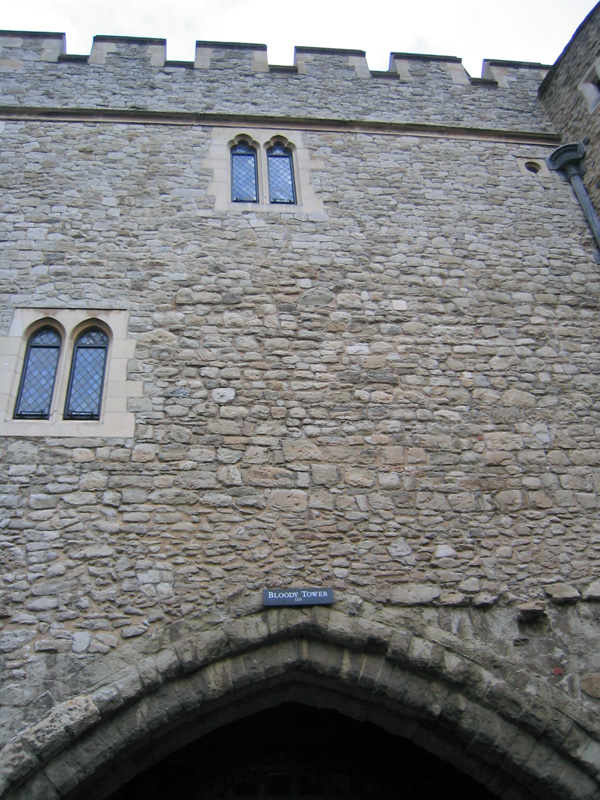

The Bloody Tower


Tower Bridge, across the Thames


The Tower campus, after a shower

After the tour, we wandered on our own into the tower housing the Crown Jewels (the glittery kind, not the naughty kind). I'm not overly impressed by jewelry, but I have to say, these were spectacular. Andrea was surprised that she liked the Imperial Crown of India, since she doesn't like Indian food.

While sitting in the chapel at the end of the yeoman warder's tour, I glanced over at the walll and noticed a plaque commemorating the Royal Fusiliers. It suddenly occurred to me that one of my goals on this trip was to research my great-grandfather's military record at the National Archives at Kew. Once our tour was over, I asked Andrea if she was interested in going, and she was.

It was still early, around 12:30, so we rode about a half-hour on the Tube to Kew, located in a London suburb called Surrey (as in "Surrey down to the stoned soul picnic" or "Surrey with the Fringe on Top"). Kew is also home to the Royal Botanic Gardens, also known as Kew Gardens (not to be confused with the neighborhood in Queens, though strikingly similar in appearance).

The National Archives is a massive but inviting complex. From the time we entered to the time we left, we found everything easy to navigate and the staff friendly and helpful. The first thing we did was apply for readers' cards, photo IDs that are good for 3 years and entitled us to request any holding in the collection. During our brief orientation, the clerk politely added that no food or drink was allowed in the reading rooms, including the gum that Andrea and I were chewing, and that he would passing around a bin for us to deposit it into. In New York they'd say either "Spit your gum out" or, more likely, they wouldn't care. But in the archives, you're not even allowed to bring in a pen for fear that you might accidentally deface the Magna Carta.

After getting our readers' cards, we went through a secure gate upstairs to the reading rooms. I was looking for military records, so I was directed to the War Office records. At the entrance to the room is a series of kiosks where we picked up leaflets instructing us in exactly what we needed to do to find a particular record. I wanted to find the military record of my great-grandfather Samuel Mason, who, according to my mother and aunt, was in the Royal Army Medical Corps and served in the Boer War. That was all they knew about him.

I knew from previous research that Samuel was born in Tandragee, County Armagh, in 1865. Since Ireland did not become independent from Britain until 1922, Irish soldiers were considered British soldiers, and thus his military record would be at Kew. I had done some preliminary research online, so I knew which collections I wanted to look at. After some false starts, I found the paper records I wanted and, with my new reader's card, requested them online. I was assigned a seat in the reading room, and while waiting for the records I could swipe my card at a monitor on the wall and find out me where in the process my records were. The records were delivered to a locker matching my seat number within 20 minutes.

It was coming up on 3:00, and the Archives closed at 5:00. I opened the box of original paper records, and Andrea and I started sifting through them. There were strict rules about handling these very old, sometimes crumbling records, for instance, no licking your fingers to separate pages. That made things a little rough.

The stack had records of about 20 Samuel Masons, none of which matched what I knew. These record were mainly of soldiers who had been discharged dishonorably or due to injury. I didn't know whether Samuel was discharged or died in service, so I sifted through dozens and dozens of records. All dead ends.

"I'm going to have to consult a genealogy expert," I said to Andrea. "I must be missing something."

The crucial piece of information I was missing was whether Samuel was a soldier or an officer. My mother thought he had a been a corporal, but most of the records I had said "soldier." I went to the microfilm room and asked the genealogy expert what other records I might consult. I said I didn't know whether Samuel had served in World War I, but I thought he might be too old by then. She said it was rare but not impossible for men in their 50s to be in active service. She directed me to two collections that might help me: "burnt" records of officers during the First World War and records of officers discharged to pension.

I located the two microfilm reels I thought might work. As in Dublin, I couldn't figure out how to thread the microfilm reader. An elderly gentleman sitting a few readers over heard me complain to Andrea.

"Just a minute," he said brightly. "I'll be right over to help you." He came over and showed me how to thread the reader. "These bloody diagrams don't help," he said. "These arrows can mean anything." Embarrassed and grateful, I thanked him. It was coming up on 4:00 and I wasn't optimistic about finding the record.

"By the way," he said, "what military records are you looking for?"

I explained that quite honestly I didn't know, but I told him what I had looked at so far. "There's the British Army Lists," he said. I said I had looked at those, with no results. "I'm afraid you're going to have to know the regiment," he said.

He walked away, then turned around and added, "Have you looked at the WO 364 records?"

I said I hadn't but that the genealogy expert had casually mentioned them. The man explained how they were organized, since there were two sets of records. He said I should definitely look at them.

"Well, that's about it for me," the man said. "Best of luck with your search." With that, he left.

I threaded the film into the reader and started looking for Samuel Masons. Andrea left to call her friend Susan and would return in a few minutes. It was now 4:15, and I resigned myself that the chances of finding the record were pretty slim.

I flipped through about five Samuel Masons and accidentally forwarded the reader too far. I backed the film up a bit, and the record it stopped on was for a Samuel Mason born in Tandragee, County Armagh. "Regiment of service: Royal Army Medical Corps." And other things matched: his birth date, the name of my great-grandmothe, and his service in the Boer War.

I was so excited I jumped out of my chair and almost let fly a loud, "Yes!" when I saw a big sign that said, "Quiet, please." I sat down again, my heart pounding in my chest with excitement as if I had just discovered the cure for cancer. Andrea had not returned, and the elderly researcher had left. Andrea had not returned, and the elderly researcher had left.
I ran over to one of the reference librarians and asked how I could get copies of the microfilm. I was told I had to go to a different reader that has a printer attached and purchase a copying card. Andrea came back, and I grabbed her: "I found it! I found it!" I whispered loudly. I thought I was going to break into song.
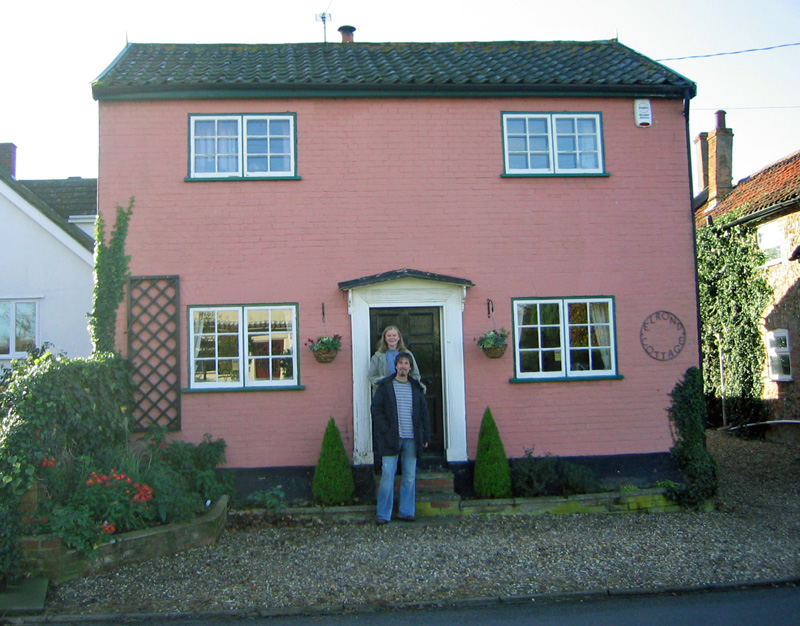
The microfilm reader with a printer was equally challenging to thread. It was now almost 4:30. Finally, I got everything working and started printing out the record. There were 14 pages in all: Samuel Mason's medical history, military campaigns, enlistment and discharge papers, pension schedule, and the Holy Grail: a list of the names, birth dates, and birth places of the children he and my great-grandmother had during his service. My grandfather was one of 9 children! I knew about only one of them previously. The record also listed my great-grandfather's four brothers' names. It was a veritable goldmine of information.

I printed out the last page just as the announcement was made that the Archives was about to close. If I hadn't seen that sign at the Tower of London, it might not have jogged my memory. Getting this record was a tremendous accomplishment for me. If only I'd been able to thank that man for his help.

Later, I couldn't help thinking that Nanny M had guided that man to me. Maybe from the great beyond she wants me to find out the truth about her husband, which she could never do when she was alive. Another piece of the puzzle revealed, another key to my past unlocked, my own jewel in the crown.

Labels: , , , , ,


Continue reading...

Thursday, November 23, 2006

I've been to me!

"I guess they don't celebrate Thanksgiving in London," my mother said rhetorically. "No, Ma," I said, "not any more than they celebrate the Fourth of July."
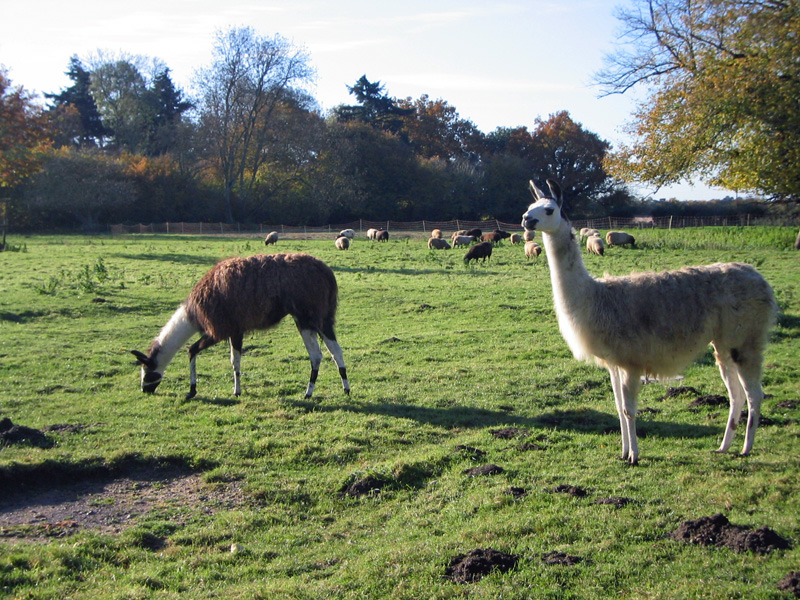
I've had some nice Thanksgivings and some not-so-nice Thanksgivings. I love turkey and stuffing and cranberry sauce and Brussels sprouts and sweet potatoes. But I don't love the stress that usually goes along with the holiday. This year I just wanted a break. I am thankful for everything, every day. I have my health and a great partner, friends, and family. I don't need the fourth Thursday in November to remind me.

Early in the day I met my boxing friends Jim and Chris. Chris and I sparred a few rounds and had lunch. The turkey sandwich on a baguette I ate for lunch was the perfect Thanksgiving token. At 5:00 I met Andrea at Angel station. "We have to go to Woolworths," I said. Andrea and I both have fond childhood memories of Woolworth's, the five-and-dime stores, in New York during the 1960s and 1970s.

"I hope they have birds and fish," she said. The Woolworth's on Flatbush Avenue sold birds (mostly parakeets and canaries) and tropical fish. It also had a luncheonette that served delicious tuna salad sandwiches. My favorite department was "Notions," just for the name. Woolworth's is where I bought a lot of my 45s, where my mother took me Halloween costume shopping, and where my grandmother bought all of her knitting wool there, which, when I was little, was why I thought it was called Woolworth's.

The American Woolworth's went into decline as competition from stores like WalMart and Target grew, and in the late 1990s the company changed its name to Foot Locker. The British Woolworths (no apostrophe), a subsidiary of the original U.S. company, carries on the tradition of low-rent merchandise aimed at young mothers and children. Andrea was disappointed by the lack of birds and fish. Had she known, she might not have wanted to go in.

The Woolworths on Liverpool Street was already bustling with Christmas stock, including cards, gift wrap, and fake trees (including an unsettling looking black plastic tree). We walked around the store like ugly Americans, taking pictures and goofing around. Our childhood selves inhabited our adult bodies at the giddy thought of being in a place like the one we used to love, even without the domestic pets.

One of the store displays had personalized Christmas ornaments shaped like bears. As a lark, I search for a Kieran bear. To my surprise, there was one. I was so excited! I never find anything in the U.S. with my name on it. The next Kieran item I found was a pen with a clip attached, followed by a zipper pull. There were also a mug and a piggy bank. But there was nothing with Andrea on it, another crushing disappointment for her.


Me, me, me

We had plans to see the 7:30 show of SchwartzStories, a revue of Stephen Schwartz songs, at the King's Head Theatre on Upper Street. Andrea and I got salads at local Italian café Carluccio's, then went back to Niamh and Jan's flat and walked into the dining room. Much to my surprise, a third person was sitting at the table.

"Kieran," Niamh said, gesturing to the mystery guest. "Kieran.

Well, this had certainly been a day of surprise. First I find material things bearing my name, and now I meet a real live-action figure Kieran, complete with a British accent. Since I am shorter than the other Kieran, we were distinguished by the nicknames Big Kieran and Little Kieran.


American or British, but Kieran nonetheless

Turns out we have more in common than our name. Besides the obvious common Irish ancestry, we are both left-handed and have mothers named Mary. Big Kieran is a guitarist and songwriter who performs in London. Check out his music here. He is a real sweetheart.

Stephen Schwartz is best known as the composer of musicals such as Pippin, Godspell, and Wicked. The premise was slightly Mamma Mia-like: weave a bunch of unrelated songs into a story. This staging was better because the numbers were a series of vignettes about love and romance. Some of the songs, taken out of their original context, were used cleverly, particularly the finale of Godspell.

The narrator was Paul Nicholas, who is well known in Britain for his stage and sitcom roles. In the United States, his claim to fame was the top 10 single "Heaven on the 7th Floor" in 1977.

The theater held about 50 people, and the typical audience member was an aging theater queen or a middle-aged womn. One queen had leathery, peach skin and was bedecked in a plaid jacket, velvet pants, thick black frames, frosted "blonde" hair, and jewelry a-go-go. He looked like the love child of Andy Dick and Rula Lenska.

This was one of my best Thanksgivings ever. I didn't overeat, I didn't have to watch football, and I spent the day with friends. And I saw myself in a new light.

Labels: , , , , ,


Continue reading...

Wednesday, November 22, 2006

Trains, planes, and autoreflection

Before leaving for London I checked the fares from London to Dublin. Aer Lingus was running a special for £6 round trip. That's right, £6 ($11). It sounded too good to be true, and it was. With taxes, the fare came out to £45 (about $85). Still not bad for a day's jaunt.

All week I'd been flip-flopping about whether to actually go, even though I had my ticket. Between getting to and from Heathrow and then to and from Dublin, I would spend about 9 hours in transit, with only about 5 hours in Dublin itself. But my burning desire to do family research overtook me, and I thought about the Frances Mayes quote my friend Cathy had sent me before the trip:

"It's not the destinations; it's the ability to be on the road, happy trails, out there where no one knows or understands or cares about all the deviling things that have been weighting you down, keeping you frantic as a lizard with a rock on its tail. People travel for as many reasons as they don't travel...Once in a place, that journey to the far interior of the psyche begins or it doesn't..."

Today marks the 24th anniversary of the death of my mother's mother, whom I called Nanny M. I was extremely close to her. She raised me about as much as my mother did. Nanny M was Scots-Irish, with a heavy burr and a strong will. When I was a child, she went to battle with my father any time he became abusive with me. While both my parents worked she looked after me. I loved staying at her house, my sanctuary from my parents' screaming and fighting. When she died, my cousin Denise and I both believed that she was, and always would be, our guardian angel. I still believe that.

And so, in her honor, I rode the Tube to Heathrow for an hour, waited an extra hour for my delayed flight, took a cab into Dublin, and went to the General Records Office (GRO), where vital records are stored. I wanted to uncover more family secrets and assemble more pieces of the puzzle. Dublin was where my grandfather left his family--his wife and three children, aged 8, 4, and 2--when he embarked for the States in 1925. Why did he do that? What was he running from? Why did he never return?

I knew I couldn't find those answers in a day, and maybe I'll never find them. But I came to get the facts, like birth and marriage dates, which were easier to come by.

The weather in Dublin was gray but mild, in the 50s. The reading room at the GRO was busy. Most of the information I'm looking for could be easily found at the Mormon family history centers in New York, but coming to Dublin, to the source, is more rewarding. Seeing all of these other people searching for keys to their past reminded me of what my other grandmother, Nanny O, used to say: "What's bred in the bone comes out in the flesh." In other words, nature trumps nurture.

My goal for this trip was to find as much information as I could about my great-grandparents. I was quite successful. I found Nanny M's mother's birth record, as well as the marriage records of both of my paternal great-grandparents. I have now gone back a full five generations and have partial info about the sixth. People always ask me why I'm doing this. The answer is, I'm not really sure. But I have some theories. For one thing, I truly enjoy it. I get an endorphin rush every time I find a major clue. And at 44, I realize I'm probably the end of the line, unless an immaculate conception takes place. My nephews will carry on the bloodline, but it won't be completley mine. I want them to know where they came from, should they ever be curious. I do believe that personality is largely genetic. But more than that, in doing this research I've learned a great deal, about history and family and character and circumstance. If my grandparents had not come to this country, obviously I wouldn't exist, but in whatever form I might have arrived on this earth I'd probably be milking a cow in Tipperary.

I lost track of time at the GRO, and at 3:45 I decided to head over to the National Archives to look up a few census records. I didn't know how long it would take to walk there, and by the time I arrived it was almost 4:15 and getting dark. The security guard was very nice. I asked him if there was any chance I might be able to get to the reading room, that I was only in town for the day and I knew it was late but...He gave me a form to fill out, and I rushed up to the fifth floor to see if anyone could help me. The staff acted with a sense of urgency. One of the clerks helped me look up the census record online and pointed me to the right microfilm drawer. He showed me how to thread and operate the microfilm reader, which was not easy. About halfway through browsing I realized this was not the right record, so I rewound the reel, exchanged it for another, and tried to thread the reader again. This time I could not find anyone to help me, and next thing I knew, the reading room was closing. I had the right record in my hand, but time ran out.

I was somewhat dejected, since I thought that getting this record would shed light on my grandfather's shady past. So, I went to a pub in Temple Bar called Fitzsimon's, which was staffed largely by Eastern Europeans, and had a pint of Guinness and a plate of fish and chips. Afterwards, I walked along the Liffey, amid the bustle of nightlife. Dublin really is a city of the young, and the energy level is high.


The Liffey at night

It was after 6:00, and my flight was leaving a little after 8:00. If I'd had more time, I was going to try to track down the house in Stoneybatter where my grandfather's family lived in the 1920s and take a picture of it. It wasn't far, but it was getting late. Some other time, I felt Nanny M say, some other time. I walked up to O'Connell Street and thought about taking a taxi. Instead, I tracked down an AirLink bus that cost €5 ($6.50). It took 40 minutes. I got to the airport early, bought an armload of Butler's Chocolates, and eyed some hot Irish rugby players. I got back to London around 9:30 and took the Tube back to Islington. The ride was almost an hour long. I'd been traveling since early in the morning, and I was tired, but I was glad I'd made the trip. And I was glad to be back in London, one of my favorite places, a place where a British woman's pre-recorded voice announces matter-of-factly "This is a District line train terminating at COCKfosters"?

Labels: , , , , , ,


Continue reading...

Tuesday, November 21, 2006

Beholder of the Eye

It looms over the river Thames, seeming to follow you wherever you go. Despite its relatively recent appearance, it seems it has always been there. The London Eye, a 443-ft-high ferris wheel on the South Bank of the Thames, offers 360-degree views of London. Admission is not cheap (£15, almost $30), but it's worth the price. The Eye is a kaleidoscope that gives riders a new perspective on an old city.

Andrea and I met in front of the National Gallery, at Trafalgar Square, around 10:00 a.m. The weather was, as it had been since our arrival, stunning. How can you quibble with a sunny day in the 50s at the end of November? We both noticed there were almost no pigeons in the square. The last time we visited together, the pigeons made Alfred Hitchcock's "The Birds" seem almost sanguine. A few years ago Mayor Ken Livingstone waged war on the birds, making it illegal to feed them. Residents fought back. Eventually a deal was struck: the city would feed the birds early in the morning if others would stop scattering their own seed. This arrangement appears to be working.


Wingless Trafalgar Square

From Trafalgar we walked to the North Bank and across Hungerford Bridge to the South Bank.


Hungerford Bridge

The walk to the Tate Modern was long, but we had a clear view of the Thames and the North Bank. London is more adventurous than New York in embracing nontraditional architecture. But I'm not so sure I like some of the results. Neither of us liked the Swiss Re building, known as The Gherkin, which to me just looks like a giant vibrator. Though I admire the concept, I didn't care for the London City Hall, another cornerless building that looks like something out of Independence Day. It looks out of place among the medieval and neoclassical structures around it. I guess I like my buildings to have edges.

While walking along the South Bank we were stopped by a friendly British film crew who were doing some sort of "viral marketing." They asked us if we wanted to record a Christmas greeting to anyone we wanted. I thought it would be cool; Andrea reluctantly went along with it. I waved and said, "Merry Christmas from London..." (original, huh?) and Andrea added, "...two days before Thanksgiving." Funny, because in New York if someone accosted me like that I'd ignore them. I'm waiting to receive a link to the video on YouTube. Once I have it I'll post the link.

We finally arrived at the Tate Modern, housed in a former power plant. Near the entrance is Fischli and Weiss's piece How to Work Better, which mocks trite corporate philosophies and reminds me of Jenny Holzer.

I'd been to the Tate Modern when it first opened and liked the space very much. I wasn't sure whether I liked the organization of art, but this time around I warmed up to it. The Poetry and Dream level, for instance, features artworks by such disparate artists as Dali, Klee, Calder, and Pollock. It takes some getting used to.

Carsten Höller's interactive installation Test Site 2006 is a fun piece. Consisting of a series of enclosed slides, the exhibit encourages museumgoers of all ages to slide to the bottom from different levels. Adults and children alike enjoy it. I thought about sliding, but the lines were kind of long.

The museum was full of children on school expeditions. Each gallery had at least one group of little kids sitting on the floor with crayons and paper busily looking at the artwork and drawing their own. Andrea remembers going on such trip as a kid, but I do not. I think I just drew all over my parents' walls instead.


Fischli & Weiss, How to Work Better; Carsten Höller, Test Site 2006; kids drawing in a gallery

When we left the museum it was raining heavily. Luckily there was a restaurant nearby where we could have lunch. In keeping with my lack of regard for nutrition on the trip, I had fish and chips and a Stella Artois.

After lunch, the rain let up. Next stop: The London Eye. The Eye is interesting from so many different perspectives it's hard not to photograph it. I had been on the Eye shortly after it opened in 2000; Andrea had never been on it. It's an impressive piece of engineering. You enter a capsule on the ground that holds 10 to 15 people. You ascend slowly, almost imperceptibly, to the top, where you get a sweeping, 360-degree view of the Thames and the whole city. The whole time you keep thinking, when are we going to move? But before you know it, half an hour later, you're almost on the ground again. Well worth the price of admission, even the second time around.


Top: Eye pods
Bottom: Southeast view of the Thames; Andrea and the Eye; me and the Eye

About halfway through the trip, I got a text message from Luis, 3500 miles away: "What was the name of Bea Arthur's character on Golden Girls?" It was sweet, really, that Luis would spend 80 cents to ask me something he could find on Google for free. I felt so...needed. I wrote back, "Dorothy...from the London Eye." As Andrea always says, it was an extra gay moment.

As we descended, a camera snapped our picture. Naturally, we bought them as souvenirs. We stood in line at the photo booth behind a rather stout, elderly British woman. "It's just like having your picture taken on a roller coaster," I said to Andrea. The woman ahead of me laughed. "I do not think," she said, "that I should like to see such a picture. There are parts of me that I simply would not want flying in front of my face."

We got to chatting, and the woman asked if we'd seen the Dalí exhibit at County Hall, a semicircular building situated right below the Eye. We said we had not seen it but that we would. Dalí is one of my favorite artists. I've been to the Dalí Museum in St. Petersburg, Florida, and have seen a number of major shows in Spain and the US featuring his works. This exhibition was very different, focusing on his sculpture, furniture, and lithographs, most of which I'd never seen before.


Entrance to Dalí Universe exhibition

Andrea's and my favorite piece was the famous Lobster Telephone, an old-fashioned rotary phone with a painted plaster lobster perched atop it as the handset. The caption read: "I cannot understand why at the restaurant when I ask for a grilled lobster, they never serve me a telephone." We both thought it was hilarious. Obviously Dalí is not for everyone. You either get him or your don't.


Andrea and Westminster Abbey

Our last art stop of the day was the magnificent Velázquez exhibit at the National Gallery. Velázquez is another of my favorite artists, along with Caravaggio, Rubens, and fellow Spaniards Goya and El Greco. The exhibition follows Velázquez's career as a young painter (his teenage works are remarkable in their skillfulness) up to his last days. Considering the unattractiveness of many of his subjects (the Habsburgs, the ruling dynasty in Spain, inbred themselves out of existence), his paintings are quite flattering. King Philip IV, for instance, looks not unlike Herman Munster. His masterwork Las Meninas was not in the exhibition. It never leaves the Prado in Madrid.

Lest anyone think I'm all highbrow for liking Baroque art, I'll shatter that image by confessing that one of my favorite pieces by Velázquez is The Forge of Vulcan, because, well, Vulcan looks kinda hot.

Kayo's Equivalence Theorem: Whether it's in the eye of the beholder, or in the beholder of the Eye, beauty is everywhere.

Labels: , , , ,


Continue reading...

Monday, November 20, 2006

The isle of grease

It used to be that when visitors to England would rave about London, they would say how mod, how stately, how mannered, how cosmopolitan. But when the subject of food arose, the accolades fell short. Right. Well, what could you say? Steak and kidney, fish and chips, chip butties, shepherd's pie. The British put the "die" in "diet." With fare such as deep-fried Mars Bars, the route to arteriosclerosis is even faster.

My first visit to London was in 1983, when I was a poor, starving college student. The culinary choices were limited, and most of what I ate was prepared by a Brit. It was generally boiled, bland, and gray, much like the cooking I grew up with. Give me the water you boiled those vegetables in, Ma, I used to say. It's more nutritious. Mercifully, times have changed, and in Islington alone, besides traditional pub fare, you can eat amazingly good Indian, Italian, Turkish, Afghan, Mexican, French, Thai, Moroccan, and Kurdish food. Vegetarian eateries exist, but even mad cow disease couldn't keep consumption of beef from disappearing. And if none of those appears to you, you can go to any one of the five Starbucks on Upper Street.

Most of the day I spent recovering from a severe case of jet lag. I met Andrea for a late afternoon snack at an Islington gastropub called The Elk in the Woods. The Brits are unabashedly enigmatic and corny in their naming of pubs. Take, for instance, The Leg of Mutton and Cauliflower, The Poosy Nancies, The Inn Next Door Burnt Down, and my favorite, Muscular Arms.

Hardly anyone was in The Elk when we arrived. It's situated on Camden Passage, a four-block-long arcade that runs parallel to the bustling main road, Upper Street. The pub sits among antique shops, newer, upscale eateries, and football pubs. You could easily pass it without noticing it, which is what attracted me to it. The rest of Islington is like New York's SoHo, eternally crowded and swarming with hip, young people who come there to eat and shop.

The staff at The Elk appear to be former residents of the Soviet Union. When we walked in, we were welcomed like we'd been regulars for years. I've read an overwhelming number of negative reviews saying the food and the service are crap, but Andrea and I found both to be just the opposite. Maybe we're just New Yorkers with low standards. One reviewer referred to the place as a "higgeldy-piggeldy sort of room." I have no idea what that means, but the review was positive, so I take it that's good. Granted, we arrived before the evening rush, but our waiters were friendly and fun, and the food and drinks were great. We both drank Moscow Mules--a sickly sweet concoction of vodka, lime juice, ginger ale, and something red (raspberries?)--and ate hummus, calamari, and tomato and mozzarella salad.

Since I arrived the other day I've drunk nothing but tea and alcohol. My body doesn't know whether it's up or down. At home if I were on that sort of diet I'd be popping aspirin. My jet-lagged sleeeping patterns still kicked in at eastern time.

We ate just enough to tide us over until dinner at Wagamama, a popular chain of Asian noodle shops in the UK. Diners sit at long picnic-style tables on benches, and the menu features gyoza, ramen, and teppan, and it's all good. Now, when I return from London and people ask how it was, I can add, how delicious!

Kayo's Axiom of Stimulants and Depressants: For every pint of beer and cup of tea consumed on vacation, the body remains in a constant state of equilibrium when accompanied by generous portions of greasy food.

Labels: , , , ,


Continue reading...

Sunday, November 19, 2006

To Bury, the past

In the sleepy town of Barningham, about 12 miles from Bury St. Edmunds, the thatched bungalows are neatly groomed and the pedigrees are centuries old. The houses sit side by side, on what was once pasture, stretching down the road to The Church, The Pub, The Village Hall, and The Convenience Store. On the surface, Suffolk is a sweet little idyll. But just read the local paper Bury Times and you'll find that problems such as signs to toilets pointing in the wrong direction are the real explosive issues.

The Bury paper also has its own local marriage announcements. A Mr. B. Stiff had wedded a Miss K. Sore. The bride is now Stiff, but not Sore.


Local stiffs


The other casa rosada

The weather was spectacular: sunny, cloudless, in the low 50s. Niamh, Jan, and I had breakfast in Stanton at The Leaping Hare, which is part of the Wyken Hall estate owned by Sir Kenneth and Lady Carlisle (probably not related to Kitty Carlisle). Sir Kenneth is a Brit, Lady Carlisle American. The restaurant is in an old, charming, high-ceilinged barn, with country decor and local prints for sale. The Scottish salmon and eggs were the freshest I've ever eaten. Afterwards we watched the llamas (yes, llamas) parade around the pasture, while a flock of sheep lazed under a tree.

Interesting article on how Wyken Hall came to be.


The llamas, Fernando and Lorenzo


Jan snogs a llama

In Suffolk the pigeons are oven ready--and you can order them in advance! I see a business opportunity in New York.


At around 1:30 we headed to Bury St. Edmunds, a medieval town best known for its association with the Magna Carta, its abbey, and its sugar factory. As we approached the town, pillars of smoke from the refinery billowed into the clear blue sky, and the smell of sugar beets and starch filled the air. The factory, owned by British Sugar, produces 1300 tons of sugar every day. Bury's a cute little town, with cobblestone streets lined with shops. One of my pet peeves is apparently international: Christmas decorations were already up, a week before Thanksgiving.


British Sugar: the sweet smell of success

A few months ago I wrote that I'd reconnected online with the wife of one of my second cousins in England. We went to Bury St. Edmunds to meet them: my cousin Kevin and his wife Kay.


Kevin, Kay, and Kieran


Cousins reunited

I recognized Kevin the moment I saw him. "You're such a Boyle!" I said, realizing afterwards that the sound of that might be construed as an insult. Kevin, who is a few years older than I, still looks great. He has worked for more than 20 years as a mechanic for Formula One racers. Kay works in the mental health field. They had two teenage daughters, and the family's list of travels is truly impressive.

I've always had a strong connection to this branch of my mother's family. My mother and aunt have always been close to both Kevin's father Frank, who died last year, and Frank's brother John in Edinburgh. I had spent a week with Kevin and his family at their home in 1983, but I was about 20 and not mature enough to appreciate connecting with remote relatives. I fondly remember Frank. When he picked me up at the rail station and took me back to the house, he barely let me put down my bags before we were drinking pints at the pub. I recall thinking at the time that a pint was an awful lot of beer--that was mainly because I didn't drink.

I also remember going to a country fair in Essex with Kevin and his brother Franny, who passed away, and his sister Jacqueline. At the fair I took the Pepsi Challenge...and lost. I think that was why I switched from Coke to Pepsi.

The morning I left to go back to London, Frank was overjoyed that that their cow had given birth. I said I had never seen a cow give birth; he was incredulous. I said we didn't have many cows in New York City.

I had not met Kay before. She and Kevin met shortly after my college visit. She is a lovely person--funny, warm, outgoing--the same as in her e-mails to me. She brought photos of their family and generously gave me a few to keep.

The afternoon ended too soon for me. We had lunch and chatted for a few hours. They returned to Essex and we to London. Kay has never been to the United States. I volunteered my aunt's house as a place to stay. I'll have to remember to tell her.

Kayo's Law of Visiting Other Lands: Say hello back, and, for God's sake, don't stare.

Labels: , , , , ,


Continue reading...

Saturday, November 18, 2006

A slow, sloe journey

For me, the worst part of traveling is not knowing what awaits me at the airport. Just to be on the safe side, Luis drove me and Andrea to JFK Airport about 4 hours before our redeye flight to London was scheduled to depart. It took us about 12 minutes to check in and go through security. The longest part of that time was spent taking our shoes off and putting them on again. Then we discovered our plane was delayed an hour.

A sleeping aid and a pint before takeoff put me in a semi-catatonic state for most of the flight. Andrea and I were seated in the very last row of the plane. We got served first and were right next to the toilets. This was nice until the morning when everyone lined up to freshen themselves. I'm still nursing the bruises from some elbow shots to the head.

Apart from a highly unfavorable exchange rate for Americans (currently, 1 GBP = 1.91 USD), being in London is tops. The weather was beautiful--50 degrees F (that's 10 degrees C, for international readers), no rain in sight. We took the Tube from Heathrow into town. It's the cheapest way to go (£4) but also the longest. Andrea had to go all the way to Enfield, which took almost 2 hours. For me, it was a little over an hour to Islington, where my friends Niamh and Jan live. At Leicester Square I had to change to another line. Extricating myself and my 800 pounds (that's 362 kilograms...) of luggage wasn't easy. Up an escalator, through a passage, up another escalator to the transfer point. I discovered that the branch of that line doesn't go to my stop. So, off again to another line and finally to my stop, Angel.

When I arrived, Niamh and Jan were thinking of going to their country home in Suffolk, a little over an hour from London, for the night. What the heck? I said. By then I'd been traveling a total of 15 hours (20 if you count the time difference), so what was an extra hour. I figured I could be one of those people who keep traveling, never reaching a destination. So we went to Suffolk by car and arrived just in time for drinks. Niamh had been making sloe gin for about a month, so we had a little of that. When I was in college, my drink of choice was a Sloe Gin Fizz, which I thought was cool because it was served in a frosted Collins Glass. (Eventually I realized it was just very girly.) Jan and I each had a bottle of a local microbrew, and about a half hour later we went to the Royal George down the road for a pint. It was nippy out, and I vaguely remember returning to the house. Niamh had just finished making blackberry brandy and gave us a shot. After dinner, we each had a shot of Maker's Mark, which I'd brought over for Jan in lieu of his favorite whiskey. I don't remember much after that, except that my eyes snapped open in bed at 3:30 a.m., without the slightest bit of a hangover.

Kayo's Paradox of Recreational Intoxication: While on vacation in a foreign land, the severity of hangover is inversely proportional to the number of hours of sleep deprivation. (I'm sure some will have what to say about this.)

Labels: , , , ,


Continue reading...
Hosted by www.Geocities.ws

1