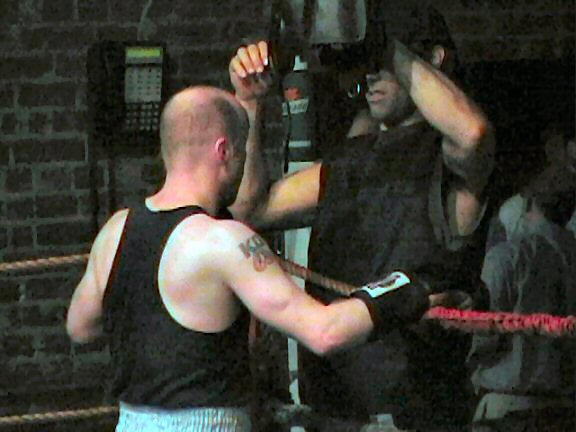
Wednesday, June 30, 2004

Weak in the presence of beauty products

And remember, dahlings, it is always better to look good than to feel good."

Billy Crystal as Fernando, Saturday Night Live


One of the most enduring quests, it seems, is that of eternal youth. From Ponce de Leon's Fountain of Youth to Porcelana, the anti-aging industry continues to drive people's insatiable appetites for a panacea to forestall the unpleasant prospect of shriveling up and dying.

Someone once told me that he went to a book signing by Joan Collins, and when he approached her he asked what her secret was to looking young. As he stood there hopefully, she looked into his eyes, put her hands up to his face, and in three downward sweeps, she said quickly, "Moisturize, moisturize, moisturize."

Women and gay men are equally afflicted by a pathological need to look like Jack LaLanne...or, these days, Cher. (Remember Cher's beauty infomercials in the early 1990s?) This need is borne out by the limitless capacity of cosmetic companies to market The Ultimate Beauty Product. Any product or service advertising the words "nourishing," "miraculous," "age-erasing," "healing," "vitamin-rich," or "health-restoring" seems to be a gateway to cash.

Hands down, the best marketing I've seen for a beauty product is Max Huber's Creme de La Mer, which Luis bought for his mother and sister at Neiman Marcus at Christmas. It's on par with anything J. Peterman ever wrote:

Conceived by NASA aerospace physicist Max Huber more than 30 years ago, Crème de la Mer defies the laws of nature and is noted by some as the new anti-wrinkle miracle. The legendary formula claims to transform the look of your skin as nothing ever has, leaving it softer, firmer, virtually creaseless.

Creme De La Mer is an ultra-rich skin treatment that aims to heal, nourish and rejuvenate skin. Aims to make skin look and feel softer, firmer and smooth in a short period of time. Creme De La Mer is used by celebrities such as Brittany Spears and J-Lo.


Any product that can succesfully incorporate NASA and J-Lo and sell for more than $100 an ounce must have something, even if we don't know quite what it is.

While women are drawn to sheep fetus injections and soy products, gay men are more inclined to find the secret of youth in spandex and supplements. When I met Bill, who was almost 70 at the time, I was amazed at how hot he looked. He was muscular and smooth-skinned and glowing and looked not a day over 50. "Know how I do it?" he asked, pulling out a drawer of dozens of vitamins, herbs, minerals, and other sundry capsules and pills. "I take all of these every day." "Every day?" I asked. "Aside from being expensive, isn't it...time consuming?" "Not if I want to stay youthful looking," he said. Unfortunately, Bill passed away last year at 75, but who knows?--maybe he had prolonged his life by taking all those supplements. Inspired, I began taking supplements shortly after I met him. I started small, with Vitamins C and E. Now I have a growing repertoire.

I start the morning with 200 mg of glutamine (fat metabolizer) and 250 mg of guarana (energy booster), followed at lunch by 2000 mg of Vitamin C (disease preventer); 400 IU of Vitamin E (skin, hair, and sex enhancer); 60 mg of CoQ10 (liver cleanser); two gelcaps of lecithin, chromium, and garlic (artery scrubber); and 1000 mg of Vitamin B-12 (energy booster). Before my workout I take a vial of panax ginseng (energy booster), and after my workout I take some creatine shots (muscle hydrator). Does all of this work? In medical terms, I don't know, but I do notice a difference when I take them versus when I don't. Except for a cold I've never been seriously ill. And people seem genuinely amazed when I tell them I'm over 40. In fact, someone told me recently I look 27--but you know, anyone can look 27 with the right lighting.

Continue reading...

Monday, June 28, 2004

Having a big head

In an earlier post, I sighed relief that my nephew Tytony had been spared our genetic big fat giant Irish head. My mother informed me today, however, that Tytony's doctor is concerned because Tytony's head is growing at a faster rate than his body.


I could only roll my eyes, since big heads are an essential gene in the formation of O'Leary boys. Not only do they allow us to store more brain matter in there (notice I deliberately did not say they make us more intelligent), they are like football helmets protecting us from head trauma.

My mother used to take my youngest brother Brian out in his carriage in the winter, dressed in layers of flannel, with a white hat that covered his face like a wimple and a pom pom on top that made him look like a human baby bottle. Being a bit rambunctious, Brian was strapped into his carriage with a harness to prevent him from tipping the carriage over. One day, while we were in a neighbor's hallway, lined with black and white mosaic tile, Brian rocked his carriage hard. The harness must not have been secured properly, because the next thing we knew, Brian was taking an Olympic-style dive out of the carriage head first into the tile floor. My mother, of course, was hysterical, thinking that Brian had suffered a concussion or cracked open his skull. No such thing. The floor he had fallen onto had cracked. Chalk it up for another Darwinian advantage of the big fat giant Irish head.

Any childhood photo I've seen of me and my brothers shows that we are a family of bobbleheads. There's no shame in this--it just is what it is. Eventually our bodies catch up with our heads, and then our hairlines recede at an alarming rate and we start getting #1-clipper-buzzed heads. Thankfully that style is in fashion.

There is a medical condition called macrocephaly, or increased head circumference. One of the causes is "benign familial macrocephaly," or, as we O'Learys call it, big fat giant [Irish] head. Showing the doctor some family pictures ought to be enough to convince him this is the case. If that fails, I hope Tytony has enough brain matter to head butt the doctor.

Continue reading...

Sunday, June 27, 2004

Goyim, oh boyim!

Until yesterday I'd never been to a temple service. My only previous experience with temples was one I grew up across the street from in Flatbush, where every fall the congregation would erect a succah, or booth, to celebrate the Jewish harvest festival Succoth.

Three years ago my colleague Jane announced that she was planning her daughter's bat mitzvah. I usually have trouble planning what time I'm going to wake up in the morning, much less an event so far in the future. But three years went fast, and yesterday a Jewish girl with the unlikely name of Kathryn Mary Millen stood before her friends and family to recite passages from the Torah.

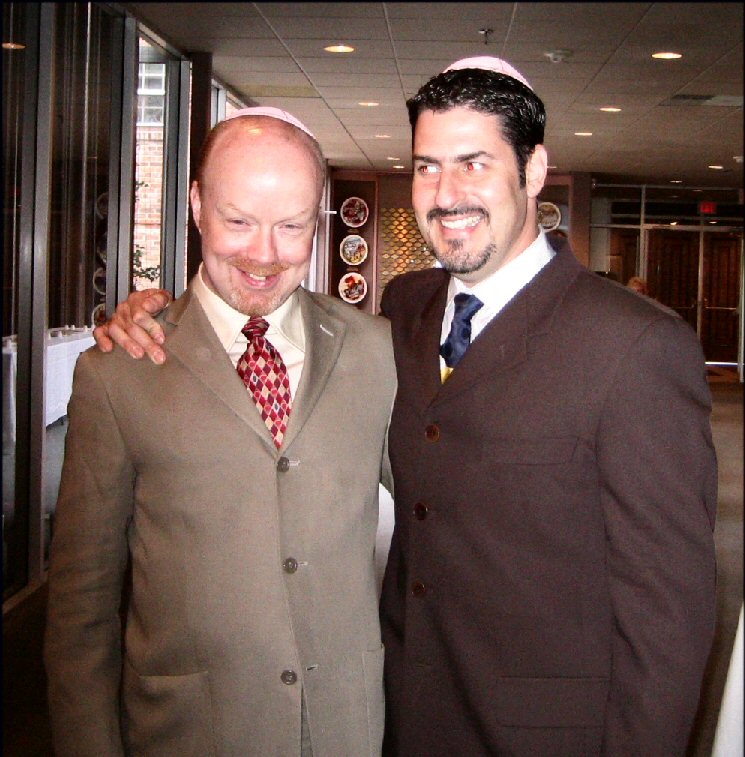
Several of us from the office attended the ceremony, most of us Christian. As a courtesy we wore yarmulkes that had Katie's name and bat mitzvah date imprinted on the inside. We were pleasantly surprised to find they were made of pink suede. "Well," I said, "isn't that nice? They knew the gays were coming." Luis held up the pair and said we could always use them for breastplates if needed.

One thing I noticed about the service was the warmth and positiveness of the rabbi. The congregation is Reformed and somewhat relaxed, and I felt welcome, unlike at Catholic Mass where I seldom feel at ease. Priests, especially these days, seem constantly annoyed by the low attendance and lackluster participation of attendees. I say they reap what they sow. If the church were not so judgmental and dogmatic about everything, maybe the people they've alienated would reconsider.

The temple itself was simply decorated, in contrast to the ornate, over-the-top, opulent houses of God I've been accustomed to worshipping in. Katie, the bat mitzvah, had the temple to herself, to show those present how diligently she had studied and how ready she was to take her place as a leader in the congregation. In the Catholic version, confirmation, you are essentially one sheep receiving the sacrament with other sheep. The only thing distinctive about you is the confirmation name you adopt. In confirmation you deepen your initiation into Catholicism, although I never really understood how that differed from baptism.

Another thing I noticed in the temple were padded seats and a lack of kneelers. When I was growing up, kneelers weren't even padded. Someone asked me why there were kneelers, and I said they were to show your subordination to God, but I think really, like sermons, they were designed to make you suffer.

The service lasted about an hour and a half, but it didn't seem that long--maybe because it was new to me. Being an outsider, I didn't know how she had done, but my colleague Bert, who is Jewish and quite versed in Hebrew, said that Katie had done an excellent job.

One thing I appreciated about the service was the explanation of the symbolism behind the ritual, something I'm usually at a loss to explain in Catholic rite. I know during Mass, for example, that altar boys ring the bells during the consecration of the Eucharist to alert churchgoers that this is the most important part of the Mass. Because the Mass used to be conducted in Latin and not everyone knew Latin, the bells signified when people were supposed to pay attention. At the bat mitzvah, the symbolism of the ritual, from the tallit, or prayer shawl, to the levels of aliyah (rising up), to the passing of the Torah through the generations, was explained in a way everyone could understand.

Jewish celebrations (except Yom Kippur) can be summed up in a simple prayer: "They tried to kill us...we survived...let's eat." And eat we did, at the reception that followed at the Millen house. Even the cake (which was quite delicious) was in the shape of a scroll. Katie lit 13 candles, one for each year of her life, reciting an anecdote about each person or group she was about to invite to help her light one of the candles.

At the end of the day I felt like the Yiddish-speaking Swede Lars Olfen in A Mighty Wind: "The naches that I'm feeling right now. I let out a geschrei, and I'm running...running around like a vilde chaya....So we've got the schpilkes, 'cause we're sittin' right there... and it's a mitzvah...Kineahora, I say, and God bless [her]."

Continue reading...

Wednesday, June 23, 2004

Tuesday, June 22, 2004

Eye popping

I don't care what anyone says, a little discipline never hurt anyone.

I sneer when I walk through family-ridden Park Slope and see parents trying to befriend their children. "Now, Bettina, I'm going to have to ask you in a very nice way to stop beating that kitty or I'll have to put you in time out. You make Daddy very sad when he feels you're not listening to him." When I was a kid that entire sentence was conveyed much more effectively nonverbally. The laxity of discipline in this day and age portends just as much therapy as excess discipline. I mean, some of these kids are straight out of a central casting remake of The Omen.

As a kid I didn't get heart-to-heart talks from my parents. That was reserved for confession at church, and even that involved some Hail Marys. My parents, especially my father, believed in a first strike approach to discipline. And although I was for the most part a good kid and--more important--a well-adjusted adult, I did some heinous things that merited the dreaded wooden spoon, the preferred parental implement of torture. Even now, I flinch while mixing batter.

I was quite the little pyromaniac, nearly setting fire to the 100-year-old Methodist church next to my apartment building. Like many little boys, I was fascinated by matches and fire and burning and flames. In the fall I loved to build leaf piles in the street and set fire to them. The physics of a pile of dry leaves burning and spreading to other piles of leaves and maybe some houses and trees and lawns never entered my mind. All I knew was that it was cool--that is, until my grandmother ratted me out to my parents after catching me in the role of Drew Barrymore. After that, the only thing on fire was my behind.

But the incident of which my punishment was most deserving is one that I don't remember except from what my mother told me. If I really did do it, it's pretty hideous, but it fits in with the whole sibling rivalry thing. My mom used to do the laundry in the basement of our building and then hang it on the roof to dry. I guess times were tough and we couldn't afford to scrape up the dimes needed to operate the dryers. When I was almost 6, my baby brother Liam came along. Having been the only spoiled rotten child for all that time, I'm told that I was incredibly jealous of the new addition. Once, purportedly, I'd taken a ballpoint pen and dug into his wrist, drawing little dots all around it. Did I think he'd look cute with a hand-drawn bracelet (gay foreshadowing), or was I devious enough to know that the ink could seep into his bloodstream and poison him?

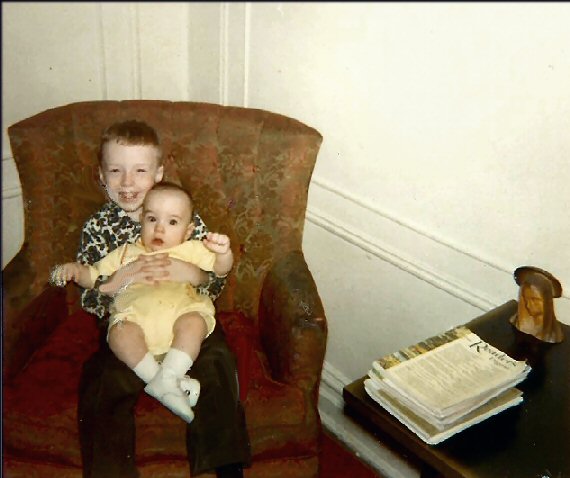
It seems somewhat surprising, then, given my mother's observance of this behavior, that she left me alone with poor defenseless little 5-month-old Liam one summer night to hang the clothes on the roof. We had a ratty old chair in the living room that I loved to sit in (the following picture shows me and Liam sitting in that chair, which is what sparked my recounting of this story).


My mother would put Liam in my lap on the chair while she went on the roof, and usually when she came down he was perfectly fine. One night, however, according to Mom, when she came down from the roof Liam and I were sitting in the chair as usual. I was calmly watching TV--probably Lassie--and Liam was bawling his eyes out as if he'd been starved for about 10 days. My mother was hysterical: "What did you do to him? What happened to his eyes?" It was very Rosemary's Baby.

Again, according to my mother, because I don't remember and that's my story and I'm sticking to it, Liam's eyes were completely bloodshot. His eyes were a sea of red among the tears: All of the blood vessels in his teeny eyes had burst, and considering that I was looking like the cat that ate the canary, she surmised that I had squeezed his eyeballs until they popped. I've never experienced this personally, so I don't know exactly how much that might hurt. But being that Liam was 5 months old and wasn't able to tell on me, I'll have to believe that his incessant caterwauling shrieks were a good indication.

To this day, I have not set fire to a pile of leaves or popped anyone else's eyeballs.

Pshaw, I say, to anyone who say that discipline doesn't work.

Continue reading...

Sunday, June 20, 2004

Mothra versus Ratner


Continue reading...
Lost in music

When I was about 10 years old I bought my first 45: "Paper Roses," by Marie Osmond. It was 1973, and I had just discovered that I could buy my very own 45 rpms. With the few dollars I got from my part-time job delivering laundry in Flatbush, I'd go to the record store cum head shop on Newkirk Avenue and stare at the long list of 45s, deliberating over which ones to buy. "Heartbeat, It's A Lovebeat," by the DeFranco Family, and "Eres Tu," by Mocedades were my second and third purchases. Each time I bought a record I couldn't wait to run home and put it on the turntable. I'd play the record over and over until I wore the grooves down. I still have all three of those original 45s, and they're barely listenable, since my turntable had a cheap sapphire needle instead of a fancy diamond one.

On my 11th birthday my grandmother gave me a General Electric portable transistor AM radio with a single earphone. FM radio, especially FM stereo, was not yet widespread. Even though FM stereo had been around since the 1960s, we didn't get our first receiver until 1975. I'd listen to that transistor radio every chance I got. I distinctly remember hearing songs such as America's "Tin Man," Janis Ian's "At Seventeen," and Carole King's "Jazzman" for the first time on that radio.

By the time I was 13 I had amassed a collection of nearly a hundred 45s. My mom worked on Flatbush Avenue next to a record store, and I'd give her my allowance and ask her to buy me my latest favorites. I listened to the countdowns on great AM stations like WABC (770), WNBC (660), and the grooviest soul station ever, WWRL (1600). I listened to WABC's Top 14 songs every week, and every Sunday morning I would turn on the radio and listen to Casey Kasem's American Top 40 (now with Ryan Seacrest of American Idol. I was fascinated by AT40, and sometimes I'd buy Billboard magazine so I could find out beforehand what was in the Top 10. I didn't do that too often, since I liked guessing what was moving up the chart. I'd get excited when a song I liked bounded up the charts really fast. Kasem's cheery voice always lent just the right amount of dramatic effect, along with a drum roll, to his delivery of the number one song. This will come as a surprise to no one who knows me: I joyfully leapt around the house when ABBA got their first number one single in the United States, "Dancing Queen" on April 9, 1977. Sometimes, though, I was disappointed that songs I liked either didn't make it onto the charts or didn't make it high enough.

So, in 1976, I started keeping my own Top 40 lists on my own radio station, WKOL. WKOL, of course, was not real, and that meant--I could rig my own charts! Every ABBA song that came out made it to number one on WKOL, whether it was an album cut, a B-side, or a foreign-language version of a song. Boney M, a very popular German disco group that never made it big in the States, also got top billing a few times. When "You Light Up My Life," a sappy ditty by Debbie Boone, fixed itself at number one for 10 weeks in 1977, the powers that be at WKOL gave her, mayyyybe, 1 or 2. WKOL was at the forefront of the disco era, emulating great stations like WPIX, WXLO (99-X), and the original incarnation of WKTU, rewarding especially artists such as Donna Summer every time she moaned, groaned, or climaxed. I still have the notebooks I meticulously kept with all the charts, which span from early 1976 to about 1981, when I was finishing my first year of college. I realize now that besides letting my fiercely Virgo side take over, I was using WKOL as a way to cope with the inner turmoil I was going through at home--my dad's drinking, my painful insecurity, and the burgeoning realization that I might be different. Like Sister Sledge, I was truly lost in music.

In freshman year of high school, my classmate Willie McFarland used to make mix tapes for me. He used to write to radio stations and ask them for tapes they were getting rid of, so he had quite a collection of promos, station IDs, and other cool sound files that he'd intersperse with the music he played. We had similar tastes in music, and I would marvel at his ability to smoothly make transitions and keep a connection to the audience. I knew Willie was talented, and little did I know that one day Willie would become radio personality Spanky McFarland on Z-100 in New York. I'd left New York by the time he was on the air, so I never got to hear him, but I was excited that he'd tried out his craft on me before he became a celebrity. I never got to track him down; I'd heard through a mutual friend that Willie had died in the late 1980s or early 1990s.

When I finally got a tape deck that I could use to transfer records to, I began making my own mix tapes. I never had a mixer or two turntables or anything that sophisticated. I did everything by cutting, which means abruptly stopping one song and starting another. To do this successfully the songs need to be of similar tempos or in the same key or have a common melody or bass line. The tape deck I used was perfect for cutting--it stopped the tape exactly where you pressed the pause button. Some decks had an overlap feature, backing up the tape just a fraction and causing an almost-but-not-quite-unnoticeable gap between songs. I always wanted two turntables and a mixer but never got them.

Last Christmas my department was holding a holiday party and was looking for someone to be DJ. I was reluctant at first, but I volunteered, since I figured that with some 1300 singles, 600 vinyl albums, 400 cassettes, and 700 CDs, many of them converted to MP3s, I could take care of any kind of crowd. I didn't know a lot about mixing on a computer, but I winged it, and people sent me e-mails and called me to say that the music was the highlight of the party. Since then I've been trying to find the right mixing program for MP3s. Currently I'm using DJ Mix Pro, which at first seemed sort of mystifying, but I'm starting to get the hang of it. The two-song mix I'm most proud of so far is ZZ Top's "Sleeping Bag" beatmatched and mixed into Shannon's "Do You Wanna Get Away." It's the same exhilarating feeling I got as an adolescent every time Casey Kasem wrapped up American Top 40: "Keep your feet on the ground and keep reaching for the stars." I've got 6 months to get good before the next holiday party.

Continue reading...

Friday, June 18, 2004

Coming out of hiding

A new book is out called Stonewall: The Riots That Sparked the Gay Revolution, by David Carter. Besides recounting the usual events gay people have heard through the years, Carter introduces new information--for instance, that Stonewall was opened by the son of a Mafioso to spite his father and that the bar was under Interpol investigation. I was only 6 when the riots happened, but thanks to the events of that evening, I am able to live, for the most part, as an openly gay man. I take for granted the LGBT posters on the walls at work in June celebrating famous gays and lesbians. I think nothing when people see the picture of Luis and me on my desk and say "You make such a handsome couple." I chuckle when we go to a family wedding and everyone fights over who sits at The Gay Table because the gays like to dance.

Clearly homophobia still exists, and clearly some people do not feel safe enough to be able to accept and affirm themselves. Some people are in such denial, they literally live two separate lives. My gym-mate Jody, a 26-year-old black woman, told me that she was seeing a guy who she thinks is on the down low. He had a male friend who seemed to accompany him everywhere, and Jody got a little suspicious. The guy seemed evasive and would go for weeks without calling her. Men on the down low have unprotected sex with other men, putting their female sex partners at high risk of HIV infection.

My late father lived on the down low. He was a tortured soul who drank himself to death because he was unable to accept who he was. He was a teenager in the 1950s, and there weren't many options for him. I wonder if he was aware of groups like the Mattachine Society, which McCarthyites were always trying to rout. In the 1950s homosexual were on equal footing with communists, and a good incentive for staying in the closet was the threat of being blackmailed.

My mother remembers a date that my father took her on early on in their dating career, which would have been the mid-1950s. My parents started out as drinking buddies before they dated. They were at a bar in Greenwich Village, she says, where she noticed there were no women. Both of them inebriated, my father tried to tell her that he liked men, but my mother just laughed. After all, my father didn't wear ascots and makeup and call everyone "Mary" (well, except her; that's her name). Masculine gays blended into society, so it wasn't easy for her to recognize that maybe he was telling the truth. If my father had had the wherewithal to accept himself then, I almost certainly wouldn't be here to tell this story.

But, coming from an abusive family, and without gay role models, Dad hid not only his homosexuality, but his shame and guilt. Drinking was the only way he could cope. For years he was absent, both emotionally and physically. He'd come home at all hours of the night bombed, but managed to get up to go to work the next day. Many times he said he'd fallen asleep on the subway and had to be woken up by a cop and sent back on the train going the other way. He claimed too many times to count that his money had been stolen while he was asleep.

When I came out, my father appeared to be OK with my being gay, but we had our share of Ordinary People moments. He was always cordial to the boyfriends he met. He thought Luis was the best thing to happen to me (which he was right about). Even before I came out I'd suspected that we were somehow more similar than either of us acknowledged. Reading David Leavitt's The Lost Language of Cranes was cathartic for me; it was my fantasy put into words. Everyone in the family knew about my father's proclivity, but no one spoke about it and I think he felt he was fooling everyone.

Shortly before my dad went into the hospital, for a leg infection from which he never recovered, I was helping him fix a problem he was having with AOL. I needed to look in his download directory for a file, and I was surprised to find a bunch of pictures of naked men. I wasn't so surprised that he had them--just that we seemed to have the same taste in men--masculine, hairy, and athletic. He never knew that I found the pictures, but to me my suspicions were confirmed.

A few years before my dad died, Mom said she would sometimes get calls and hear a click when the caller heard a female voice. My mom knew something was going on, but she really didn't want to know. She sometimes heard him speaking in hushed tones and whispering things like "She's home." She knew it was a man he was talking to because several times she accidentally picked up the extension. When my dad died I offered to go through his things in case something turned up, but my mom courageously did it herself. She found a few cryptic e-mails printed out in his drawer and some garments she wasn't quite sure about. She cried, she said, finally accepting that all these years their marriage had been a pretense. But, she always adds, "God blessed me with three wonderful boys, and that makes up for it all."

I do consider myself lucky to have been born when I was. Despite my Irish Catholic upbringing, my own coming out, even in the late 1970s, was relatively easy. There were movements, books, friends, groups, and then, of course, AIDS, which, sadly, forced people to confront the truth about their loved ones.

Among gay people I'd say I'm in the minority on the subject of gay marriage. Practically everyone in my family supports it. Semantically I prefer "civil union." I suppose I've read too much about the intent behind marriage as property ownership to want that. Sure, it upsets me that I could die and Luis could potentially get nothing (though unlikely since I can't imagine my family wanting my boxing gear and ABBA records). If one of us becomes hospitalized, neither can make decisions about the other. And then there's the whole kids issue, which Luis keeps dropping hints about, as if the stork is about to deposit a parcel in the middle of our living room any day now.

But despite these setbacks, I can't say that we've suffered because we can't get married. I've been in a happy relationship for just about 6 years now, and we've worked around that piece of paper. Luis gets health insurance through me, we own a house together, we split the tax breaks, and he's the beneficiary of everything I have. Sometimes I think my family loves him just a little bit more than they love me. But most of all I think about the 25-year chasm separating me and my father and wonder how things could always have been different.

Continue reading...

Tuesday, June 15, 2004

Opposite corners

I was watching this kid jump rope at the gym tonight. He was jumping very high, at least 6 inches off the ground, putting his arms and shoulders into every turn. He was trying really hard, but he couldn't get the hang of it. Jody and I tried to teach him to jump just high enough to let the rope pass under his feet and use his wrists instead of his shoulders to turn the rope. He got a little better as he jumped but he was trying too hard; he was determined to get the hang of it.

One great thing about Martin is that he introduces people to each other. He introduced the kid as John, 14 years old. Quiet boy, a little stocky, but absorbing everything all at once. You can learn the basics of boxing in a day, but, like piano or scuba diving or rocket science, to get good at it takes practice, practice, practice.

As I was doing my pushups in the ring near the end of my workout, John came and sat next to me. He asked me how long I'd been boxing. Seventeen years, I said. "This is my first day," he said. "I never jumped rope before." I told him he'd get the hang of it, just stick with it. "I love boxing," he said. "This workout was great. I want to get good at it." He asked what exercises he should do at home, what he should eat, how much weight he should lift. How far should he run? How long should he work out? How many pushups should he do every day? Whoa, I said, one step at a time. Watch and learn, I told him, in my best David Carradine voice, although I forgot to add, "grasshopper."

"How can I improve my stamina?" John asked. I was impressed--not the sort of question I expect coming from a 14-year-old. Do you have a running track at school? I asked. "I don't go to school," he said. I figured maybe he's home schooled. "I just got out of a detention center. My friend said I should take up boxing so I could channel my energy into something positive." I said that was a good idea and that boxing had many rewards. "How long will it take before I see a difference?" he asked. Well, I said, that depends on you, but if you stick with it, you'll notice a difference in a short amount of time. Martin's a good guy, I said, he'll get you into shape and teach you how to box.

"Did you learn to box here?" he asked. No, I said, Virginia. "Oh," he said, "that's where my detention center was...near some mountains...in Covington." Didn't ring a bell. I didn't want to pry. He seemed pretty mature for his age...and honest. When I was 14 all I cared about was my favorite song of the day. This kid broke my heart.

Meeting John got me thinking about parallel lives...about how much of our lives are luck and circumstance...and about how we never know whose lives we're going to change--and who will change ours.

I hope John sticks with boxing.

Continue reading...

Monday, June 14, 2004

Langue life

Are Canadian researchers just trying to patch the rift between the fiercely Francocentric Quebecois and their Anglocentric compatriots by suggesting that being bilingual keeps your brain sharp, or is bilingualism the new gingko biloba?

I was fortunate to go to a high school that emphasized immersion in a foreign language. Each student had to choose French, Spanish, or Italian as his language of choice. In freshman and sophomore years we had to take three classes a day--language, history, and literature--in our chosen language. I chose Spanish. In junior and senior years I took advanced placement courses and spent a summer in Spain. I loved language so much that I majored in Spanish in college and spent a semester in Madrid. I'd always wanted to be a translator, and that was one of the main reasons I moved to Washington, DC, but I quickly found out that bilingual translators were in no short supply. I'm still fluent in Spanish, thanks to jobs where I've gotten to use it and of course to Luis, whose family can never talk about me in another language...at least to my face. But fluency means nothing if I can't remember where I put my keys.

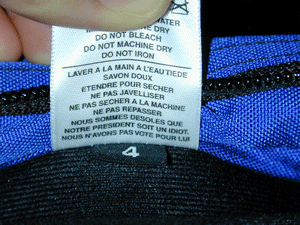
For evidence that foreign languages can be a good thing, here's a label sewn into a laptop case made by a small American company. The label is in French. The translation is below the photo.


Translation:
Wash with warm water.
Use mild soap.
Dry flat.
Do not use bleach.
Do not dry in the dryer.
Do not iron.
We are sorry that
our President is an idiot.
We did not vote for him.


Thanks, A, for sending me the picture.

Continue reading...

Sunday, June 13, 2004

Windows of the world

Wednesday, for the first time in 10 months, I sparred with Angel. I didn't get winded, my form was good, and I was relaxed. But I felt like Angel could have gotten out of the ring, gotten a cup of coffee, and come back in time to see my punches coming. The exciting thing, though, is that afterwards my shoulder and elbow didn't hurt. I attribute that to my new best friend, Celebrex.

The new Trinity Boxing Gym, which is on Greenwich Street, two blocks south of Ground Zero, is in an open storefront that used to be a Dolphin Sports Club. It's similar in character to Waterfront, with exposed brick and beams and a warehouse feel. It looks more like a boxing gym you'd see in 1940s movies like The Leather Saint or Somebody Up There Likes Me. At Waterfront the space was divided into four floors--two boxing floors, a weight room, and a cardio floor. In this space, all the boxing and cardio equipment is on one floor and the weights and the locker rooms are on the lower floor. The open storefront invites passersby to look in the window. It's amusing to watch tourists looking in as though they're at an aquarium. It's hard to tell what they're thinking. They just stare. Many of them could desperately use a boxing workout...or any kind of workout...or more restraint in their eating habits.

Yesterday I made what Martin always calls "a rare Saturday appearance." With the nice weather, I've been more into my workouts. There were a lot of spectators. On the one hand, I get uncomfortable having people watch me work out 10 feet away from them; but on the other hand, it's motivating. It's brilliant marketing for the gym--what you see is what you get. Martin said that membership has been exploding because of the location, without any marketing or advertising. Waterfront was Tin Pan Alley, tucked away behind the New York Stock Exchange, where the flanking businesses put out their trash; Trinity is one step closer to Broadway (literally and figuratively). Sly Stallone chose it to hold the New York tryouts of his boxing reality show The Contender, so it's on the map. One of the women who work out is Sue Costello, a comic who has been appearing on the NBC show Last Comic Standing. Some workmen who were looking in even recognized her.

One of the guys watching from outside yesterday sported a giant mohawk. The spikes looked like porcupine quills; each must have been--no lie--a foot long. The spikes were perfectly stiff and straight. While Martin was working the pads with one of the regulars, in typical salesman mode he called out to the mohawk guy, "That's a cool haircut. Come in and let me see that!" The guy and his buddies came in, and Martin spent a good 10 minutes chatting with them: Where are you from? How long does it take you to get the hair like that? They were from Denver, visiting New York for the first time. Martin was all charm. It was like theater fans getting to spend time with the star of the show.

Ultimately, that's what makes this gym different from Waterfront. Martin had partners and investors to please there. Trinity is all his. Like Madonna, he's reinvented himself. And the fish in the bowl, for the most part, are happy with the change of scenery.

Continue reading...

Thursday, June 10, 2004

Krush groove

I find myself lately developing crushes, mild crushes, not even ones based on wanting to have sex, and not the sort that would drive me to act on them. Most of the crushes, in fact, are on straight guys, or at least guys that profess to be straight. This whole metrosexual business is so friggin' confusing, because in New York I really have no idea any more who's straight, gay, or bi. Queer Eye for the Straight Guy has seen to that, thank you very much.

Lest you wonder what BooBoo thinks of my crushes, well, he has his own, and we compare notes.

One of my crushes is a 23-year-old straight guy in another department at work. We'll call him Rafael. He's Hispanic (my Achilles heel), has sleepy brown eyes and a killer smile, and dresses impeccably. I usually don't even pay attention to guys under 30. But in all my dealings with Rafael, he is faultlessly professional and exceedingly charming. Although this wouldn't send most gay men's schwingmeters into the upper registers, for me it's a step toward canonization. He exhibits a maturity I don't find in many people his age--or older than I for that matter. And that's sexy. Last Friday I needed to call him about a project we were working on together. "Rafael is off today," his boss, Vanessa, said. "He's visiting his girlfriend at college." Girlfriend? Rats! "He's pretty adorable," I said. (I'm out at work, so these remarks don't surprise anyone.) "Yes, he is just so cute!" she gushed. "He tries so hard to be grown up and professional. I'm trying to keep him going in the right direction." That's when I realized that Rafael reminded me of myself at his age, when I was also guided by an African-American female mentor.

Tony works out at my boxing gym. There are a lot of hot, sweaty guys at the gym, but most of them are too straight, and there's nothing really distinctive about them. Yeah, nice bodies, nice faces, blah blah blah. Attractiveness to me is deeper than that. I'll take average looking with a good personality any day (yes, really). Tony is a little younger than I, turning 40 this year. He's a typical guido from Bensonhurst and a musclehead. He used to be a powerlifter and a bodybuilder, and now he's a boxer. Historically guidos seem to take a liking to me, which bemuses me. I don't think I'm blatantly obvious, but I know I give off a gay vibe.

Tony watches me hitting the bags and sparring and likes to playfully punch me; sometimes I think he's flirting with me. He often asks me for boxing tips and constantly tells me that he wants to have good form like me. In the locker room he likes taking his shirt off in front of me, and I like it when he does that; clearly he likes to be looked at. He's good looking but not overly so, and he's got a nice body but not a perfect one. He calls me "brother." I guess I like that he wants to learn and looks up to me. Maybe it's a power trip for me--a straight guido respecting me.

I wonder if in the end what is at the root of my crushes: are they reflections of me, or projections of what I wish I were, or is this the start of a mid-life crisis? At any rate, I'm having a good time. I just hope I'm not compelled to go buy a Porsche.

Continue reading...

Wednesday, June 09, 2004

My heart goes out to my good friend Glenn, whose mom died Monday. His tribute to her is quite moving.

Continue reading...

Tuesday, June 08, 2004

Give as good as you get

Matthew 5:39 says "I tell you not to resist an evil person. But whoever slaps you on your right cheek, turn the other to him also." This pretty much sums up my Catholic upbringing and, for many years, my approach to life. Along with "don't challenge authority" and "do as I say, not as I do," for years I truly believed that I didn't deserve to make a lot of money or to live in a great house or to have a great relationship. It took years and years of undoing and relearning to make me feel I deserved those things. Even so, it was with some apprehension that I took a seminar today called "Best Negotiating Practices."

Ruth Shlossman, the instructor, said she has been a negotiator all her life. At 10 she remembers going into the kitchen at 6:00 one evening to find that her mother had not started dinner yet. When Ruth asked her mother when she was going to start dinner, her mother replied, "What are you going to do for me?" Not exactly my experience in life.

Granted, as a New Yorker I am constantly negotiating. I negotiate where I'm going to walk on the street, where I stand in the elevator, where my co-workers and I are going to have lunch, and where I stand on the train.

The negotiation of which I'm most proud, though, was during my trip to Indonesia in 1996. Promising myself that I would never visit a country without at least knowing how to ask where the bathroom is, I immersed myself in Bahasa Indonesia the month before I went. I figured I was going to be there for a month on a business trip, and I wasn't sure how much English people spoke. Bahasa was not an especially difficult language to learn, because it has simple grammar--so simple, in fact, that it's like learning Tarzan language (me eat food, me sleep now). Phrases such as terima kasih (thank you) and selamat malam (good night) were infinitely useful, and I mastered words for meals, weather, and numbers...or so I thought.

One Saturday afternoon I ventured over to the flea market not far from the Hotel Aryaduta, where I was staying. It didn't look so different from flea markets I'd been to in the States, and the clientele was largely Yankee, Aussie, and Brit. The Yankees shouted at the merchants as though they were deaf, the Aussies were condescending, and the Brits were arrogant. I really just wanted to look around, but one particular object caught my eye: an intricately carved ebony bust of the Hindu deities Vishnu and Shiva. The merchant saw that I was looking at the bust and appeared quite eager to sell it to me. I suspected that I might be his first sale of the day, which in Indonesia is a sign of good fortune. I did want the statue, but I had no idea of its value or its uniqueness. I had it in my head that I would pay about $25 for it. Speaking only in Bahasa, I asked the merchant berapa harga? (how much?). He answered in English, "80 dollars." "Mahal [too expensive]," I said. I kept looking at the statue. Silence. He asked me who taught me Bahasa. I pointed to myself and said saya saya (myself). The merchant looked at me, incredulous. He asked me again, "No, who is your teacher?" I repeated that I had taught myself. (Indonesians cannot believe that anyone would want to learn their language, so they are quite flattered when someone makes the effort.)

The man was clearly impressed, and he saw me still looking at the statue. Without my saying a word, he said, "80,000 rupiah," which at the time was about $32. I had not made any offer, and already the price had come down 60 percent. I figured I'd go for broke and offer 60,000 rupiah ($24), in the hope that the guy would go to 70,000 rupiah ($28) and we'd both be happy. But as I stood there, my mind went blank: I couldn't remember how to say "six" in Bahasa. I went through my head: "satu, dua, tiga, empat, lima...." Damn! I was going to make a liar out of myself if I couldn't remember the number. It hadn't occurred to me to go down to 50,000, which I could say. I was embarrassed that I couldn't remember the number for six, and I started to walk away. The merchant called after me: "enam puluh seribu" (60,000). As soon as I heard the number, I remembered it. "Ya!" I exclaimed, and the merchant was overjoyed that I had accepted his offer. In the back of my mind I wondered whether I'd gotten a deal or a trinket. Regardless, I got what I think is a beautiful piece of art, and the merchant got his first sale of the day. From what I learned today, that's the essence of successful negotiation--both parties getting what they want and walking away happy.

Continue reading...

Monday, June 07, 2004

Hooray, hooray, it's a holi holiday

It was a good weekend. On Friday my new Prada sandals arrived. I had dinner with Glenn and Derrick Friday night in Williamsburg at Food Swings and drinks at The Metropolitan. Saturday I had breakfast with Mark & Keith and Andrea at Purity Diner in Park Slope, went shopping with Andrea for a suit at Century 21 in Bay Ridge and had sushi for lunch, and then had dinner with Eric and Sheri at LouLou in Fort Greene. Plus, as a special bonus, Ronald Reagan died! It was such a good weekend.

Continue reading...

Friday, June 04, 2004

Kissing the porcelain god

Simply amazing!

Continue reading...

Thursday, June 03, 2004

Fuhgeddaboudit!

Overheard at work:

Joe: The Web sucks.
Steve: The Web here sucks. The one at home is better.

I love New York.

Continue reading...

Wednesday, June 02, 2004

Fighting the battle of age

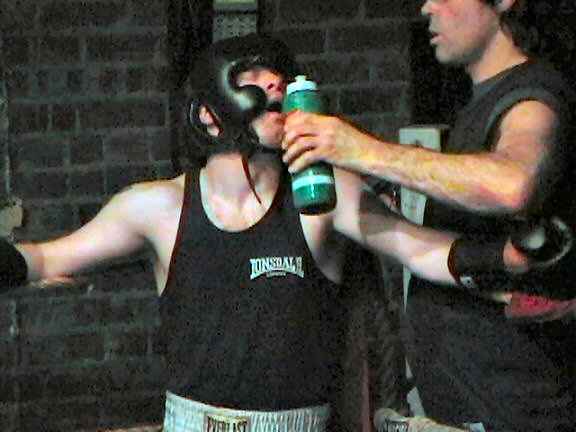
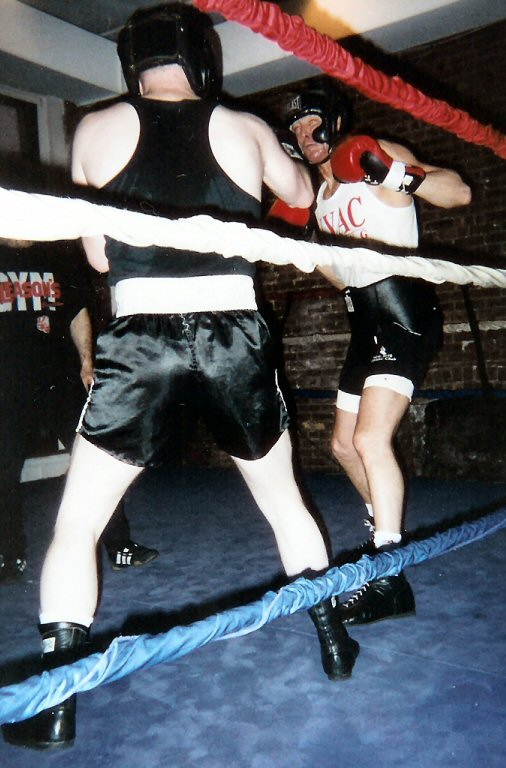
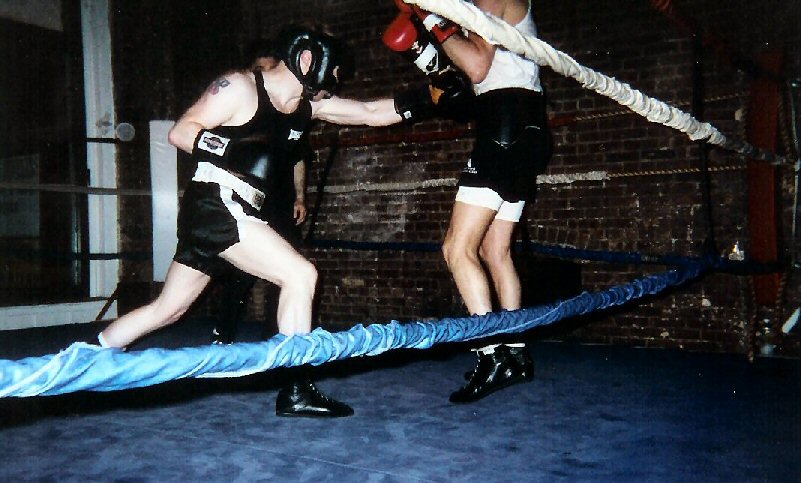
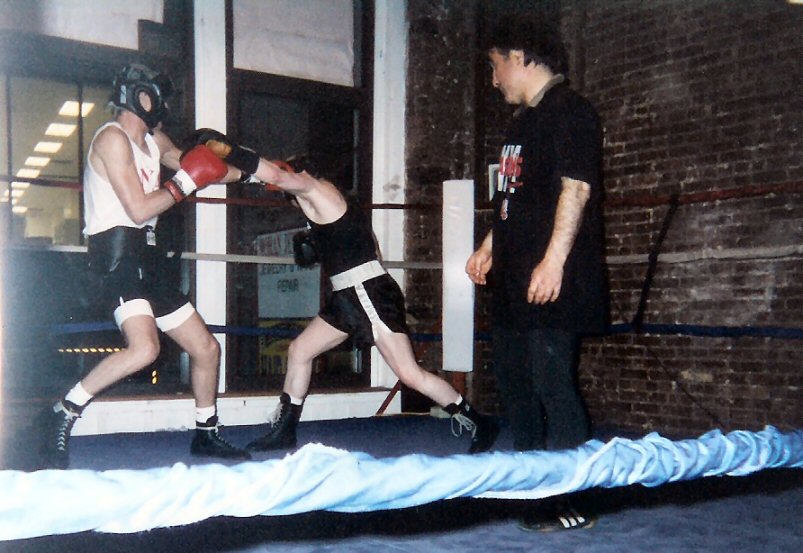
It's been almost a year since I boxed in the last smoker at Waterfront (now Trinity). I haven't sparred since last August, when I developed lateral epicondylitis, more commonly known as tennis elbow. It hurt to throw any punch, and even lifting weights was a little painful. Regular visits to the chiropractor helped but didn't solve the problem. I started taking glucosamine and chondroitin, but I wasn't disciplined enough to swallow the ginormous pills. Then during the winter, I developed a chronic pain in my shoulder, probably brought on by my tennis elbow. I hadn't stopped hitting the bags; I just sort of put up with the pain, becoming mildly addicted to ibuprofen. I kept up chiropractic treatment, with ultrasound therapy, contrast bathing (heat and ice), and stretching. Nothing seemed to work. I was miserable, because I was itching to get in the ring--the only place where I'm truly happy.

Then, a few months ago, Luis's plantar fasciitis got the better of him, and he went to an orthopedic surgeon, who prescribed Celebrex for him. For some reason I couldn't get past the name and thought it was an antidepressant, as in "Celebrate life with Celebrex!" But Luis assured me it was an arthritis medication, and even though AARP won't have me in its sights for another 10 years or so, I figured I'd give it a shot. It worked immediately, and just like the woman in the commercial who takes Arthritis Pain Formula and exclaims, "I can lift this pan!" I've become a new person, almost like Tina Louise in The Stepford Wives.

Tonight I almost felt well enough to spar with Angel, but lately I've been battling another old foe: allergies. With Celebrex as my jab and Tylenol Allergy and Sinus as my cross, I'm going to kick the crap out of these conditions so I can get the hell back in the ring.

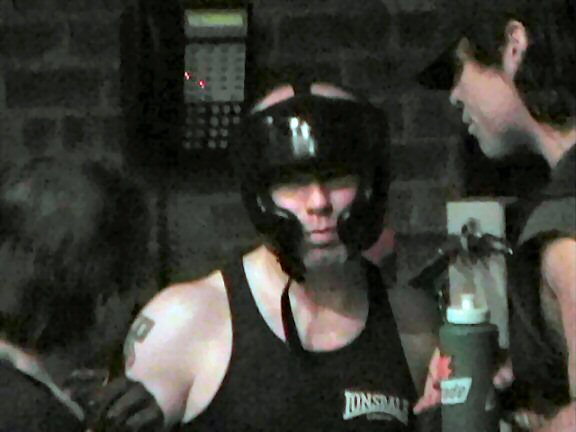
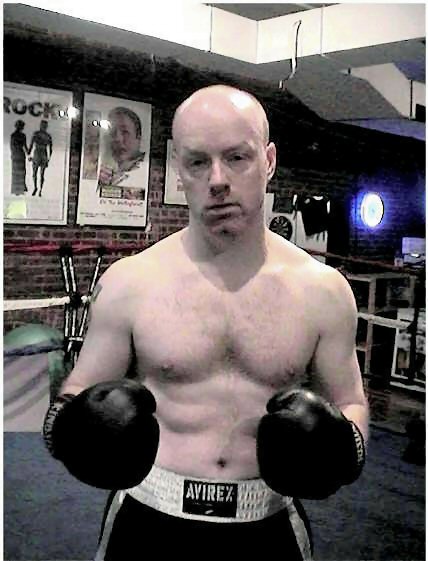
A few shots of me from the smoker last year:

>

Continue reading...
Measure for measure


Continue reading...
Hosted by www.Geocities.ws

1