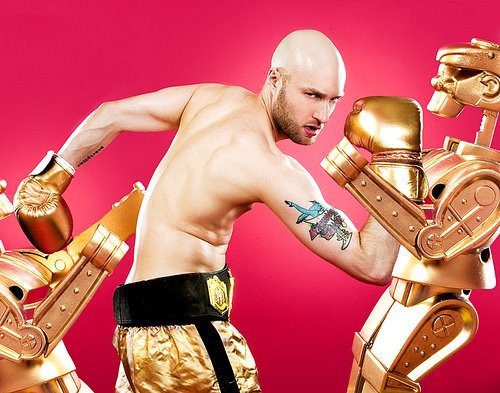
Cazwell throws some shade
 I was beginning to think camp was dead. But it's not; it's just different.
I'm old enough to remember pre-AIDS camp. Back then, "camp" was synonymous with "gay." "Gay" meant "underground." "Underground" meant "immoral." Camp was subversive, dangerous, even anarchical. It defied description and categorization. You just knew something was camp. If you were not on that wavelength, camp meant nothing to you. In mainstream America, camp was unpatriotic. It was up there with Communism.
The camp icons I remember most in the 1960s were Charles Nelson Reilly, Liberace, Paul Lynde, Alan Sues. Women were not camp, but rather the objects of camp: Marilyn Monroe, Bette Davis, Joan Crawford, and, of course, the obligatory Judy Garland. Despite featuring men in drag, the 1959 movie Some Like It Hot is not camp, unless you count the presence of Marilyn Monroe. A man's mere wearing of a dress doesn't make him camp or gay or immoral--or funny, for that matter. An illusion of reality has to be created. As much as drag could be considered a distortion or exaggeration of women, it is really an homage to them. Post-Stonewall drag queens like Divine, RuPaul, and Dame Edna portrayed women as confident, sassy, and complex. They inspired empathy and affinity, but they were still camp. The difference is they were in on the joke.
By the 1970s, essays like Susan Sontag's "Notes on Camp" redefined "camp" to emphasize "artifice, frivolity, naïve middle-class pretentiousness, and shocking excess." Sontag said, "You can't do camp on purpose." In a way, she's right. Camp has to come from the heart, however misguided. In the past 15 years, the gold standard of camp has been, of course, Showgirls, an earnest, jaw-dropping, 15-car pileup that purports to portray the real-life, gritty underpinnings of exploited Vegas performers.
On television there have been camp-like roles, such as Patsy and Edina in Absolutely Fabulous, the women of Sex and the City, and Karen in Will and Grace, but there's a self-consciousness there: gay spirits inhabiting the bodies of real women. I think that one reason straight women and gay men get along so well is because they concurrently fought to be treated as equals and in the past 30 years have gained political clout. They can now use mainstream media to express themselves and large numbers of people don't see them as subversive anymore. That's a far cry from the creepy innuendoes of Paul Lynde's bitchy retorts on The Hollywood Squares (which, by the way, are still hilarious).
The other day I stumbled onto a YouTube video by gay rapper Cazwell called "I Seen Beyoncé at Burger King." At first I thought it was amateurish and not funny, but about halfway through the viewing, it hit me: This is John Waters for the New Millennium. This is the new camp!
But is it camp if the intent is deliberate? To me it is, since it incorporates the three main components of camp: attitude, humor and allusion, and drag.
If the grammatically flawed title doesn't clue you in, the garish, seizure-inducing, psychedelic color scheme and irritatingly monotonous synth track will. Influenced by artists such as Deee-Lite, Caz crafts a novelty song that's as clever as it is annoying. Decked out in what can only be described as white-trash rapper couture, Caz and his over-the-top homo-nerdy sidekick Jonny Makeup let viewers in on their dirty little secret: they've spotted Beyoncé in the Home of the Whopper chowing down on a host of calorie-laden food items.
In the video, "Beyoncé" is a tranny who uses her wiles to get Caz to lend her 10 bucks because her car is parked 3 blocks away and "that's just too far, too far." Caz lets on that he and Ms. Knowles are tight, as he nonchalantly advises her that she'd better repay him. In a subsequent encounter at JC Penney, Beyoncé shows up in her '94 Chevy bedecked in curlers and shades and asks Caz to watch her car while she shops. Caz reminds her of the 10-dollar loan, which she dismisses with a fierce "f**k it." And then Ms. B delivers the ultimate bitch slap, mistaking Caz for a liquor store employee while she shops for a case of beer.
This far-fetched sequence of events is interspersed with shots of Makeup in various ridiculous getups (the nosy neighbor, the fashion-challenged queen) gossiping with a half-stoned Caz, himself dressed in a pink scooped-out tank top and bling, about the alleged sightings. Whether intentional or not, the addition of backup dancers in Burger King uniforms and kitten outfits is a great tribute to camp variety shows like Hullaballoo.
The line on whether this video is more satire than camp is blurred. The premise of a white-trash gay rapper dissing a glamorous hip-hop star in the 'hood is a smart statement on what constitutes celebrity and reality, something John Waters exposed so brilliantly in Pecker. Everyone has something to say about Britney, Lindsay, and Paris, but what do we really know about them?
The YouTube commenters don't seem to get what's going on here, but then viewing comments on that site is like visiting a putrid cesspool. Uh-huh, the music is lame. Yeah, the cinematography is garish. OK, the acting is silly. That's the point. The best that YouTubers can muster up are unironic remarks like "GAY," "Retarded," and "Fucking stoopid!"--remarks that indicate camp is still the purview of those who are in on the joke and that Beavis and Butthead are alive and well and surfing the Web.
Labels: celebrities, funny, gay, video
Continue reading...
posted by Kayo Kid at 9:40 PM
0 comments
links to this post