Thursday, January 15, 2009

The 'Book and the tree

I have been conspicuously (and by conspicuously, I mean in my own mind) from the blogosphere for a while now. I start blog entries and then forget about them. I wonder what there is to say that anyone could possibly care about. I still get comments on old blog posts and start writing but lose interest. Facebook and Ancestry.com have tightened their grip on me.

My friend Michelle invited me to join Facebook almost a year ago. I resisted at first, but I thought it would be a good way to research social networking, since my department was looking into building virtual communities. I thought the best way to study them was to become a member. Now I'm hooked on Facebook, and like the Internet itself, I can't imagine what my life was like before it. Well, actually, I know what my life was like before it. It wasn't full of poking, flair, and status updates by the nanosecond.

I've always felt somewhat alone in the blogosphere; Facebook, on the other hand, lets me connect with any of the currently 140 friends I have. I had no idea I knew 140 people, but they are, in fact, people I know, from work, school, the neighborhood, blogging, the gym, the past, my family. Some are casual acquaintances; some are people I've known for many years. In many ways my contact with them mirrors how I would interact with them in real life, but in other ways I've gotten to know people better by observing and interacting with them virtually. For instance, a colleague of mine is in the hospital recovering from a serious illness and was unable to speak on the phone. His wife, through Facebook, was able to keep us all up to date on his condition and relay messages to him. It was better than wondering how he is and having her be bombarded with phone calls and e-mails.

On our recent trip to London, I saved money on cell phone calls by contacting my cousins on Facebook to set up places and times to meet. I saw photos of our friends' new baby who was born while we were away. I correspond with my friend Michelle, who lives in Mongolia and is already living tomorrow. To me Facebook is not a substitute for human contact, and if someone lives hundreds or thousands of miles away, this kind of interaction makes sense. Oh yes, and many of my loyal readers are on Facebook!

But Facebook is only part of the reason why I've put aside blogging. The other part is my genealogical pursuit, which has grown considerably since I started 3 years ago with about 20 people in my tree. Now there are almost a thousand. I've gone back 6 or 7 generations on all four sides, taking me, in some cases, to the late 1700s. I've expanded across generations to almost 700 blood relatives, 400 of them living! I've uncovered cousins in Ireland, England, Scotland, Canada, Australia, Italy, and many parts of the US. I've met dozens of new cousins both in person and through e-mail (and Facebook). And so far I've helped solve three family mysteries. But that's another blog entry. Stay tuned...

Labels: , , , , ,


Continue reading...

Thursday, December 27, 2007

A bad way to diet

This is only the second day since our arrival that it's rained. It hardly ever rains when I come to London, so I don't know why there's such a hoo-ha about London being rainy. I suspect it's a myth Londoners like to perpetuate to keep tourists away.

It's been 12 days since my last workout, and my new diet of alcohol, tea, meat, and chocolate is working just fine. I feel lighter than when I left and know it's just a matter of time before the scales start to tip the other way.

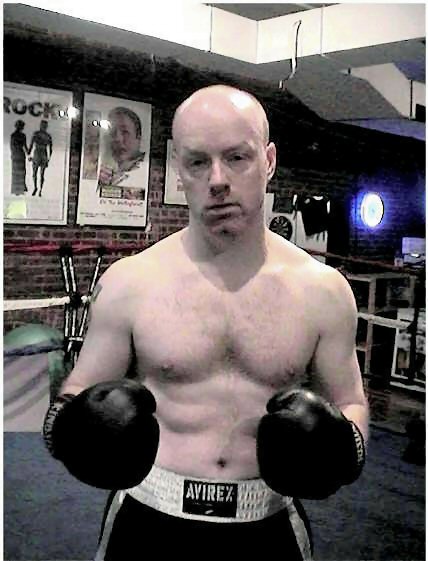
One of my favorite places to eat in London is Giraffe, conveniently located downstairs from our friends' flat. Their motto is "Love Eat Live." I decided I should eat something healthful. I always order the same "brekkie" item, smoked salmon and scrambled eggs. Giraffe has a funky vibe; some Putumayo compilation is always playing in the background. I've already had two cups of tea this morning, which is already more than I ever drink at home. Tea is a way of life here. On a previous trip to London I worked out at a boxing gym and the trainer served me a cup of tea afterwards.

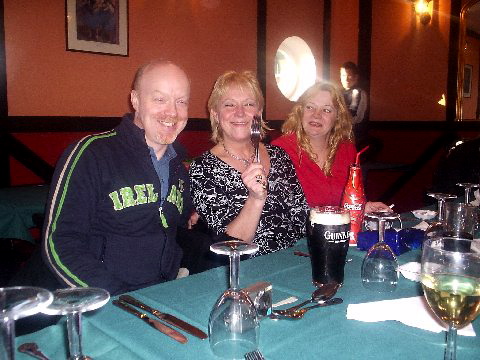
After lunch we took the DLR (the New York equivalent of Long Island Railroad) to the quiet Maida Vale section of London to meet my relatives at the Queen's Arms Pub: Jackie and her friend Billy, Sandra and her daughter Sandy (the ones who visited New York in October), Shonette and Jim and their son James, and Aunt Gladys. Willie and his son William (one of the boxing brothers) came later.

It's early, about 2:00, and I'm already having a Guinness. At home I would never drink before 5, but with the time difference I feel like it's OK. The pub menu has a cheese and tomato sandwich that looks tempting. When it comes, it is literally some hunks of cheese and a slice of tomato shoved between two pieces of white bread--no other condiments. Even my cousins are horrified.

It's strange how at ease I feel with them, as if I've known them all my life. I wonder if my grandmother would have approved of our meeting. But, as I've written before, I feel that she had a hand in this meeting from the great beyond.

Cousin Sandra is already giving me a hard time for not seeing them more often during the trip. Yes, we're definitely family.

"I'm trying to find a pantomime for us to go to on New Year's Eve," Sandra said.

"Great," I said, thinking, oh my God, is this what the English do for fun? And isn't Marcel Marceau dead? I figured I'd better ask, since I had no clue what a pantomime was.

"Well, it's like a fairy story, really," Sandra said. I looked puzzled.

"Like a gay story?" I said.

"No, silly, like Cinderella or Peter Pan."

"Oh, that kind of fairy story."

Shonette added, "All the female roles are played by males."

"Like a drag show?" I said.

"No, not really," Shonette said.

In the US, pantomime conjures up images of slim, white-faced clowns in berets and suspenders who play charades for a living. In th UK, pantomime has an entirely different meaning in the US. In the UK, a pantomime (or panto) is a holiday theatrical performance of a fairy tale (or fairy story, as my cousins call it). It's geared toward both adults and children, so innuendo and double entendre work much like in a Bugs Bunny cartoon. Female roles are played by men, not for camp value (allegedly) but in the Shakespearean or commedia dell'arte tradition. There's slapstick and audience participation (for instance, "Look out! The villain is behind you!") The pantomime is more desirable if a B celebrity (like Gavin McLeod or Joyce DeWitt in the US) is in it. The hot ticket this year is Stephen Fry's adaptation of Cinderella at the Old Vic Theatre (which is now under the direction of Kevin Spacey).

On the way back, Luis got a text message from Niamh saying there had been a murder in Islington, either on the Tube or near it. When we get out at Angel station, the whole area is cordoned off. The mist-filled streets are eerily quiet, and people line the streets to watch the forensics experts in hazmat suits look for clues. They look overdressed. I mean, Khandi Alexander on CSI: Miami just throws on some Prada when she examines dead bodies.

More sad news as we return to the flat: Benazir Bhutto has been assassinated. The murder scene we just passed was a double stabbing of two teens. London has been having a wave of gang-related killings, and no one knows what to do about it.

All four of us are off to bed early tonight. We have a 7:30 a.m. flight to Perugia to visit Luis's mom and stepdad at their new pied-à-terre. We have to get up at 4:00 a.m. That should be fun.

In Italy my new diet will be challenged by the easy availability of pasta and wine. The scales are sure to tip the other way, but I won't mind. Abbondanza!

Labels: , , , , , , , , , ,


Continue reading...

Monday, December 24, 2007

Spice girls

For most of my life I spent Christmas Eve at my aunt's house in Brooklyn, tearing my way through a seven-course fish dinner in the Italian tradition. This year things were more subdued but still a little spicy.

If you fancy garish, over-the-top seasonal displays mixing religious and secular icons like those in Dyker Heights (who doesn't love a manger scene with Santa and his reindeer riding on top?), London is not the place for you. Wreaths, trees, white lights, and the occasional Father Christmas are common, but not a lot else. England is neither a terribly religious or showy country.

Christmas Eve here is quite civilized. Even at midday the streets were quiet. After shopping at one of my favorite stores, Reiss, which had pre-Christmas Day sales, Luis and I had a tasty plate of bangers and mash at S&M Cafe (not what you might think). While Americans shop into the late hours of Christmas Eve, most stores in London close at 5 on Christmas Eve and don't reopen until Boxing Day or the day after. There's the occasional corner market or candy store run by non-Jesus-worshippers that remains open, but by around 7, at least in Islington, the streets were empty. It was tough to find a restaurant to book past 8:00. Luis's sister M and her friend L came to Niamh and Jan's flat for drinks, and then M and L and Luis and I had dinner at a wonderful Turkish place called Cafe Gallipoli. We ate many delicious dishes: grilled hellim (halloumi cheese), boreks (pastries filled with feta and parsley), and sucuk izgara (spicy Turkish garlic sausages).

Things got a little rowdy after a few glasses of wine. L started grooving to the infectious Turkish music, and next thing you know, she was up on a chair dancing, followed by M. The Turkish waiters started clapping and egging them on, then turned up the music and started dancing too. (They slipped a little, though, and accidentally turned on "YMCA".) Even the kitchen staff came up from below to watch the spectacle. Our waiter was very into the dancing, as you can see in the following video. (It's sideways. I swear we weren't THAT drunk.)

Labels: , , , , , , , ,


Continue reading...

Tuesday, December 18, 2007

Top it off

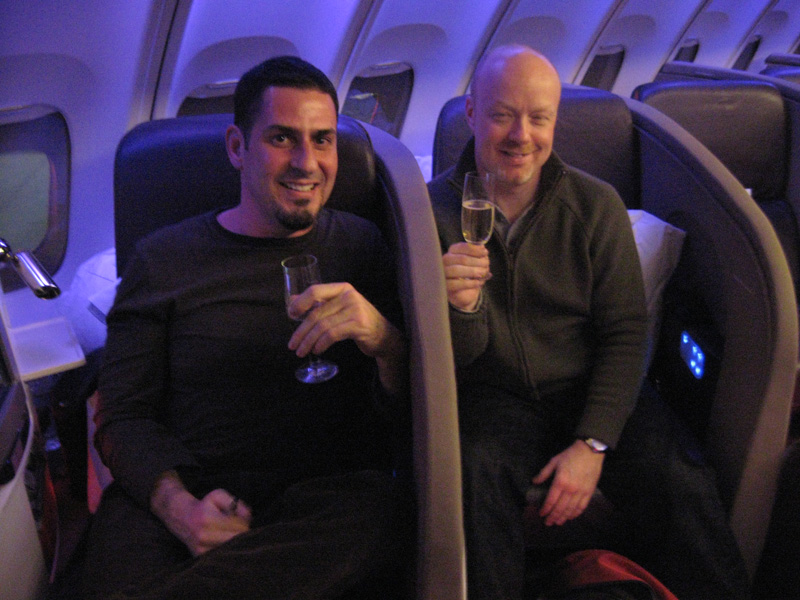
After chowing down a dozen dubious wings at the airport bar (Luis: "I think this one is made of cat"), we were whisked away to the Upper Class cabin, where the other half really lives.

I looked around to make sure Karen Black wasn't on board. That would have been ominous. Luis was in seat 1K. Where was I? Why, 2K! Right behind the pilot and the lavatory.

The attendants wasted no time in offering us drinks. We both had champagne. "I also took the liberty of putting a bottle of water next to you," the attendant said. Well done.

Clare, the chef, came around to each of us to ask whether we would like to be served breakfast in bed 90 minutes before landing. Why, I couldn't possibly...well, all right then.

Another attendant asked us if we would like to have massages or beauty treatments. I said I would prefer to sleep. Before takeoff yet another attendant came by: "May I make your bed up?" Why, yes you may!

I took something called No-Jet-Lag, a homeopathic remedy consisting of Arnica Montana (the evil twin of Hannah Montana) and several other witches' brew ingredients. I took one every 2 hours, according to the directions. The label warned that consumption of alcohol may impair its effectiveness. Yeah, whatever.

I actually fell asleep for about an hour and a half but was awakened by Wizard-of-Oz-house-pitching turbulence. Luis said later that he thought we were going to die, but at least he'd die happy. I almost never get queasy in turbulence, but this was prolonged, and the alcohol didn't help.

Breakfast was served on schedule, and we landed safely, about 90 minutes later than planned. UK immigration is divided into "Fast Track" (i.e., rich people), "European Union," and "Rest of the World," which is pretty much how the real world divides. Luis went through Fast Track, whilst I used my newly minted Irish passport to speed through the EU line. No stamp, but that's OK.

We took the Tube into Islington, about an hour's ride. It's amusing to hear a calm British female at every stop say, "This is a Piccadilly line train headed in the direction of COCKfosters." I never get tired of that.

Labels: , , , , , ,


Continue reading...

Wednesday, November 28, 2007

Adding on the pounds

While relaxing by the pool at Luis's mom's over Labor Day weekend, Luis and I had a brilliant idea: let's avoid the holiday madness and go somewhere to avoid family drama. Several Cosmos later, we had economy tickets to London on Virgin. Granted, they were very cheap (under $300), but that won't make up for our hemorrhagic spending once we land. With the dollar at more than 2 to 1 to the pound, we're leaving plenty of room in our luggage for ramen noodles.

Lodging is not a worry, since we'll be staying with our friends. We decided that our trip was our mutual Christmas present. I plan to go to Dublin for 2 days to do some genealogical research and possibly meet up with some cousins. Two weeks ago hotel and airfare would have cost me about $300, but I waited a week too long and ended up paying $500. The euro is no bargain either.

We thought we might escape family gatherings altogether, but Luis's mom and stepdad are living temporarily near Perugia in Umbria, and what the heck, we'll already be on that side of the ocean. The Brits and Luis and I are going the weekend before New Year's. We'll be within drinking distance of wine regions Montepulciano and Montalcino. Ironically, the wine there will be more expensive than it is here!

The only thing more intimidating than the exchange rate is the prospect of flying from London to Perugia on Ryanair, a low-budget Irish airline that has fewer frills than a Mennonite church. The fares are so inexpensive I'm envisioning a Flinstones-like plane where everyone flaps their arms to make the plane run. I can't seem to find a good word about the airline; their bad-boy image makes Colin Farrell look like St. Patrick. France is in a lawsuit with Ryanair, customer complaints are rampant, and the EU is threatening to shut down its Web site for bogus pricing. Earlier this year, Ryanair unsuccessfully attempted to take over Aer Lingus, the national airline of Ireland, earning it the airline's enmity. I don't know if it's good or bad that I share the same last name as the airline's president. It will be anyone's guess whether we'll actually make it to Italy. I feel an I Love Lucy episode coming on.

Having said all this, I'm very excited about the trip. I haven't had a vacation since my last trip to London in March, and that was a trip to remember. At least I'll have stories to tell about this one. And if worse comes to worst, I have plenty of healthy organs to sell when the bills start coming in.

Labels: , , , , , , , , , , ,


Continue reading...

Sunday, June 24, 2007

When it's time to change...

I always thought it would be an affair, or a Maserati, or a wacky new interest, like skydiving, that would jolt me into a midlife crisis. I thought I had gone through one a few years ago, when I started hanging out with The Young, people 10 or more years younger than I who liked to stay out late and party. I went disco roller skating and ate hash brownies. I even bought some White Stripes albums for the occasion. But that was nothing compared to what I'm going through now.

In the past few weeks, I've gotten the sinking feeling that my real midlife crisis has been simmering for some time, like an unwatched pot, waiting to boil over. I can trace it back to my trip to Ireland last summer. For someone who had mocked his Irish heritage for pretty much 40-something years, finding my roots had an unexpectedly profound effect on me. A few months later, on my fifth visit to the UK, I spent 10 days in London with Andrea. It was like being in love again. In part my romantic notions had to do with discovering more about my identity. Getting my Irish citizenship in January opened a treasure chest of possibilities: Luis and I could get married, have free health care, get jobs, buy a house, travel. On my trip to London and Edinburgh in March, I met family I never knew I had. Pieces of the puzzle were starting to fall into place. I felt even more like I belong there. I felt connected. Since then, I haven't been able to shake the feeling that I want to be there. The trouble is, I don't know what to do about it. All I know is that the whole idea is weighing heavily on me.

I've always liked the Robert Frost poem "The Road Not Taken." When I was younger, I saw no urgency in it. If I started down one road and didn't like it, I figured I could always turn back and go the other way. When I was younger, time stretched out endlessly before me. I was in full control of it. I don't feel that way anymore. Time is in full control of me. Songs run through my head, like time won't give me time,, time keeps flowing like a river to the sea, and time won't let me wait that long.

I realize now when I read Frost's poem that there are actually many roads and many forks. Which ones you take depends on how much risk you're willing to face. Complacency and inertia are comforting friends once you're on the road. You get settled into your routine, you lead a comfortable life, everything becomes familiar and safe. Why shake things up? Why not continue along the road you're on and see where it ends? But what if that road leads you nowhere?

Last week I took a class called "Mastering Priorities," taught by Dr. Rick Brinkman. He's an Anthony Robbins type, a motivational speaker who gives strategies for coping with everyone's number one enemy: time. At first I thought the seminar would be platitudinous, but it was quite the opposite. Dr. Brinkman asserts that the key to mastering our priorities is understanding our values, like family, career, fun, friendship. Our values drive our goals, and our goals drive our priorities. If something is a priority and conflicts with your values, Dr. Rick says, it causes internal stress and you need to rethink it.

Coincidentally, this last point was raised almost verbatim in a tarot card reading I had last week, after I took the class. The reader, a stranger, said the cards showed me to be in a state of major change and upheaval. As a result, he said, I am experiencing a high level of internal stress, which is caused by my fear of what might happen if I make the change. The change, which will continue until next spring, will have a positive outcome, with a pleasant surprise involving my relationship. In the light of the inner turmoil I've been going through the past few months, the reading was as clear as day to me. Then why don't I feel any better?

I'm still looking into going to grad school, but I'm not convinced that's the answer to my angst. I have so many things to consider about my life in New York: Luis, my family, my friends, our building project. What would I lose? What would I gain?

I don't have the answers yet, but the weight of this feeling is as oppressive as humidity in July. Eventually something will give. I keep going back to the last lines of that Frost poem: "Two roads diverged in a wood, and I, I took the one less traveled by, And that has made all the difference." Maybe I need to go back to listening to The White Stripes.

Labels: , , , , , ,


Continue reading...

Monday, March 26, 2007

High anxiety

My friend Hal, who lives in London, is acrophobic. He has been to Machu Picchu (the bottom), the Tower of Pisa (the base), and the Empire State Building (the lobby). He's making progress, though. Recently, on a trip to India, he bravely sat atop an elephant.

Rather than face the dizzying prospect of riding down a moving staircase and being paralyzed by fear, Hal bikes to work every day. It's much healthier and scenic anyway, except when England loses in the World Cup and alcohol is involved.

The Angel Tube stop, near Hal's house, has not a long and steep escalator, but the longest escalator in all of Western Europe. At 200 ft long, it takes almost 2 minutes just to stand and ride on it. You can't see the top from the bottom. I don't have the patience for standing, so I usually walk up or down it and am sweating by the end. That should qualify as a Boy Scout badge or something.

Others have taken on the Angel Tube escalator as their own personal Everest. Sure, you can ride the normal way, but wouldn't it be more fun--and faster--to ski down it, as this Norwegian chap did?

Then, of course, there are riders who go against the natural order and try to run up it, usually while drunk. Sometimes they succeed, sometimes they don't.

I'm sure all of this won't make Hal take his feet off the ground.

Labels: , , , , ,


Continue reading...

Saturday, March 24, 2007

Two worlds

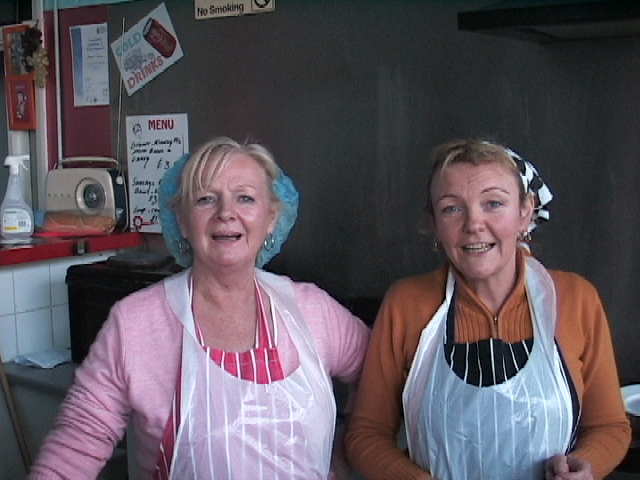
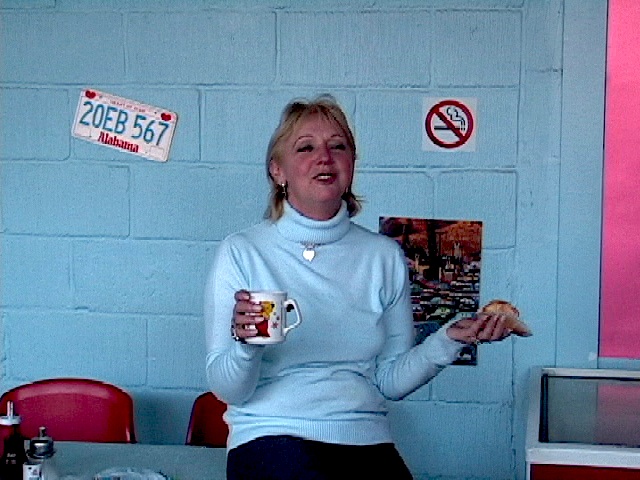
It sounds like something out of a Christopher Guest movie: My cousin Sandra manages a talent agency for identical twins on the second floor of an industrial building in the Colindale section of London. Her husband operates an auto body shop on the first floor; adjoining that is a cafe run by my cousins Colette and Shonette. The cafe has a Route 66 motif, with a hand-painted mural on the wall showing the road from Chicago to LA. The wall is dotted with US license plates, Elvis posters, and other American memorabilia. I asked my cousins how they'd acquired these things. "eBay," said Shonette. "Pretty much all of it." They have never been to the United States.

I'd spent the day after our Mother's Day dinner with my cousins at the cafe. Business was slow, so I got to chat with them a lot. We hit it off very well. Sandra has a large client database. In fact, many family members are in it. They all appear to have been on "EastEnders," the enormously popular British soap that at one time I was addicted to. Sandra said her biggest problem was getting paid. "Sometimes the companies ask for twins," she said, "thinking they'll get two for the price of one. What a load of rubbish."

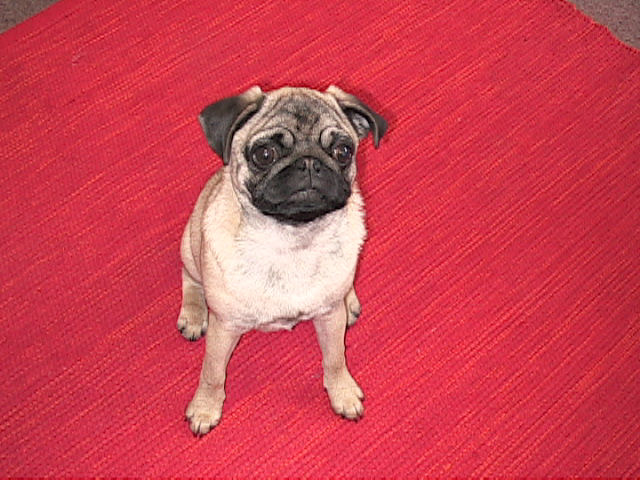
I made fast friends with Sandra's adorable 5-month-old pug, Muffin, which I proclaimed the British cousin of our friends Eric and Sheri's pug Donut. Donut and Muffin sound like a breakfast combo.

Speaking of breakfast combos, Colette made me a nice English breakfast of poached eggs, sausage, and beans. I don't know why I never eat beans for breakfast; they taste so good with eggs.

"Will you be going to mum's this afternoon?" Shonette asked, referring to her mother, my Aunt Gladys.

"Yes," I said, "she said to come over around 3."

"I'll be happy to drive you," she said. "I live right up the road."

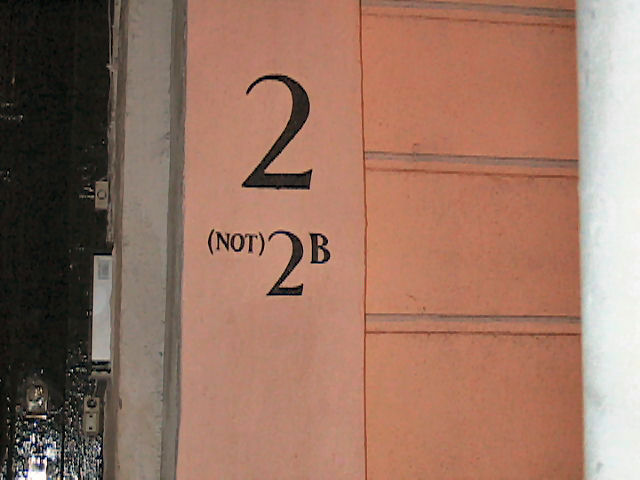
Aunt Gladys's daughters live within one or two miles of her. They are all pretty close. Aunt Gladys lives in a wonderful Victorian house in Westminster that she and her husband bought in the 1960s. One of their sons, Ronnie, is a Shakespearean actor, obviously with a wry sense of humor. The house number is 2, and the house next door is 2B. People confused the two, so Ronnie had "(not 2B)" painted under the 2. Chuckle chuckle.

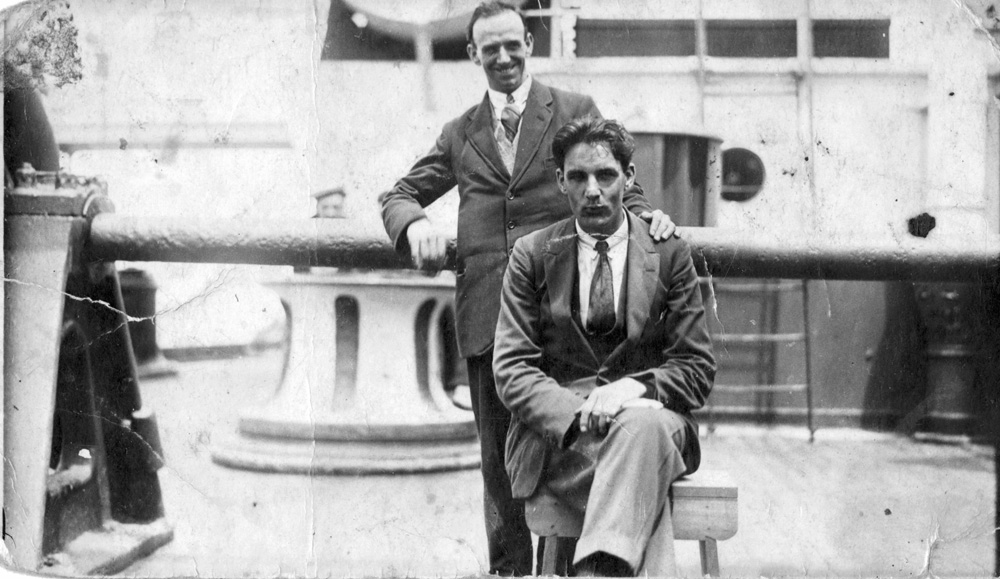
At 83, Aunt Gladys is still sharp. She was eager to show me her photo album, a veritable goldmine. I never saw many pictures of my grandfather because my grandmother destroyed whatever she had. Aunt Gladys had pictures of my grandfather as a young footballer in Dublin and as a passenger on the boat to New York with a friend of his. I definitely saw a family resemblance in some of the photos, especially to my Uncle Willie, who was a very good-looking man. Photos of Aunt Gladys's mother and brothers showed them at various ages.


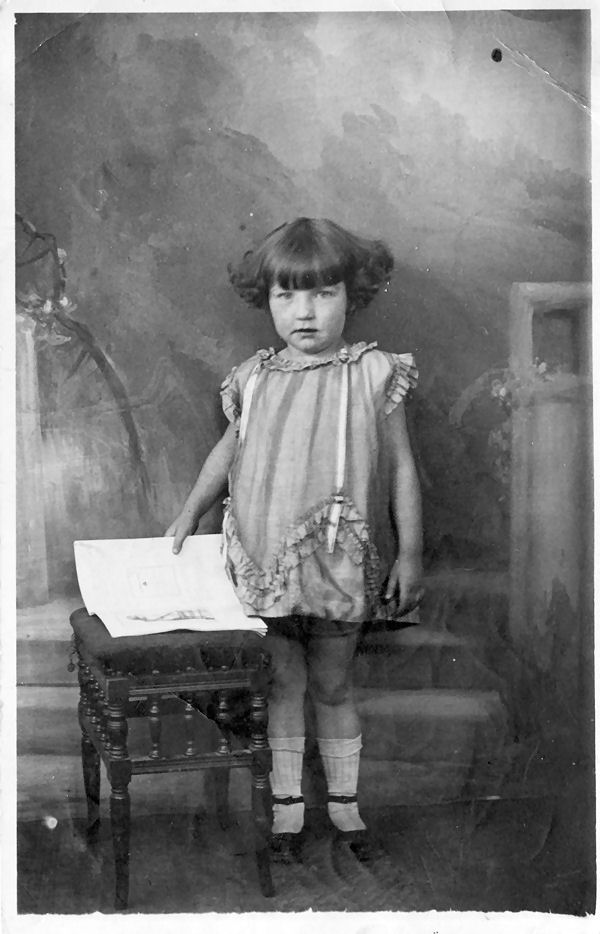
"These are outfits that my father sent back from America for us," Aunt Gladys said, pointing to a smart little dress she was wearing in the photo. As I understand it, my grandfather sent money and clothes to the family regularly. It was only after he met my grandmother that he gradually, and then abruptly, stopped supporting them altogether.

"He was very generous," she said. "My mother always forbade us from speaking ill of him." She thought for a minute. "Really, if anyone is to blame, it's her. She just didn't want to leave her mother and sisters and go to America....So, there you have it."

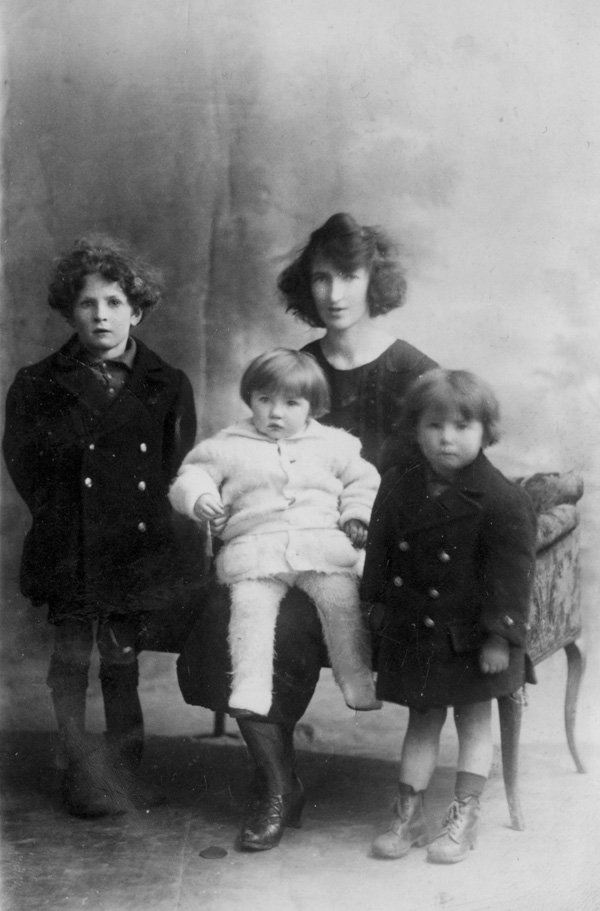
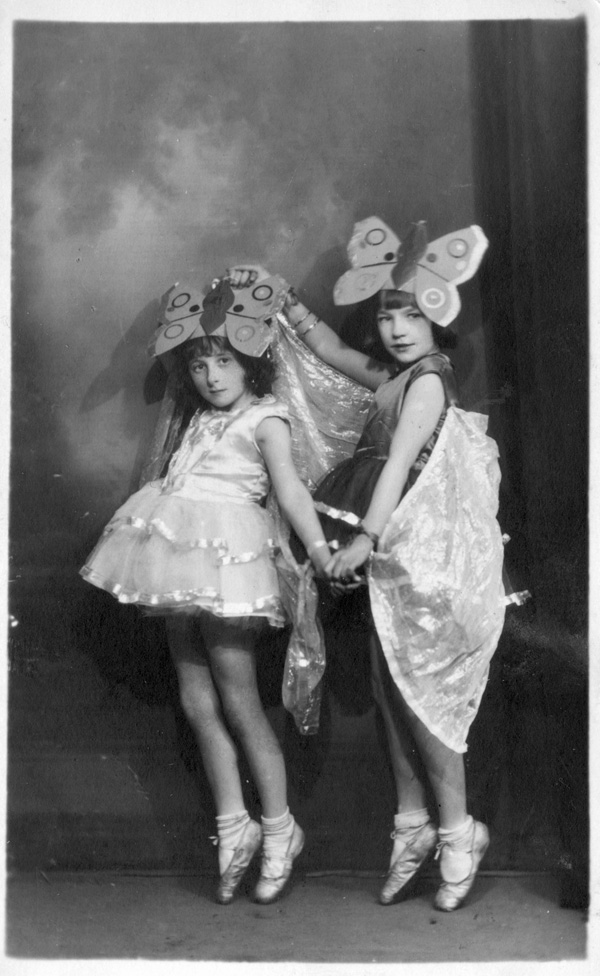
More photos, of a young Gladys in costume, performing in a Dublin production of "Little Red Riding Hood" in the 1920s, another of her in dance costume with another little girl, some other photos of Aunt Gladys and her brothers at various ages. "I helped support the family," Aunt Gladys said, without the slightest hint of bitterness. I asked her if she missed those days. "Yes," she said a little wistfully, "very much."

Besides her son Ronnie, Aunt Gladys lives with her daughter, also named Gladys. It turns out that Gladys Junior, as she called herself, and I had something in common. My cousins had told me beforehand, but I don't think I would have had to guess upon meeting. Gladys Junior made some punk videos in the 1980s, as she said, "for ourselves, just for fun." Now in her early 60s, Gladys looks more like a docent than a denizen of CBGB's.

As I had done with Colette, Shonette, and Sandra, I asked Aunt Gladys and her daughters to record a video greeting for my mother and aunt. Their comments were touching and sincere. Afterwards I kept thinking about the asshole priest in the 1950s who insisted that the two families never meet. I hope that Ellie and Mary tracked him down in the great beyond and gave him a piece of their minds.

On my way to the Tube station, Gladys Junior walked part of the way with me, headed to her favorite pub. "It was a pleasure to meet you," she said, and added, "And I'm very glad about your persuasion."


****************************

On Saturday I walked into the cafe and thought my LASIK surgery had gone haywire. The cafe was filled with identical twins. Cousin Sandra was doing her first day of commercial headshots for her clients, which she plans to use on her agency Web site. There were lots of infants and toddlers, as well as a pair of identical twin mothers in their late 30s, dressed in matching outfits. "Aren't they a bit old for that?" I asked Colette. "A bit strange, isn't it?" she said. "I wouldn't even do that for a 2-year-old." While waiting for my lunch, a man came up to the counter to order food. Shonette recognized him from a previous visit. She introduced me to the man, whose name was Tim. He was a striking man, late 40s about 5'10" with dark hair and Mediterranean features. Shonette told him I was her cousin visiting from America. Whenever someone says, "visiting from America," I automatically think of Rula Lenska, who did Alberto VO5 commercials in the 1970s. (Note: If you are under 40 you will have not the slightest clue what I just said.) Tim was very excited that I was from New York and started asking me all sorts of questions. He was quite a character, and when I turned away to get my food and turned back, suddenly there were two of him. "This is my brother Met," said Tim. Thankfully they were not dressed exactly alike, so I had a chance at telling them apart. I sat down with them at their table. Met and Tim are Turkish, both from London, married with kids. Tim is a park ranger, Met a school counselor. They've done some television and photo shoots, including a session in Scotland for a German commercial.

"We went to New York for a charity event a few years ago, after 9/11," said Tim, who sat on my left.

"It was at a restaurant called Twins," Met said. "Ever heard of it?" Yes, I said, I had.

"New York was such a blast," Tim said.

"We got stopped by an officer, one of these real New York types," Met said, perhaps forgetting he was talking to a New Yorker. He adopted a bad New York accent: "Whaddayas doin' heah? This ain't no part of town for you to be in." Frankly I've never seen a police officer tell anyone they were in the wrong part of town. But this was right after 9/11, and they do have vaguely Arabic features for Turks.

I was sitting in between the guys and got used to the ping-pong effect of finishing each other's sentences. There was no break in the conversation, but they were fascinating to watch.

"Have you ever been to LA?" I asked.

"Once," Met said.

"What do you think of it?" Tim asked.

"Hate it," I said, twisting my mouth. "Nice weather, but very plastic. California built a fence around irony and won't let it enter, not even illegally."

"My wife is from California," Met said.

"Oh." I said.

"But she says the same thing."

Both men had been married a long time. "Do you guys ever switch with your wives just to see if they're paying attention?" I asked.

They looked at each other, as if the idea hadn't occurred to them. "No," Met said. "He's a bigger pain in the arse. Our wives would know." Tim threw a napkin at him.

We exchanged e-mail addresses in case they were ever in New York again. About a half hour later it was Tim and Met's turn to get their headshots taken. I went back up to the counter to talk with my cousins.

"Those two are characters, aren't they?" said Colette. I nodded. "Nice enough," she added, whispering, "But real Hollywood types, full of themselves."

The cafe was empty of twins, leaving the cafe to me and my cousins, two families united by one man, now no longer strangers from two different worlds.

Labels: , , , , , , , ,


Continue reading...

Friday, March 23, 2007

Rivals

On Friday night I went with my friends Jim and Phil to see an amateur boxing tournament between England and Hungary. The venue was Newham Leisure Centre, located in a part of south London called Plaistow. To get there we took the DLR, which is like Metro North in NYC, to Beckton. The train passes Canary Wharf, London's financial rival to The Square Mile and analog to Jersey City's financial district. When first conceived in the mid-1980s, Canary Wharf held great promise for the UK. A few years later, the world property market crashed, putting the future of the area in jeopardy. An international consortium rescued the area, and since then it has risen like a phoenix from the ashes of disaster. Canary Wharf was a highly touted contender, beaten down by economic circumstances, and has returned triumphant. It now houses the UK's three tallest buildings, and plans are under way to double its size.

Before the boxing event, ticket takers handed out white flags with a red cross. I asked Jim what flag it was, and he said it was St. George's Cross, the flag of England. I realized I had never seen the English flag before, only the Union Flag, a composite of the flags of England, Scotland, and Ireland. From then on I noticed the flag everywhere. Each boxer waved it in the ring before his bout. The 11 amateur bouts, one in each weight class, were conducted under the auspices of the Amateur Boxing Association of England. They were the first ones held as part of a series of showcase events to determine which boxers may be selected for the 2008 Beijing Olympics. These boxers are considered the 11 best amateur fighters in the country.

First up was a flyweight bout. I thought the Hungarian boxer scored well, but the judges gave the decision to the Brit. According to Jim there are five judges, each scoring by number of clean blows landed. The highest and lowest scores are discarded in order to avoid bias. In the second bout, the Brit's brother won more decisively.

There were a few standout fights, but for the most part the performances were messy and lackluster. European boxers are more stand-up than U.S. fighters and incorporate more hooks and uppercuts. In Golden Gloves boxing, judges tend to look only at jabs and crosses since it's easier to see them land. Power punches are thrown on the inside and thus are harder to see.

Even though the Hungarian fighters lacked some of the credentials of the Brits, I thought they were tough and well schooled. Jim, who's an amateur coach at a reputable boxing gym in south London, has seen most of these fighters box before and provided interesting color commentary. The final score was 9-2 in favor of the Brits.

Although the press commented on the low turnout, I thought attendance was certainly greater than it would have been at a comparable U.S. tournament. Americans are not as interested in technique and strategy as they are in bloody fistfights. USA Boxing, the amateur governing body, is in an atrocious state of affairs. Brits have a much better governing body in the ABAE.

Labels: , ,


Continue reading...

Signs in English

London is a highly walkable city, even though it is not designed for pedestrians. There's no grid to speak of, no numbered streets, and in many cases, no street signs. You just have to know where you're going. Even my cousins, who've lived in London all their lives, carry around maps with them.

I've been to the UK now enough to remember to look to the right first before crossing, but there are times when the just-in-time help "Look Left" or "Look Right" painted on a one-way road saves me from flattening by a careering lorry. I confidently went to cross one street that had a "Look Left" marking only to find out it had been converted to a two-way street. Thankfully I automatically looked to my right anyway before becoming urban roadkill. I've noticed that Brits favor walking on the left, whereas we tend to walk on the right. It makes sense, since this mirrors what drivers do. Still, plenty of people flout this convention.

Our friends live in north London, in an area called Islington, which reminds me very much of my Brooklyn neighborhood, Park Slope. Upper Street, one of the main avenues, is jam packed with restaurants--Moroccan, Afghan, Indian, Cuban, Vietnamese, Lebanese, Thai, Spanish, Turkish, Italian, Brazilian, French--and, oh yes, British. After about 7:00 it is almost impossible to get a table at any of them without a booking. One of my favorites is the S&M Cafe, which is not as sordid as it sounds. It stands for Sausage & Mash. The only thing whipped you'll find on the menu is potatoes, which go very nicely with bangers.

On my walk down to south London, I stopped in at the local supermarket Tesco. Every time I go grocery shopping I feel like Jim Carrey in "Earth Girls Are Easy," as if I have never seen food or packaging before. At the Tesco near my friends' house I kept going up and down the aisles, not to really buy anything in particular, but because I am just so intrigued by what Brits eat and what they call food. Words like "savoury," "beetroot," and "pudding" (though not together) are common. There is a whole section devoted to offal, which has things like lamb's kidney, lamb's heart, and pig's liver. In most cases, the Brits are more clear than Americans. Health food is "wellbeing food." Wine coolers are "alcopops." "Dish detergent" is "washing up liquid." But then there is the French tribute "blancmange," whose nearest relative is flan, and the false friend "conserve," which we call "preserves."

The Brits combine yogurt (or yoghurt, as it is spelled there) and juice, the sound of which made me a little vomitous at first, but actually tastes delicious. But most of all, I am delighted that in any supermarket you can buy not only beer and wine, but also champagne, hard liquor, and liqueurs. You can pick up alcopop, bangers, and crisps in one trip!

Labels: , , , , ,


Continue reading...

Tuesday, March 20, 2007

Edinburgh doesn't rhyme with Pittsburgh

It's not cheaper or faster to take the train rather than the plane from London to Edinburgh, but it's more scenic and more pleasant. Overall, the UK is a much friendlier place for international travelers than the US, where people just assume you know where you're going. Even local New Yorkers have a hard time navigating Penn Station or Grand Central Station unless they know where they're going.

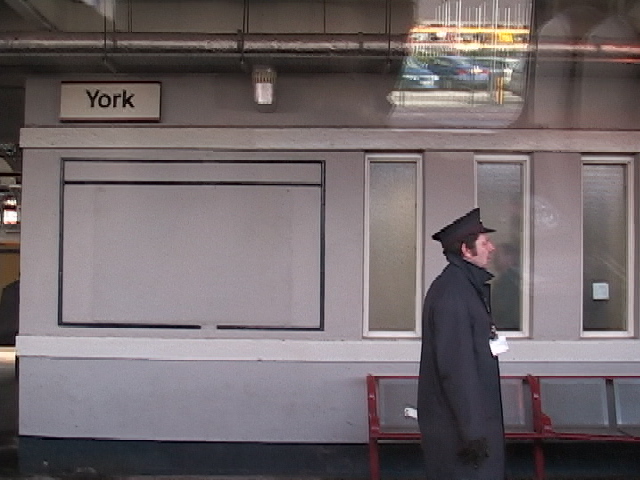
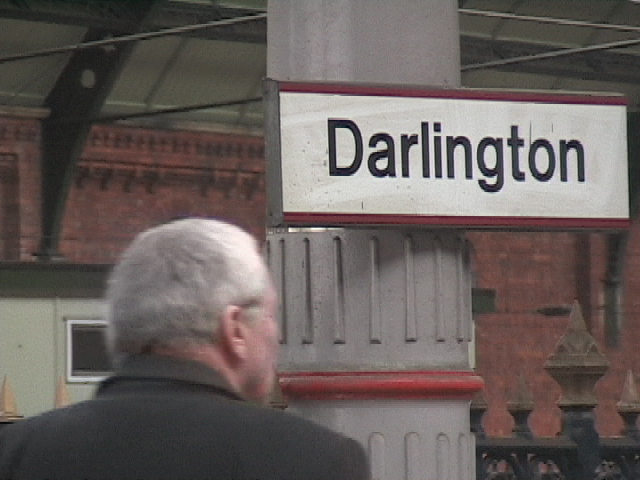
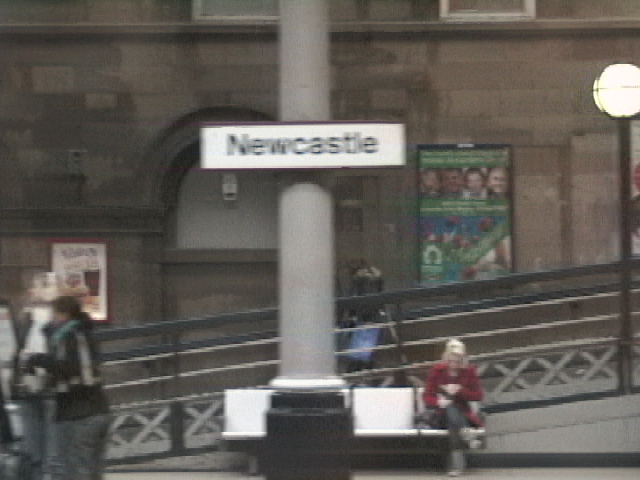
I left Kings Cross station at 10:00 a.m. I rode in the cheap seats, which were by no means cheap. Round-trip the unreserved fare was £98, almost $200. But I had a great window seat, with an outlet to plug in my laptop and use (paid) wireless access, and my cell phone got seamless reception. Along the four-and-a-half-hour route, the train passes through Quaker haven York, leisurely Darlington, coal king Newcastle, and Berwick-upon-Tweed, the northernmost town in England.


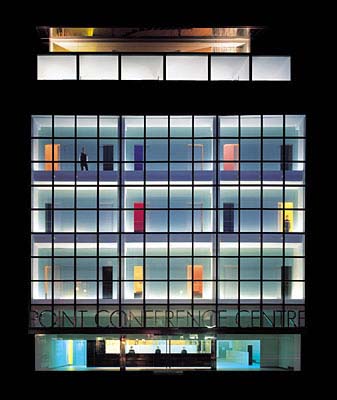
I'd considered not going to Edinburgh at all when I heard it might be snowing there. When I arrived, it was sunny and cold, but I was dressed warmly enough and it was very pleasant. I'd booked a hotel south of the Royal Mile, the main tourist drag. The Point is a modern, Ian Schrager-style hotel in what must be the lap-dancing district, judging from all the go-go clubs near it.


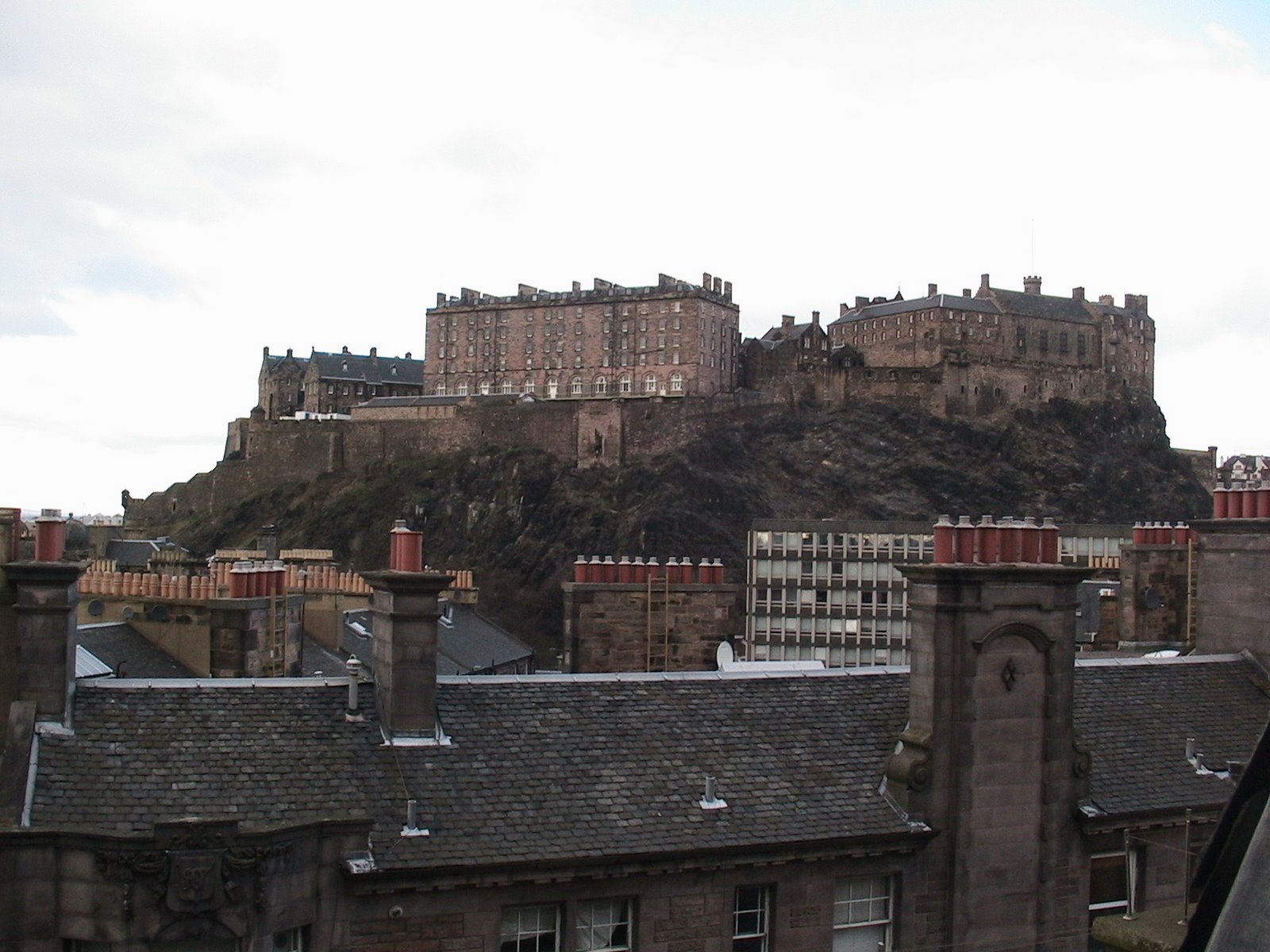
Edinburgh is full of medieval buildings that have largely been preserved and converted to other uses. Banks become bars, clock towers become chocolatiers, and, in the case, of The Point, department stores become hotels. I'd read mixed reviews of the hotel on Trip Advisor. It had just changed owners and the rooms were being refurbished in stages. Anyone who stayed before January seemed to have a uniformly bad experience, while those who stayed after January raved about it. I am with the latter group. My fourth-floor room was modern, with a flat-screen TV and clean lines. But the real gem was my view of Edinbugh Castle. I could almost reach out and touch it.

I was hungry from the train ride and landed at a Caffè Nero (the Starbucks of the UK) on Lothian Road. Much of the service staff in the city is Eastern European, and their accents are hard to distinguish from those of Scots. I ordered a panino. The server said she'd bring it to my table, but after about 10 minutes I could smell the ham and cheese burning in the press. I went to the counter, which now had a long line, and couldn't find my server. Finally she reappeared and I said, "My sandwich?" She turned completely pale, ran to the press, and opened it to find two little charred, smoking pieces of bread. She quickly ran and got another sandwich and this time got it right.

"Aha," I thought. "Is this how it's going to be?"

But after walking along Princes Street, the main shopping and transport drag, in step with the rush-hour bustle, I forgot about my cindered sandwich. The south side of Princes Street has spectacular public gardens that lead to the National Gallery of Scotland and the mammoth Scott Monument, while the north side has the (sadly) obligatory Gap, Disney Store, HMV, and Marks & Spencer but also the stately Victorian department store Jenners. At the end of the strip is the beautiful five-star Balmoral Hotel.

My ex-colleague David moved to Edinburgh from New York last summer. I called him to arrange a time to meet for drinks. He's been having a tough time adjusting to life in a much smaller place, and I was his first visitor since he'd moved there. We had a drink at Tiles Café Bar near St. Andrew Square and then met up with his Irish friend Alan at a bar called The Dome, a former bank. Coincidentally Alan is from the same small town in Donegal as my great-grandparents.

David and I ate dinner at The Olive Branch on Broughton, the gay district. The food was excellent. I had a cassoulet of beans and lentils and tasty Crombie's of Edinburgh sausages and for dessert a sticky toffee pudding that David approved of. ("A bit thin," he said, "but pretty good.)

When we left the restaurant it had gotten considerably chillier. I walked across North Bridge to the Royal Mile, where pubs and clubs were just getting fired up. I thought about stopping in one to have a drink, but it had been a long day and I wanted to get an early start in the morning. I found my way back to The Point and looked out the window at the magnificent castle until I got sleepy.

Labels: , , , , , , , , ,


Continue reading...

Monday, March 19, 2007

Blood is thicker than Guinness

I arrived at Neasden Tube station about 2:15. Anne-Marie was waiting for me outside the turnstiles. I had no picture of her in my mind. I'd asked her a few days earlier her how I would recognize her, but she remained silent. She's about 5'3" with long ginger hair, and we're about the same age.

We walked along the road to the Blarney Stone pub where we were having Sunday dinner. Even though we'd never met I felt like I knew her. She was as sweet in person as in her e-mails.

"I can't help thinking," I said, "that Mary and Ellie had a hand in this."

"I think you're absolutely right," she said. "I think they've met and given poor Fred an earful."

It's interesting to speculate that if there is an afterlife, you might have to spend eternity with those you wronged in this life.

It was Mother's Day in the UK. I brought Aunt Gladys a bouquet of pink and white mums and carnations.

Neasden, formerly a strong Irish enclave in London, is now a potpourri of nationalities, including North African, Indian, Korean, and even Brazilian. You wouldn't know it from the noisy and crowded pub, which was still virtually all Irish.

All of the family members live within several miles of each other, just like my family in New York. First to arrive was Willie, Anne-Marie's husband, to whom Anne-Marie said I bore more than a passing resemblance, and their sons, 15-year-old Ronnie and 18-year-old William, who is an amateur boxer.

Sandra and her daughters Cassandra and Sandy came next, followed by Shonette and her son James, and Colette and her daughter Alex, who brought Aunt Gladys. As soon as I saw Shonette, I saw the family resemblance to my aunt Eileen.


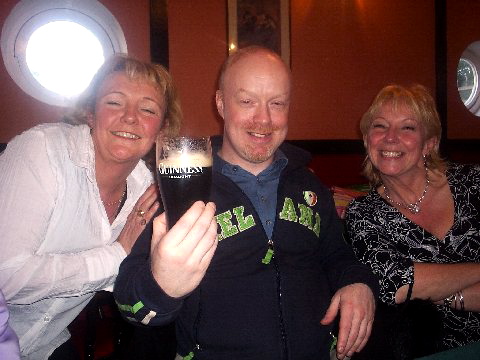
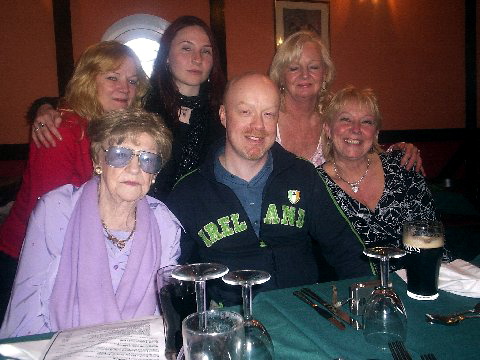
Left: Shonette, me, Sandra
Right: Anne-Marie, Alex, her mother Colette. Gladys, me, Sandra


Left: Me, Sandra, Anne-Marie
Right: Gladys and me


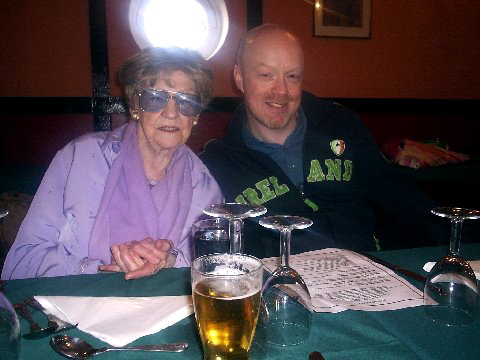
I felt immediately welcome. Everyone wanted to buy me drinks. I think I had three pints of Guinness the whole night. I know it sounds cliche, but I felt like I'd known them all my life. It was like fitting pieces of the puzzle being together to make the picture make sense. I sat between Aunt Gladys and all the daughters and Anne-Marie. They all knew about Luis since I had told Anne-Marie in an earlier e-mail about him. None of them were even the least bit surprised or bothered; in fact, they were disappointed that he was not with me.

Aunt Gladys was very interested in my mother and aunt and was hopeful that she would meet them. She'd had both hips replaced in the last year, and at 83, she was worried about a long trip. No one in the family has ever been to the United States, so unfortunately, many of them still picture New York as a crime-ridden ghetto. I said that such places existed but that they should come see for themselves. Cassandra, who's a very pretty teenager, wants to come to New York to try modeling.

The family, it turns out, has been heavily involved in show business, starting with Aunt Gladys. At the age of 3, she started performing in theaters in Dublin with famous Irish comedian Jimmy O'Dea, who, sadly, is probably best known for playing King Brian in Darby O'Gill and the Little People. Gladys was quite the stage performer. There's a wonderful photo of her in a Mother Goose production. She was like an Irish version of a Busby Berkeley showgirl.

Gladys's son Ronnie is a Shakespearean actor, while daughter Gladys is a video artist. Sandra is a well-known talent agent for identical twins in the UK. She's lining up twins for a new Ewan MacGregor film. Shonette has appeared in re-enactments for documentaries, and Anne-Marie and Willie's son Ronnie played a body double in the Johnny Depp movie Finding Neverland.

Our dinner was slow to arrive. The pub had just changed ownership, and the new owners had not anticipated such a large turnout for Mother's Day. So it took almost 3 hours for the food to arrive. I'd already had two Guinnesses, and my gastrological clock was off by many hours, so it didn't bother me. I was having a great time. My camera decided to die, so my cousins took some photos. You'd never really know we'd just met.

"I would really love to meet Mary Jane and Eileen soon," Aunt Gladys said. I told her that they, too, would like to meet her. She gave me a bag with a gift each for my mother and aunt, a decorative plate that says "Memories of Ireland." I thought of the letter Nanny M wrote to Gladys in the 1950s, to keep remembering Fred as he was and not to judge, because after all, all that is left is memories.

Labels: , , , , , , , , , ,


Continue reading...

Sunday, March 18, 2007

Top it off

"May I top that off for you, sir?" said the attendant, refilling my glass with Charles Hiedsieck Brut champagne as I reclined in my business class seat, my cloth napkin spread on my lap. The lunch appetizer was gravlax with mustard, a fresh fruit salad of grapefruit, melon, and grapes, and a spot of tea. I thought I must be dreaming, considering my situation 12 hours earlier, but I looked out the window at the clear New York sky and realized I was not. I was in heaven.

"Taking off," I text-messaged Luis. "Ta!"

Without my even asking, British Airways upgraded my seat to Club class. I'd flown it only once before, when Luis and I were returning from London and had been upgraded due to a BA error. If I could afford it, I would fly that way all the time.

While on the ticket line, a young, attractive Asian man, probably Indian, explained to me that he absolutely had to get on the next flight out. He was in mergers and acquisitions, you see, and was in the middle of a particularly difficult acquisition. He'd called a meeting of his staff, family men who otherwise wouldn't have had to work on Saturday, and he felt a sense of shame for not being there. To prove his point, he had strategically placed his three bags all along the ticketing line, trying to be in three places at once. Asking us to hold his place in line, he insinuated himself up to the ticket agent, and whatever he did, he got his ticket processed and bags checked and off he went through security. I was a bit awe-struck by his nerve, and even more so that he managed to pull it off.

I perused the brunch menu and decided on a full English breakfast of sausage, eggs, ham, tomatoes, potatoes, and mushrooms. All I'd eaten in the past 18 hours was a sugary muffin and an insipid yogurt and very little water, so massive amounts of protein were welcome. After brunch, served with real linens, silver, and china, I enjoyed a couple of chocolates and champagne. I felt like a rap star.

The attendant, Pascal, who had a mild case of Graves's disease, asked me how I liked my Mac. He was thinking of getting one to produce video. He was a far cry from the frosty British attendant I had back in coach class on the other flight.

After brunch I slept, a deep sleep that lasted several hours. It would not have been possible without the fully reclining seats. No one was sitting in the adjoining seat, and most of the other passengers had been on the same flight as me, or worse. One man I spoke with was supposed to fly out of Newark the previous night. His flight got canceled and he had to stay the night in Secaucus (shudder!), then take a taxi to JFK to get on this flight so he could make his connection to Israel.

Before I knew it, an attendant was announcing our imminent arrival.

"We will be landing at London Heathrow Airport in the next 20 minutes. Passengers on this flight who are making connections to other flights should proceed to our Flight Connections Centre, where staff who are aware of your situation will help you with the necessary arrangements."

This was quite a switch from the earlier chaos at JFK. I chuckled. The British girl on the ticketing line who complained about missing being home in her pajamas was silenced by a Joe Pesci-like BA employee who said to her in as jovial-but-fuck-you manner as possible, "You know if this was London and there was even a little snow on the ground you wouldn't be standing on line at the airport...so we're tryin' to do the best we can."

As a final meal I had Scottish salmon with chive and sour cream potato salad, topped off with a slice of cinnamon apple crumble, and another cup of tea.

The plane landed at Heathrow at 12:55 a.m. Because it arrived after curfew, the plane had to be towed to the gate. The first tractor that came out broke, so we had to wait 20 minutes for another tractor come out. The baggage carousel also broke, and we had to wait for another carousel to open up. At that point, there was nothing to do but shrug.

While at the baggage carousel, I ran into the young Indian man who had pushed his way ahead of everyone.

"Ah, I see you made it," I said. "Did you get upgraded to business class too?"

"No," he said, "I was in business class on the previous flight and they downgraded me to coach." I think Murphy might have had something to do with that.

The only way to the city from Heathrow in the middle of a Saturday night is by taxi. I waited about 20 minutes for a cab. It's about an hour's drive to Islington from there, and the fare was £65 (about $130).

Thanks, Murphy. You had to get that last one in right at the tail end of St. Paddy's Day. But you didn't break my spirit. I raised a glass to you--not porter, but champagne. I arrived in London safely, Nanny M. Just so you know.

Labels: , , , , , , , , ,


Continue reading...

Friday, March 16, 2007

Let me fly!

Is Nanny M trying to tell me something with this treacherous weather? I have been so hopped up about my trip to London I dreamt about it for days. Anne-Marie invited me to Sunday dinner with the family in the Blackbird Hill section of London at a pub called The Blarney Stone. Sunday is Mother's Day in the UK. Aunt Gladys will be there, as will many of my unmet cousins. I am excited, nervous, and choked up all at the same time. I'm not exactly sure why the last, but I suspect it's because of everything I've learned. If I hadn't done all this research and gotten to the core of things, this would be just another trip.

I'm taking the train up to Edinburgh on Tuesday. I'll visit my cousin John and tour around Broxburn and Uphall, where Nanny M was born and raised. I plan to stay there a few days in the city. I can't wait to see Edinburgh Castle and Loch Lomond and the Highlands. If I'm lucky, maybe I'll even see Brigadoon.

So, Nanny, did you help plot the ice storm that's raining down on New York at the moment? Are those your frozen, bitter tears hurtling down from the heavens, telling me not to go? I've come this far. I want to see the heather on the hill.

So far the plane is scheduled to leave on time. Luis is driving me to JFK in a couple of hours. I hadn't expected this would happen on the day I planned to leave, but then so much has happened that I hadn't expected. It's all about the journey, anyway, isn't it?

Labels: , , ,


Continue reading...

Tuesday, March 13, 2007

Waves

My grandmother, or Nanny M as I called her, has been dead now almost 25 years. While my parents worked, she raised me and significantly shaped who I am today. My cousin Denise and I believe that Nanny M guides us on our journey through life. There have been too many signs and too many fortuitous coincidences to chalk up to luck. Now that I've established contact with the other family of her deceased husband, the feeling that she's guiding me is stronger than ever.

I haven't written for the past few weeks because there's been a lot to digest, a lot to let go of, a lot to look forward to. My liaison with the family, Anne-Marie, Gladys's daughter-in-law, has been the perfect medium between us and Gladys. She has handled a delicate situation with nothing but grace and tact. For more than 60 years questions have remained unanswered, truths have been muddied, facts twisted. Many of the players are dead and buried, but for the living the legacy of betrayal and duplicity has persisted like a black cloud unable to rain.

Anne-Marie started the conversation by sending me a picture of Ellie (my grandfather Fred's first wife), Gladys (his daughter by Ellie), and one of Gladys's daughters. After Fred left Ireland, Ellie raised the three children by herself in Dublin. Ellie was 98 years old when she passed away. At the age of 3, Gladys was singing and dancing in theatres all over Ireland, working with a famous Irish entertainer. For many years she worked three shows a day at the Gaiety and Theatre Royal in Dublin, helping to keep the family, earning as much as ten pounds a week. She even worked with Mickey Rooney.

In another exchange, I found out that Gladys had 7 children, my half-first cousins. At some point the family moved to London, and Ellie moved there too to help look after Gladys's children, just as Nanny M helped raise me. Gladys was excited about our connecting and even toyed with the idea of coming to New York to meet us. At 83, though, Anne-Marie related, the trip might be too much for her.

With each new e-mail Anne-Marie sent, I learned more and more about the family. Gladys had letters from Fred to Ellie, diary pages that my great-grandfather Samuel kept during the Boer War, photos of my grandfather and my great-grandparents. It seems that Gladys, like me, is a sentimentalist. I like that about her.

The e-mails were coming steadily for a while. And then, they stopped. Days went by, and I started to worry. Maybe someone had died. Or maybe I had said something to offend them. After all, I had referred to my grandfather as a cad, and maybe they didn't like that. But weren't they the ones who had been wronged? Six days later, I sent an e-mail to Anne-Marie, asking if everything was OK. My aunt, my mother, and I had been hanging on every word she wrote. They waited 60 years for this, and now there was nothing but a pregnant pause in cyberspace.

Finally, on the 10th day, Anne-Marie wrote to say that she hadn't been feeling well. She'd put a hot water bottle on her feet and it had exploded all over her legs, causing them to blister. She was bedridden for the better part of a week. She apologized for being out of touch. I felt bad for her, but I was relieved that we were in touch again. This is what I mean about a delicate situation.

The next e-mail Anne-Marie sent was shocking. In it, Anne-Marie transcribed a letter my grandmother had written to Gladys 6 years after Fred had died. The letter was in Nanny M's hand, dated Sept. 23, 1954. My grandmother told Gladys how the parish priest had called her to come and see him. She did, and he asked her to confess everything she knew about Fred. Up until my aunt was born, she believed she had married an unmarried man. One day she had mistakenly opened a letter she thought was addressed to her but was in fact addressed to Fred. The letter was from Fred's son in Dublin, asking what was going on. Nanny M confronted Fred; he said it was true. She threatened to leave him, and he threatened to kill himself, so she stayed for the sake of her daughters. "I have been waiting to get this off my mind," she wrote Gladys, "and think God is the judge and for my girls sake just keep remembering as he was....The parish priest said he would write you and he said you should destroy this letter after you have read it, for after all, all that is left is memories."

I sat, stunned after reading that letter, and cried for about an hour. I'm sure Nanny M's story is not unique, not by any stretch, but after all, she was my grandmother and I felt for her. I called my aunt and asked her if she wanted me to send the letter to her. I told her she would cry, and she said that was all right, that it was a good thing for her to do.

Anne-Marie said she hoped the letter did not distress us, and it did not. We needed to see it. Gladys, she said, had no animosity toward anyone, that in fact she blamed her mother. Nanny M had always told my mother and aunt that Fred had jumped ship coming to New York. My mother liked to believe that he was escaping some sinister deed he had done, like gun-running for the IRA. In reality, Fred had come over legally and was sponsored by his wife Ellie's uncle. He had come to the States looking for work and had planned to send for Ellie and the kids (two boys and a girl) once he got settled. Many years before he met my grandmother, he returned to Dublin to take Ellie and Gladys with him to the States. They would leave the boys with Ellie's mother and send for them in about 6 months. Ellie refused to go, claiming she did not want to leave the boys, even for 6 months. Gladys thought that in reality Ellie did not want to leave her mother and sisters and instead used the boys as an excuse.

Since Fred was not a citizen, the only way he could get back into New York was to jump ship. It's not clear how he would have brought Gladys and Ellie with him. I can only surmise that Ellie's uncle in New York had died or that something happened to make Fred lose his sponsorship. After he returned to New York, he must have decided to move on with his life, and later he met and fell in love with my grandmother.

The next e-mail from Anne-Marie had a wonderful photograph attached of Fred's sister's wedding from 1920. It was the first time I'd ever seen my great-grandparents in a photo.

In that same e-mail Anne-Marie attached the letter that the parish priest had written to Gladys, which my grandmother had alluded to in her letter. It seems that Gladys had written to the parish priest trying to find out what had happened to her father. She was still unaware of the existence of my grandmother and her daughters, and letters had gone unanswered for years. The parish priest wrote what I think is a rather callous and insensitive letter to Gladys. In part, he wrote:

"I must ask you, in fairness to your father to keep this letter in secret. I am answering your letter, first, that you may have assurance that your father is dead, and second, that you may pray for the repose of his soul. I must, nevertheless, ask you never to write or try in any way to communicate with his children by the present wife. To do so, would destroy your father's reputation and be a gesture of uncharitableness to him and his children especially, since nothing could be gained by revealing to them the misconduct of their father who has passed on."

My aunt was furious when she read the letter, which was written 50 years ago. It's no wonder to me that people have strayed from the Church, when those who claim to represent God pass judgment on a dead person and close the door on reconciliation.

The truth, or a clearer version of it at least, is out now. If my grandmother didn't have closure, at least my aunt and mother will. I am very excited about my upcoming trip to London. I will forget about the ghosts and concentrate on the living. That's how Nanny M would have wanted it.

Labels: , , , , , ,


Continue reading...

Monday, March 12, 2007

The wearing (down) of the green

I like green. I like beer. But I don't like green beer. Nor do I like window displays adorned with leprechauns, shamrocks, and harps. Tired, tired, tired. When did St. Patrick's Day become a season, like Easter or Christmas? Hoboken had its St. Patrick's Day parade on March 3. This past weekend, on a visit to Lambertville, NJ, for the day, I thought I had landed in Dublin. The local bakery had green petit fours in the window. I am sorry, but green cake just makes me think of mold. Shamrocks--stenciled, cardboard, and plastic--were more plentiful than on the rolling hills of Eire. Thankfully, there was no riverdancing in sight.

Even La Villa, the local Italian restaurant around the corner from my house, had shamrocks painted on the windows. I can't imagine the local Irish pub putting up pictures of the Nina, the Pinta, and the Santa Maria on Columbus Day.

Ah well, this St. Paddy's Day I will be in a place where, rest assured, I won't have to worry about leprechauns or shamrocks or green beer: London.

Labels: , , , ,


Continue reading...

Friday, November 24, 2006

The crowning jewel

Despite being a handsome lad, James Scott, the Duke of Monmouth, led a star-crossed life. For starters, his mom, Lucy Walter, was being shtupped by Charles II, though they weren't married. This wasn't a bad thing, except that it's not even clear whether Chuck was his real dad. Still, Lucy and the king may have married secretly, which would have made the Duke the heir to the throne. But then Lucy up and died, and his Royal Hoggishness married Portuguese princess Catherine of Braganza and things got fuzzy.

James proved himself quite capable on the battlefield, and many admirers wanted to see him accede to the throne, not least because he was Protestant, while the throne's rightful heir was Charles II's brother James, a Catholic. When Charles died, brother James became king, and later on James the duke and James the king's forces met in battle. The duke's army was defeated, and he was executed at the Tower of London.

Unluckily for the duke, the executioner, Jack Ketch, was a butcher by trade...and a big drunk. He took eight swings of the axe and still hadn't cleanly lopped off the duke's head. So, he had to get a butcher knife and finish the job.

This was one of the many stories told to me and Andrea by the yeoman warder on our Tower of London tour. If you ever go to the tower, don't do the audio tour; go live.

The story of James Scott had an even more macabre ending. After the duke was buried, someone realized that there was no official portrait of him, so he was exhumed, his head was stitched onto his body, and he "sat" for a portrait. The court painter had a day to finish the job.


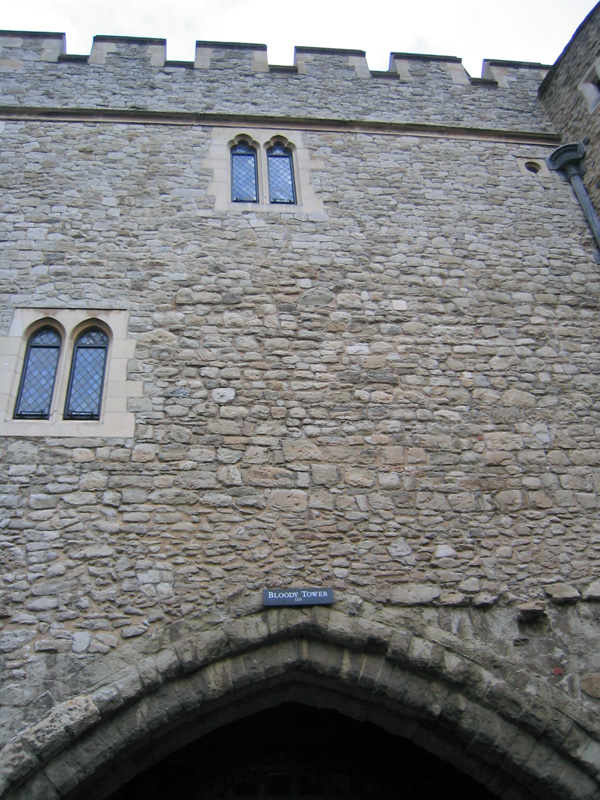
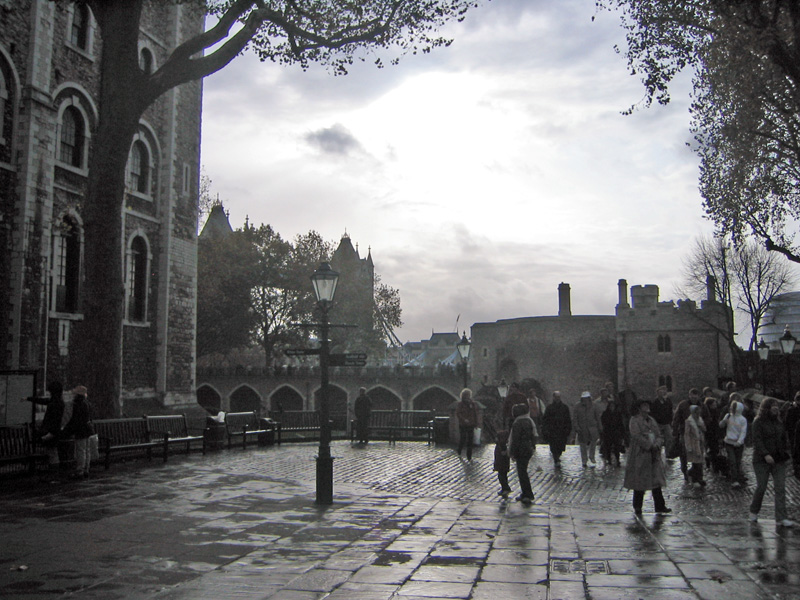
The Bloody Tower


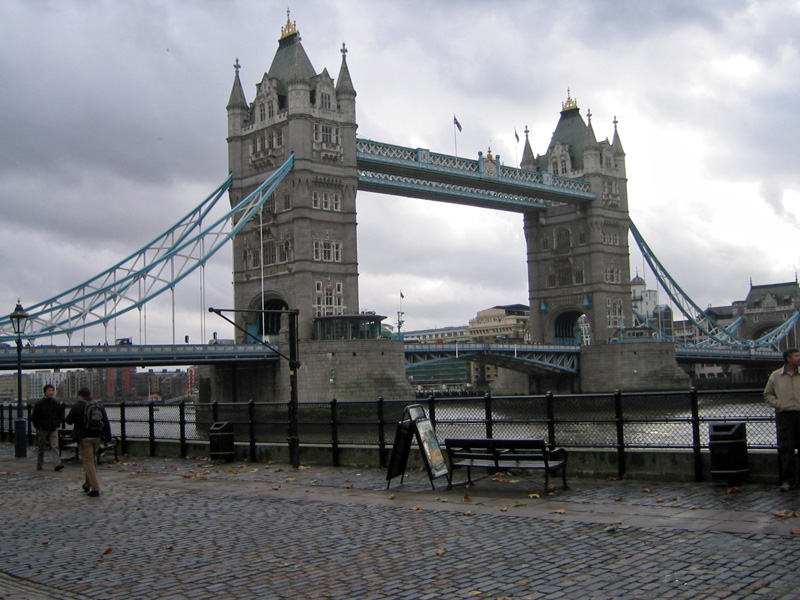
Tower Bridge, across the Thames


The Tower campus, after a shower

After the tour, we wandered on our own into the tower housing the Crown Jewels (the glittery kind, not the naughty kind). I'm not overly impressed by jewelry, but I have to say, these were spectacular. Andrea was surprised that she liked the Imperial Crown of India, since she doesn't like Indian food.

While sitting in the chapel at the end of the yeoman warder's tour, I glanced over at the walll and noticed a plaque commemorating the Royal Fusiliers. It suddenly occurred to me that one of my goals on this trip was to research my great-grandfather's military record at the National Archives at Kew. Once our tour was over, I asked Andrea if she was interested in going, and she was.

It was still early, around 12:30, so we rode about a half-hour on the Tube to Kew, located in a London suburb called Surrey (as in "Surrey down to the stoned soul picnic" or "Surrey with the Fringe on Top"). Kew is also home to the Royal Botanic Gardens, also known as Kew Gardens (not to be confused with the neighborhood in Queens, though strikingly similar in appearance).

The National Archives is a massive but inviting complex. From the time we entered to the time we left, we found everything easy to navigate and the staff friendly and helpful. The first thing we did was apply for readers' cards, photo IDs that are good for 3 years and entitled us to request any holding in the collection. During our brief orientation, the clerk politely added that no food or drink was allowed in the reading rooms, including the gum that Andrea and I were chewing, and that he would passing around a bin for us to deposit it into. In New York they'd say either "Spit your gum out" or, more likely, they wouldn't care. But in the archives, you're not even allowed to bring in a pen for fear that you might accidentally deface the Magna Carta.

After getting our readers' cards, we went through a secure gate upstairs to the reading rooms. I was looking for military records, so I was directed to the War Office records. At the entrance to the room is a series of kiosks where we picked up leaflets instructing us in exactly what we needed to do to find a particular record. I wanted to find the military record of my great-grandfather Samuel Mason, who, according to my mother and aunt, was in the Royal Army Medical Corps and served in the Boer War. That was all they knew about him.

I knew from previous research that Samuel was born in Tandragee, County Armagh, in 1865. Since Ireland did not become independent from Britain until 1922, Irish soldiers were considered British soldiers, and thus his military record would be at Kew. I had done some preliminary research online, so I knew which collections I wanted to look at. After some false starts, I found the paper records I wanted and, with my new reader's card, requested them online. I was assigned a seat in the reading room, and while waiting for the records I could swipe my card at a monitor on the wall and find out me where in the process my records were. The records were delivered to a locker matching my seat number within 20 minutes.

It was coming up on 3:00, and the Archives closed at 5:00. I opened the box of original paper records, and Andrea and I started sifting through them. There were strict rules about handling these very old, sometimes crumbling records, for instance, no licking your fingers to separate pages. That made things a little rough.

The stack had records of about 20 Samuel Masons, none of which matched what I knew. These record were mainly of soldiers who had been discharged dishonorably or due to injury. I didn't know whether Samuel was discharged or died in service, so I sifted through dozens and dozens of records. All dead ends.

"I'm going to have to consult a genealogy expert," I said to Andrea. "I must be missing something."

The crucial piece of information I was missing was whether Samuel was a soldier or an officer. My mother thought he had a been a corporal, but most of the records I had said "soldier." I went to the microfilm room and asked the genealogy expert what other records I might consult. I said I didn't know whether Samuel had served in World War I, but I thought he might be too old by then. She said it was rare but not impossible for men in their 50s to be in active service. She directed me to two collections that might help me: "burnt" records of officers during the First World War and records of officers discharged to pension.

I located the two microfilm reels I thought might work. As in Dublin, I couldn't figure out how to thread the microfilm reader. An elderly gentleman sitting a few readers over heard me complain to Andrea.

"Just a minute," he said brightly. "I'll be right over to help you." He came over and showed me how to thread the reader. "These bloody diagrams don't help," he said. "These arrows can mean anything." Embarrassed and grateful, I thanked him. It was coming up on 4:00 and I wasn't optimistic about finding the record.

"By the way," he said, "what military records are you looking for?"

I explained that quite honestly I didn't know, but I told him what I had looked at so far. "There's the British Army Lists," he said. I said I had looked at those, with no results. "I'm afraid you're going to have to know the regiment," he said.

He walked away, then turned around and added, "Have you looked at the WO 364 records?"

I said I hadn't but that the genealogy expert had casually mentioned them. The man explained how they were organized, since there were two sets of records. He said I should definitely look at them.

"Well, that's about it for me," the man said. "Best of luck with your search." With that, he left.

I threaded the film into the reader and started looking for Samuel Masons. Andrea left to call her friend Susan and would return in a few minutes. It was now 4:15, and I resigned myself that the chances of finding the record were pretty slim.

I flipped through about five Samuel Masons and accidentally forwarded the reader too far. I backed the film up a bit, and the record it stopped on was for a Samuel Mason born in Tandragee, County Armagh. "Regiment of service: Royal Army Medical Corps." And other things matched: his birth date, the name of my great-grandmothe, and his service in the Boer War.

I was so excited I jumped out of my chair and almost let fly a loud, "Yes!" when I saw a big sign that said, "Quiet, please." I sat down again, my heart pounding in my chest with excitement as if I had just discovered the cure for cancer. Andrea had not returned, and the elderly researcher had left. Andrea had not returned, and the elderly researcher had left.

I ran over to one of the reference librarians and asked how I could get copies of the microfilm. I was told I had to go to a different reader that has a printer attached and purchase a copying card. Andrea came back, and I grabbed her: "I found it! I found it!" I whispered loudly. I thought I was going to break into song.

The microfilm reader with a printer was equally challenging to thread. It was now almost 4:30. Finally, I got everything working and started printing out the record. There were 14 pages in all: Samuel Mason's medical history, military campaigns, enlistment and discharge papers, pension schedule, and the Holy Grail: a list of the names, birth dates, and birth places of the children he and my great-grandmother had during his service. My grandfather was one of 9 children! I knew about only one of them previously. The record also listed my great-grandfather's four brothers' names. It was a veritable goldmine of information.

I printed out the last page just as the announcement was made that the Archives was about to close. If I hadn't seen that sign at the Tower of London, it might not have jogged my memory. Getting this record was a tremendous accomplishment for me. If only I'd been able to thank that man for his help.

Later, I couldn't help thinking that Nanny M had guided that man to me. Maybe from the great beyond she wants me to find out the truth about her husband, which she could never do when she was alive. Another piece of the puzzle revealed, another key to my past unlocked, my own jewel in the crown.

Labels: , , , , ,


Continue reading...

Thursday, November 23, 2006

I've been to me!

"I guess they don't celebrate Thanksgiving in London," my mother said rhetorically. "No, Ma," I said, "not any more than they celebrate the Fourth of July."

I've had some nice Thanksgivings and some not-so-nice Thanksgivings. I love turkey and stuffing and cranberry sauce and Brussels sprouts and sweet potatoes. But I don't love the stress that usually goes along with the holiday. This year I just wanted a break. I am thankful for everything, every day. I have my health and a great partner, friends, and family. I don't need the fourth Thursday in November to remind me.

Early in the day I met my boxing friends Jim and Chris. Chris and I sparred a few rounds and had lunch. The turkey sandwich on a baguette I ate for lunch was the perfect Thanksgiving token. At 5:00 I met Andrea at Angel station. "We have to go to Woolworths," I said. Andrea and I both have fond childhood memories of Woolworth's, the five-and-dime stores, in New York during the 1960s and 1970s.

"I hope they have birds and fish," she said. The Woolworth's on Flatbush Avenue sold birds (mostly parakeets and canaries) and tropical fish. It also had a luncheonette that served delicious tuna salad sandwiches. My favorite department was "Notions," just for the name. Woolworth's is where I bought a lot of my 45s, where my mother took me Halloween costume shopping, and where my grandmother bought all of her knitting wool there, which, when I was little, was why I thought it was called Woolworth's.

The American Woolworth's went into decline as competition from stores like WalMart and Target grew, and in the late 1990s the company changed its name to Foot Locker. The British Woolworths (no apostrophe), a subsidiary of the original U.S. company, carries on the tradition of low-rent merchandise aimed at young mothers and children. Andrea was disappointed by the lack of birds and fish. Had she known, she might not have wanted to go in.

The Woolworths on Liverpool Street was already bustling with Christmas stock, including cards, gift wrap, and fake trees (including an unsettling looking black plastic tree). We walked around the store like ugly Americans, taking pictures and goofing around. Our childhood selves inhabited our adult bodies at the giddy thought of being in a place like the one we used to love, even without the domestic pets.

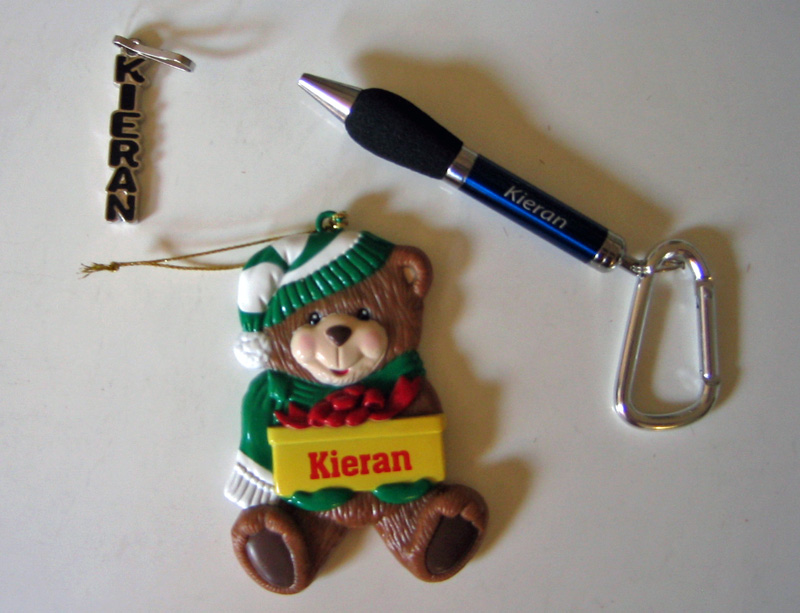
One of the store displays had personalized Christmas ornaments shaped like bears. As a lark, I search for a Kieran bear. To my surprise, there was one. I was so excited! I never find anything in the U.S. with my name on it. The next Kieran item I found was a pen with a clip attached, followed by a zipper pull. There were also a mug and a piggy bank. But there was nothing with Andrea on it, another crushing disappointment for her.


Me, me, me

We had plans to see the 7:30 show of SchwartzStories, a revue of Stephen Schwartz songs, at the King's Head Theatre on Upper Street. Andrea and I got salads at local Italian café Carluccio's, then went back to Niamh and Jan's flat and walked into the dining room. Much to my surprise, a third person was sitting at the table.

"Kieran," Niamh said, gesturing to the mystery guest. "Kieran.

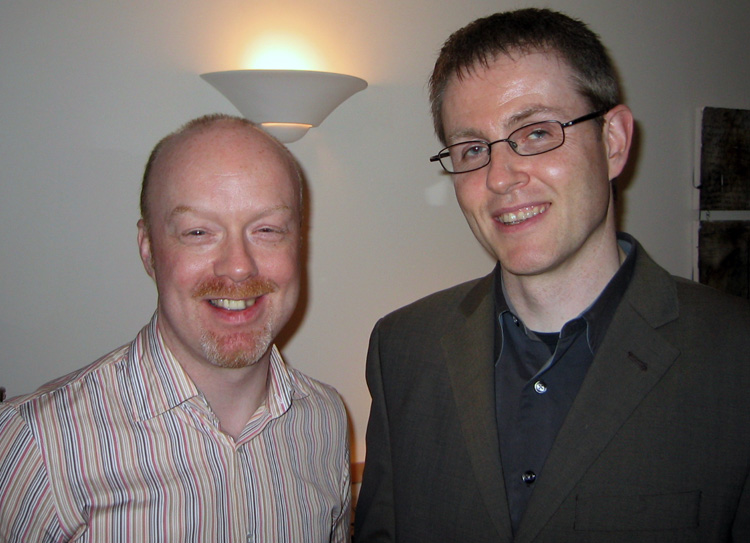
Well, this had certainly been a day of surprise. First I find material things bearing my name, and now I meet a real live-action figure Kieran, complete with a British accent. Since I am shorter than the other Kieran, we were distinguished by the nicknames Big Kieran and Little Kieran.


American or British, but Kieran nonetheless

Turns out we have more in common than our name. Besides the obvious common Irish ancestry, we are both left-handed and have mothers named Mary. Big Kieran is a guitarist and songwriter who performs in London. Check out his music here. He is a real sweetheart.

Stephen Schwartz is best known as the composer of musicals such as Pippin, Godspell, and Wicked. The premise was slightly Mamma Mia-like: weave a bunch of unrelated songs into a story. This staging was better because the numbers were a series of vignettes about love and romance. Some of the songs, taken out of their original context, were used cleverly, particularly the finale of Godspell.

The narrator was Paul Nicholas, who is well known in Britain for his stage and sitcom roles. In the United States, his claim to fame was the top 10 single "Heaven on the 7th Floor" in 1977.

The theater held about 50 people, and the typical audience member was an aging theater queen or a middle-aged womn. One queen had leathery, peach skin and was bedecked in a plaid jacket, velvet pants, thick black frames, frosted "blonde" hair, and jewelry a-go-go. He looked like the love child of Andy Dick and Rula Lenska.

This was one of my best Thanksgivings ever. I didn't overeat, I didn't have to watch football, and I spent the day with friends. And I saw myself in a new light.

Labels: , , , , ,


Continue reading...

Wednesday, November 22, 2006

Trains, planes, and autoreflection

Before leaving for London I checked the fares from London to Dublin. Aer Lingus was running a special for £6 round trip. That's right, £6 ($11). It sounded too good to be true, and it was. With taxes, the fare came out to £45 (about $85). Still not bad for a day's jaunt.

All week I'd been flip-flopping about whether to actually go, even though I had my ticket. Between getting to and from Heathrow and then to and from Dublin, I would spend about 9 hours in transit, with only about 5 hours in Dublin itself. But my burning desire to do family research overtook me, and I thought about the Frances Mayes quote my friend Cathy had sent me before the trip:

"It's not the destinations; it's the ability to be on the road, happy trails, out there where no one knows or understands or cares about all the deviling things that have been weighting you down, keeping you frantic as a lizard with a rock on its tail. People travel for as many reasons as they don't travel...Once in a place, that journey to the far interior of the psyche begins or it doesn't..."

Today marks the 24th anniversary of the death of my mother's mother, whom I called Nanny M. I was extremely close to her. She raised me about as much as my mother did. Nanny M was Scots-Irish, with a heavy burr and a strong will. When I was a child, she went to battle with my father any time he became abusive with me. While both my parents worked she looked after me. I loved staying at her house, my sanctuary from my parents' screaming and fighting. When she died, my cousin Denise and I both believed that she was, and always would be, our guardian angel. I still believe that.

And so, in her honor, I rode the Tube to Heathrow for an hour, waited an extra hour for my delayed flight, took a cab into Dublin, and went to the General Records Office (GRO), where vital records are stored. I wanted to uncover more family secrets and assemble more pieces of the puzzle. Dublin was where my grandfather left his family--his wife and three children, aged 8, 4, and 2--when he embarked for the States in 1925. Why did he do that? What was he running from? Why did he never return?

I knew I couldn't find those answers in a day, and maybe I'll never find them. But I came to get the facts, like birth and marriage dates, which were easier to come by.

The weather in Dublin was gray but mild, in the 50s. The reading room at the GRO was busy. Most of the information I'm looking for could be easily found at the Mormon family history centers in New York, but coming to Dublin, to the source, is more rewarding. Seeing all of these other people searching for keys to their past reminded me of what my other grandmother, Nanny O, used to say: "What's bred in the bone comes out in the flesh." In other words, nature trumps nurture.

My goal for this trip was to find as much information as I could about my great-grandparents. I was quite successful. I found Nanny M's mother's birth record, as well as the marriage records of both of my paternal great-grandparents. I have now gone back a full five generations and have partial info about the sixth. People always ask me why I'm doing this. The answer is, I'm not really sure. But I have some theories. For one thing, I truly enjoy it. I get an endorphin rush every time I find a major clue. And at 44, I realize I'm probably the end of the line, unless an immaculate conception takes place. My nephews will carry on the bloodline, but it won't be completley mine. I want them to know where they came from, should they ever be curious. I do believe that personality is largely genetic. But more than that, in doing this research I've learned a great deal, about history and family and character and circumstance. If my grandparents had not come to this country, obviously I wouldn't exist, but in whatever form I might have arrived on this earth I'd probably be milking a cow in Tipperary.

I lost track of time at the GRO, and at 3:45 I decided to head over to the National Archives to look up a few census records. I didn't know how long it would take to walk there, and by the time I arrived it was almost 4:15 and getting dark. The security guard was very nice. I asked him if there was any chance I might be able to get to the reading room, that I was only in town for the day and I knew it was late but...He gave me a form to fill out, and I rushed up to the fifth floor to see if anyone could help me. The staff acted with a sense of urgency. One of the clerks helped me look up the census record online and pointed me to the right microfilm drawer. He showed me how to thread and operate the microfilm reader, which was not easy. About halfway through browsing I realized this was not the right record, so I rewound the reel, exchanged it for another, and tried to thread the reader again. This time I could not find anyone to help me, and next thing I knew, the reading room was closing. I had the right record in my hand, but time ran out.

I was somewhat dejected, since I thought that getting this record would shed light on my grandfather's shady past. So, I went to a pub in Temple Bar called Fitzsimon's, which was staffed largely by Eastern Europeans, and had a pint of Guinness and a plate of fish and chips. Afterwards, I walked along the Liffey, amid the bustle of nightlife. Dublin really is a city of the young, and the energy level is high.


The Liffey at night

It was after 6:00, and my flight was leaving a little after 8:00. If I'd had more time, I was going to try to track down the house in Stoneybatter where my grandfather's family lived in the 1920s and take a picture of it. It wasn't far, but it was getting late. Some other time, I felt Nanny M say, some other time. I walked up to O'Connell Street and thought about taking a taxi. Instead, I tracked down an AirLink bus that cost €5 ($6.50). It took 40 minutes. I got to the airport early, bought an armload of Butler's Chocolates, and eyed some hot Irish rugby players. I got back to London around 9:30 and took the Tube back to Islington. The ride was almost an hour long. I'd been traveling since early in the morning, and I was tired, but I was glad I'd made the trip. And I was glad to be back in London, one of my favorite places, a place where a British woman's pre-recorded voice announces matter-of-factly "This is a District line train terminating at COCKfosters"?

Labels: , , , , , ,


Continue reading...

Tuesday, November 21, 2006

Beholder of the Eye

It looms over the river Thames, seeming to follow you wherever you go. Despite its relatively recent appearance, it seems it has always been there. The London Eye, a 443-ft-high ferris wheel on the South Bank of the Thames, offers 360-degree views of London. Admission is not cheap (£15, almost $30), but it's worth the price. The Eye is a kaleidoscope that gives riders a new perspective on an old city.

Andrea and I met in front of the National Gallery, at Trafalgar Square, around 10:00 a.m. The weather was, as it had been since our arrival, stunning. How can you quibble with a sunny day in the 50s at the end of November? We both noticed there were almost no pigeons in the square. The last time we visited together, the pigeons made Alfred Hitchcock's "The Birds" seem almost sanguine. A few years ago Mayor Ken Livingstone waged war on the birds, making it illegal to feed them. Residents fought back. Eventually a deal was struck: the city would feed the birds early in the morning if others would stop scattering their own seed. This arrangement appears to be working.


Wingless Trafalgar Square

From Trafalgar we walked to the North Bank and across Hungerford Bridge to the South Bank.


Hungerford Bridge

The walk to the Tate Modern was long, but we had a clear view of the Thames and the North Bank. London is more adventurous than New York in embracing nontraditional architecture. But I'm not so sure I like some of the results. Neither of us liked the Swiss Re building, known as The Gherkin, which to me just looks like a giant vibrator. Though I admire the concept, I didn't care for the London City Hall, another cornerless building that looks like something out of Independence Day. It looks out of place among the medieval and neoclassical structures around it. I guess I like my buildings to have edges.

While walking along the South Bank we were stopped by a friendly British film crew who were doing some sort of "viral marketing." They asked us if we wanted to record a Christmas greeting to anyone we wanted. I thought it would be cool; Andrea reluctantly went along with it. I waved and said, "Merry Christmas from London..." (original, huh?) and Andrea added, "...two days before Thanksgiving." Funny, because in New York if someone accosted me like that I'd ignore them. I'm waiting to receive a link to the video on YouTube. Once I have it I'll post the link.
We finally arrived at the Tate Modern, housed in a former power plant. Near the entrance is Fischli and Weiss's piece How to Work Better, which mocks trite corporate philosophies and reminds me of Jenny Holzer.

I'd been to the Tate Modern when it first opened and liked the space very much. I wasn't sure whether I liked the organization of art, but this time around I warmed up to it. The Poetry and Dream level, for instance, features artworks by such disparate artists as Dali, Klee, Calder, and Pollock. It takes some getting used to.

Carsten Höller's interactive installation Test Site 2006 is a fun piece. Consisting of a series of enclosed slides, the exhibit encourages museumgoers of all ages to slide to the bottom from different levels. Adults and children alike enjoy it. I thought about sliding, but the lines were kind of long.

The museum was full of children on school expeditions. Each gallery had at least one group of little kids sitting on the floor with crayons and paper busily looking at the artwork and drawing their own. Andrea remembers going on such trip as a kid, but I do not. I think I just drew all over my parents' walls instead.


Fischli & Weiss, How to Work Better; Carsten Höller, Test Site 2006; kids drawing in a gallery

When we left the museum it was raining heavily. Luckily there was a restaurant nearby where we could have lunch. In keeping with my lack of regard for nutrition on the trip, I had fish and chips and a Stella Artois.

After lunch, the rain let up. Next stop: The London Eye. The Eye is interesting from so many different perspectives it's hard not to photograph it. I had been on the Eye shortly after it opened in 2000; Andrea had never been on it. It's an impressive piece of engineering. You enter a capsule on the ground that holds 10 to 15 people. You ascend slowly, almost imperceptibly, to the top, where you get a sweeping, 360-degree view of the Thames and the whole city. The whole time you keep thinking, when are we going to move? But before you know it, half an hour later, you're almost on the ground again. Well worth the price of admission, even the second time around.
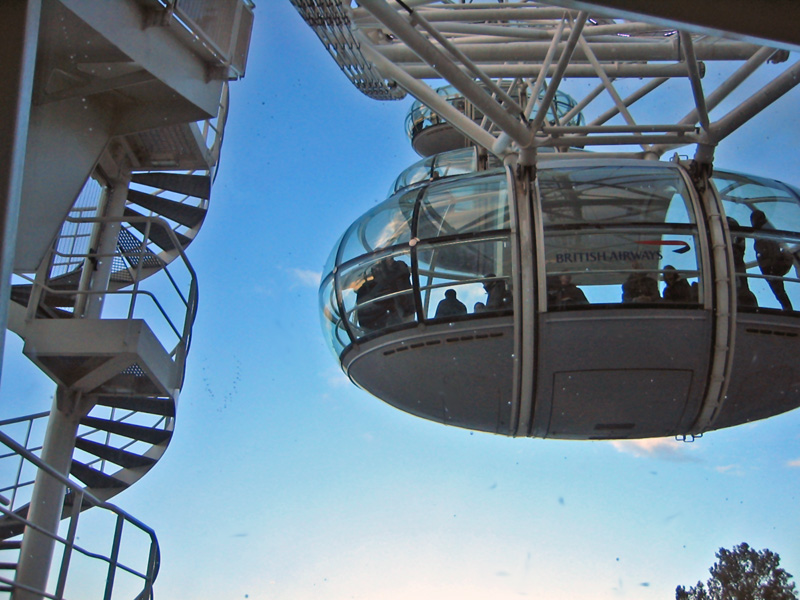
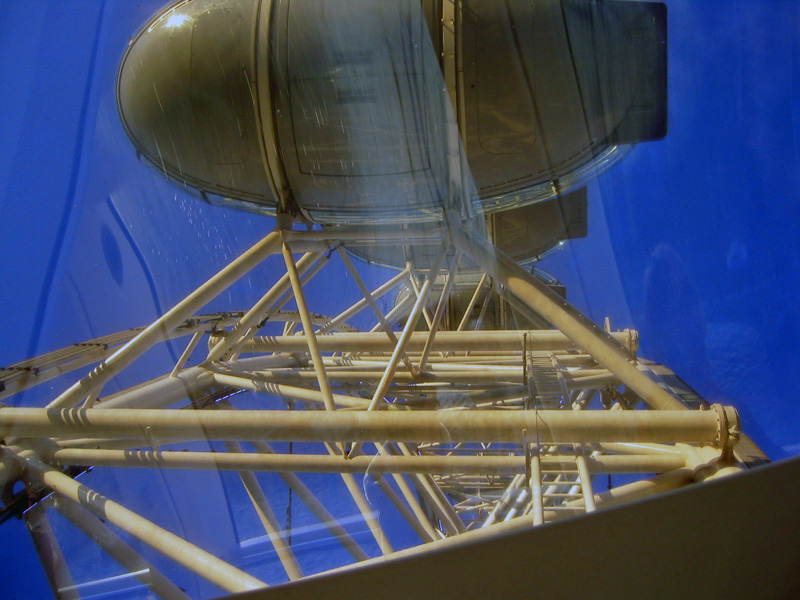


Top: Eye pods
Bottom: Southeast view of the Thames; Andrea and the Eye; me and the Eye
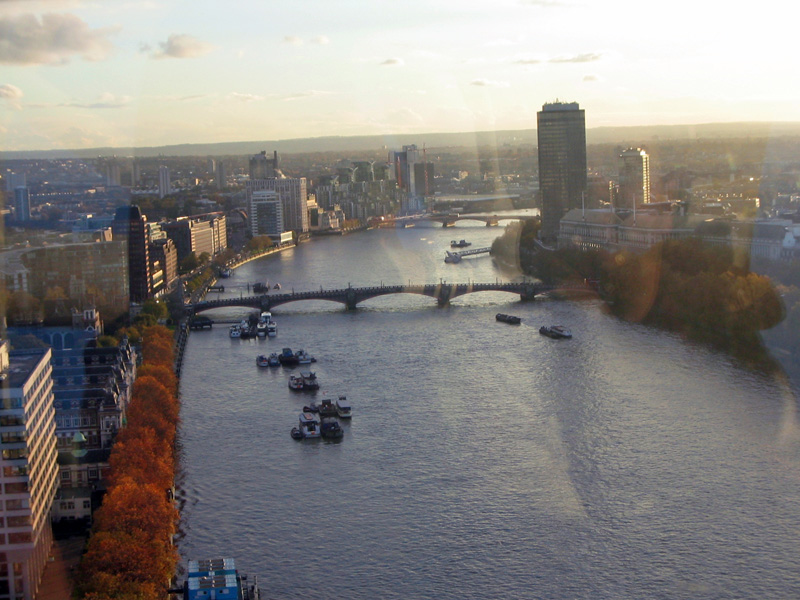
About halfway through the trip, I got a text message from Luis, 3500 miles away: "What was the name of Bea Arthur's character on Golden Girls?" It was sweet, really, that Luis would spend 80 cents to ask me something he could find on Google for free. I felt so...needed. I wrote back, "Dorothy...from the London Eye." As Andrea always says, it was an extra gay moment.

As we descended, a camera snapped our picture. Naturally, we bought them as souvenirs. We stood in line at the photo booth behind a rather stout, elderly British woman. "It's just like having your picture taken on a roller coaster," I said to Andrea. The woman ahead of me laughed. "I do not think," she said, "that I should like to see such a picture. There are parts of me that I simply would not want flying in front of my face."

We got to chatting, and the woman asked if we'd seen the Dalí exhibit at County Hall, a semicircular building situated right below the Eye. We said we had not seen it but that we would. Dalí is one of my favorite artists. I've been to the Dalí Museum in St. Petersburg, Florida, and have seen a number of major shows in Spain and the US featuring his works. This exhibition was very different, focusing on his sculpture, furniture, and lithographs, most of which I'd never seen before.


Entrance to Dalí Universe exhibition

Andrea's and my favorite piece was the famous Lobster Telephone, an old-fashioned rotary phone with a painted plaster lobster perched atop it as the handset. The caption read: "I cannot understand why at the restaurant when I ask for a grilled lobster, they never serve me a telephone." We both thought it was hilarious. Obviously Dalí is not for everyone. You either get him or your don't.


Andrea and Westminster Abbey

Our last art stop of the day was the magnificent Velázquez exhibit at the National Gallery. Velázquez is another of my favorite artists, along with Caravaggio, Rubens, and fellow Spaniards Goya and El Greco. The exhibition follows Velázquez's career as a young painter (his teenage works are remarkable in their skillfulness) up to his last days. Considering the unattractiveness of many of his subjects (the Habsburgs, the ruling dynasty in Spain, inbred themselves out of existence), his paintings are quite flattering. King Philip IV, for instance, looks not unlike Herman Munster. His masterwork Las Meninas was not in the exhibition. It never leaves the Prado in Madrid.

Lest anyone think I'm all highbrow for liking Baroque art, I'll shatter that image by confessing that one of my favorite pieces by Velázquez is The Forge of Vulcan, because, well, Vulcan looks kinda hot.

Kayo's Equivalence Theorem: Whether it's in the eye of the beholder, or in the beholder of the Eye, beauty is everywhere.

Labels: , , , ,


Continue reading...

Monday, November 20, 2006

The isle of grease

It used to be that when visitors to England would rave about London, they would say how mod, how stately, how mannered, how cosmopolitan. But when the subject of food arose, the accolades fell short. Right. Well, what could you say? Steak and kidney, fish and chips, chip butties, shepherd's pie. The British put the "die" in "diet." With fare such as deep-fried Mars Bars, the route to arteriosclerosis is even faster.

My first visit to London was in 1983, when I was a poor, starving college student. The culinary choices were limited, and most of what I ate was prepared by a Brit. It was generally boiled, bland, and gray, much like the cooking I grew up with. Give me the water you boiled those vegetables in, Ma, I used to say. It's more nutritious. Mercifully, times have changed, and in Islington alone, besides traditional pub fare, you can eat amazingly good Indian, Italian, Turkish, Afghan, Mexican, French, Thai, Moroccan, and Kurdish food. Vegetarian eateries exist, but even mad cow disease couldn't keep consumption of beef from disappearing. And if none of those appears to you, you can go to any one of the five Starbucks on Upper Street.

Most of the day I spent recovering from a severe case of jet lag. I met Andrea for a late afternoon snack at an Islington gastropub called The Elk in the Woods. The Brits are unabashedly enigmatic and corny in their naming of pubs. Take, for instance, The Leg of Mutton and Cauliflower, The Poosy Nancies, The Inn Next Door Burnt Down, and my favorite, Muscular Arms.

Hardly anyone was in The Elk when we arrived. It's situated on Camden Passage, a four-block-long arcade that runs parallel to the bustling main road, Upper Street. The pub sits among antique shops, newer, upscale eateries, and football pubs. You could easily pass it without noticing it, which is what attracted me to it. The rest of Islington is like New York's SoHo, eternally crowded and swarming with hip, young people who come there to eat and shop.

The staff at The Elk appear to be former residents of the Soviet Union. When we walked in, we were welcomed like we'd been regulars for years. I've read an overwhelming number of negative reviews saying the food and the service are crap, but Andrea and I found both to be just the opposite. Maybe we're just New Yorkers with low standards. One reviewer referred to the place as a "higgeldy-piggeldy sort of room." I have no idea what that means, but the review was positive, so I take it that's good. Granted, we arrived before the evening rush, but our waiters were friendly and fun, and the food and drinks were great. We both drank Moscow Mules--a sickly sweet concoction of vodka, lime juice, ginger ale, and something red (raspberries?)--and ate hummus, calamari, and tomato and mozzarella salad.

Since I arrived the other day I've drunk nothing but tea and alcohol. My body doesn't know whether it's up or down. At home if I were on that sort of diet I'd be popping aspirin. My jet-lagged sleeeping patterns still kicked in at eastern time.

We ate just enough to tide us over until dinner at Wagamama, a popular chain of Asian noodle shops in the UK. Diners sit at long picnic-style tables on benches, and the menu features gyoza, ramen, and teppan, and it's all good. Now, when I return from London and people ask how it was, I can add, how delicious!

Kayo's Axiom of Stimulants and Depressants: For every pint of beer and cup of tea consumed on vacation, the body remains in a constant state of equilibrium when accompanied by generous portions of greasy food.

Labels: , , , ,


Continue reading...

Saturday, November 18, 2006

A slow, sloe journey

For me, the worst part of traveling is not knowing what awaits me at the airport. Just to be on the safe side, Luis drove me and Andrea to JFK Airport about 4 hours before our redeye flight to London was scheduled to depart. It took us about 12 minutes to check in and go through security. The longest part of that time was spent taking our shoes off and putting them on again. Then we discovered our plane was delayed an hour.

A sleeping aid and a pint before takeoff put me in a semi-catatonic state for most of the flight. Andrea and I were seated in the very last row of the plane. We got served first and were right next to the toilets. This was nice until the morning when everyone lined up to freshen themselves. I'm still nursing the bruises from some elbow shots to the head.

Apart from a highly unfavorable exchange rate for Americans (currently, 1 GBP = 1.91 USD), being in London is tops. The weather was beautiful--50 degrees F (that's 10 degrees C, for international readers), no rain in sight. We took the Tube from Heathrow into town. It's the cheapest way to go (£4) but also the longest. Andrea had to go all the way to Enfield, which took almost 2 hours. For me, it was a little over an hour to Islington, where my friends Niamh and Jan live. At Leicester Square I had to change to another line. Extricating myself and my 800 pounds (that's 362 kilograms...) of luggage wasn't easy. Up an escalator, through a passage, up another escalator to the transfer point. I discovered that the branch of that line doesn't go to my stop. So, off again to another line and finally to my stop, Angel.

When I arrived, Niamh and Jan were thinking of going to their country home in Suffolk, a little over an hour from London, for the night. What the heck? I said. By then I'd been traveling a total of 15 hours (20 if you count the time difference), so what was an extra hour. I figured I could be one of those people who keep traveling, never reaching a destination. So we went to Suffolk by car and arrived just in time for drinks. Niamh had been making sloe gin for about a month, so we had a little of that. When I was in college, my drink of choice was a Sloe Gin Fizz, which I thought was cool because it was served in a frosted Collins Glass. (Eventually I realized it was just very girly.) Jan and I each had a bottle of a local microbrew, and about a half hour later we went to the Royal George down the road for a pint. It was nippy out, and I vaguely remember returning to the house. Niamh had just finished making blackberry brandy and gave us a shot. After dinner, we each had a shot of Maker's Mark, which I'd brought over for Jan in lieu of his favorite whiskey. I don't remember much after that, except that my eyes snapped open in bed at 3:30 a.m., without the slightest bit of a hangover.

Kayo's Paradox of Recreational Intoxication: While on vacation in a foreign land, the severity of hangover is inversely proportional to the number of hours of sleep deprivation. (I'm sure some will have what to say about this.)

Labels: , , , ,


Continue reading...
Hosted by www.Geocities.ws

1