Saturday, October 11, 2008

Bailing our eyes out

I try hard to not look at my 401(k), but I can't help it. Even after putting most of my meager fortune into fixed income, I watch it spiral downward each day like a banker on his way to meet the pavement. Thankfully I'm not anywhere near retirement, but I do wonder what the markets will look like when I get there.

I don't play the stock market, since I've proved time and time again that I'm no good at it. I got into the market at the tail end of the dotcom boom. I didn't understand what on earth I was doing. When eBay went public in 1998, the anticipated $18 share price blasted up to $53 before falling back to $47 the first day. A few weeks later it had settled down in the $20s, and I remember saying to Luis that buying it probably didn't seem like such a good deal after all. So I missed that boat.


So now almost all of our money is in real estate, the building that we bought with our friends 3-1/2 years ago. In 3-1/2 years you can build hotels and condo buildings of much greater size, apparently. Our little shanty has been tied up in some sort of bureaucratic morass since we've owned it. It took a year and a half to get a zoning variance, and for the last 2 years we've been paying various other agencies to get permits, approve plans, and bicker over things like whether we should be allowed to have Juliette balconies (they are classified as "obstructions"). We had hoped to be well into construction by now, but the most we've gotten is a gutted shell that will need to be razed completely anyway. And we've already laid out more than $100,000.

Now we are about to attempt to get a construction loan in the middle of a serious financial crisis. The contractors' bids have come in, and we're meeting with our architect next week to figure out our options. Luis spoke with a banker yesterday who said that we might be able to get 60 percent financing, which is better than a kick in the teeth, but that means we'd have to collectively front about a half-million dollars.

I'm seriously thinking of writing to HGTV to see if they'd be interested in our project. Or maybe Warren Buffett will come to our rescue.

To celebrate Luis's birthday, we're going to Danny Meyer's Shake Shack, where burgers cost $3.75. Desperate times call for delicious measures.

Labels: , ,


Continue reading...

Tuesday, August 12, 2008

Terminal disappointment

In the final scene of Love, Actually, hordes of hot, smiling people swathed in flattering lighting and fresh makeup come bouncing off planes into Heathrow, and it makes you think, "Damn, international travel is sexy!"

In Rome, Dublin, London, Singapore, Tokyo, Vancouver, and even Paris, I've never had problems figuring out where I need to go. The arrivals halls are usually well designed, with clear, well placed signs. Passport control (a more civilized term than Immigration) is well managed, except at Charles de Gaulle, where queueing is optional, and agents are usually helpful and courteous. ATMs, restrooms, food, and transportation options within sight.

And then there's JFK.
Compared with other international airports, arriving on an overseas flight at JFK is like being on the Dating Game. When you get to the other side of the wall, it can be highly disappointing. Whenever I come back from somewhere else, I brace myself for unhelpful employees, surly customs agents, and confusing signs. I'm not surprised, but I expect better.

The BA departures hall is all right, but the arrivals hall is dismal. Imagine it's your first time jetting in to New York and you're looking forward to bright lights, big city. Instead you enter what looks like a prison waiting room, or worse, the department of motor vehicles. The waiting area looks like an afterthought. If, like we did, you have to wait over an hour for your party to arrive, there aren't a lot of options. You need bionic vision to figure out where the restrooms are. And let's not even talk about what those are like, shall we? There's little thought given to what people might expect once they arrive. After enduring the trifecta of endurance--Immigration, Baggage Claim, and Customs--you'd think you'd get a cheery welcome. Oh, you get a cheer all right--a Bronx cheer. Sucker!

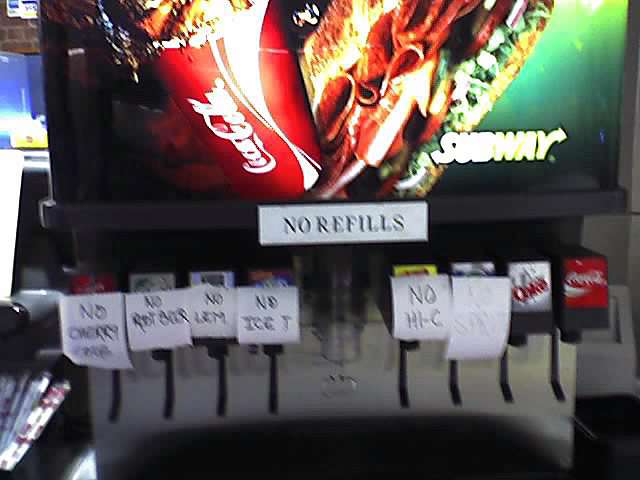
The only kiosk open when we were there was a Subway. I took a picture of the signs on the soda machine, which exemplified JFK's commitment to quality of service: No Cherry Coke, No Root Beer, No Lem., No Ice T, No Hi-C, No Sprite. NO REFILLS. Only Coke or Diet Coke. You don't want that? Fuhgeddaboudit! Welcome to New Yawk.

Next!

Labels: , , ,


Continue reading...

Saturday, August 09, 2008

A world away

Luis took me with him on a real estate listing today to a six-story building in the Flatbush section of Brooklyn, the neighborhood I was born and raised in. When I saw the building again, it brought back to me an extraordinary incident that happened there, coincidentally 33 years ago to the day, an incident that for me symbolized the end of my innocence.

I vividly and fondly remember my childhood in Flatbush in the 1960s and 1970s. I wouldn't have traded the experience for anything else. We lived in a six-story building on Ocean Avenue called Ethel Arms (which Luis likes to call "Ethel Flabby Arms"). Ocean Avenue was once a sleepy path leading to Sheepshead Bay, but in the 1920s, as immigrant waves kept rolling in, high-rise apartment buildings sprouted all along the avenue, urbanizing it. When I was growing up, Ocean Avenue was a four-lane street, and the most popular sport was dodging cars to get to the other side. Once across, you entered Ditmas Park, where the scenery changed markedly and you felt like you were in the country.

The side streets were--and still are--lined with shade trees and stately Victorian homes dating from the early 1900s. The nearby Pink Palace in Sophie's Choice exemplifies those homes. Erasmus Hall High School, alma mater of Barbra Streisand, Susan Hayward, and Donny Most, was the closest public high school. Movie stars such as Douglas Fairbanks and Mary Pickford lived in Flatbush around the time it urbanized. By the early 1970s the only famous local residents I knew of were Tiny Tim and Miss Vicki, a few soap actors, and Barry Manilow and his mother. The giant, fenced-in house across from my building was purportedly the home of a porn director, but I never knew whether that was true.

I always felt safe growing up in Flatbush, and evidently so did my parents, since they let me play unsupervised out on the big, open dangerous street. We weren't really unsupervised, as hundreds of invisible pairs of eyes somehow managed to report unseemly activity to our respective parents. Assaults and thefts were rare, but there did seem to be a fair amount of arson. On Hallowe'en my mother and some friends' parents would escort us to select homes around the neighborhood, including the Ebinger house on E. 19th Street. For those unfamiliar with Ebinger's, it was a family-owned bakery famous for its chocolate blackout cake.

The local movie palaces were the spectacular Loew's Kings (Baroque) and Rialto (Beaux-Arts) theatres, both now houses of worship. I realize now how magnificent some of the local architecture was. I remember old ice-cream parlors like Karp's on Flatbush and Newkirk, where my mother would get me a little cup of Coke syrup to combat an upset stomach.

At the time, I was unaware that the rest of the world was not like mine. Mine was what would be categorized today as "diverse"--a concept that is now enforced politically rather than organically. My building was like a mini-United Nations of different races, religions, and family status. The Pavlicases were a middle-aged Greek couple whose apartment smelled of cardamom, anise, and cumin. Our Jewish neighbor Miriam was a housebound single hemophiliac living with her 80-year-old widowed mother. My best friend, a black girl named Angela Barnes, had a white mom and a black dad. Glenn was a soft-spoken Jamaican man who I think was probably gay. I had friends who were Argentinian, Chinese, Haitian, Italian, Irish, Norwegian, Puerto Rican, Russian. I started studying Spanish on my own when I was 11 by sitting with El Diario and a Spanish dictionary so I could try to understand the Hispanics around the corner. Later, when we moved to an all-Irish block in Sunset Park in my late teens, I realized that worlds like mine were the exception rather than the rule.

In the summer of 1975, I was in love with a beautiful Trinidadian girl named Allison whom I'd been hanging out with for 6 months. When people ask me whether that wasn't a sign that I was straight, I remind them that we were both 12 and neither of us had gone through puberty yet. When we'd watch "Gidget" movies together, I was far more interested in James Darren than Sandra Dee.

Every Sunday morning I went to 10:00 mass at Our Lady of Refuge Church. I sometimes served as a lector, reading from the New Testament before the priest delivered the Gospel reading. I was a faithful churchgoer, a good little Catholic boy who never questioned authority, at least not until much later.

That was the first summer I had been allowed to cross Ocean Avenue by myself and play at my friend Chris's house on E. 19th Street between Ditmas and Newkirk avenues. I had a pretty large group of friends of different ages and backgrounds, and we all hung out together, forming cliques and clubs and factions but in the end always coming back together. Ditmas Park was like living in a suburban community without the sameness. On summer nights a big group of our friends would divide into teams and play Ring-o-levio for hours, using the 16-block grid of Ditmas Park as our playing field.

On August 9 of that year, the news broke that Sam Bronfman, a son of Seagram's heir Edgar Bronfman, had been kidnapped. At first there were reports that Bronfman was tied up in a cave somewhere, but then it was discovered that he was being held in an apartment building right around the corner from our building! My friends and I stood on the corner for long periods, trying to see if there was any action, but all we saw were black cars with tinted windows waiting for something.

One night, a news reporter said that one of the kidnappers was Dominic Byrne, the father of one of my classmates, Tommy. Everyone in the area knew Mr. Byrne, a small, slight Irishman who used to own a liquor store on Newkirk Plaza and then became a limo driver. No one could believe that he could be involved in such a caper because he was so unassuming. There was hushed talk of homosexual activity between Tommy's father and the other kidnapper, a fireman named Mel Lynch. (Lynch later claimed in court that he and Sam Bronfman had met at a gay bar and had been lovers and that Sam was a co-conspirator in the kidnapping, an allegation that was never proved.)

At church the following Sunday, the priest asked everyone to pray for Mr. Byrne, an upstanding usher known to everyone in the community. It was all anyone talked about for weeks. When school started a month later, Tommy wasn't there, though I think eventually he returned after the publicity had died down. Tommy's father went to prison for 3 years, for extortion, not kidnapping.

When I saw the building that was the scene of the crime yesterday I felt a little sad. It was the first time I realized that the kidnapping symbolically signaled the end of the Flatbush I had known and loved, or maybe I'm just older and more cynical.

In October 1975, New York City went bankrupt, and the federal government refused to bail the city out. Garbage piled up on the streets, and crime spiked as cops became scarcer. In 1976 the brand-new 10-speed bike I got for graduation was stolen from me at knifepoint in broad daylight on Ditmas Avenue, half a block from my building.

By 1977, the burning of Bushwick during the NYC blackout and the Son of Sam shootings were further emblems of the city's ailing health. Many of my friends and their families were moving to the suburbs or to other states to escape the worsening climate. My mother was mugged in the vestibule of our building, and my father had his wallet stolen several times. And then, the coup de grace: some random teenager picked up my 8-year-old brother and dropped up him on his head on the grass down the block for no apparent reason. In September 1977, we said goodbye to Flatbush.

It was strange walking around the area. I found a faded patch of concrete where a bunch of us had etched our initials in the then newly paved sidewalk. And there was the fence--or was it the fence?--we climbed over to get to our favorite hiding place during Ring-o-levio. Everything looked the same as it did 30 years ago, only smaller and less magical. Today I live only 3 miles from my childhood home, but in so many respects it's a world away.

Labels: , , , , , , , , ,


Continue reading...

Thursday, November 22, 2007

A lot to Bear

When people asked me what I was doing for Thanksgiving this year, I matter-of-factly said, "Nothing." That was the truth. Every year since I turned 21 I've done something different. Last Thanksgiving I spent in London with Andrea while Luis was at his brother's wedding in El Salvador. Nothing, however, compared to the year it took me 9 hours to drive from DC to New York. I have nothing against my family. We see each other often. We're just not big on the forced holidays. I like having the option to do my own thing. It leaves the door open for spontaneity.

Sometimes, however, spontaneity doesn't like having the door swing open too wide.

With temperatures in the 60s, it was a balmy fall day. Luis called me from the gym around 9 and said we should take a drive somewhere, maybe Upstate. I had thought the same thing even before he called. The question was how to find someplace to go.

I Googled "thanksgiving dinner upstate new york" and got a lot of personal Web sites about turkey dinners. I narrowed the search down to "thanksgiving hudson valley" and found some inns and hotels serving dinner, but nothing appealing. Then I noticed a link to OpenTable.com, a site where you can reserve a table at a decent restaurant at the last minute. I've been using it for years.

I looked up Hudson Valley and found a place called Monteverde at Oldstone Manor, right across from Bear Mountain. Bear is a big ski resort in the winter, hugging the western shoreline of the Hudson River. The restaurant, at an 18th century manor house near Peekskill, was right acros the river on the east side. We thought we might drive the '72 Mercedes to New Jersey, up the Palisades Parkway to take in the rich fall foliage, stop in little towns along the way, and make our way to the restaurant. It was a very romantic idea, and we were both excited about spending the day together, which is rare, and relaxing amid the scenery. Monteverde was written up in the New York Times this past Sunday, to rave reviews. Neil Ferguson, a former chef at Gordon Ramsay's New York restaurant The London, had taken over the helm of Monteverde and had turned it into a stellar dining experience.

I made the reservation at Monteverde for the only available slot: 7 pm. That would give us plenty of time to leisurely make our way up to Peekskill. According to MapQuest, the ride should take less than 90 minutes. Even with heavy traffic the worse estimate was 160 minutes. After making the reservation, I realized I hadn't looked for any user reviews. Zagat's had several negative reviews about the service, how inattentive and unresponsive the wait staff were. I don't take such reviews to heart, because when reviewers say things like "the least they could have done was offer us free drinks" I peg them as problem people.

We left Brooklyn in the Mercedes around 12:30, plenty of time to enjoy the scenery before dark. Traffic through the Brooklyn-Battery Tunnel was a breeze. I love driving in the Mercedes. People stare at car like they're cruising Angelina Jolie. Older men, especially Italian and black guys, give thumbs up or say things like, "She is SO byoo-tee-ful!" We were hot stuff as we headed toward the West Side Highway.

An hour later, we had moved four whole blocks.

Luis was visibly nervous. The Mercedes had been acting up lately, unpredictably, especially while idling. He was afraid we might get stuck in the boondocks on a holiday with no recourse. It was about 1:30 when we turned back to Brooklyn, sailing over the Brooklyn Bridge, and made it home less than 20 minutes later. Thankfully we have another car, an '88 Volvo wagon, which has also had major surgery but is far more reliable than the Mercedes. Around 2:00 we got back on the road to Manhattan. I checked the traffic reports, and every major thoroughfare was jammed for miles. Much of it was due to the Macy's parade, which shuts off Midtown from the rest of the city. The rest was local traffic, people trying to get to and from New Jersey, Long Island, Westchester. Luis was convinced that the West Side Highway had to have cleared up.

He was wrong.

Traffic was even worse than the first time, backing almost into the Battery Tunnel. We spent the next 2 hours, zig-zagging our way through streets, trying to outsmart other drivers who knew faster ways, but we weren't that smart. Finally we ended up on the FDR Drive, which was virtually clear...all the way to the Bronx at least.

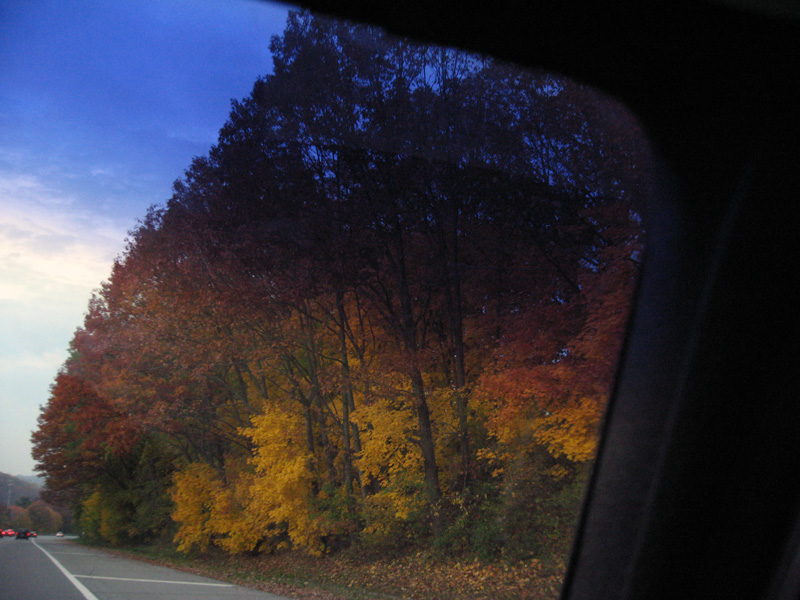
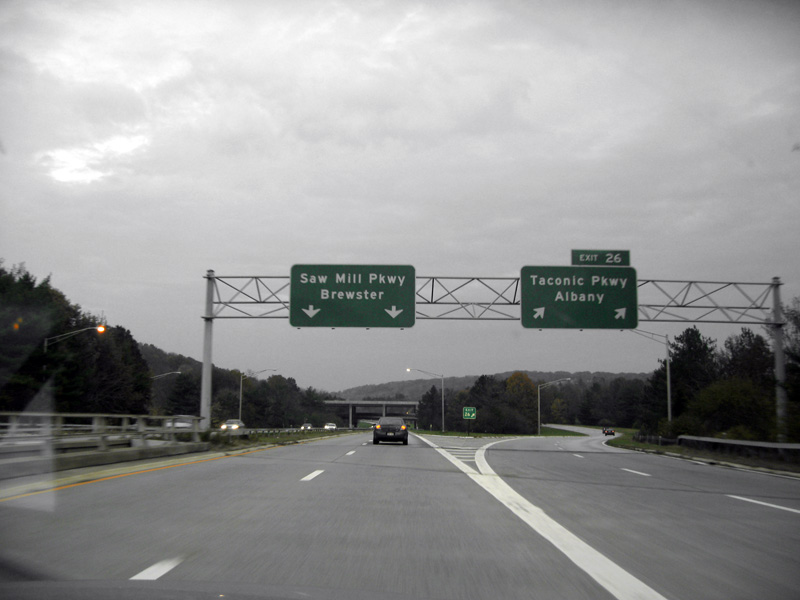
At last we made it out of Manhattan and into Westchester. It was a little after 4:00. Ah well, at least we had 3 hours, but our hopes at viewing the brilliant hues of sugar maple, pine, spruce autumn were waning. The clouds were rolling in, and the temperature had fallen a good 20 degrees. We didn't make it to New Jersey, but the Saw Mill River Parkway, which we drove on, had a nice blend of yellow, orange, red, and green to keep us engaged.

The drive got more relaxing as we went on. I had my iPod playing, and I tried snapping photos of the leaves with my camera. We were certainly making good time. It was about 4:30 now. We I checked the map to see how far away we were.

Now, even with my 20/15 Lasik-corrected vision, I can't see up close very well, and I haven't yet invested in a pair of drugstore glasses. The New York State maps we had didn't show Westchester roads very well. They were mainly concerned with real upstate places like Buffalo and Schenectady. Plus the maps had been from the Mercedes, when Luis's elderly aunt owned it, so the roads stopped at about 1970. When I looked up at road signs and saw Katonah, I knew we were in trouble.

We were only about 20 miles east of where we needed to go, but neither of us was familiar enough with the ares to figure out which westbound road to take. I pulled out my cell phone and started the navigation program, and just as I was about to get the map, my battery died.

It was getting pretty dark now, at around 5:00, and we had to pull over and try to figure out between us the nearest route to take. We finally figured it out and headed on the road. My original MapQuest directions had long since become useless since we hadn't followed any of the roads. (Later, when I looked at the photos I'd taken on the road, I'd inadvertently snapped a picture of the split where we should have gotten off.) By some miracle we ended up on Route 202, which would take us straight to the restaurant.

At about 5:20 we stopped for gas. We figured we were close but decided to fill up in case things went horribly wrong. Back on the road again, we passed a diner on the left that looked open. We both looked at each other and said, "Plan B." Even though we were close and we had plenty of time, we still weren't sure what lay ahead.

Driving through the town of Peekskill, I was shocked by how run-down and seedy it looked. The only other time I'd been there was in 8th grade, when we took a class trip to the Peekskill Dude Ranch (now an orthodox Jewish seminary), and I rode a horse for the first time.

We followed the street according to our directions: a dead end.

The way things were going, we weren't sure we were going to find the restaurant. Luis remarked that even McDonald's was closed. But along the way we did pass an Art Deco-y looking diner, and I said, "Plan B."

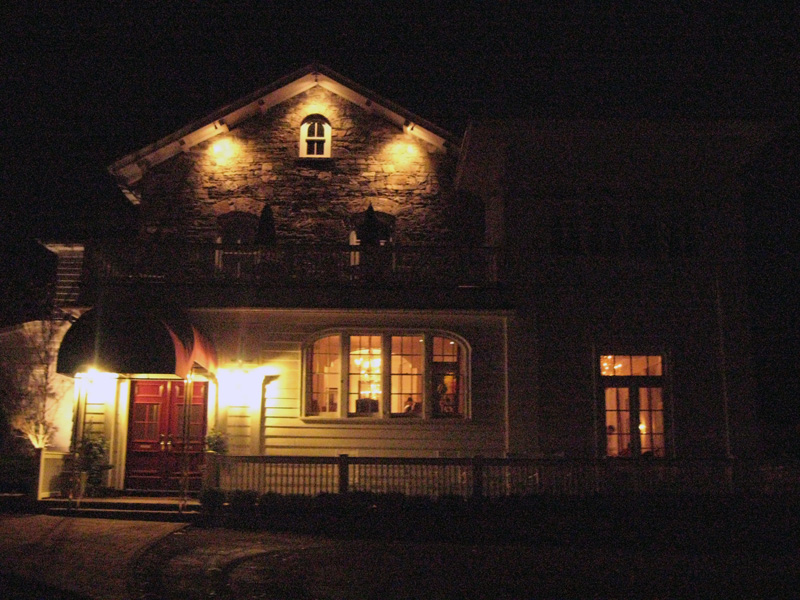
About 20 minutes later we found Monteverde. It looked really charming from the outside, and I'm sure it would have looked stunning in the daylight.

"Mmm hmmm," Luis said, "it's gonna be us a bunch of ultra-whiteys."

"Yeah," I said, "and the homos will probably be lynched."

We looked at each other and said, "Let's eat!"

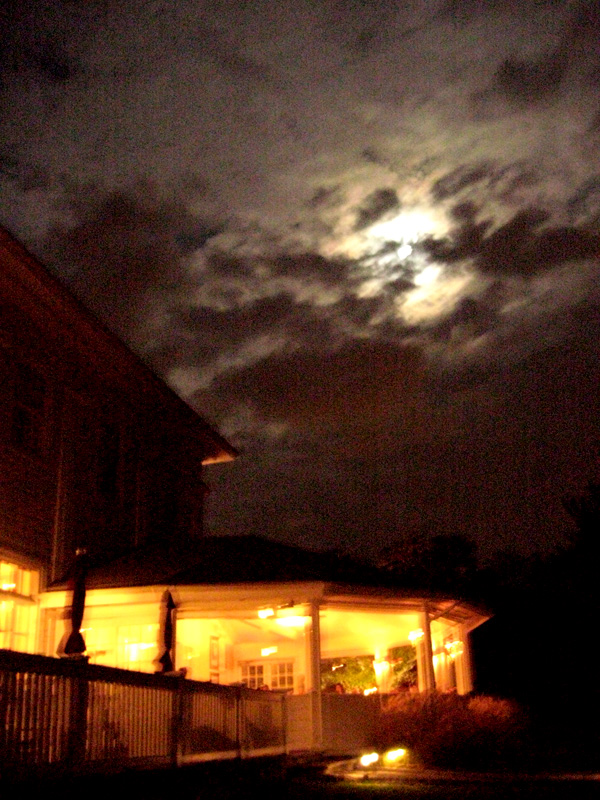
The problem now was not whether we would arrive late but that we had arrived more than an hour before our reservation. It was 5:40 and no longer balmy. We decided to walk around the grounds for a few minutes. Even in the dark we could tell it was beautiful in the daylight. A brilliant red sugar maple was illuminated against the gibbous moon. A glass-enclosed gazebo jutted out on one side of the restaurant.

It was getting cold. We decided to go to the bar and stick out the wait. We gave our names to the hostess. Before I could even tell her how awful our drive was and how early we were, she said she had a table for us. The table was in the gazebo, right by the window, overlooking the lake. We looked around at the other guests: a Chinese family, an interracial couple, a group of Hispanic friends. Two women were seated right behind me.

"Oh, look, we're in the same-sex section," Luis said.

Our waitress, Ramona, appeared a few minutes after we were seated. She was quite pretty, a cross between Paula Abdul and Phylicia Rashad. I explained to her, as I had to the hostess, that it had taken us 4 hours to get here. I'm sure I'll be a joy as an old man.

We got drinks and looked at the three-course prix-fixe menu, which read like this:

Appetizers

Terrine of smoked ham knuckle, chicken and foie gras, pickled beet salad
Garden salad of seasonal fruits, vegetables, herbs and pickles
Butternut squash soup, wild mushrooms and parmigiano reggiano
Smoked trout fillet with a salad of avocado and green apple, crème fraiche

Entrées
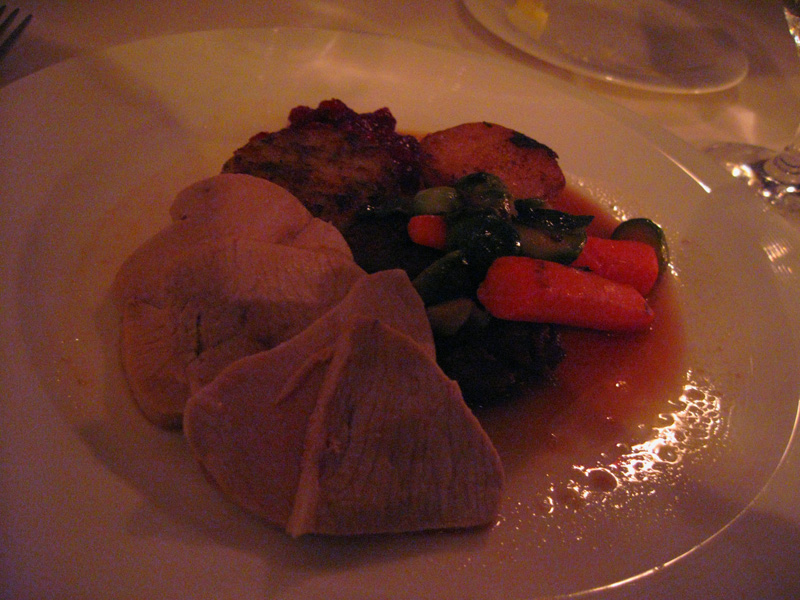
Butter poached turkey,confit leg,potato puree,cranberry compote and cooking juices
Potroasted, glazed ham, spiced red cabbage, parslied, honey carrots, port sauce
Roast salmon fillet, sage gnocchi, chestnuts, wild mushrooms and shaved pecorino cheese

Desserts
Pecan pie, maple ice cream
Chestnut parfait, milk chocolate and pear
Slow roasted gala apple, rum and raisin ice cream and golden puff pastry
Artisanal domestic cheeses

Chef Neil Ferguson

We were just the right amount of starving. We finally got a chance to relax and absorb the atmosphere. It was a pity we hadn't seen the grounds in the daylight, but it was still beautiful.

I ordered the terrine, Luis got the butternut squash soup. Portions were just right, and both were delicious.

For the second course we had the traditional turkey dinner, and for dessert the chestnut parfait.

What Gordon Ramsay lost Monteverde gained. The food was wonderful, the service attentive, and the venue beautiful.

We drove back to the highway, passing the Deco-y diner we'd passed earlier. We were both glad we didn't have to resort to Plan B. Traffic home was a breeze. We made it home in an hour and 20 minutes. Congestion aside, the day was exactly what we had both wanted. It had not gone quite as we had expected, but the destination was worth the journey. And we were thankful for the beautiful meal and for having each other.

Labels: , , , , , , , ,


Continue reading...

Friday, July 27, 2007

Cropsey crops up

While hiking on a nature trail today near Chester, Connecticut, Jenn, Luis, and I came to a clearing overlooking a stream. As we descended the banks to cool our feet in the water, we noticed a tree trunk covered in a dark red substance. About 5 feet away, on another tree, hung a towel and a baseball cap. The towel also had a reddish substance on it that looked a lot like blood.

"Ooh, maybe Cropsey was here," I said in my best Shaggy voice.

"Who's that?" Jenn said.

"Cropsey," I said, "is the stuff that nightmares are made of."

In the fall of 1972, my Cub Scout troop, Pack 175, went on an overnight hike to Lake Minnewaska, NY, not far from New Paltz. My scoutmaster, Kenny, was jovial yet commandeering. I have no idea how old he was. To a 10-year-old, even 20 seems ancient. His military demeanor fully suited his post, and most of the boys respected him. The assistant scoutmaster, Roger, was quiet but had a mischievous streak. He could be jokey with us even while falling in line with Kenny's leadership style. I recall that he looked like Don Knotts's character Barney Fife on The Andy Griffith Show.

Our cabins were in a desolate area with no running water or bathrooms. I remember the minute I entered my cabin, I stepped on a rusty nail, which dug into my heel. It hurt, but it didn't go deep. One of the other kids told me I'd get lockjaw from it, but I didn't know whether to believe him. I didn't know what lockjaw was, but it sounded bad, and I kept feeling my jaw to see if I could still move it. When nothing happened by the next day, I figured I was probably going to live.

While some of the kids unloaded their stuff in the cabins, Kenny rounded up five of us--I'd say we were all brown-nosers--and took us on a hike through the woods. The October air grew chillier just as sunset took hold. As a scout I'd learned how to mark a trail and look for the position of the sun overhead, so I wasn't afraid of getting lost. Besides, I knew Kenny would get us back to camp safely.

I don't know how long we hiked--not very long--before we came to a stone structure in a thicket of weeds and grass. Moss grew all over the outside. I could tell at one point that it had been a house, but now it was largely a pile of rubble. Some rooms remained intact, but there was hardly a roof. The sky was turning dark with each minute, making it more difficult to see where we were going. The wind started picking up too, and then suddenly, it started to rain, torrents . We all ran inside the part of the stone house that was covered. Kenny was nowhere to be found. One scout called out his name, and Kenny answered from another part of the house. We followed his voice and saw the glow of his flashlight down below. We climbed down some stairs, and there was Kenny, standing in front of what looked like a steel bed frame.

"Shhhhh," Kenny said, and we all stood still. "He could come back at any moment."

"Who?" whispered Tommy. The rain was beating down full force now, and thunder boomed in the distance.

Just after a particularly loud boom, Kenny said softly, "Cropsey."

We'd never heard of Cropsey before, but just the name was enough to make us feel we didn't want Cropsey to come back.

"This," said Kenny, pointing to the steel bed frame, "is the rack that Cropsey uses..." Another thunder clap came. "...to punish little boys."

If there was ever a time I wanted to wet my pants, that was it. But I didn't. Five 10-year-old boys let out a collective gasp and huddled together. I didn't know how such a rack worked, nor did I care. I didn't want Cropsey to get me.

"Cropsey was a nice man. His son was a Cub Scout. One night his son was out in the woods with some other Scouts and they dared him to jump into Lake Minnewaska. Only the boy couldn't see how deep the water was, and he drowned." We all stood wide-eyed and completely still. One kid was shaking and holding back tears.

"Once a year, on the night of his son's death, Cropsey roams the woods, looking for revenge. Tonight is that night."

I remember thinking, well that explains why Cropsey's not home. I wasn't too worried, though. Kenny wouldn't let anything bad happen to us.

Kenny shone his flashlight to lead us out of the house. What if Cropsey saw the light and followed us? What if he was waiting outside?

We all held hands and made our way out into the woods again. The rain, which had stopped, made the trail muddy. It was pitch black out, and Kenny led the way back to the campsite. I remember looking back, convinced that Cropsey was following us. I could have sworn I saw another light following us.

That night the whole scout pack sat around a big campfire, as Kenny recounted the tale of the vengeful Cropsey. All around us, the snapping of twigs echoed in the woods. Kenny and Roger had walkie-talkies with them. Suddenly, Kenny's walkie-talkie crackled.

"Roger here. Light shining about half a mile ahead. Over."

"10-4," Kenny said. "Nothing to worry about, boys. There's a full moon overhead. Probably just bouncing off something."

Kenny continued telling the grisly tale of Cropsey, of his son's death, and how Cropsey's hand was mangled in an accident (I remember thinking this family was careless) and replaced by a hook that he used to nab innocent campers. Tonight, Kenny said, was the anniversary of his son's death. That's why Roger was on the lookout for anything suspicious.

I doubt any of us slept that night. In our bunk beds, we giggled and tried to scare each other using creepy voices and sneaking up and grabbing each other's legs. In the morning we were all still there. We had evaded Cropsey.

Many years later I was talking to another New Yorker who went to sleepaway camp in the 1970s and told him about the Cropsey story. He said that he had been told a similar tale, but that his Cropsey wielded an axe. Over the years I talked to others who knew about Cropsey, and I wondered where it began and how it spread. After all, this was way before the advent of the Web, and the tale extended to scouts and campers alike.

It turns out that the tale is far more widespread than I imagined. An article called "The Cropsey Maniac" appeared in New York Folklore in 1977. A horribly disfigured Cropsey (or Cropsy) terrorized campers in the 1980 movie The Burning, which was eclipsed by the Friday the 13th series. A book published in 1997 called The Legend of Cropsey: A Legacy of Terror at Summer Camp, by the aptly named Hugo Furst, explains the story.

As we made our way up the banks to dry land, Luis put his finger on the reddish substance. Was it sap? Or blood? Jenn felt the towel, which was still damp. We looked around nervously to see if anyone was lurking. I put my finger on the sticky red stuff, too, and smelled it.

"Barbecue sauce," I said. Jenn smelled it and agreed. That's all it was: just barbecue sauce. That would explain the color of the towel. Maybe.

We walked back through the woods, occasionally turning around to make sure we were all in tow. Cropsey liked to surprise his victims. Even in broad daylight, you could never be too sure. The woods are good at keeping secrets.

Labels: , , , ,


Continue reading...

Friday, January 26, 2007

Kunta-Kiki

Everyone has been really sweet about my attainment of Irish citizenship. I still haven't heard from the State Department, but I'm sure they'll come around...to investigate. (Just kidding.) People hug me, offer to raise a pint of Guinness. Even complete strangers have sent their congratulations. My friend J sent me the following note, attached to a box of Lucky Charms (which, by the way, really are magically delicious).

In your case, it wasn't just, well...shall we say, "the luck of the Irish," rather dogged, persistent, tireless, resolute, assiduous, tenacious, unswerving, unwavering, indefatigable, indomitable, unflagging efforts on the part of a lost boy from Flatbush looking to find his roots. Success! To Kunta-Kiki!! Congratulations and lotsa love.


Then there's my family.

Their reaction has been more sanguine. To them, New York is the center of the universe. It's all they've ever known. Ireland is just a land of leprechauns, lushes, and lugs. Our ancestors came here for opportunity, the chance to fulfill their dreams. A little romantic, perhaps. Our grandparents, who came over in the late 1920s, escaped a climate of unemployment, poverty, and oppression and arrived just as the Great Depression began.

If any of my other friends attained citizenship in their ancestral lands, their families would weep with pride. There would be wine and dancing and the telling of poignant, life-affirming stories of the trials and tribulations of those brave emigrants seeking a better life in the New World. There would be recognition that the world has become a smaller, not bigger, place through globalization. And globalization opens up new opportunities. Our lives and those of our ancestors have come full circle.

"Why did you want to go and do that?" one of my brothers asked, as if I had announced I'd had a sex-change operation. "What's there that isn't here?" he asked. I was tempted to say, "You." But as the Irish would say, "Don't let your tongue cut your throat." My family's idea of foreign travel is crossing the Brooklyn Bridge.

"It just gives me some options in the future," I said. "Plus I'll zip right through the passport control line next time I go to Europe."

"Aren't you gonna get in trouble?" another relative asked. The State Department does not endorse dual citizenship, nor does it forbid it. But if I were to pledge allegiance to the orange, white, and green, I might find myself no longer protected by the red, white, and blue.

My mother's reaction was more blasé. "Good for you," she said, in a perfunctory tone of maternal support. "I guess it's what you wanted, as far as that goes."

I guess I can't argue with that.

Labels: , , ,


Continue reading...
Hosted by www.Geocities.ws

1