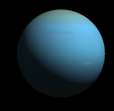
 Uranus
is the seventh planet from our sun and the third in a line of
four gas giants; it is four planets outward from Earth. Uranus
is about 1.78 billion miles (2.86 billion miles) from the sun,
more than twice as far from the sun as its closest neighbour,
Saturn. Thus, the discovery of Uranus doubled the known size of
the solar system. Uranus is 31,800 miles (51,166 kilometers) in
diameter at its equator, making it the third largest planet in
the solar system. It is four times the size of Earth, yet less
than half the size of Saturn. Similar to Jupiter, Saturn, and
Neptune, Uranus consists mostly of gas. Its pale blue-green, cloudy
atmosphere is made of 83 percent hydrogen, 15 percent helium,
and small amounts of methane and hydrocarbons. Uranus gets its
color beacause the atmospheric methane absorbs light at the red
end of the visible spectrum and reflects light at the blue end.
Deep down into the planet, a slushy mixture of ice, ammonia, and
methane surrounds a rocky core. Uranus is surrounded by fifteen
moons and eleven rings.
Uranus
is the seventh planet from our sun and the third in a line of
four gas giants; it is four planets outward from Earth. Uranus
is about 1.78 billion miles (2.86 billion miles) from the sun,
more than twice as far from the sun as its closest neighbour,
Saturn. Thus, the discovery of Uranus doubled the known size of
the solar system. Uranus is 31,800 miles (51,166 kilometers) in
diameter at its equator, making it the third largest planet in
the solar system. It is four times the size of Earth, yet less
than half the size of Saturn. Similar to Jupiter, Saturn, and
Neptune, Uranus consists mostly of gas. Its pale blue-green, cloudy
atmosphere is made of 83 percent hydrogen, 15 percent helium,
and small amounts of methane and hydrocarbons. Uranus gets its
color beacause the atmospheric methane absorbs light at the red
end of the visible spectrum and reflects light at the blue end.
Deep down into the planet, a slushy mixture of ice, ammonia, and
methane surrounds a rocky core. Uranus is surrounded by fifteen
moons and eleven rings.
^Back
To Top^
Who
discovered the planet Uranus?
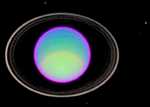 German
astronomer William Herschel (1738-1822), who lived and worked
in England, was conducting a general survey of the stars and planets
in 1971 when he observed a disk-shaped object in the constellation
Gemini. At first Herschel thought the ocject was a comet. But
its orbit was not aselongated as a comet's; it was more circular,
like that of a planet. Six months later he became convinced that
this body was indeed a planet, Uranus. HE calculated its orbit
and found its was twice as far from the sun as the closest planet,
Saturn. The new planet was given two tentativ names before astronomers
decided to called it Uranus, the mythological father of Saturn.
German
astronomer William Herschel (1738-1822), who lived and worked
in England, was conducting a general survey of the stars and planets
in 1971 when he observed a disk-shaped object in the constellation
Gemini. At first Herschel thought the ocject was a comet. But
its orbit was not aselongated as a comet's; it was more circular,
like that of a planet. Six months later he became convinced that
this body was indeed a planet, Uranus. HE calculated its orbit
and found its was twice as far from the sun as the closest planet,
Saturn. The new planet was given two tentativ names before astronomers
decided to called it Uranus, the mythological father of Saturn.
 Upon
confirmation that he had discovered a new planet, Herschel was
made a member of the prestigious British science club called the
Royal Society. The discovering also came to the attention of England's
King George III, who appointed Herschel to be the KIng's Astronomer.
The position included a small salary, which enable Herschel to
study the skies full time. Working alongside his sister, astronomer
Caroline Herschel made contributions to our understanding of stars,
nebulae, the Milky Way, asteroids, the sun, and our solar system.
Herschel came to believe that other solar systems outside our
own may exist. He challenged the popular notion that the Milky
Way was the center of the universe and suggested that our galaxy,
and Earth itself, were quite insignificant pieces of an immense
puzzle.
Upon
confirmation that he had discovered a new planet, Herschel was
made a member of the prestigious British science club called the
Royal Society. The discovering also came to the attention of England's
King George III, who appointed Herschel to be the KIng's Astronomer.
The position included a small salary, which enable Herschel to
study the skies full time. Working alongside his sister, astronomer
Caroline Herschel made contributions to our understanding of stars,
nebulae, the Milky Way, asteroids, the sun, and our solar system.
Herschel came to believe that other solar systems outside our
own may exist. He challenged the popular notion that the Milky
Way was the center of the universe and suggested that our galaxy,
and Earth itself, were quite insignificant pieces of an immense
puzzle.
^Back
To Top^
What
is the nature of Uranus's rings?
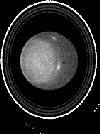 The
first nine rings of Uranus were discovered only nine years before
Voyager 2's visit. We now know that Uranus is surrounded by eleven
rings plus ring fragments, consisting of dust, rocky particles,
and ice. The eleven rings occupy the region between 23,560 and
31,700 miles (38,000 and 51,000 kilometers) from the planet's
center. Each ring is anywhere from less than a mile to 1,550 miles
(0.5 to 2,5000 kilometers) wide. The outermost ring, called the
epsilon ring, is only several feet across and is made up of ice
boulders. The pressure of ring fragments indicate that the rings
are may be younger than the planet they encircle. One theory suggests
that the rings are made of fragments of a moon that was smashed
to pieces.
The
first nine rings of Uranus were discovered only nine years before
Voyager 2's visit. We now know that Uranus is surrounded by eleven
rings plus ring fragments, consisting of dust, rocky particles,
and ice. The eleven rings occupy the region between 23,560 and
31,700 miles (38,000 and 51,000 kilometers) from the planet's
center. Each ring is anywhere from less than a mile to 1,550 miles
(0.5 to 2,5000 kilometers) wide. The outermost ring, called the
epsilon ring, is only several feet across and is made up of ice
boulders. The pressure of ring fragments indicate that the rings
are may be younger than the planet they encircle. One theory suggests
that the rings are made of fragments of a moon that was smashed
to pieces.
^Back
To Top^
DID
YOU KNOW?
Why
do days last forty-two Earth years on Uranus?
Uranus
rotates on its side, so that one of its poles faces toward the
sun throughout half of its eighty-four year orbit, while the other
leg of its journey, the other pole faces the sun for forty-two
Earth years. At some point in its history, Uranus was probably
struck by a large object that knocked it sideways. As a result,
its equator lies on a plane perpendicular to the plane of the
planets' orbits. In contrast to Uranus, the Earth is positioned
nearly upright. Our equatorial plane lies almost parallel to the
plane of our orbit around the sun, so our entire planet experiences
both night and day in every twenty-four hour period.
^Back
To Top^


