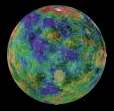
 Venus
is second planet out from our sun and the closest planet to Earth.
Beginning in 1961 the United States and former Soviet Union have
depolyed a long string of space probes that have examined the
Venusian atmosphere and peered beneath its dense cloud cover.
The probes have revealed that Venus is an extremely hot, dry planet,
with no signs of life. Its atmosphere is made primarily of carbon
dioxide with some nitrogen and trace amounts of water vapour,
acids, and heavy metals. Its clouds are laced with sulfur dioxide.
Venus
is second planet out from our sun and the closest planet to Earth.
Beginning in 1961 the United States and former Soviet Union have
depolyed a long string of space probes that have examined the
Venusian atmosphere and peered beneath its dense cloud cover.
The probes have revealed that Venus is an extremely hot, dry planet,
with no signs of life. Its atmosphere is made primarily of carbon
dioxide with some nitrogen and trace amounts of water vapour,
acids, and heavy metals. Its clouds are laced with sulfur dioxide.
^Back
To Top^
What
is the cause of the tremendous heat on Venus?
 Venus
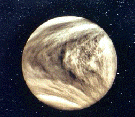
provides a perfect example of the greenhouse effect. Heat from
the sun penetrates the planet's atmosphere and reaches the surface.
The heat is then prevented from escaped back into space by atmospheric
carbon dioxide. The result is that Venus's surface temperature
is a fierce 900 degrees (482 degrees Celsius), even hotter than
that of Mercury, its neighbour closer to the sun.
Venus
provides a perfect example of the greenhouse effect. Heat from
the sun penetrates the planet's atmosphere and reaches the surface.
The heat is then prevented from escaped back into space by atmospheric
carbon dioxide. The result is that Venus's surface temperature
is a fierce 900 degrees (482 degrees Celsius), even hotter than
that of Mercury, its neighbour closer to the sun.
^Back
To Top^
How
does Venus rotate?
 Venus
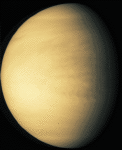
is unusual in that it is the only planet besides Uranus to rotate
from east to west. Thus, if you lived on Venus, the sun would
rise in the west and set in the east. In addition, Venus rotates
very, very, slowly. In fact, it takes Venus 243 Earth days to
complete one rotation. A day on Venus lasts even longer than its
year (length of time it takes Venus to orbit Venus to orbit the
sun), which is 255 Earth days.
Venus
is unusual in that it is the only planet besides Uranus to rotate
from east to west. Thus, if you lived on Venus, the sun would
rise in the west and set in the east. In addition, Venus rotates
very, very, slowly. In fact, it takes Venus 243 Earth days to
complete one rotation. A day on Venus lasts even longer than its
year (length of time it takes Venus to orbit Venus to orbit the
sun), which is 255 Earth days.
^Back
To Top^
What
are the surface features of Venus like?
U.S
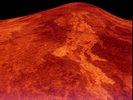
and Soviet space probes studying Venus uncovered a rocky surface
covered with volcanes (some still active), volcanic features (such
as lava plains), channels (like dry riverbeds), mountains, and
medium and large craters. No small craters exist, apparently because
small meteorites cannot penetrate the planet's atmosphere. Another
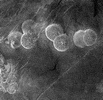
set of features found on the surface are arachnoids. These features
are circular formations ranging anywhere from 30 to 137 miles
(48 to 220 kilometers) in diameter, filled with concentric circles
extending spokes outward.
^Back
To Top^
How
old is Venus's surface?
 The
most recent probe to study Venus, Magellan, mapped the entire
Venusian surface from 1990 to 1994. It discovered that, from a
geological viewpoint, the planet's surface is relatively young.
Astronomers analyzing Magellan's data have concluded that about
three hundred to five hundred years ago, lava erupted and covered
the entire plane, giving it a fresh, new face. One indication
of this event is the presence of craters and other formations
on the surface that lack the same weathered appearance of that
of older formations. Also, relatively few craters appear on Venus.
In fact, more craters can be counted when viewing a section of
the moon through a small telescope than occur on the entire surface
of Venus.
The
most recent probe to study Venus, Magellan, mapped the entire
Venusian surface from 1990 to 1994. It discovered that, from a
geological viewpoint, the planet's surface is relatively young.
Astronomers analyzing Magellan's data have concluded that about
three hundred to five hundred years ago, lava erupted and covered
the entire plane, giving it a fresh, new face. One indication
of this event is the presence of craters and other formations
on the surface that lack the same weathered appearance of that
of older formations. Also, relatively few craters appear on Venus.
In fact, more craters can be counted when viewing a section of
the moon through a small telescope than occur on the entire surface
of Venus.
^Back
To Top^
What
are the plans for the future exploration of Venus?
The
Amercian space probe Magellan collected enough information on
Venus to keep scientists busy with analysis for years to come.
Even so, discussions are now taking place about the possibility
of sending a joint U.S.-Russian space-probe laboratory back to
Venus to learn more.
^Back
To Top^
Can
I see Venus from Earth?
 Venus
is visible in the sky either just after dark or just before sunrise,
depending on the season. This pattern prompted ancient astronomers
to refer to the planet as the "evening star" or "morning star".
Venus, named for Roman goddess of love and beauty, has been thought
of throughout history as one of the most beautiful objects in
the sky. It is often referred to as a brightly glittering jewel.
Venus
is visible in the sky either just after dark or just before sunrise,
depending on the season. This pattern prompted ancient astronomers
to refer to the planet as the "evening star" or "morning star".
Venus, named for Roman goddess of love and beauty, has been thought
of throughout history as one of the most beautiful objects in
the sky. It is often referred to as a brightly glittering jewel.
^Back
To Top^
DID
YOU KNOW?
Why
are Earth and Venus called sister planets?
Venus
and Earth have long been considered sister planets. The reason
for this comparsion is that they are similar in size, mass and
age. And while astronomers could not see beneath Venus' thick
cloud cover until recently, they assumed that Venus would have
seas and plant life like that on Earth. We now know, however that
this is not the case. The two planets are so different that it
hardly makes sense to still call them "sister".
^Back
To Top^


