
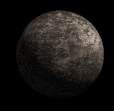
 Mercury
is a small, bleak planet, and the closest object to our sun. Mercury
is the second smallest planet in the solar system; only Pluto
is smaller. Mercury's diameter is a little over one-third the
Earth's, yet it has just 5.5 percent of Earth's mass. On average,
Mercury is 36 million miles (58 million kilometres) from the sun.
One effect of the sun's intense gravitational field is to tilt
Mercury's orbit and to stretch it into a long ellipse (oval).
Mercury orbits the sun so quickly, in just eighty-eight days.
In contrast to its short year, Mercury has an extremely long day.
It takes the planet the equivalent of fifty-nine Earth days to
complete one rotation.
Mercury
is a small, bleak planet, and the closest object to our sun. Mercury
is the second smallest planet in the solar system; only Pluto
is smaller. Mercury's diameter is a little over one-third the
Earth's, yet it has just 5.5 percent of Earth's mass. On average,
Mercury is 36 million miles (58 million kilometres) from the sun.
One effect of the sun's intense gravitational field is to tilt
Mercury's orbit and to stretch it into a long ellipse (oval).
Mercury orbits the sun so quickly, in just eighty-eight days.
In contrast to its short year, Mercury has an extremely long day.
It takes the planet the equivalent of fifty-nine Earth days to
complete one rotation.
^Back
To Top^
How
visible is Mercury from Earth?
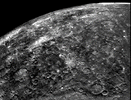 Because
of the sun's intense glare, it is difficult to observe Mercury
from Earth. Mercury is visible only periodically, just above the
horizon, for about one hour before sunrise and one hour after
sunset. For these reasons, many people have never seen Mercury.
Because
of the sun's intense glare, it is difficult to observe Mercury
from Earth. Mercury is visible only periodically, just above the
horizon, for about one hour before sunrise and one hour after
sunset. For these reasons, many people have never seen Mercury.
^Back To Top^
How
have been able to gather information about Mercury?
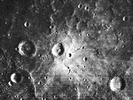 Little
was known about Mercury until the space probe Mariner 10 photographed
the planet in 1975. Mariner first approached the planet Venus
in February 1974, and then used that planet's gravitational field
to send it around like a slingshot in the direction of Mercury.
The second leg of the journey to Mercury took seven weeks. On
its first flight past Mercury, Mariner 10 came within 470 miles
(756 kilometres) of the planet and photographed about 40 percent
of the its surface. The probe then went into orbit around the
sun and flew past Mercury twice more in the next year before running
out of fuel.
Little
was known about Mercury until the space probe Mariner 10 photographed
the planet in 1975. Mariner first approached the planet Venus
in February 1974, and then used that planet's gravitational field
to send it around like a slingshot in the direction of Mercury.
The second leg of the journey to Mercury took seven weeks. On
its first flight past Mercury, Mariner 10 came within 470 miles
(756 kilometres) of the planet and photographed about 40 percent
of the its surface. The probe then went into orbit around the
sun and flew past Mercury twice more in the next year before running
out of fuel.
^Back
To Top^
What
did the space probe Mariner 10 find out about Mercury?
Mariner
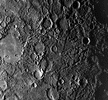
10 collected much valuable information about Mercury. It found
that the planet's surface is covered with deep craters, separated
by plains and huge banks of cliffs. Mercury's most notable feature
is an ancient crater called the Calories Basin, which is about
the size of Texas.
^Back
To Top^
What
forms Mercury's core?
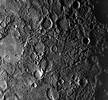 The
space probe Mariner 10 gathered information about Mercury's core,
which is nearly solid metal and is composed primarily of iron
and nickel. This core, the densest of any in the solar system,
accounts for about four-fifths of Mercury's diameter. It may also
be responsible for creating the magnetic field that protects Mercury
from the sun's harsh particle wind.
The
space probe Mariner 10 gathered information about Mercury's core,
which is nearly solid metal and is composed primarily of iron
and nickel. This core, the densest of any in the solar system,
accounts for about four-fifths of Mercury's diameter. It may also
be responsible for creating the magnetic field that protects Mercury
from the sun's harsh particle wind.
^Back
To Top^
What
are the climatic conditions like on Mercury?
 Mercury's
very thin atmosphere is made of sodium, potassium, helium, and
hydrogen. Temperatures on Mercury reach 800 degrees Fahrenheit
(427 degrees Celsius) during its long day and -280 degrees Fahrenheit
(-173 degrees Celsius) during its long night, when heat escapes
through the negligible atmosphere.
Mercury's
very thin atmosphere is made of sodium, potassium, helium, and
hydrogen. Temperatures on Mercury reach 800 degrees Fahrenheit
(427 degrees Celsius) during its long day and -280 degrees Fahrenheit
(-173 degrees Celsius) during its long night, when heat escapes
through the negligible atmosphere.
^Back
To Top^
DID
YOU KNOW?
How
did Mercury's topography evolve?
Astronomers
believe that Mercury, like the moon, was originally made of liquid
rock, and that the rock solidified as the planet cooled. Some
meteorites hit the planet during the cooling stage and formed
craters. Other meteorites, however, were able to break through
the cooling crust. The impact caused lava to flow up to the surface
and cover older craters forming plains.
^Back
To Top^


