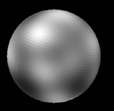
 Pluto
stands at the center of a decades-long astronomical debate over
its classification as a planet. Pluto, after all, is by far the
smallest planet in the solar system and travels on an inclined
orbit that crosses the plane of all other planetary orbits. Furthermore,
it doesn't obey planetary spacing the way the other planets do.
Although its orbit is mostly outside of that of its closest neighbour,
Neptune, at times it crosses over Neptune's orbit. For instance,
Pluto has been closer to the sun than Neptune since 1979 and will
continue that way until 1999. Pluto, however does not quite fit
the description of other bodies orbiting the sun, such as asteroids
or comets either. So what is Pluto? While that question remains
open, for practical purposes most astronomers consider it to be
a planet.
Pluto
stands at the center of a decades-long astronomical debate over
its classification as a planet. Pluto, after all, is by far the
smallest planet in the solar system and travels on an inclined
orbit that crosses the plane of all other planetary orbits. Furthermore,
it doesn't obey planetary spacing the way the other planets do.
Although its orbit is mostly outside of that of its closest neighbour,
Neptune, at times it crosses over Neptune's orbit. For instance,
Pluto has been closer to the sun than Neptune since 1979 and will
continue that way until 1999. Pluto, however does not quite fit
the description of other bodies orbiting the sun, such as asteroids
or comets either. So what is Pluto? While that question remains
open, for practical purposes most astronomers consider it to be
a planet.
^Back
To Top^
How
was Pluto discovered?
 Pluto
was discovered in 1930 during a painstaking search of photographic
plates by Amercian astronomer Clyde Tombaugh. He and other astronomers
(chief among them was Percival Lowell) were looking for a planet
(then called Planet X) to explain disturbances in the orbit of
Uranus. The gravitational field of Neptune accounted for some
of its neighbour's orbital irregularities, but not all of them.
The search for Planet X yielded only Pluto.
Pluto
was discovered in 1930 during a painstaking search of photographic
plates by Amercian astronomer Clyde Tombaugh. He and other astronomers
(chief among them was Percival Lowell) were looking for a planet
(then called Planet X) to explain disturbances in the orbit of
Uranus. The gravitational field of Neptune accounted for some
of its neighbour's orbital irregularities, but not all of them.
The search for Planet X yielded only Pluto.
^Back
To Top^
Why
was the ninth planet given the name Pluto?
In
Greek mythology, Pluto is the god of the underworld. The ninth
planet was given its name for several reasons. First, due to its
great distance from the sun, Pluto is almost always dark. The
sunlight it receives is about the intensity of moonlight on the
Earth. Another reason is that Pluto is the mythological brother
of Jupiter and Neptune. And finally, the planet's name begins
with "PL," the initials of Percival Lowell, the astromoner who
spent the final years of his life searching unsuccessfully for
the elusive planet.
^Back
To Top^
How
long do Pluto's orbit and rotation take?
 Pluto
is so far from the sun that it takes almost 250 years to complete
one revolution around the sun. A Plutonian day, however, is only
6.39 times longer than an Earth day. That is, it takes 6.39 of
our days for Pluto to complete one rotation about its own axis.
Pluto
is so far from the sun that it takes almost 250 years to complete
one revolution around the sun. A Plutonian day, however, is only
6.39 times longer than an Earth day. That is, it takes 6.39 of
our days for Pluto to complete one rotation about its own axis.
^Back
To Top^
How
big is Pluto, and why is its size a surprise to astronomers?
Pluto
is only 1,457 miles (2,344 kilometers) across, just 18 percent
of the Earth's diameter. Before Pluto was located, astronomers
expected it be a large planet, about the size of Jupiter. They
thought it would be able to influence the path of Uranus, a whole
two planets away. At that time, the solar system appeared to fit
a neat pattern: small, dense planet were closest to the sun and
giant, gaseous planets were farthest away. Pluto broke this pattern,
since it is a small, dense planet at the farthest reaches from
the sun.
^Back
To Top^
What
are Pluto's composition, topography and climatic conditions?
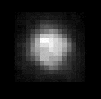 Pluto
is so distant that no Earth-bound telescope has been able provide
a detailed picture of its surface features. The HST revealed only
that Pluto has frozen gases, icy polar caps, and mysterious bright
and dark spots. Beyond that, astronomers can only rely on imprecise
observations and what is known about the planet's density to paint
a more complete picture of the planet. Pluto is probably composed
mostly of rock and some ice, with a surface temperature between
-350 and -380 degrees Fahrenheit (-212 and -228 degrees Celsius).
The bright areas on its surface are most likely nitrogen ice,
solid methane, and carbon monoxide. The dark spots may hold some
form of organic material, possibly hydrocarbons from the chemical
splitting and freezing of methane. Pluto's atmosphere is probably
made of nitrogen, carbon monoxide, and methane. At Pluto's perihelion
(the point on its orbit closest to the sun), its atmosphere exists
in a gaseous state. But for most of its orbit the atmosphere is
frozen.
Pluto
is so distant that no Earth-bound telescope has been able provide
a detailed picture of its surface features. The HST revealed only
that Pluto has frozen gases, icy polar caps, and mysterious bright
and dark spots. Beyond that, astronomers can only rely on imprecise
observations and what is known about the planet's density to paint
a more complete picture of the planet. Pluto is probably composed
mostly of rock and some ice, with a surface temperature between
-350 and -380 degrees Fahrenheit (-212 and -228 degrees Celsius).
The bright areas on its surface are most likely nitrogen ice,
solid methane, and carbon monoxide. The dark spots may hold some
form of organic material, possibly hydrocarbons from the chemical
splitting and freezing of methane. Pluto's atmosphere is probably
made of nitrogen, carbon monoxide, and methane. At Pluto's perihelion
(the point on its orbit closest to the sun), its atmosphere exists
in a gaseous state. But for most of its orbit the atmosphere is
frozen.
^Back
To Top^


