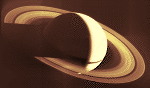
 Saturn
is the sixth planet from our sun and the second largest, after
Jupiter. Saturn is also the only planet with a density less than
water (about 30 percent less). Thisfact means that, if plopped
into an immense ocean, Saturn would float. Saturn is about 9.4
times wider and 95 times more massive than Earth, and its axis.
In fact, it takes this giant planet only ten hours and thrity-nine
minutes-less than half the time it takes Earth_to complete a turn.
As a result of this rapid spinning, Saturn has been flattened
at its poles. In contrast to the relative brevity of its day,
Saturn marks out a very long year. Because it is so far from the
sun, it takes Saturn 29.5 Earth years to complete one orbit.
Saturn
is the sixth planet from our sun and the second largest, after
Jupiter. Saturn is also the only planet with a density less than
water (about 30 percent less). Thisfact means that, if plopped
into an immense ocean, Saturn would float. Saturn is about 9.4
times wider and 95 times more massive than Earth, and its axis.
In fact, it takes this giant planet only ten hours and thrity-nine
minutes-less than half the time it takes Earth_to complete a turn.
As a result of this rapid spinning, Saturn has been flattened
at its poles. In contrast to the relative brevity of its day,
Saturn marks out a very long year. Because it is so far from the
sun, it takes Saturn 29.5 Earth years to complete one orbit.
^Back
To Top^
What
is the composition of Saturn?
 Saturn
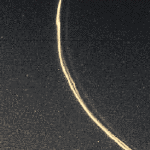
consists primarily of gas. Its hazy yellow clouds are made of
crystallized ammonia, swept into bands by fierce easterly winds
that have been clocked at up to 1,100 miles (1,770 kilometers)
per hour at the equator. Winds near the poles, however, are much
tamer. Covering Saturn's surface is a sea of liquid hydrogen and
helium, which gradually becomes a metallic form of hydrogen. The
liquid hydrogen and helium conduct strong electric currents that,
in turn, generate the Earth's powerful magnetic field. Saturn's
core, which is serveral times the size of Earth, is made of rock
and ice. The planet's atmosphere is made up of about 97 percent
hydrogen, 3 percent helium, and trace amounts of methane and ammonia.
Saturn
consists primarily of gas. Its hazy yellow clouds are made of
crystallized ammonia, swept into bands by fierce easterly winds
that have been clocked at up to 1,100 miles (1,770 kilometers)
per hour at the equator. Winds near the poles, however, are much
tamer. Covering Saturn's surface is a sea of liquid hydrogen and
helium, which gradually becomes a metallic form of hydrogen. The
liquid hydrogen and helium conduct strong electric currents that,
in turn, generate the Earth's powerful magnetic field. Saturn's
core, which is serveral times the size of Earth, is made of rock
and ice. The planet's atmosphere is made up of about 97 percent
hydrogen, 3 percent helium, and trace amounts of methane and ammonia.
^Back
To Top^
What
is Saturn's "Great White Spot"?
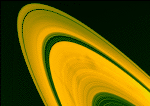 About
every thirty Earth years, following Saturn's summer, a massive
storm occurs. Known as the "Great White Spot," it is visible for
nearly a month, shining like a spot-light on the planet's face.
The spot then dissipates and stretches around the planet as a
thick white stripe. The storm is thought to be a result of the
warming of the atmosphere, which causes ammonia to bubble up and
solidify, only to be whipped around by the planet's monstrous
winds.
About
every thirty Earth years, following Saturn's summer, a massive
storm occurs. Known as the "Great White Spot," it is visible for
nearly a month, shining like a spot-light on the planet's face.
The spot then dissipates and stretches around the planet as a
thick white stripe. The storm is thought to be a result of the
warming of the atmosphere, which causes ammonia to bubble up and
solidify, only to be whipped around by the planet's monstrous
winds.
^Back
To Top^
Have
any space probes visited Saturn?
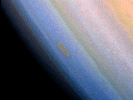 In
1980 and 1981 the world watched with wonder as the Voyager 1 and
Voyager 2 spacecraft sent back the first detailed photos of Saturn
and its spectacular rings. The two space probes also transmitted
images of Saturn's moons, revealing new details about many of
them and even discovering a few news ones. This elaborate system
of planet, rings, and moons still holds many mysteries, most of
which will probably remain unsolved untill the next scheduled
spacecraft reaches Saturn in the year 2004.
In
1980 and 1981 the world watched with wonder as the Voyager 1 and
Voyager 2 spacecraft sent back the first detailed photos of Saturn
and its spectacular rings. The two space probes also transmitted
images of Saturn's moons, revealing new details about many of
them and even discovering a few news ones. This elaborate system
of planet, rings, and moons still holds many mysteries, most of
which will probably remain unsolved untill the next scheduled
spacecraft reaches Saturn in the year 2004.
^Back
To Top^
How
were Saturn's rings interpreted by early astronomers?
Centuries
ago, astronomers saw Saturn's ring as bulges on either side of
the planet, which they guessed were moons. For this reason astronomer
Galileo Galilei hypothesized in the early 1600s that Saturn was
a triple-planet.
^Back
To Top^
What
is the physical composition of Saturn's rings?
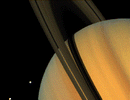 While
the compositionof Saturn's rings is not entirely known, scientists
do know that they contain dust and a large quantity of water.
The water is frozen in various forms, such as snowflacks, snowballs,
hailstones, and icebergs, ranging in size from 3 inches (7.6 centimeters)
or so to 10 yards (9 meters) in diameter.
While
the compositionof Saturn's rings is not entirely known, scientists
do know that they contain dust and a large quantity of water.
The water is frozen in various forms, such as snowflacks, snowballs,
hailstones, and icebergs, ranging in size from 3 inches (7.6 centimeters)
or so to 10 yards (9 meters) in diameter.
^Back
To Top^
How
were Saturn's rings formed?
Scientists
are not sure how Saturn's rings were formed. One theory suggests
that the rings were once larger moons that were smashed to tiny
pieces by comets or meteorites. Another theory holds that the
rings are pre-moon matter, cosmic fragments that never quite formed
a moon.
^Back
To Top^
DID
YOU KNOW?
Is
Saturn, as is commonly depicted, the only planet with rings?
Saturn's
most outstanding characteristic is its set of rings. The three
other largest planets (Jupiter, Uranus, and Neptune) also feature
rings, but Saturn's are by far the most spectacular.
^Back
To Top^


