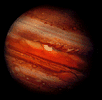
 Jupiter
is by far the largest planet in our solar system. The fifth planet
out from the sun, it is thirteen hundred times larger than Earth,
with three hundred times Earth's mass. Its diameter measures 85,000
miles (137,000 kilometers) across, while the Earth's diameter
is just over 7,900 miles (12,700 kilometers) at the equator. With
its sixteen moons, Jupiter is considered a mini-solar system of
its own. Jupiter is often the brightest object in the sky after
the sun and Venus. For an unknown reason, it reflects light that
is twice as intense as the sunlight that strikes it. Through a
telescope, Jupiter looks like a globe of colourful swirling bands.
These bands may be a result of Jupiter's fast rotation. One day
on Jupiter lasts only ten hours (compared to a rotational period
of twenty-four hours for the Earth).
Jupiter
is by far the largest planet in our solar system. The fifth planet
out from the sun, it is thirteen hundred times larger than Earth,
with three hundred times Earth's mass. Its diameter measures 85,000
miles (137,000 kilometers) across, while the Earth's diameter
is just over 7,900 miles (12,700 kilometers) at the equator. With
its sixteen moons, Jupiter is considered a mini-solar system of
its own. Jupiter is often the brightest object in the sky after
the sun and Venus. For an unknown reason, it reflects light that
is twice as intense as the sunlight that strikes it. Through a
telescope, Jupiter looks like a globe of colourful swirling bands.
These bands may be a result of Jupiter's fast rotation. One day
on Jupiter lasts only ten hours (compared to a rotational period
of twenty-four hours for the Earth).
^Back
To Top^
What
is the core of Jupiter composed of?
 Astronomers
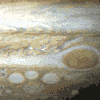
believe that Jupiter has a rocky core made of material similar
to Earth, but with a diameter about five or ten times than that
of Earth's core. The core's temperature may be as hot as 18,000
degrees Fahrenheit (10,000 degrees Celsius), with pressures two
million times those at the Earth's surface. Scientists believe
that a layer of compressed hydrogen surrounds the core. Hydrogen
in this layer may act like a metal and may be the cause of Jupiter's
intense magnetic field (five times greater than the sun's).
Astronomers
believe that Jupiter has a rocky core made of material similar
to Earth, but with a diameter about five or ten times than that
of Earth's core. The core's temperature may be as hot as 18,000
degrees Fahrenheit (10,000 degrees Celsius), with pressures two
million times those at the Earth's surface. Scientists believe
that a layer of compressed hydrogen surrounds the core. Hydrogen
in this layer may act like a metal and may be the cause of Jupiter's
intense magnetic field (five times greater than the sun's).
^Back
To Top^
What
is Jupiter's Great Red Spot?
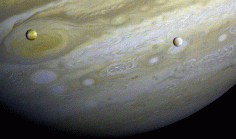
 Jupiter's
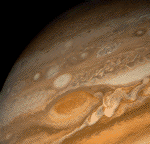
most outstanding feature is its bright Great Red Spot. The spot
is actually a swirling, windy storm over 8,500 miles (14,000 kilometers)
wide and 16,000 miles (26,000 kilometers) long, an area enough
to cover two Earths. Winds blow counterclockwise around the Great
Red Spot at about 250 miles (400 kilometers) per hour. The spot
may derive its red color from sulfur or phosphorus, but no one
is certain. Beneath it lie three white oval areas. Each is a storm
about the size of the planet Mars.
Jupiter's
most outstanding feature is its bright Great Red Spot. The spot
is actually a swirling, windy storm over 8,500 miles (14,000 kilometers)
wide and 16,000 miles (26,000 kilometers) long, an area enough
to cover two Earths. Winds blow counterclockwise around the Great
Red Spot at about 250 miles (400 kilometers) per hour. The spot
may derive its red color from sulfur or phosphorus, but no one
is certain. Beneath it lie three white oval areas. Each is a storm
about the size of the planet Mars.
^Back
To Top^
How
was Jupiter formed?
 One
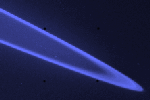
theory about the planet's origin is that Jupiter is made of the
original gas and dust that came together to form the sun and planets.
Since Jupiter is so far from the sun, its components may have
undergone little or no change. A more recent theory, however,
states that Jupiter was formed from ice and rock from comets,
and that it grew by attracting other matter around it.
One
theory about the planet's origin is that Jupiter is made of the
original gas and dust that came together to form the sun and planets.
Since Jupiter is so far from the sun, its components may have
undergone little or no change. A more recent theory, however,
states that Jupiter was formed from ice and rock from comets,
and that it grew by attracting other matter around it.
^Back
To Top^
Could
there be life on Jupiter?
 Perhaps
the biggest surprise uncovered by Galileo's mini-probe was the
lack of water on Jupiter. Of course, overall conclusions can not
be drawn from one sampling. But if it turns out that Jupiter is
not the watery planet scientists have always assumed, then there
is little chance of finding life there.
Perhaps
the biggest surprise uncovered by Galileo's mini-probe was the
lack of water on Jupiter. Of course, overall conclusions can not
be drawn from one sampling. But if it turns out that Jupiter is
not the watery planet scientists have always assumed, then there
is little chance of finding life there.
^Back
To Top^
DID
YOU KNOW?
Why
are astronomers today particularly interested in studying Jupiter?
One
reason Jupiter is considered such an important object for study
is that scientists believe it may hold information about the birth
of the solar system. "Jupiter is a giant ruin left over from events
we hardly understand," said astronomer Toby Owen of the University
of Hawaii in late 1995. "It's like opening a tube that has been
sealed for four and one-half billion years."
^Back
To Top^


