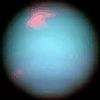
 Neptune
is a large planet on our solar system, seventeen times more massive
than Earth and far more blue. It is the eighth planet out from
our sun, and five planets further out than Earth, or 2.7 billion
miles (4.3 billion kilometers) away. Neptune, at about 2.8 billions
miles (4.5 billion kilometers) from the sun, is the most remote
of the large planets. It lies a billion miles beyond Uranus and
almost that far from the last planet in the solar system, Pluto.
Althought Neptune's day is shorter than ours (just over sixteen
hours) it orbit the sun only once every 165 Earth years. Since
it is the color of water, Neptune was named for the Roman god
of the sea. But Neptune's blue-green color is not that of a sea.
It is due to methane gas. Neptune wears a cold (-352 degrees Fahrenheit,
or -213 degrees celsius) outer layer of hydrogen, helium. Within
that lies a layer of ionized (electrically charged) water, ammonia,
and methane ice, and deeper yet is a rocky, iron core.
Neptune
is a large planet on our solar system, seventeen times more massive
than Earth and far more blue. It is the eighth planet out from
our sun, and five planets further out than Earth, or 2.7 billion
miles (4.3 billion kilometers) away. Neptune, at about 2.8 billions
miles (4.5 billion kilometers) from the sun, is the most remote
of the large planets. It lies a billion miles beyond Uranus and
almost that far from the last planet in the solar system, Pluto.
Althought Neptune's day is shorter than ours (just over sixteen
hours) it orbit the sun only once every 165 Earth years. Since
it is the color of water, Neptune was named for the Roman god
of the sea. But Neptune's blue-green color is not that of a sea.
It is due to methane gas. Neptune wears a cold (-352 degrees Fahrenheit,
or -213 degrees celsius) outer layer of hydrogen, helium. Within
that lies a layer of ionized (electrically charged) water, ammonia,
and methane ice, and deeper yet is a rocky, iron core.
^Back
To Top^
What
are conditions like on Neptune?
 Neptune
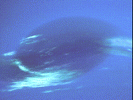
is subject to the fiercest winds in the solar system. Its layer
of blue surface clouds whip around with the wind while an upper
layer, wispy white clouds of methane crystals, rotate with the
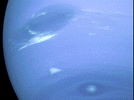
planet. Three storm systems are evident on Neptune's surface.
The most prominent is a dark blue area called the Great Dark Spot,
which is about the size of the Earth. Another storm, about the
size of our moon, is called the Small Dark Spot. Then there is
Scooter, a small, fast-moving white storm system that seems to
chase the other storms around the planet.
Neptune
is subject to the fiercest winds in the solar system. Its layer
of blue surface clouds whip around with the wind while an upper
layer, wispy white clouds of methane crystals, rotate with the
planet. Three storm systems are evident on Neptune's surface.
The most prominent is a dark blue area called the Great Dark Spot,
which is about the size of the Earth. Another storm, about the
size of our moon, is called the Small Dark Spot. Then there is
Scooter, a small, fast-moving white storm system that seems to
chase the other storms around the planet.
^Back
To Top^
Who
discovered the planet Neptune?
 Since
William Herschel's discovery of Uranus in 1781, astronomers had
wondered if that planet's fluctuating orbit was caused by the
pressure of another planet's gravitational field. In 1843, the
year that he graduated first in his class in mathematics from
Cambridge University, John Couch Adams, a self-taught astronomer,
completed his calculations of the location of the unknown planet.
In 1845, Adams presented his findings to England's highest authority
on such matters, George Airy, the Astronomer Royal. Airy paid
little attention to Adam's work.
Since
William Herschel's discovery of Uranus in 1781, astronomers had
wondered if that planet's fluctuating orbit was caused by the
pressure of another planet's gravitational field. In 1843, the
year that he graduated first in his class in mathematics from
Cambridge University, John Couch Adams, a self-taught astronomer,
completed his calculations of the location of the unknown planet.
In 1845, Adams presented his findings to England's highest authority
on such matters, George Airy, the Astronomer Royal. Airy paid
little attention to Adam's work.
 Some
authorities think that Airy ignored Adams's discovery because
he was working on his own theory to explain Uranus's orbit. One
year later, Airy was forced to reconsider. A French astronomer
named Urbain Jean Leverrier (1811-1877) announced that he had
determined the position of the new planet. Leverrier's calculations
placed the planet at almost the exact location as had Adams. Scientists
at the Cambridge Observatory and the Berlin Observatory confirmed
the findings of both men.
Some
authorities think that Airy ignored Adams's discovery because
he was working on his own theory to explain Uranus's orbit. One
year later, Airy was forced to reconsider. A French astronomer
named Urbain Jean Leverrier (1811-1877) announced that he had
determined the position of the new planet. Leverrier's calculations
placed the planet at almost the exact location as had Adams. Scientists
at the Cambridge Observatory and the Berlin Observatory confirmed
the findings of both men.
^Back
To Top^
DID
YOU KNOW?
What
causes the magnetic field on Neptune?
The
magnetic field that has been measured on Neptune is tilted from
its axis at a 48 degree angle and just misses the center of the
planet by thousands of miles. Given the planet's frigid exterior,
it is surprising that this field is created by 4,000-degree-Fahrenheit
(2,200-degree-Celsius) water beneath its surface, water so hot
and under so much pressure that it generates an electrical field.
^Back
To Top^


