 Dutch
physicist, astronomer, and mathematican Willebrord Snell (1580-1626)
made significant advances in the fields of trigonometry, optics
(the study of light), and map making. Snell is best remembered
today for Snell's law, which explains the angle of refraction
(bending) of light. He used a large quandrant (a circular arc
divided into 90-degree angles) to measure angles of separation
of two points, and in this way could calculate the distance between
them. He arrived at a figure for the radius of the Earth, a figure
we know today to be very accurate.
Dutch
physicist, astronomer, and mathematican Willebrord Snell (1580-1626)
made significant advances in the fields of trigonometry, optics
(the study of light), and map making. Snell is best remembered
today for Snell's law, which explains the angle of refraction
(bending) of light. He used a large quandrant (a circular arc
divided into 90-degree angles) to measure angles of separation
of two points, and in this way could calculate the distance between
them. He arrived at a figure for the radius of the Earth, a figure
we know today to be very accurate.
The
measurement of Earth also occupied German mathematican Carl Friedrich
Gauss (1777-1855). As director of the Gottingen Observatory from
1807 until his death forty-eight years later, Gauss became interested
in geodesy, the study of the size and shape of the Earth. To his
end, in 1821 he invented the heliotrope. The heliotrope is an
instrument that reflects sunlight over great distances to mark
the positions of participants in a land survey.
^Back
To Top^
How
does a planet hang on to its atmosphere?
 A
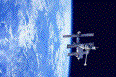
planet's ability to retain an atmosphere is determined by its
gravitational field. A gravitational field, in turn, depends on
a planet's mass. In the case of our planet, Earth's mass is great
enough to keep most gases (except for very light gases like hydrogen
and helium) from escaping.
A
planet's ability to retain an atmosphere is determined by its
gravitational field. A gravitational field, in turn, depends on
a planet's mass. In the case of our planet, Earth's mass is great
enough to keep most gases (except for very light gases like hydrogen
and helium) from escaping.
^Back
To Top^
What
does the Earth's atmosphere consist of?
 The
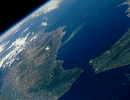
Earth's atmosphere is made up of 78 percent nitrogen, 21 percent
oxygen, and 1 percent argon, with minute quantities of water vapour,
carbon dioxide, and other gases.
The
Earth's atmosphere is made up of 78 percent nitrogen, 21 percent
oxygen, and 1 percent argon, with minute quantities of water vapour,
carbon dioxide, and other gases.
^Back
To Top^
How
did the Earth form its atmosphere?
 Various
theories try to explain the origin of these gases. One theory
states that when the Earth was formed, the gases were trapped
in layers of rock beneath the surface. They eventually escaped,
primarily through volcanic eruptions, to form the atmosphere.
Water vapour was the most plentiful substance to spew out, and
it condensed to form the oceans. Carbon dioxide was second in
terms of quantity, but most of it disolved in the water or was
altered chemically through reactions with other substances in
the rocks. Nitrogen came out on smaller amounts, but has always
remained in its present form because it never underwent reactions
or condensation. For that reason, it is the most abundrant gas
in the atmosphere today.
Various
theories try to explain the origin of these gases. One theory
states that when the Earth was formed, the gases were trapped
in layers of rock beneath the surface. They eventually escaped,
primarily through volcanic eruptions, to form the atmosphere.
Water vapour was the most plentiful substance to spew out, and
it condensed to form the oceans. Carbon dioxide was second in
terms of quantity, but most of it disolved in the water or was
altered chemically through reactions with other substances in
the rocks. Nitrogen came out on smaller amounts, but has always
remained in its present form because it never underwent reactions
or condensation. For that reason, it is the most abundrant gas
in the atmosphere today.
^Back
To Top^
Has
oxygen always been part of the Earth's atmosphere?
 According
to the prevailing theor, oxygen only became part of our atmosphere
when green plants came into being. Green plant, through photosynthesis,
produce oxygen by converting carbon dioxide. The other gases in
the atmosphere were probably released from underground by volcanic
activity- a process that began long before green plants came into
being. Oxygen is also removed from the atmosphere when green plants,
as well as animals, die. As they decay, they oxidize- a process
that uses up oxygen.
According
to the prevailing theor, oxygen only became part of our atmosphere
when green plants came into being. Green plant, through photosynthesis,
produce oxygen by converting carbon dioxide. The other gases in
the atmosphere were probably released from underground by volcanic
activity- a process that began long before green plants came into
being. Oxygen is also removed from the atmosphere when green plants,
as well as animals, die. As they decay, they oxidize- a process
that uses up oxygen.
^Back
To Top^
How
does Earth's atmosphere compare to the rest of the solar system?
 The
Earth's atmosphere is unique within the solar system. Inparticular,
it stands out as the only planetary atmosphere capable of sustaining
life. By way of comparsion, Saturn, and Neptune, on the other
hand, are each more massive than the entire Earth. And while our
atmosphere is mainly made of nitrogen, those of Mars and Venus
are dominated by carbon dioxide.
The
Earth's atmosphere is unique within the solar system. Inparticular,
it stands out as the only planetary atmosphere capable of sustaining
life. By way of comparsion, Saturn, and Neptune, on the other
hand, are each more massive than the entire Earth. And while our
atmosphere is mainly made of nitrogen, those of Mars and Venus
are dominated by carbon dioxide.
^Back
To Top^
DID
YOU KNOW?
Could
our atmosphere have come from space?
A
fairly recent theory proposes that the elements found in the Earth's
atmosphere were deposited here by comets. Deris from comets is
shown to have carbon and nitrogen in roughly the same proportion
as found in our atmosphere. And scientists have identified numerous
impact craters on Earth from past collisions with comets.
^Back
To Top^


