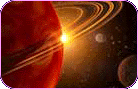
 Our
solar system consists of the sun and all of its orbiting objects.
These objects belong to various classes, including planets and
their moons and rings; asteroids; comets; meteors and meteorites;
and particles of dust and debris. The sun, which keeps the other
objects in orbit with its immense gravitational field, alone accounts
for 99.8 percent of the mass of the solar system. Jupiter, the
largest planet, represents another 0.1 percent of the mass, and
everything else together makes up the remaining 0.1 percent.
Our
solar system consists of the sun and all of its orbiting objects.
These objects belong to various classes, including planets and
their moons and rings; asteroids; comets; meteors and meteorites;
and particles of dust and debris. The sun, which keeps the other
objects in orbit with its immense gravitational field, alone accounts
for 99.8 percent of the mass of the solar system. Jupiter, the
largest planet, represents another 0.1 percent of the mass, and
everything else together makes up the remaining 0.1 percent.
A
planet is a body that orbits the sun (or another star) and produces
no light of its own, but reflects the light of the sun or star.
At present, scientists know of nine planets in our solar system.
They are grouped into three categories: the solid, terrestrial
planets; the giants, gaseous (also know as "Jovian") planets;
and Pluto.
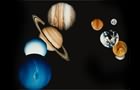 The
first group of planet consist of Mercury, Venus, Earth, and Mars,
the planet closest to the sun. The next group, farther from the
sun, consists of Jupiter, Saturn Uranus, and Neptune. The third
group consists of a single planet, Pluto, the smallest planet,
farther away even than the string of gas giants.
The
first group of planet consist of Mercury, Venus, Earth, and Mars,
the planet closest to the sun. The next group, farther from the
sun, consists of Jupiter, Saturn Uranus, and Neptune. The third
group consists of a single planet, Pluto, the smallest planet,
farther away even than the string of gas giants.
 Astronomers
have speculated about the existence of two other planets in our
solar system: Vulcan, between Mercury and the sun, and Planet
X, beyond Pluto. However, despite exhaustive effort, neither planet
has as yet been found. A moon is any natural body (as opposed
to a man-made satellite) that's orbits a planet. Seven of our
solar system's planets are accompanied on their journeys around
the sun by moons. In total, these planets are orbited by sixty-one
moons. This number will probably change as a result of new findings
like the recent unconfirmed sighting of four additional moons
around Saturn. Although moons do not orbit the sun independently,
they are still considered members of the solar system.
Astronomers
have speculated about the existence of two other planets in our
solar system: Vulcan, between Mercury and the sun, and Planet
X, beyond Pluto. However, despite exhaustive effort, neither planet
has as yet been found. A moon is any natural body (as opposed
to a man-made satellite) that's orbits a planet. Seven of our
solar system's planets are accompanied on their journeys around
the sun by moons. In total, these planets are orbited by sixty-one
moons. This number will probably change as a result of new findings
like the recent unconfirmed sighting of four additional moons
around Saturn. Although moons do not orbit the sun independently,
they are still considered members of the solar system.
^Back
To Top^
History
 Today
the theory of the solar system's formation considered most likely
to be correct is a modified version of the eighteenth-century
nebular hypothesis. The current theory states that 4.56 billion
years ago the sun and planets formed from the solar nebula-a cloud
of interstellar gas and dust.
Today
the theory of the solar system's formation considered most likely
to be correct is a modified version of the eighteenth-century
nebular hypothesis. The current theory states that 4.56 billion
years ago the sun and planets formed from the solar nebula-a cloud
of interstellar gas and dust.
 Due
to the mutual gravitational attraction of the material in the
nebula, and possibly triggered by shock waves from a nearby supernova,
the nebula eventually collapsed it on itself. As the nebula contracted,
it spun increasingly rapidly, leading to frequent collisions between
dust grains. These grains stuck together to form ever larger objects,
first pebbles, then boulders, and then planetesimals.
Due
to the mutual gravitational attraction of the material in the
nebula, and possibly triggered by shock waves from a nearby supernova,
the nebula eventually collapsed it on itself. As the nebula contracted,
it spun increasingly rapidly, leading to frequent collisions between
dust grains. These grains stuck together to form ever larger objects,
first pebbles, then boulders, and then planetesimals.
 These
planetesimals continued to stick to solid particles as well as
gas (in what's known as the accretion theory) and eventually gave
way to protoplanets, planets in their early. As the nebula continued
to condense, the temperature at its core rose to the point where
nuclear fusion could begin. It then became a star (our sun) and
the bodies farther from the core became the planets.
These
planetesimals continued to stick to solid particles as well as
gas (in what's known as the accretion theory) and eventually gave
way to protoplanets, planets in their early. As the nebula continued
to condense, the temperature at its core rose to the point where
nuclear fusion could begin. It then became a star (our sun) and
the bodies farther from the core became the planets.
 While
the nebular hypothesis was popular in the 1800s and the modified
nebular theory is preferred today, there was a period in the early
1900s when another group of theories were in fashion-the encounter
theories. These theories all stated, in one way or another, that
the planets were created by a collision between a foreign object
(such as another star) and the sun. This resulted in the ejection
material from the sun, which cooled to form the planets. This
theory has been rejected for two main reasons. One is that such
material would have likely remained very close to the sun and
not scattered at the distances of the planet, and the other is
that solar material would be more likely to dissipate than to
come together.
While
the nebular hypothesis was popular in the 1800s and the modified
nebular theory is preferred today, there was a period in the early
1900s when another group of theories were in fashion-the encounter
theories. These theories all stated, in one way or another, that
the planets were created by a collision between a foreign object
(such as another star) and the sun. This resulted in the ejection
material from the sun, which cooled to form the planets. This
theory has been rejected for two main reasons. One is that such
material would have likely remained very close to the sun and
not scattered at the distances of the planet, and the other is
that solar material would be more likely to dissipate than to
come together.
 Some
scientists at the time believed that the solar system had been
created when another star had passed by the sun millions of years
ago. The star's gravitational field, they proposed, had pulled
material away from the sun, and this material then formed into
the planets. British astronomer Arthur Stanley Eddington's research
into the structure of stars disproved this popular theory. Eddington
showed that any material pulled from a star's core would explode
into a thin gas when it was removed from the star's balance of
energy production and gravity.
Some
scientists at the time believed that the solar system had been
created when another star had passed by the sun millions of years
ago. The star's gravitational field, they proposed, had pulled
material away from the sun, and this material then formed into
the planets. British astronomer Arthur Stanley Eddington's research
into the structure of stars disproved this popular theory. Eddington
showed that any material pulled from a star's core would explode
into a thin gas when it was removed from the star's balance of
energy production and gravity.
 British
astronomer Fred Hoyle (1915- ), who served as a professor of astronomy
and philosophy at the Institute of Theoretical Astronomy at Cambridge,
England, has made detailed studies of the nuclear reactions that
take place in the core of a star. He has also researched the gravitational,
electrical, and nuclear fields of stars and the various elements
formed within them. Hoyle is the author of several books on stars,
both technical and for general readers, as well as a number of
science fiction stories and even a script for an opera. Hoyle
proposes that the solar system was formed out of the remains of
an exploded star that was once paired with our sun.
British
astronomer Fred Hoyle (1915- ), who served as a professor of astronomy
and philosophy at the Institute of Theoretical Astronomy at Cambridge,
England, has made detailed studies of the nuclear reactions that
take place in the core of a star. He has also researched the gravitational,
electrical, and nuclear fields of stars and the various elements
formed within them. Hoyle is the author of several books on stars,
both technical and for general readers, as well as a number of
science fiction stories and even a script for an opera. Hoyle
proposes that the solar system was formed out of the remains of
an exploded star that was once paired with our sun.
^Back
To Top^
DID
YOU KNOW?
How
large is the solar system?
The
average distance between the sun and Pluto, the farthest planet
in our solar system, is about 3.65 billion miles (5.87 billion
kilometres). And if we consider the solar system to incorporate
the entire space within the orbit of the furthermost planet, that
area would be a whopping 41.85 quantillion square miles (108.4
quantillion square kilometres). However, our solar system seems
quite insignificant when considered in the context of the more
than one hundred billion stars in our galaxy and the estimated
fifty billion galaxies in the universe.
Are
there other solar systems in the universe?
Recently
evidence has come to light suggesting that ours may not be the
only solar system in the galaxy. In the late 1995 and early 1996,
three new planets were found, ranging in distance from thirty-five
to forty light-years from Earth. The first planet, discovered
by Swiss astronomers Michael Mayor and Didier Queloz, orbits a
star in the constellation Pegasus. The next two planets were discovered
by American astronomers Geoffery Marcy and Paul Butler. One is
in the constellation Virgo and the other is in the Big Dipper.
These new discoveries give astronomers and space enthusiasts hope
that on some yet-to-be-discovered planet, in some yet-to-be-discovered
solar system, scientists may yet find intelligent life.
^Back
To Top^


