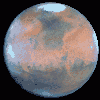
 Mars,
the fourth planet out from the sun in Earth's solar system, is
about half the size of Earth and has a rotation period just slightly
longer than one Earth day. Since it takes Mars 687 Earth days
to orbit the sun, its seasons are about twice as long as ours.
Mars has two polar caps. The northern one is larger and colder
than the southern. Two small moons, Phobos and Deimos, orbit the
planet.
Mars,
the fourth planet out from the sun in Earth's solar system, is
about half the size of Earth and has a rotation period just slightly
longer than one Earth day. Since it takes Mars 687 Earth days
to orbit the sun, its seasons are about twice as long as ours.
Mars has two polar caps. The northern one is larger and colder
than the southern. Two small moons, Phobos and Deimos, orbit the
planet.
^Back
To Top^
Who
discovered the polar caps on Mars?
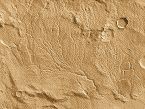 Gian
Domenico Cassini (1625-1712) made detailed observations of Mars,
the only planet whose surface can be seen clearly from Earth.
He discovered that Mars has polar caps that spread during the
Martian winter and shrink in the summer. These seasonal variations
caused him to consider the possibility of life on Mars.
Gian
Domenico Cassini (1625-1712) made detailed observations of Mars,
the only planet whose surface can be seen clearly from Earth.
He discovered that Mars has polar caps that spread during the
Martian winter and shrink in the summer. These seasonal variations
caused him to consider the possibility of life on Mars.
^Back To Top^
What
are the so-called canals seen on Mars?
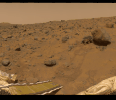 Mars
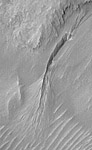
is marked by what appear to be dried riverbeds and flash-flood
channels. These features could mean that ice below the surface
melts and is brought above ground by occasional volcanic activity.
The water may temporarily flood the landscape before boiling away
in the low atmosphere pressure. Another theory is that these eroded
areas could be left over from a warmer, wetter period in Martian
history.
Mars
is marked by what appear to be dried riverbeds and flash-flood
channels. These features could mean that ice below the surface
melts and is brought above ground by occasional volcanic activity.
The water may temporarily flood the landscape before boiling away
in the low atmosphere pressure. Another theory is that these eroded
areas could be left over from a warmer, wetter period in Martian
history.
^Back
To Top^
What
are conditions like on Mars?
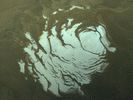 Spacecraft
sent to Mars revealed a barren, desolate, crater-covered world
prone to frequent, violent dust storms. They found little oxygen,
no liquid water, and ultraviolet radiation at levels that would
kill any known life form. The high temperature on Mars was measured
at -20 degrees Fahrenheit (-29 degrees Celsius) in the afternoon,
and the low was -120 degrees Fahrenheit (-84 degrees Celsius)
at night.
Spacecraft
sent to Mars revealed a barren, desolate, crater-covered world
prone to frequent, violent dust storms. They found little oxygen,
no liquid water, and ultraviolet radiation at levels that would
kill any known life form. The high temperature on Mars was measured
at -20 degrees Fahrenheit (-29 degrees Celsius) in the afternoon,
and the low was -120 degrees Fahrenheit (-84 degrees Celsius)
at night.
^Back
To Top^
What's
notable about the topography of Mars?
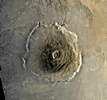 The
two most distinguishing features of the northern hemisphere of
Mars are a 15-mile-high (24-kilometers-high) volcano called Olympus
Mons, larger than any other in the solar system, and a 2,000-mile-long
(3,220-kilometers-long) canyon called Valle Marineris, twenty-six
times as long and three times as deep as the Grand Canyon. The
southern hemisphere is noteworthy for Hellas, an ancient canyon
that was long ago filled with lava and is now a large, light area
covered with dust.
The
two most distinguishing features of the northern hemisphere of
Mars are a 15-mile-high (24-kilometers-high) volcano called Olympus
Mons, larger than any other in the solar system, and a 2,000-mile-long
(3,220-kilometers-long) canyon called Valle Marineris, twenty-six
times as long and three times as deep as the Grand Canyon. The
southern hemisphere is noteworthy for Hellas, an ancient canyon
that was long ago filled with lava and is now a large, light area
covered with dust.
^Back
To Top^
How
has our understanding of the planet Mars changed over time?
 Mars
was named for the Roman god of war. It was long believed to hold
life, perhaps even intelligent, human-like life. Early astronomers
peered through telescopes and saw dark seas on the planet, connected
by lines. Some imaginative scientists theorized that the dark
spots were seas and that the lines were channels dug by Marthian
engineers to bring water to populated areas. A series of space
probes launched by the United States and the former Soviet Union
in the 1960s and 1970s, however, put an end to such speculation.
Mars
was named for the Roman god of war. It was long believed to hold
life, perhaps even intelligent, human-like life. Early astronomers
peered through telescopes and saw dark seas on the planet, connected
by lines. Some imaginative scientists theorized that the dark
spots were seas and that the lines were channels dug by Marthian
engineers to bring water to populated areas. A series of space
probes launched by the United States and the former Soviet Union
in the 1960s and 1970s, however, put an end to such speculation.
^Back
To Top^


