|
|
for publications
click here
Onset of
Ferromagnetism
|
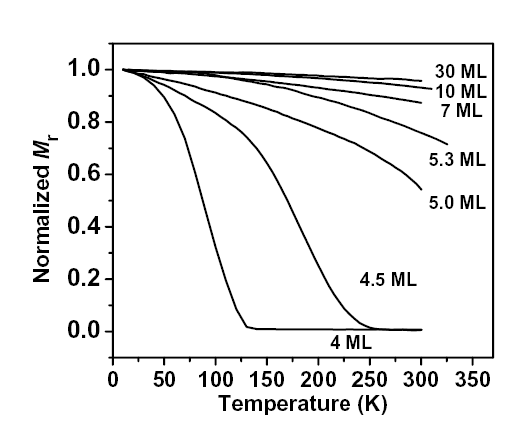
Figure 1: Temperature dependence of remanent magnetization
Mr of Fe/GaAs(113)A films having different thicknesses. All curves
are normalized with respect to the remanent magnetization at 10 K. Onset of RT
ferromagnetic order is between 4.5 to 5.0 ML.
The onset of
ferromagnetism was studied by temperature dependence of remanent magnetization
Mr.
A plot of Mr
vs temperature T for film thicknesses from
4.0 ML to 30 MLs is shown in Fig.1. The remanent magnetization
Mr is
normalized with respect to its value at 10 K, i.e., M0r . These
measurements were performed while heating the sample from 10 K to 300 K. Before
the measurement, the samples were magnetized along the [332] direction up to
fields large enough to ensure a complete orientation of the magnetic moments.
Since all these measurements were made with the magnetic field applied parallel
to the easy axis. The remanent magnetization is essentially the same as the
saturation magnetization, Ms.
For samples above 10 ML thickness, the RT remanence changes by less than 10 % of
its value at 10 K, indicating a high Curie temperature of these samples. Thinner
samples below 10 ML show a drastic change in remanence with temperature. The
Curie temperature decreases strongly when decreasing the thickness and reaches
120 K for the 4 ML sample which is well known in ultrathin films due to the
reduced co-ordination. For the 3.5 ML Fe sample we did not observe any
ferromagnetism even at 2 K. This implies that the first signature of
ferromagnetic order in our films starts between 3.5 to 4.0 ML. This is
approximately the same thickness for which we observe the first RHEED pattern
from the Fe layer. The onset of ferromagnetism in these layers can be ascribed
to a percolation phenomenon during coalescence of Fe islands similar to that
observed in Fe on GaAs(001).
|
|
More details
|
|
P. K. Muduli,
J. Herfort, H.-P. Sch�nherr, and K. H. Ploog,
Evolution of magnetic anisotropy and spin-reorientation
transition in Fe films grown on GaAs(113)A substrates by molecular beam epitaxy,
J. Appl.
Phys.
97
123904 (2005) (7 pages) |
|
Last Updated
Wednesday June 22, 2005 |
|
Molecular Beam Epitaxy
Reflection High Energy
electron Diffraction (RHEED)
High Resolution X-Ray Diffraction
In-situ Kerr Effect
(MOKE)
SQUID Magnetometry
Magnetotransport
SPINTRONICS BASICS
Research Highlights
Fe/GaAs(113)A:
Onset of
Ferromagnetism
Evolution of Magnetic
anisotropy
Antisymmetric
contribution to the planar Hall effect
Fe3Si/GaAS(113)A
Growth optimization
and basic magnetic Properties
|