Magnetotransport measurements
Magnetotransport measurements provide a sensitive tool to
study magnetic anisotropy and magnetization reversal in
low-dimensional magnetic structures. They also provide information
on transport-related phenomena such as the spin-dependent
scattering mechanism of carriers. One important advantage of
magnetotransport, particularly for the case of FM/SC hybrid
structures, is its relative insensitivity to a semiconducting or
insulating substrate. For thin films, it is difficult to subtract
the magnetic contribution of the substrate in traditional
magnetometry techniques like vibrating sample magnetometry or
SQUID magnetometry. In magnetotransport, only the metallic portion
of the sample (the thin film) is measured. Another advantage of
magnetotransport is the simplicity of the experimental set-up and
the relative low cost of the equipment.
Enlarge
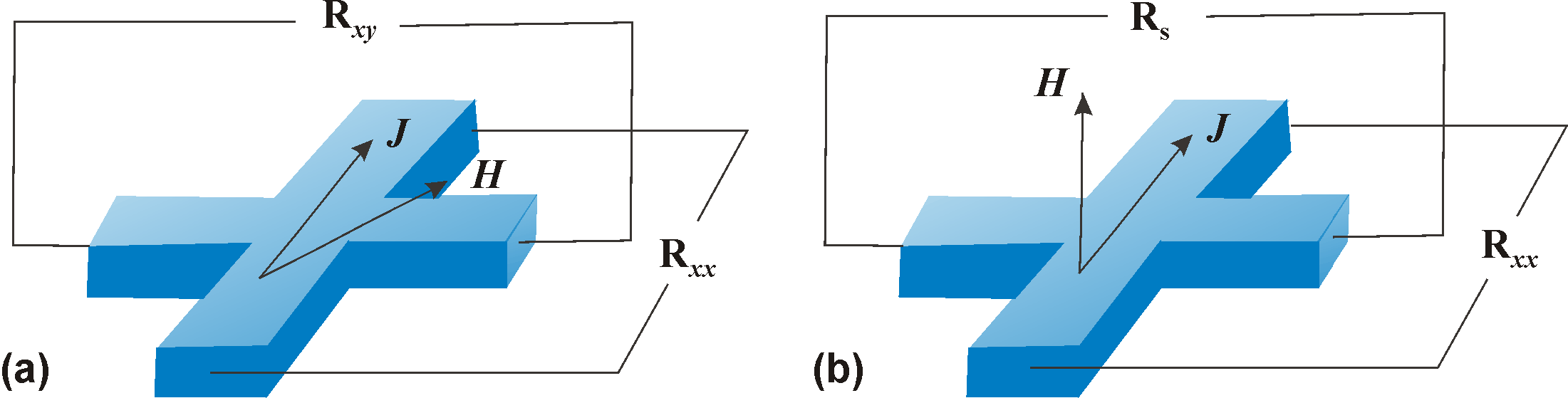
Figure 0.1: The geometry of magnetotransport measurements. (a)
Magnetic field is applied in-plane. The longitudinal
magnetoresistance is referred to as anisotropic magnetoresistance
(Rxx) and the transverse magnetoresistance (Rxy)
as planar Hall effect. (b) Magnetic field is applied perpendicular
to the film plane and the transverse resistance is measured. This
is the usual Hall effect geometry. For ferromagnets this is sum of
ordinary and extraordinary Hall effect.
The subject of galvanomagnetism is rather vast. One of the most
important type of electrical resistance change in ferromagnetic
metals, which is to be studied in this work, is the one associated
with the direction of magnetization relative to the current.
Magnetotransport measurements can be performed in several applied
magnetic field geometries as defined schematically in
Fig. 1. When the magnetic field is applied
in-plane [Fig. 1 (a)], the longitudinal
resistance Rxx is referred to as anisotropic
magnetoresistance (AMR), and the transverse resistance Rxy as the planar Hall effect (PHE). For perpendicular magnetic
field [Fig. 1 (b)], two contributions arise
in the transverse resistance of ferromagnets. The ordinary Hall
effect (OHE) arises from the Lorenz force while the Anomalous Hall
effect (AHE) (also called extraordinary Hall effect) is related to
the magnetization of the thin film. The electric field
E for arbitrary orientations of the external magnetic
field H and magnetization M for a
polycrystalline and single domain ferromagnetic sample is often
written in the following way [1,[2]:
|
E=r^J+(r||-r^) |
^
a
|
(J. |
^
a
|
)+rAHE |
^
a
|
×J, |
| (0.1) |
where J is the current density and [^(a)] is a
unit vector in the direction of the magnetic moment of the single
domain sample. r^ and r|| are
the longitudinal resistivities parallel and perpendicular to
[^(a)], respectively. rAHE is the transverse
resistivity for the magnetization perpendicular to the film plane.
Thus the last term denotes the AHE. The first two terms represent
both AMR and PHE. When the magnetic field is applied in the film
plane with a current along the x-axis, we can find from
Eq. (1) [1,[2]:
| |
rxx = r^+(r||-r^)cos2q M, |
| | (0.2) |
| | rxy = |
1
2
|
(r||-r^)sin2q M, |
| | (0.3) |
|
where qM represents the angle between J
(or x-axis) and [^(a)]. These Eqs. (2)
and (3) are conventionally used to describe the AMR and
PHE, respectively. It may be pointed out that the above three
equations are simplified form for polycrystalline samples and do
not necessarily describe the behavior of single crystalline
samples. When a saturating field H with components
Hi=Hai, is applied to a crystal, the
relationship between the electric field E and current
density J is defined through the relation:
where rij(a) is a second-rank
magnetoresistivity tensor and Ei (Jj) are
components of E (J). Here, the Einstein
summation convention is understood. The tensor rij(a) depends on the direction cosines,
ai. Since rij(a) is a
second-rank tensor it can be divided into its symmetrical and
antisymmetrical parts:
| | rijs(a)= |
1
2
|
[rij(a)+r ji(a)], |
| | (0.5) |
|
and
| | rija(a)= |
1
2
|
[rij(a)-r ji(a)]. |
| | (0.6) |
|
The Onsager's theorem [3] applied to a
magnetically saturated crystal implies that:
so that rijs is an even function of the
ai and rija is an odd function of
the ai. In fact it can be easily shown that AMR
originates from the symmetric part of the resistivity tensor
whereas the AHE originates from the antisymmetric part of the
resistivity tensor. Though there is very few literature examining
the exact origin of PHE, usually the PHE is also attributed to the
symmetric part of the resistivity tensor.
Bibliography
- [1]
-
T. McGuire and
R. Potter,
IEEE Trans. Magn. 11,
1018 (1975).
- [2]
-
J. P. Jan, in
Solid State Physics, edited by
F. Seitz and
D. Turnbull
(Academic Press Inc., New York,
1957), vol. 5, pp. 1-96.
- [3]
-
R. R. Birss,
Symmetry and Magnetism
(North-Holland Publishing Company,
Amsterdam, 1964), p. 70.
File translated from
TEX
by
TTH,
version 3.68.
On 20 Oct 2005, 17:23. |