Ex situ SQUID magnetometry
SQUID magnetometry is well-known as one of the most sensitive
methods of magnetometry. This technique uses a combination of
superconducting materials and Josephson junctions to measure
magnetic fields with resolutions up to 10-14 T or better.
The DC SQUID A DC SQUID is actually a rather simple device.
It consists of two Josephson junctions connected in parallel on a
closed superconducting loop as shown in
Fig. 1(a) [1]. A fundamental
property of superconducting rings is that they can enclose
magnetic flux only in multiples of a universal constant called the
flux quantum, h/2e=2.07×10-15 Wb. Because the flux
quantum is very small, this physical effect can be exploited to
produce an extraordinarily sensitive magnetic detector known as
the SQUID. SQUIDs actually function as magnetic flux-to-voltage
transducers where the sensitivity is set by the magnetic flux
quantum. Applying current to the SQUID (biasing it) sends Cooper
pairs of electrons tunnelling through the junctions. A magnetic
field applied to the ring, however, alters the flow. Specifically,
it changes the quantum-mechanical phase difference across each of
the two junctions. These phase changes, in turn, affect the
critical current of the SQUID. A progressive increase or decrease
in the magnetic field causes the critical current to oscillate
between a maximum value and a minimum one. The maximum occurs when
the flux administered to the SQUID equals an integral number of
flux quanta through the ring; the minimum value corresponds to a
half-integral number of quanta. The flux applied to the SQUID can
assume any value, unlike the flux contained within a closed
superconducting ring, which must be an integral number. In
practice, we do not measure the current but rather the voltage
across the SQUID, which also swings back and forth under a
steadily changing magnetic field as shown in
Fig. 1(b). This quantum interference effect
provides us with a digital magnetometer. Each "digit" represents
one flux quantum. In fact, conventional electronics can detect
voltages corresponding to changes in magnetic flux of much less
than one flux quantum. Thus the SQUID in essence is a
flux-to-voltage transducer, converting a tiny change of magnetic
flux into a voltage.
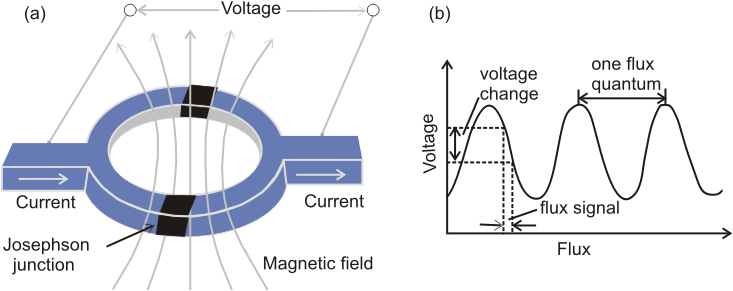
Figure 1: The DC SQUID construction and principle: (a) Shows the
two Josephson junctions forming a superconducting ring, which
forms the DC SQUID.(b) Shows the output voltage as a function of
applied flux. A tiny flux signal produces a corresponding voltage
swing across the SQUID, which conventional electronics can
measure. Figure inspired by Ref. [1].
Practical SQUID Magnetometer Although in some
applications it is convenient to expose the SQUID directly to the
magnetic field of interest, more often the magnetic signal is
conveyed to the SQUID by a flux transformer. A flux transformer is
a closed superconducting circuit consisting of two coils in
series. One coil, the input coil, is magnetically coupled to the
SQUID and is usually fabricated along with it; the second, or
pick-up coil, is exposed to the field to be measured. This second
coil acts as a magnetic antenna that couples external signals into
the SQUID. It is a basic principle of superconductivity that the
flux inside a closed superconducting circuit cannot change.
Consequently, a change in field that causes the flux in the
pick-up coil to change also causes a change in the flux in the
input coil. The SQUID senses this latter flux change. The area of
the pick-up coil is usually much greater than the area of the
SQUID. The prime function of the transformer is to convert the
high magnetic flux sensitivity of the SQUID itself into a high
magnetic field sensitivity. Another advantage of using a flux
transformer is that the input coil, which can be made as a wire or
a thin film structure, can be configured to suit the measurement
at hand. In particular, it can be wound so as to be sensitive not
to the magnetic field itself, but to the gradient of the field in
a chosen direction, or to a higher derivative of the field. In
these cases, the flux transformer is referred to as a gradiometer.
Since the gradient of the magnetic field falls off more rapidly
with distance from the magnetic source than the field itself, a
gradiometer tends to reject magnetic interference from distant
sources, while remaining sensitive to closer objects. Again, a
gradiometer is essentially sensitive to changes in the field
gradient rather than its absolute value, and the technique of
controlled resetting can be applied to yield a large dynamic
range. The system used in this work implements a second-derivative
gradiometer that minimizes background drifts in the SQUID
detection system caused by relaxation in the magnetic field of the
superconducting magnet. The second-derivative gradiometer is also
more noise immune than a first-order gradiometer.
The MPMS SQUID system [2] used in this work is
composed of several units: the dewar, the probe and SQUID
assembly, and the electronic control system. The probe contains a
high-precision temperature control system that allows measurements
between 1.9 K to 400 K with an accuracy of 0.01 K (valid at low
temperature). A superconducting electromagnet can deliver a field
of up to 5×10⁴ G with a field accuracy of 0.1 G (for
small magnetic fields). The dewar consists of an inner liquid
helium reservoir, and an outer liquid nitrogen jacket to reduce
excessive liquid helium boil-off. Liquid helium is used both to
maintain the electromagnet in a superconducting state and to cool
the sample space. The samples are mounted within a plastic straw
and connected to one end of a sample rod which is inserted into
the dewar. The other end is attached to a stepper motor which is
used to position the sample within the center of the SQUID pickup
coil. The generated magnetic field is well-shielded from the
surroundings.
Bibliography
- [1]
-
J. Clarke,
Scientific American 271, 46 (1994).
- [2]
-
MPMS from Quantum Design, see http://www.qdusa.com/products/mpms.html.
File translated from
TEX
by
TTH,
version 3.68.
On 20 Oct 2005, 16:32. |