|
|
Reflection High Energy
electron Diffraction (RHEED)
|
Refection high energy electron diffraction (RHEED) is widely
used as a sensitive technique for the in situ
investigation of surface structures and growth
processes in MBE. The geometry of RHEED is quite simple. A high energy beam
(3-100 keV) is directed at the sample surface at a grazing angle (<
� 3).
The electrons are diffracted by the crystal structure of the sample and then
impinge on a phosphor screen mounted opposite to the electron gun. Upon
refection, electrons diffract, forming a diffraction pattern that depends on the
structure and the morphology of the probed surface. The grazing incidence angle
ensures that only a few atomic layers are probed despite the high energy of the
incident electrons. Conceptually, perfectly flat surfaces should result in a
diffraction pattern that consists of spots arranged on Laue rings. However,
because of the non-idealities in the electron beam and the sample's surface,
streaks appear instead of spots. [1,2]
The distance between the streaks is an indication of the surface lattice unit
cell size. If a surface is atomically flat, then sharp RHEED patterns are seen.
If the surface is rough, then the RHEED pattern is more diffuse. In many cases,
because of the surface roughness, the diffraction pattern is produced by
transmission through the three-dimensional crystalline islands. In kinematic
scattering theory, [3] the
diffraction results when the Laue condition is satisfied:
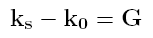
where ks
and k0
are the wave vectors for the diffracted and the
incident beams, respectively and G
is the reciprocal-lattice vector. In the special case of
elastic scattering, |k0|=
|ks|
and the diffraction condition can be obtained from
the geometrical construction of Ewald sphere. An Ewald sphere is a sphere that
has its origin as the origin of the k0
and a radius |k0|.
Hence, the Laue condition may be re-formalized as "diffraction occurs for all
connecting the origin of the sphere and a reciprocal-lattice point".
For detailed discussions on RHEED theories
please see [2,3]
Find the New BOOK on RHEED (highly
recommended)
Reflection High-Energy Electron Diffraction
by Ayahiko Ichimiya, Philip I. Cohen, Cambridge University Press (2004)
also see
useful links |
|
Literature on RHEED
[1] J. E. Mahan, K. M.
Geib, G. Y. Robinson, and R. G. Long, J. Vac. Sci. Technol. A
8, 3692 (1990).
[2] W. Braun, Applied
rheed, in Springer Tracts in Modern Physics,
edited by G. H�hler
et al., volume 154, Springer-Verlag, Berlin and Heidelberg, 1999.
[3] E. Bauer, Reflection
electron diffraction (red), in Techniques of
metals research, edited by R. F. Bunshah, volume
II, Part-2, page 501, Interscience, New York, 1969.
To the Top |
|
Useful Links (RHEED):
RHEED summary by MHeGazy
A
Lecture abt RHEED
MBE Talk (U.
Bochum)
Another
talk
RHEED intro
Foundations:
Molecular Beam Epitaxy
Reflection High Energy
electron Diffraction (RHEED)
High Resolution X-Ray Diffraction
X-ray reflectivity
In-situ Kerr Effect
(MOKE)
SQUID Magnetometry
Magnetotransport
SPINTRONICS BASICS
Research
Highlights |