High resolution X-ray diffraction
High resolution X-ray diffraction (HRXRD) is employed in this work to characterize the basic structural
properties of the ferromagnetic films. HRXRD is a powerful tool for non-destructive
ex situ investigations of epitaxial layers. From HRXRD,
information about the composition and uniformity of the epitaxial
layers, layer thickness, strain and strain relaxation, as well as
the presence of defects such as dislocations can be obtained.
There are several text books and
reviews [1,2,3,4]
on the analysis of epitaxial layers by HRXRD. Here only a brief
description of some relevant topics will be presented.
Geometries of asymmetric reflections The two major kinds of
scans in HRXRD, namely w-2q scan and w scan,
are sensitive to different properties of the layer. The
w-2q scan is sensitive to information such as strain,
lattice constant and composition, whereas the w scan is
sensitive to defects such as dislocations and mosaic spread. The
w-2q type scans can be used for both symmetric and
asymmetric reflections resulting in quite different scattering
geometries. The geometry of the w-2q scan for an
asymmetric reflection (hkl) making an angle j with the
sample surface is schematically defined in
Fig. 1. There are three measurement
geometries: grazing-incidence (GI), grazing-exit (GE) and skew. In
the skew geometry (a quasisymmetric configuration), the sample is
tilted with respect to its surface normal by the lattice plane
inclination j. Because of this tilting requirement, a
four-circle diffractometer is required for the measurements in
skew geometry.
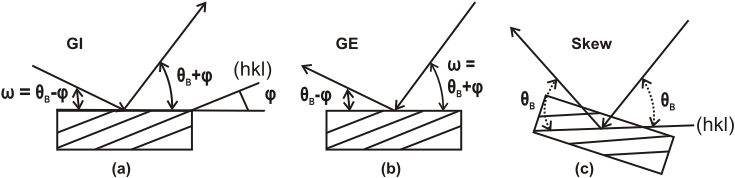
Figure 0.1: Definitions of diffraction geometry for an asymmetric
Bragg diffraction.(a) grazing-incidence geometry (b) grazing-exit
geometry and (c) skew-geometry for the plane (hkl) making an angle
j to the sample surface. qB is the Bragg
angle.
Determination of the strain and composition of the epitaxial layers
The lattice constant of a thin film that grows coherently on a
single crystalline substrate is modified parallel to the growth
direction. From X-ray diffraction, the information about lattice
constant of the layer is obtained, which in principle is determined by Bragg's law:
where dhkl is the spacing of the lattice planes with Miller indices (hkl) and qB is the
corresponding Bragg angle. From symmetric X-ray diffraction,
information on the lattice constant of the layer
perpendicular to the film plane a^L can be obtained. However, this is the strained lattice constant
of the layer. For a tetragonal distortion of the layer, the unstrained lattice constant of the layer
a0L is related to the strained lattice constant by the
following equation [4]:
|
a0L= |
C11
C11+2C12
|
(a^L-a0s)+a0s, |
| (0.2) |
where the constants C11 and C12 are the elastic
stiffness of the layer and a0s is the relaxed lattice
constant of the substrate. This unstrained lattice constant of the
layer is used to determine the composition of the
layer. For binary and ternary alloys, the composition is often determined
from Vegard's law, which simply states that the lattice
constant of a solid solution alloy varies linearly with composition, following a line
drawn between the values for the pure constituents.
Determination of thickness of the layers A very accurate way
to determine the layer thickness can be achieved from the so
called thickness fringes, which are small periodic oscillations
around the layer peak in an w-2q scan. These fringes
originate from the interference of the wave fields. The
measurement of these interference peak separation,
DqB, provides the thickness
t [1]:
|
DqB= |
lsin(qB�j)
tsin2qB
|
, |
|
(0.3) |
where l is the wavelength, and j is the angle
between the reflecting plane and the surface. Positive sign
applies to the GI geometry and negative sign to the GE geometry.
This is a very useful method, since the above equation does not
contain anything about the material or diffraction conditions
other than the Bragg angle and geometry. In practice, a more
accurate computer simulation is usually employed to extract the
layer thickness and other parameters. In this study, a computer
program called
MadMax was employed which uses a dynamical
X-ray diffraction formalism using the Takagi-Taupin
formalism [5].
Reciprocal space map (RSM) As the name suggest, the RSM
refers to the intensity contour maps, keeping one of the Miller
indices, e.g., l in the reciprocal lattice, fixed, while the
other two indices h and k are varied by �Dh and
�Dk, respectively. This is achieved with a triple axis
diffractometer, where an analyzer is placed behind the specimen
and in front of the detector. The analyzer is mounted on an axis
concentric with the specimen and is scanned independently of the
sample. The experimenter can then map the intensity distribution
with respect to the direction of the radiation scattered by the
instrument. Usually, one measures several w-2q scans
for different w offsets with the analyzer crystal. The
w-2q scan in fact corresponds to a scan along the
vector Sx[hkl] reflection in reciprocal space whereas the
w scan is perpendicular to Sx[hkl] as shown in
Fig. 2(a). The conversion of a peak position
(w, 2q) to reciprocal space co-ordinates Sx
and Sy can be obtained from
Fig. 2(b) [2]:
|
Sx[h1k1l1]=Qx/2p = |
1
l |
[cosw-cos(2q- w)], Sy[h1k1l1]=Qy/2p = |
1
l |
[sinw+sin(2q-w)]. |
| (0.4) |
Usually, the vector components Sx and Sy refer
to directions perpendicular and parallel to the growth plane. The
region that is accessible in reciprocal space depends on the
geometry, the wavelength and the lattice constants of the
epitaxial layers. In a RSM, the strain influences only the Sy direction whereas the mosaic spread or tilt is observed along
the Sx direction in reciprocal space. Thus, using RSM,
the strain and strain gradients can be separated from structural
imperfections such as tilts and mosaicity.
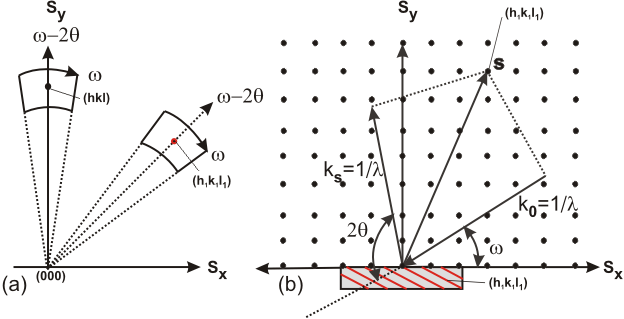
Figure 0.2: (a) Scans in reciprocal space for two different
reciporcal lattice points (hkl) (symmetric) and
(h1k1l1) (asymmetric). (b) Reciprocal space
construction for the asymmetric reflection (h1k1l1).
ks and k0 are the wave vectors for
the diffracted and the incident X-rays, respectively.
S=k0+ks is the scattering
vector.
Bibliography
- [1]
-
D. K. Bowen and
B. K. Tanner,
High Resoultion X-ray Diffractometry and Topography
(Taylor and Francis, London,
1998), 1st ed.
- [2]
-
P. F. Fewster,
X-ray Scattering from Semiconductors
(Imperial College Press, London,
2005), 2nd ed.
- [3]
-
P. F. Fewster,
Rep. Prog. Phys. 59,
1339 (1996).
- [4]
-
A. Krost,
G. Bauer, and
J. Woitok, in
Optical Characterization of Epitaxial
Semiconductor Layers, edited by
G. Bauer and
W. Richter
(Springer-Verlag, New York,
1996).
- [5]
-
O. Brandt,
P. Waltereit,
and K. H. Ploog,
J. Phys. D 35, 577
(2002).
|