X-ray Reflectivity (XRR)
X-ray reflectivity (XRR) is a non-destructive, non-contacting
method to measure film thickness, interface and surface roughness and density of
films ranging from 20 � to 1 mm total thickness.
Films can be single or multilayer structures, and the thickness of individual
layers can be determined with no optical constant corrections required. The
films can be epitaxial, polycrystalline or amorphous. The thickness of the film
is measured from the periodicity of fringes, the density from the angle at which
the intensity begins to drop and the roughness from the damping of the thickness
fringes and rate of intensity decrease with angle. These are not affected by the
crystallinity of the film. XRR is basically a grazing incidence scattering
technique, with the incident and scattered beams at equal angles to the surface
of the sample. In XRR, an X-ray-beam strikes a solid-surface at a small angle (0-2�)
and is totally reflected. Above the critical angle of total reflectance
qc beam penetrates the sample. Measurement
of the critical angle provides the determination of the density of the material.
If the sample contains a thin layer, X-rays are reflected from the air/layer as
well as from the layer/substrate interfaces. This leads to the interference
fringes. In this case the position of the mth order fringe maximum
qm can be shown to be related to the layer
thickness t and the critical angle qc by
the following simple equation.
| |
|
| |
�
�
|
| |
�
� |
(m+1/2)l
2t
|
�
� |
2
|
+qc2 |
|
|
|
|
|
| |
|
|
|
|
(0.1) |
|
where ns and nl are the refractive indices of the
substrate and the layer for X-ray of wavelength l.
From this formula, thickness of the layer can be derived.
Reflection from ideal layered structures : The X-ray
reflectivity from a layer structure can be calculated by applying the recursive
theory of Parratt [1], a
generalization of the Fresnel reflectivity theory, to a system of flat, ideal
layers, each with a constant electron density. The refractive index n of a
material, is given by:
where d+ib
is related to the atomic scattering factors of a particular type of atom. Thus,
the refractive index of matter for X-rays is less than unity. Due to this
reason, at a grazing angle below a certain critical angle qc
a beam of X-rays incident on a surface will be totally reflected. Applying
Snell's law in the small angle approximation one can show that
qc=�{2d}.
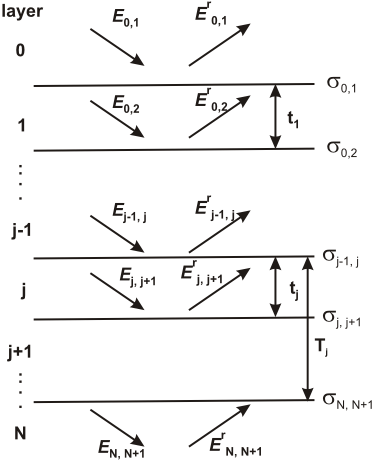
Figure 0.1: Multilayer representation for calculation of
X-ray specular reflectivity. Each layer j is defined by its thickness tj,
refraction index nj, and roughness of the bottom interface
sj. Total of N layers are considered plus
the incident space vacuum and the substrate.
Let us consider the specular reflection of X-rays with an
angle of incidence q from a system of N smooth
homogenous layers as illustrated in Fig. 0.1. The
refractive index of the jth layer is denoted by nj=1-dj-ibj,
the reflection amplitude (fresnel amplitude) of the interface between the j-1th
and jth layers is denoted by rj-1,j
and the electric vectors of the incident and reflected waves at the interface
between the j-1th and jth
layers are denoted by Ej-1,j and Erj-1,j,
respectively. Maxwell's equations require that the tangential component of the
total electric field be continuous at each of the jth interfaces. The
solution to this problem leads to a recursive formula for the reflection
amplitude Rj-1,j of the stack of layers
from the substrate to the interface between the jth and j-1thlayers:
| Rj-1,j=a4j-1 |
�
� |
rj-1,j+Rj,j+1
Rj,j+1rj-1,j+1
|
�
� |
|
|
(0.3) |
where
| Rj,j+1=a2j-1 |
�
� |
Erj,j+1
Ej,j+1
|
�
� |
rj-1,j= |
�
� |
fj-1-fj
fj-1+fj
|
�
� |
fj=(q2-2dj-2ibj) |
|
(0.4) |
and aj is the phase factor for half the thickness tj
| aj=exp |
�
� |
-i |
p
l
|
fjtj |
�
� |
|
|
(0.5) |
The recursion formula is solved by starting at the substrate
(layer N) whose thickness is assumed to be infinite and therefore there is no
reflected wave in it; hence RN, N+1 is zero.
One then solves the equation with j=N and continues
recursively until the top of the layer of the material is reached (j=1), where a1
is unity, giving the reflectivity
The ratio of the reflected to the incident X-ray intensities
is given by the product of R0,1 with its complex conjugate
In the above analysis, we assumed perfectly smooth surfaces.
However, the real surfaces and interfaces are not infinitely sharp as assumed
above. In general we have some roughness which can be taken into account by
considering the so called Born Approximation (BA) or Distorted Wave Born
Approximation (DWBA) [2].
The BA is valid when reflectivity is small, whereas DWBA is valid when
reflectivity approaches unity. In general, the reflection amplitude r which is
valid for both the BA and DWBA, is written in the following form:
| r=rFexp{-1/2(sj-1,
j2SjSj-1)} |
|
(0.8) |
where rF is the
reflection amplitude for a single ideal surface, also called as Fresnel
amplitude. sj-1, j
is the root-mean-square roughness between the j-1th
and jth layers. Sj and Sj-1
are the scattering vectors for the j-1th
and jth layers, respectively. This can be substituted in the
reflection amplitude from the interface between j-1th
and jth layers.
| rj-1,j= |
fj-1-fj
fj-1+fj
|
exp(-1/2(sj-1,j2SjSj-1)) |
|
(0.9) |
This modified Parratt formalism will be used in this work for
XRR simulations to evaluate the layer thickness and interface/surface roughness.
Bibliography
- [1]
- L. G. Parratt, Phys. Rev.
95, 359 (1954).
- [2]
- S. K. Sinha, E. B. Sirota, S. Garoff, and H. B. Stanley,
Phys. Rev. B 38,
2297 (1988).
File translated from TEX by
TTH,
version 3.68.
On 26 Oct 2005, 14:56. |