|
|
for publications
click here
|
Evolution of Magnetic
anisotropy |
|
Magnetic anisotropy as a
function of the thickness could provide understanding for uniaxial magnetic
anisotropy (UMA) found in Fe films on GaAs(001) substrates. Using SQUID
magnetometry, we investigate the evolution of the in-plane magnetic anisotropy
in these Fe films. The evolution of the in-plane magnetic anisotropy with film
thickness is distinguished into two regions. First, for Fe film thicknesses
≤
50 MLs, we observe an in-plane uniaxial magnetic anisotropy (UMA) with the easy
axis along the in-plane
 33 33![[overline 2]](http://scitation.aip.org/servlet/GetImg?key=JAPIAU000097000012123904000001%3A0%3A0%3A28&t=a&d=a)  axes. Second, for Fe film thicknesses
≥ 70 MLs, we observe a
four-fold with the easy axes along the in-plane
03
axes. Second, for Fe film thicknesses
≥ 70 MLs, we observe a
four-fold with the easy axes along the in-plane
03![[overline 1]](http://scitation.aip.org/servlet/GetImg?key=JAPIAU000097000012123904000001%3A0%3A1%3A28&t=a&d=a) directions.
The reorientation of the easy axis from [33]
to the in-plane
03
axes is found to take place between 50 and 70 MLs, the same
thickness range where the relaxation of the layer starts. The
existence of an out-of-plane perpendicular magnetic anisotropy is also detected
in ultrathin Fe films. Similar to Fe on GaAs(001), our results provide evidence
for the interfacial origin of the in-plane uniaxial and out-of-plane
perpendicular magnetic anisotropy. Both the uniaxial and the perpendicular
interface anisotropy are found to be independent of the epitaxial orientation
and are hence an intrinsic property of the Fe/GaAs interface.
directions.
The reorientation of the easy axis from [33]
to the in-plane
03
axes is found to take place between 50 and 70 MLs, the same
thickness range where the relaxation of the layer starts. The
existence of an out-of-plane perpendicular magnetic anisotropy is also detected
in ultrathin Fe films. Similar to Fe on GaAs(001), our results provide evidence
for the interfacial origin of the in-plane uniaxial and out-of-plane
perpendicular magnetic anisotropy. Both the uniaxial and the perpendicular
interface anisotropy are found to be independent of the epitaxial orientation
and are hence an intrinsic property of the Fe/GaAs interface.
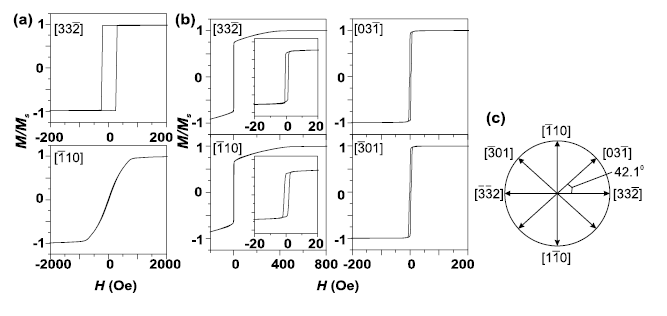
Fig. 1 Room temperature
magnetization curves of Fe films on GaAs(113)A for (a) dFe= 10
MLs (0.14 nm) and (b) dFe = 714 MLs (100 nm) measured along
the different in-plane crystallographic directions shown schematically in (c).
The curves are normalized to their saturation magnetization after correction for
the diamagnetic contribution of the GaAs substrate. The insets in (b) for the
[33]
and [110] directions show magnified portions of the magnetization curves in the
low field region.
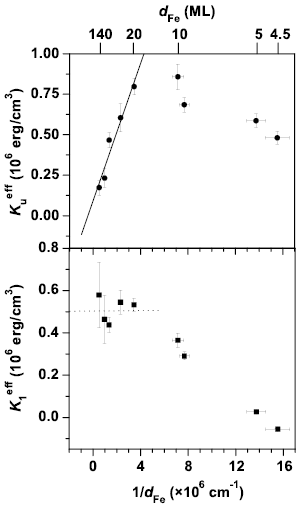
Fig. 2 Variation of effective (a)
uniaxial, Kueff
and (b) four-fold,
K1eff
anisotropy constants with inverse of Fe film thickness dFe
at 10 K. Individual thicknesses are also indicated at the top. A linear fit to
the variation Kueff
vs 1/dFe for Fe film thickness above 20 MLs gives
the surface/interface anisotropy constant to be
Kuint
= (2.1 �0:5)
�
10-1
erg/cm2. K1eff
in (b) remains almost constant above 20 MLs as shown by the dotted line.
The value of Kuint
agrees with literature values reported for Fe films on GaAs(001) and (110)
substrates pointing
towards an identical origin of the UMA in
all these systems. |
|
More details |
|
P. K. Muduli,
J. Herfort, H.-P. Sch�nherr, and K. H. Ploog,
Evolution of magnetic anisotropy and spin-reorientation
transition in Fe films grown on GaAs(113)A substrates by molecular beam epitaxy,
J. Appl.
Phys.
97
123904 (2005) (7 pages)
P. K.
Muduli,
J. Herfort, L. D�weritz,
H.-P. Sch�nherr,, and K. H. Ploog,
Magnetic anisotropy of Fe films on GaAs(113)A substrates,
Appl. Phys. A, In Press (Rapid Communications) (6 pages)
[PDF] |
|
For A 3D animation of the plot of the
anisotropic energy of the Fe(113) surface
click here |
|
Last updated
29-06-2005 |
|
To the Top |
|
Foundations:
Molecular Beam Epitaxy
Reflection High Energy
electron Diffraction (RHEED)
High Resolution X-Ray Diffraction
In-situ Kerr Effect
(MOKE)
SQUID Magnetometry
Magnetotransport
SPINTRONICS BASICS
Research Highlights
Fe/GaAs(113)A:
Onset of
Ferromagnetism
Evolution of Magnetic
anisotropy
Antisymmetric
contribution to the planar Hall effect
Fe3Si/GaAS(113)A
Growth optimization
and basic magnetic Properties
|