|
Ougendal today
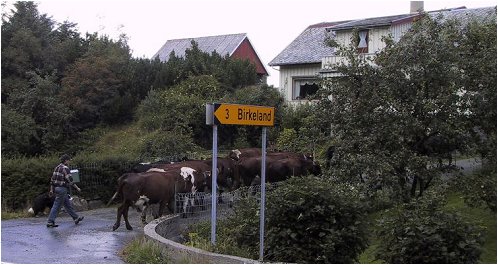
Terje Golf has picked up the cows on the fields at the Gyland-road, and herds them back to the Ougendal-farm for afternoon milking, summer 2000.
It was early apparent that Mandius' fourth son Terje, born in 1969, was the one who took
most interest in farming, and after building himself a beautiful new house in the mid 1990'ies,
Terje formally took over the farm in 2000. He still gets a lot of help from his parents,
something that enables him to work as a car-mechanics in Egersund besides running the farm.
Some years earlier Terje had bought the northern farm at Åvendal, Vasskaret, when
Birger Åvendal, who was Georg's cousin, died without having any children.
Thus the farm has more land than ever and Terje has built a new barn for the sheep at Vasskaret,
just 300 yards down the road from the main farm. He has also built tractor-tracks enabling him
to take out timber and wood from the forests around the farm.
Through the years the number of animals on the farm has increased steadily. Back in 1930 Georg
had 8 milking cows, a horse, 4 heifers, 2 calves and around 40 adult sheep.
Nowadays the number of animals is around 60 lamming sheep, and just over 50 cattle, including
15 milking cows.
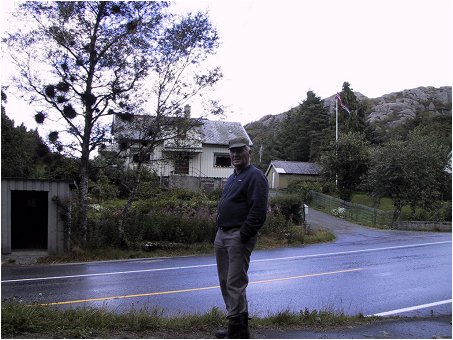
Mandius Golf in front of the farmhouse, summer 2000.
Today there is 25 acres cultivated fields and around 125 acres of forest on the farm out of
the 1500 acres in total.
With the way the agricultural politics are being run in Norway, when farmers have to work more
for less pay year after year, the future of small farming communities as the ones in our part of the country often seem bleak.
Better communications and directives from the EU bureaucrats make the competition from huge
European fabric-farms stiffer than ever.
However, the fact that most people still want a living, thriving countryside where the farmers
maintain their land, and other arguments such as healthy, safe food and a generally excellent
animal-health compared to many other countries, should keep the farmers such as Terje
optimistic that there still is a place for smaller farms like Åvendal in the future.
|
