|
Gunder B Ougendal
- a famous laypreacher
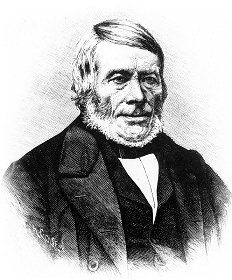 Born at nearby Gyland in 1790, Gunder Berentsen Ougendal was to put his mark on many people's life in and around Sokndal at the time which he lived.He is by far the person originating from Åvendal who is mentioned most in written sources.
Gunder was confirmed at Sokndal Church in the spring of 1806, and the Parson of Sokndal, Bernhoft, described him as «a very bright head».
He was offered to join the staff of teachers in the «Rotation-School», so-called because each farm held school after turn in their houses. To be employed as a teacher in those days had a clear advantage.
In most cases it led to being exempted from military duties, at a time when there was a lot of unrest in Europe with the Napoleonic wars going on.
The British Navy patrolled the Norwegian coastline, sometimes getting into battles as the united Norway and Denmark supported the French. In Sokndal
there were defence-batteries in Rekefjord and at Sokndalsstrand, with the one in Rekefjord once being attacked by a British warship.
Born at nearby Gyland in 1790, Gunder Berentsen Ougendal was to put his mark on many people's life in and around Sokndal at the time which he lived.He is by far the person originating from Åvendal who is mentioned most in written sources.
Gunder was confirmed at Sokndal Church in the spring of 1806, and the Parson of Sokndal, Bernhoft, described him as «a very bright head».
He was offered to join the staff of teachers in the «Rotation-School», so-called because each farm held school after turn in their houses. To be employed as a teacher in those days had a clear advantage.
In most cases it led to being exempted from military duties, at a time when there was a lot of unrest in Europe with the Napoleonic wars going on.
The British Navy patrolled the Norwegian coastline, sometimes getting into battles as the united Norway and Denmark supported the French. In Sokndal
there were defence-batteries in Rekefjord and at Sokndalsstrand, with the one in Rekefjord once being attacked by a British warship.
As a teacher, Gunder was a strict disciplinarian, and one former pupil described him as having « a terrifying presence».
Gunder took over his father's farm at Gyland in 1813, and married 25-year old Anne Berntsdatter Rosland a year later.
In October 1825 Gunder sold off his farm at Gyland for 100 Speciedalers, purchasing the slightly bigger farm at Åvendal for twice that amount.
To give an indication of how much a Speciedaler was worth, a teacher in those days had an annual wage of between 10 and 15 Spd.
Gunder and Anne had nine children, none of whom died as infants, but in 1843 their home was hit by a Typhus-epidemic and his wife, three of the children and his sister died.
Gunder himself was ill for three months.
He re-married four years later with 48-year old widow Kristine Rekedal, but they had no children.
Gunder is best known as a lay-preacher.
At the end of the 18th century Hans Nielsen Hauge, a farmer's son from the East of Norway, started to hold religious speeches, something that was forbidden by law if you were not proper educated.
The «Haugianer-Movement» as it was called after it's founder was a revival-movement, and the new religious winds reached Sokndal a few years later with Sven Dybing from Heskestad addressing the crowd outside church on Sundays after services had been held.
The Church saw it's power being threatened and Gunder who was an obedient disciple of the Parson Bernhoft argued with and reprimanded Dybing and asked how he, as an unlearned, could speak the Gospel.
Dybing replied:»You (Gunder) have the godliness, but you deny it's power».
On another occasion Dybing compared Gunder with Paul, the apostle, and he was to be right as Gunder joint the Haugianer's after searching his soul and concluding that the Church was without spiritual life.
Gunder was preaching as far as Bergen and Kristiansand, and even travelled full-time for some years after 1843.
He strongly encouraged his followers to read the Bible at home, even though in those days it took the revenue of a slaughtered bull to buy yourself a Bible.
Later, Gunder was engaged by the abstainer-movement for some years.
Drunkenness was almost a folk-decease, and often people would go straight from Church to a tavern nearby, not returning home until Monday morning.
Some were eager to get Gunder elected onto the Norwegian Parliament, The «Stortinget», but the Haugianer-movement persuaded him to continue as a preacher.
Still, he was a member of the District-Council for many years, and was also Vice- Chairman for a while.
Gunder also was a key-figure in the building of Bø Chapel.
Lying adjacent to the church the chapel has been a home to different christian missionary organisations ever since, and a portrait of Gunder has hung in the chapel since 1910.
His home at Åvendal was a spiritual cornerstone in the Sokndal community, but in the 1865-census Gunnar, then 75, is listed living at Lindland with a friend. When his son Ole moved to Rosland in 1872 he took care of his ageing father. Gunnar died 10th March 1875, and when he was put to rest eight days later a considerable crowd paid him respect.
|
