Session eight will explain
the implications of public access to the vast amount
of data being generated daily and the difference between
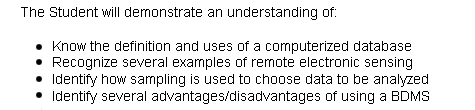
data and information. You will know the definition
and uses of a computerized database as well as identify
several different methods for collecting data. Be
able to recognize several examples of remote electronic
sensing. The student will also be able to understand
the FBI fingerprint retrieval system as a highly organized
database encompassing a large amount of data and how
statistics are used to analyze data in a database.
You will be able to identify how sampling is used
to choose data to be analyzed. Know how samples can
be skewed to give inaccurate results and how false
correlations can lead to erroneous conclusions. Finally,
identify the elements of a DBMS, from field to file,
several advantages of using a DBMS and identify several
disadvantages of using a DBMS.
The
following are the activities for this Week. It is important
to emphasize that each assignment is designed to be performed
in one day, and maximum two if pertinent.