IANFU, HEIHO DAN ROMUSA TUNTUT UANG GANTI RUGI
Eka Hindrati
Peneliti Independen Ianfu Indonesia
Awal bulan Juni lalu belasan ex Heiho dan ahli waris Ianfu mendatangi Kejaksaan Agung untuk menuntut uang Ianfu ganti rugi sebesar 24 milyar sebagai klaim kompensasi perang kepada Ianfu, Heiho dan Romusa. Uang tersebut merupakan sisa uang 380 juta yen yang diberikan lembaga swasta bentukan pemerintah Jepang Asian Women’s Fund (AWF) periode 1997-2007. Kedatangan mereka didampingi pengacara dari Gerakan Rakyat Sadar Hukum Indonesia (GRASHI). Mereka menuntut uang tersebut karena belum mendapatkan bantuan kesejahteraan dari AWF sebagai korban perang Jepang 1942-1945. Kelompok ini meminta Kejaksaan Agung membuat kerjasama lintas sektoral antar departemen yang terkait guna menyelesaikan persoalan ini.
Sebelumnya kelompok yang tergabung dalam Forum Komunikasi ex-Heiho telah melakukan mediasi dengan Departemen Sosial tahun 2007, namun tidak mendapatkan hasil. Departemen Sosial menyatakan bahwa pemberian uang dari pemerintah Jepang tidak diberikan secara individual. Sehingga dana tersebut dipakai Departemen Sosial untuk membangun 42 panti jompo di 20 propinsi dengan uang sebesar 11 milyar (2005). Penandatangan kesepakan dilakukan pemerintah Jepang dan pemerintah Indonesia pada tanggal 25 maret 1997. Dalam kesepakatan tersebut disebutkan bahwa pemerintah Jepang akan memberikan uang sebesar 380 juta yen yang diangsung selama 10 tahun.
Persoalan pengucuran uang ini selalu menjadi konflik yang tidak kunjung selesai diantara para korban Ianfu di Indonesia. Sesungguhnya uang ini khusus diperuntukan untuk Ianfu sebagai uang hibah bukan sebagai kompesasi perang seperti anggapan banyak orang selama ini. Hal ini terjadi oleh karena pemerintah Indonesia tidak mengambil langkah yang terbuka dengan melibatkan para korban Ianfu yang terkait masalah ini dalam mengelola uang hibah tersebut.
Di negara lain seperti di Korea, Taiwan, Belanda, Filipina dan Cina perolehan uang dari AWF ini diumumkan secara terbuka oleh pemerintah dan juga tanpa intervensi pemerintah yang bersangkutan. Sehingga korban Ianfu leluasa memiliki hak pilih untuk menerima atapun menolak uang tersebut.
Sejak kasus sistem perbudakan seksual militer Jepang tahun 1942-1945 terungkap tahun 1946 dalam pengadilan Batavia. Pemerintah Jepang dengan segala daya upaya menolak mengakui bertanggung jawab secara politik atas perkosaan brutal 400.000 perempuan di Asia Pasifik dan Belanda. Indonesia dibungkam pemerintah Jepang dengan perjanjian pemberian pampasan perang yang dituangkan dalam UU 13/1958. Dalam perjanjian itu disebutkan bahwa pemerintah Indonesia menerima pampasan perang senilai 80,308 milyar yen atau setara dengan 223 juta USD yang dicicil selama 12 tahun. |
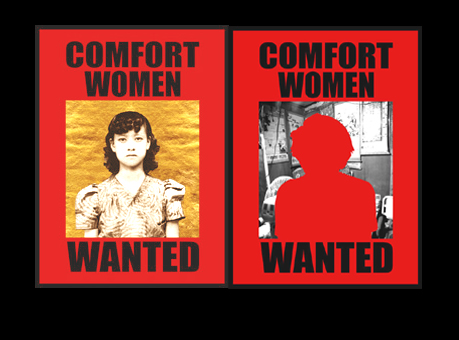
COMFORT WOMEN WANTED
A Public Art Project
Advertisement-like posters exhibited throughout Manhattan
December 1, 2008 - December 22, 2008
Artist Reception:
Friday, December 12, 6-8pm
The Dressing Room
75A Orchard St. (Btwn Broome St. & Grand St.)
COMFORT WOMEN WANTED - honoring the memory of 200,000 young women, refered to as "comfort women," who were systematically exploited as sex slaves in Asia during World War II, and increasing awareness of sexual violence against women during wartime.
The gathering of women to serve the Imperial Japanese Army was organized on an industrial scale not seen before in modern history. This project promotes awareness of these women, some of whom are still alive today, and brings to light a history which has been largely forgotten and denied.
The title, COMFORT WOMEN WANTED, is a reference to the actual text of advertisements which appeared in newspapers during the war. When advertising failed, young women from Korea, China, Taiwan, Indonesia, the Philippines, Thailand, Vietnam, Malaysia, and the Netherlands were forced into sexual slavery. Most were teenagers, some as young as 12 years old, and were raped by as many as fifty soldiers a day at military rape camps, known as "comfort stations." Women suffered serial and gang rape, forced abortions, humiliation, and torture, sometimes resulting in mutilation, and even death. The event is considered the largest case of human trafficking in the 20th century.
This public art project involves a series of advertisement-like posters. The text COMFORT WOMEN WANTED is in black atop a red background. Some of the posters present the portrait of a former "comfort woman" during her enslavement at a comfort station, with her image surrounded by gold leaf, suggesting the halo of a saint from Renaissance painting. In other posters, a silhouette of an aged former "comfort woman" appears against an actual photo of her current home. There were very few survivors, and many of these women could never return home because of their "shameful past." For these women, the sense of home was forever destroyed.
Despite growing awareness of the issue of trafficking of women and of sexual slavery as a crime against humanity, this particular recent historical event has gone largely unacknowledged. COMFORT WOMEN WANTED attempts to bring to light this instance of organized violence against women and to restore the honor of those who lived through it.
Comfort women
(
Wikipedia)
is a euphemism for women working in military brothels, especially those women who were forced into prostitution as a form of sexual slavery by the Japanese military during World War II.
Around 200,000 are typically estimated to have been involved, with estimates as low as 20,000 from some Japanese scholars[3] and estimates of up to 410,000 from some Chinese scholars,[citation needed] but the disagreement about exact numbers is still being researched and debated. Historians and researchers have stated that the majority were from Korea, China and Japan, but women from the Philippines, Thailand, Vietnam, Malaysia, Taiwan, the Dutch East Indies, Indonesia, and other Japanese-occupied territories were also used in "comfort stations". Stations were located in Japan, China, the Philippines, Indonesia, then Malaya, Thailand, then Burma, then New Guinea, Hong Kong, Macau, and what was then French Indochina
Young women from countries under Japanese Imperial control were reportedly abducted from their homes. In some cases, women were also recruited with offers to work in military.[5] It has been documented that the Japanese military itself recruited women by force.[6] However Japanese historian Ikuhiko Hata stated that there was no organized forced recruitment of comfort women by Japanese government or military.
The size and nature of sexual slavery by the Japanese military during World War II is still being actively debated, as the matter is still highly political in both Japan and Far East Asia.
Many military brothels were run by private agents and supervised by the Japanese Army. Some Japanese historians, using the testimony of ex-comfort women, have argued that the Imperial Japanese Army and Navy were either directly or indirectly involved in coercing, deceiving, luring, and sometimes kidnapping young women throughout Japan's Asian colonies and occupied territories.
Japanese military prostitution
Military correspondence of Japanese Imperial Army shows that the aim of facilitating comfort stations was the prevention of rape crimes committed by Japanese army personnel and thus preventing rise of hostility among people in occupied areas.
Given the well-organized and open nature of prostitution in Japan, it was seen as logical that there should be organized prostitution to serve the Japanese Armed Forces. The Japanese Army established the comfort stations to prevent venereal diseases and rape by Japanese soldiers, to provide comfort to soldiers and head off espionage. The comfort stations were not actual solutions to the first two problems, however. According to Japanese historian Yoshiaki Yoshimi, they aggravated the problems. Yoshimi has asserted, "The Japanese Imperial Army feared most that the simmering discontentment of the soldiers could explode into a riot and revolt. That is why it provided women."
Recruitment
Fig.1. Recruitment advertisements for comfort women
The first "comfort station" was established in the Japanese concession in Shanghai in 1932. Earlier comfort women were Japanese prostitutes who volunteered for such service. However, as Japan continued military expansion, the military found itself short of Japanese volunteers, and turned to the local population to coerce women into serving into these stations. Many women responded to calls for work as factory workers or nurses, and did not know that they were being pressed into sexual slavery.
In the early stages of the war, Japanese authorities recruited prostitutes through conventional means. Middlemen advertised in newspapers circulating in Japan and the Japanese colonies of Korea, Taiwan, Manchukuo, and mainland China. However, these sources soon dried up, especially from Japan.
On April 17, 2007 Yoshiaki Yoshimi and Hirofumi Hayashi announced the discovery, in the archives of the Tokyo Trials, of seven official documents suggesting that Imperial military forces, such as the Tokeitai (Naval military police), forced women whose fathers attacked the Kempeitai (Army military police), to work in front line brothels in China, Indochina and Indonesia. These documents were initially made public at the war crimes trial. In one of these, a lieutenant is quoted as confessing to having organized a brothel and having used it himself. Another source refers to Tokeitai members having arrested women on the streets, and after enforced medical examinations, putting them in brothels
On 12 May 2007 journalist Taichiro Kajimura announced the discovery of 30 Dutch government documents submitted to the Tokyo tribunal as evidence of a forced massed prostitution incident in 1944 in Magelang.
The Ministry of Foreign Affairs resisted further issuance of travel visas for Japanese prostitutes, feeling it tarnished the image of the Japanese Empire.[20] The military turned to acquiring comfort women outside mainland Japan, especially from Korea and occupied China. Many women were tricked or defrauded into joining the military brothels.
The US Army Force Office report of interview with 20 comfort women in Burma found that the girls were induced by the offer of plenty of money, an opportunity to pay off the family debts, and on the basis of these false representations many girls enlisted for overseas duty and were rewarded with advance of a few hundred yen.
In urban areas, conventional advertising through middlemen was used alongside kidnapping. However, along the front lines, especially in the countryside where middlemen were rare, the military often directly demanded that local leaders procure women for the brothels. This situation became worse as the war progressed. Under the strain of the war effort, the military became unable to provide enough supplies to Japanese units; in response, the units made up the difference by demanding or looting supplies from the locals. Moreover, when the locals, especially Chinese, were considered hostile, Japanese soldiers carried out the "Three Alls Policy", which included indiscriminately kidnapping and raping local civilians.
South Korean government designated Bae Jeong-ja as pro-Japan collaborator (chinilpa) in September 2007 for recruiting comfort women.
Number of comfort women
Lack of official documentation has made estimates of the total number of comfort women difficult, as vast amounts of material pertaining to matters related to war crimes and the war responsibility of the nation's highest leaders were destroyed on the orders of the Japanese government at the end of the war. Historians have arrived at various estimates by looking at surviving documentation which indicate the ratio of the number of soldiers in a particular area to the number of women, as well as looking at replacement rates of the women. Historian Yoshiaki Yoshimi, who conducted the first academic study on the topic which brought the issue out into the open, estimated the number to be between 50,000 and 200,000.
Based on these estimates, most international media sources quote about 200,000 young women were recruited or kidnapped by soldiers to serve in Japanese military brothels. The BBC quotes "200,000 to 300,000" and the International Commission of Jurists quotes "estimates of historians of 100,000 to 200,000 women."
____________________________________________
“Taiwan’s Virtual Museum on Sexual Slavery by
Japanese Military and women’s Rights”
“Taiwan’s Virtual Museum on Sexual Slavery by Japanese Military and women’s Rights” is the world’s first digital museum to faithfully chronicle the history of Taiwan’s sex slaves, their campaign for Japanese reparation, and their struggle for human rights. This virtual museum archives the life stories of surviving sex slaves. These Ah Mas (“grandmother[s]” in Taiwanese) leave behind their voices, images, and creative works on this Web site.
During World War II, the Japanese military instituted the apparatus of sexual slavery. It was one of the massive and systematic collective crimes of the twentieth century. In Asia, nearly four hundred thousand women were victimized, forced into sexual slavery by the Japanese military. From Taiwan, a Japanese colony at the time, over two thousand young women were deceived, abducted, or forced to serve as sex slaves; they were ravaged by the war and the Japanese soldiery.
Until now, the Japanese government does not acknowledge this heinous crime of human trafficking, sexual slavery, and enforced labor. Furthermore in 2005, the Japanese ignored international condemnation in the whitewashing of Japanese schools’ history textbooks. Such historical revisionism prevents Japan’s younger generations from learning the truth.
One of Taiwan’s surviving sex slaves Wu Hsiu-mei Ah Ma says: “This scar, this pain, I will remember no matter how long. They [the Japanese government] can pretend they don’t know, but I will never forget.”
Since 1992, various nations bearing this historical scar, such as Taiwan, South and North Korea, China, the Philippines, East Timor, Indonesia, the Netherlands, have campaigned for Japanese reparation for comfort women. Numerous European and American societies have also joined the chorus in support of the female victims. In 2007, countries such as the United States, the Netherlands, the European Union, and Canada have passed resolutions on sex slaves. Likewise in 2008, Taiwan and South Korea have passed resolutions demanding Japan to come to terms with the sexual slavery question. The United Nations have urged Japan to do so in the committee members’ report on human rights. The campaign for Japanese reparation for sex slaves has become part of the global movement for women’s rights.
On January 13, 2009, Taipei Women’s Rescue Foundation launches “Taiwan’s Virtual Museum on Sexual Slavery by Japanese Military and women’s Rights.” It speaks to the world, exposes Japanese war crimes, transmits historical facts, and seeks justice and dignity, albeit belatedly, for this group of victimized women. This worldwide platform crystallizes the pursuit of justice and uncovers wartime sexual violence perpetrated against women.
|
|