History
of Tenerife
-
Tenerife's
History Museum is situated in La Laguna,
the first urban centre of the Island.
This city is characterized by an
important architectural wealth of
historical buildings as in its day was
the political, administrative and
military capital of the Canarian
Archipelago. In itself is a museum
centre which offers a general view of
the institutional, social, economic and
cultural development of Tenerife between
the XV and XX centuries. With this
museum's creation, the Cabildo de
Tenerife has covered an important
cultural demand which had remained
unrevealed. The centre aims at a
permanent presentation of a general idea
of the institutional, social, economic
and cultural aspects of Tenerife during
that period. It also intends to rescue,
research and preserve Tenerife's
Historical and Cultural heritage for
future generations. It is situated
within an ancestral nobleman's home:
Casa Lercaro which dates from 1593 and
which was owned by the Lercaro family.
It's architectural design is of Genovese
influence, with Renaissance and
Mannerist elements on its fa�ade.
|
ADDRESS
San Agust�n, n� 22
38201
San Crist�bal de
La Laguna
Ph.: 63 01 03 - 63 01 21
Fax: 63 00 13
TENERIFE
Canary Islands
|
HOW
TO GET THERE
Buses:SantaCruz/La Laguna
014-015-105
Puerto de la Cruz/La Laguna
101-102
Las Am�ricas/Santa Cruz
l l l
|
VISITING
HOURS
Tuesdays Thrursday Saturdays:
10:00 - 17:00 h
Sundays:
10:00 - 14:00 h
Closed on Mondays
Group visits
by appointment
|
|
|
-
The
ancient Greeks already knew The Canary Islands. The
original inhabitants of Tenerife were called Guanches.
No one knows for sure where the first settlers came from
or when they came. Modern archaeological findings
suggest they came across the Atlantic from North Africa
about 200 B.C. However, early navigators report
Canarians as having been tall, blond-haired, blue-eyed
people, perhaps of a northern European origin. There is
also a romantic view that the highest peaks of Tenerife
are the remains of the lost continent of Atlantis, which
was the Greek philosopher Plato first wrote about.
-
Before
the arrival of the Spanish, the island was divided into
nine tribal kingdoms, the names of which are still in
use in modern Tenerife - Abona, Adeje, Anaga, Daute,
Icod, G�imar, Tacoronte, Taoro and Tegueste.
-
By
the time Spanish forces began their conquest of the
Canaries in 1402, Tenerife had already become an
important trading centre due to its inter-continental
location. The island's population was then around 30
000.
-
The
Spanish conquered Tenerife in 1495 by Alonso Fernandez
de Lugo, who founded the town of La Laguna as his
capital. La Laguna is therefore the oldest town in the
Canaries and remained the capital until 1723. It was
built inland, away from the robbing pirates. Tenerife
began developing quickly as the major commercial trading
link between Europe, Africa and the new world - America.
This attracted also the unwelcome pirates, and also
whole nations such as Britain. The most famous victory
of the islanders was the defeat of Nelson at Santa Cruz
in 1797.
-
In
the 19th century Spain was politically weak and in 1812
political and administrative power for the whole of the
Canary Islands was given to Santa Cruz in Tenerife. In
1927 the Canaries were divided into two provinces, east
and west. Santa Cruz remained the capital of the western
province of Tenerife, La Palma, La Gomera and El Hierro,
while the control of Gran Canaria, Lanzarote and
Fuerteventura was given to the city of Las Palmas (Gran
Canaria).
-
Tenerife
had strong economic links to the American continent and
in 1920s and 1930s many of the islanders moved to
America, especially to Venezuela, to find a better
living there. It is said that today there are 4 million
people of Tenerifean origin in Venezuela!
-
The
Spanish Civil War in 1930s was a difficult time for
Tenerife. The Civil War actually started from Tenerife
where Franco had been moved from Spain. So Tenerife was
the first to suffer mass executions of writers, trade
unionists, socialists and anyone who Franco considered a
threat. On the one hand, Franco did bring new wealth to
Spain and to the Canaries, but today not very many
people of Tenerife think well of Franco's time.
-
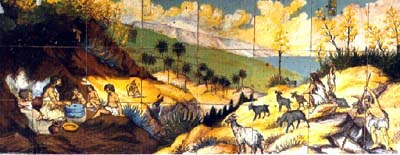
-
Mysterious
Guanche
The natives of Tenerife were called Guanches. They were cave
men and they embalmed the dead in caves. From the mummies
that have been found it can be assumed that they were of the
northwest African origin. A few years ago a stone was found.
It has the symbols 'Z(a)N(a)T(a)' on it, which probably has
some sort of a connection to the same name with a Berber
origin. But no certain answer has been found yet.
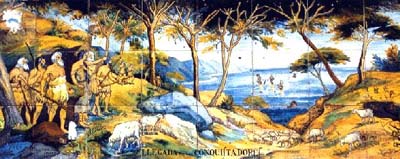
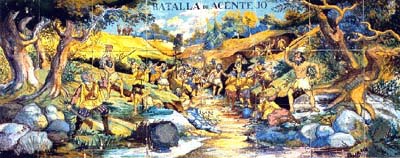
The
pictures on this page are from the walls of Cabildo Insular,
the Tenerife Government in Sta Cruz. They tell of the
Guanche and were painted in the 1960s.
-
There are only
theories and speculations how the Guanches even arrived to
the islands for the first time. The natives did not have any
knowledge of boats or ocean travel, nor had they any
familiarity with metal-working (there are no natural metal
resources on the island). Stone was the main tool they had
to work with and in this sense the island was living in the
Stone Age at the end of the 15th century. They had no
connection with the very near island of La Gomera. Another
mystery is why the Guanches did not make any evolution in
time despite the many visits from the Phoenicians,
Carthaginians and Romans.
-
What
is left of the Guanches
There are only few things left in the Museums. Some of the
things that come from the Guanches today are: The 'Gofio'
which is flour made of toasted grains (earlier from barley,
today from wheat and corn), Wrestling (see traditions), and
Stickfighting among other sport traditions. The ceramic
items were made without a ceramic wheel.
500 years ago the Spanish conqueror Alonso Fern�ndez de
Lugo arrived at the bay of A�aza (today the harbour of
Santa Cruz). The royal house had ordered him to conquer
Tenerife. But the Guanches were very brave and fought back.
-
Bencomo,
the king of Raoro (today La Orotava) the mightiest of
all nine kings, gathered all his warriors and lured the
Spanish to the Bay of Acentejo. 2 000 soldiers of the
Spanish crown fell and 'de Lugo' was seriously injured.
-
This
happened on the 31st of May in 1494. Since then the town
of the massacre is called La Matanza (the slaughter).
Today there is a huge stone wall painting by the
motorway with a Guanche blowing the victory signal
through a horn in the place of the massacre. One and a
half years later, on the 25th of December in 1495 and
after the serious plague which weakened the Guanches the
Spanish crown finally conquered Tenerife.
-
For
a long time the extermination of a nation and all its
culture was held in secret. Under the rule of General
Franco it was even forbidden to talk about it. After
Franco everything has changed and now even Guanche names
are being registered on streets. Families with the
surname 'Oramas' are proud again of their name and tell
about their ancestor Juan Oramas a grandson of the King
Doramas de Guanarteme who was killed in Gran Canaria.
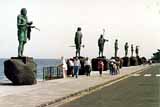
In Candelaria, the
memory of the last nine Kings was kept alive by lava
statues on the beach in front of the Bas�lica. Time and
especially the erosion corroded and destroyed partially
these statues. A few years ago the native artist Jos�
Abad from La Laguna made 7 bronze statues with royal and
other symbolic objects.
-
After
the victory over the Guanches, de Lugo built the
Metropolis of San Cristobal de La Laguna in 1496 by a
lake about seven kilometres away from the bay of A�aza.
In 1723 the capital changed to the harbour city of Santa
Cruz. This colonialist city from the late Middle ages
became later the University and Bishop's city. La Laguna
was the first Spanish city without city walls. The
events of the Guanche Era had long been forgotten but
last year the Museum of History of Tenerife was opened.
Copyright
� 2000, J. Lee. All rights reserved. Text, graphics, and
HTML code are protected by US and International Copyright
Laws, and may not be copied, reprinted, published,
translated, hosted, or otherwise distributed by any means
without explicit permission.
|
|