| Click
each thumbnail to see the full-size picture, then use your
Web browser's Back button to return to this page.
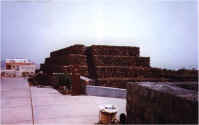
The Pyramids of Guimar
Discovery
Archaeologists and authorities scoffed when a local
newspaper published an article claiming to have discovered
mysterious step-pyramids on the island of Tenerife. Just
more agricultural stone terraces they said, such as are
common throughout the Canaries.
But Thor Heyerdahl thought differently. Dr. Heyerdahl, who
has done extensive research on the pyramids of Tucume in
Peru, was intrigued by photos of the site, and on visiting
the valley of Guimar to see for himself, he was no longer in
any doubt. These were neither terraces nor random piles of
stone cleared by the Spaniards, as some had tried to explain
them away. They were painstakingly built step-pyramids,
constructed according to similar principles as those of
Mexico, Peru, and ancient Mesopotamia.
The
Evidence
-
Far
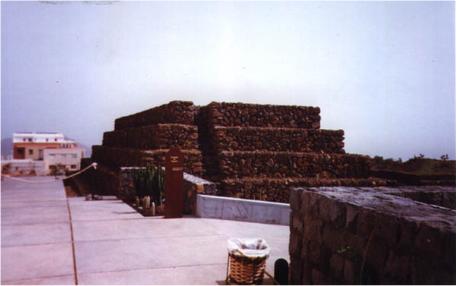
from being piles of unworked rubble, every stone was
turned with its flat side out and placed together by
stone masons.
-
With
slopes of the volcano Mt. Teide at their back and facing
the Atlantic, the edifices are precisely aligned
according to the sunset on the summer solstice, as are
other sacred structures in different parts of the world.
-
Carefully
built stairways on the west side of each pyramid lead up
to the summit, which is not a pile of stones, but a
perfectly flat platform covered with gravel, as though
for ceremonial performances and/or sun worship.
-
The
stones were not weather-worn, rounded boulders, such as
farmers had found in the fields, but sharp fragments of
lava, and some of the corner stones had been trimmed.
-
Archaeologists
from the University of La Laguna were contracted to do
test excavations of a ceremonial platform between two of
the pyramids. As predicted by Dr. Heyerdahl, they found
that rather than being a random pile of stones as they
had expected, it was built of blocks, gravel and earth.
The skeptics had to admit that this was definitely some
kind of ceremonial architecture. Yet some still refused
to admit that such impressive structures could have been
built by the Guanche, the original inhabitants of
Tenerife, and suggested that they might have been
constructed by the early Christian conquistadores as a
time measuring device to know when to celebrate the
Catholic festivities of St. John.
What
is the Significance of the Pyramids?
Following
Dr. Heyerdahl's express wishes, no theory is forced on the
visitors to Guimar. In fact the symbol of the exhibit is a
question mark, asking each person to make up his own mind.
Yet
certainly, the evidence leads Heyerdahl and others involved
in the project to believe that these pyramids may be remains
from pre-European voyagers who sailed the Atlantic in
ancient times, and may have possibly forged a link with the
pre-Columbian civilizations of the Americas.
Among
the original inhabitants of the Canaries many were
fair-haired and bearded, and probably related to the Berbers
who inhabited the coastal areas of North Africa before the
Arab conquest. Is it possible that long before the 15th
century, people of the same stock as those who settled the
Canary Islands also sailed the same route along the Canary
Current that Columbus took to the Americas? Columbus'
starting off point was the Canaries, where his ships got
supplies and water on Gomera, the island next to Tenerife.
The Guanches on Tenerife in 1492 did not permit Columbus or
any other Europeans to land on their island. They were not
impressed by the physical appearance of the bearded
Europeans, who looked like the Guanches themselves. But when
Columbus and the Europeans who followed in his wake landed
in the New World they were welcomed and initially worshipped
as gods, since the beardless Indians they encountered
believed that the Spanish belonged to the same people as the
legendary founders of their civilization, bearded men from
across the Atlantic Ocean.
The
priority is to preserve the pyramids, which were slated for
destruction to make way for urban development. Two of the
smaller pyramids, which were partially damaged in recent
decades, have also been restored.
A
historic building at the site has been restored to house a
museum. The exhibits will present the evidence and arguments
for ideas about the spread of culture and ideas in ancient
times, including examples of cultural parallels in art and
other archaeological materials from across the oceans,
models of ancient watercraft, and illustrations of stepped
pyramids from around the world.
EXCAVATIONS
AT PIRAMIDES DE GUIMAR, TENERIFE, CANARY ISLANDS
On
the proposal of Dr. Thor Heyerdahl, archaeologists from La
Laguna University, Tenerife, carried out test excavations at
the site in 1991. They confirmed that Guanches had been in
the area, as some samples of Guanche materials were found.
Since the entrance to the cave was so filled with refuse and
had been disturbed in recent times, neither carbon dating
nor any form of stratigraphic work was attempted.
In
November 1997, Dr. Heyerdahl proposed that excavations
should be continued at the site, and they were carried out
from November 24-December 5, under the professional
leadership of Dr. Donald P. Ryan of Pacific Lutheran
University, Washington, USA and Lic. Vicente Valencia Afonso
of Tenerife, who is the resident archaeologist and curator
at the pyramid site. Several days were lost in merely
removing refuse to reach virgin ground level and
stratigraphic excavations covering a one-meter square were
conducted down to sterile rock.
 Immediately
inside the cave opening a typical occupation layer showed
that the cave had been used for Guanche habitation. Immediately
inside the cave opening a typical occupation layer showed
that the cave had been used for Guanche habitation.
The
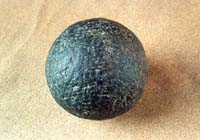
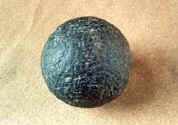
refuse included: 75 potsherds of Guanche ceramics; 47 flakes
of obsidian; four fragments of bone needles; one spheroid of
basalt, pecked to perfection, with a diameter of six or
seven cm; a large quantity of bones, some identifiable as
those of goats; a few molluscs; some fish bones; and one
ceramic bead.
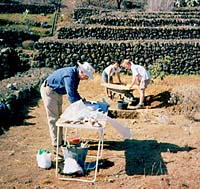
Excavations
were resumed in March/April 1998. This time the expedition
members included: Dr. Thor Heyerdahl, Director; Dr. Donald
P. Ryan and Lic. Vicente Valencia Afonso, Field Directors;
Prof. Brian Holmes and Katie Rorrer, archaeologists; Mr.
Darrell Baker, Dr. Elaine Shen, Mr. Russ Chandler, Mr. Nils
Hagelberg, Mr. Enrique Javier Fernandez Perez, Mr. Sergio
Pou Hernandez, Mr. Jose Antonio Acosta Navarro and Mr.
Carlos Gustavo Gonzalez Diaz, volunteers (the last four are
students at the University of La Laguna).
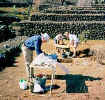
Excavations
in the cave provided little additional material and
clearance in front of the cave door demonstrated extensive
modern disturbance of that area. A series of test pits were
made in an area that was speculated to be goat pens
associated with the pyramids. The pits revealed that the
area has been extensively reused for agriculture up to
modern times and thus little if any intact strata from
ancient usage was revealed.
 Although
not much was found which might directly address the major
questions surrounding the site, the work was necessary in
exploring specific areas therein and will help to set the
stage for further work which will address the pyramids
themselves. Although
not much was found which might directly address the major
questions surrounding the site, the work was necessary in
exploring specific areas therein and will help to set the
stage for further work which will address the pyramids
themselves.
Copyright
� 2000, J. Lee. All rights reserved. Text, graphics, and
HTML code are protected by US and International Copyright
Laws, and may not be copied, reprinted, published,
translated, hosted, or otherwise distributed by any means
without explicit permission.
|
|