|
|
|
|
TRANSPORTATION
HISTORY OF TENERIFE
|
| In
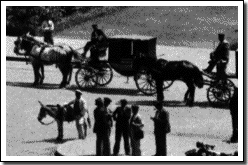
1884 work began on the first Omnibus Company in
Tenerife, it operated with one horse and
carriage, it was able to transport five people
at a time and made a daily trip between Santa
Cruz and La Laguna. A few months later they
introduced two more carriages, enclosed this
time, they could make two trips a day and soon
became a successful way of transport.
|
 |
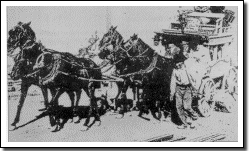 |
By
1885 there was already several transport
companies running between Santa Cruz and La
Orotava carrying more than 16,000 passengers a
year. The local newspaper of the time featured
articles highlighting their extraordinary speed. |
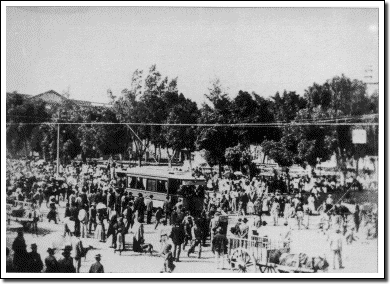
| Plans
for the first tram service in Tenerife were
presented to the Civil Government and City
Council in 1898 and approved the same year, they
included a electricity power station and a tram
depot at La Cuesta. The work took 18 months to
complete; it ran from Santa Cruz to Icod de los
Vinos with branch lines to La Orotava and Puerto
de la Cruz. The manager of the first Electric
Tram Corporation of Tenerife was D. Fernando
May, who later become The Spanish Consul for
Belgium. The
inaugural trip was on 7 April 1901 and it
lasted 34 minutes from the jetty to the church
of La Concepci�n in La Laguna. For 50 years it
was an enormous help for the communications
between both cities. In the summer of 1942 it
was carrying in excess of 16,000 passengers a
day, it also transported goods although not in
large amounts. In 1904 a new concession was
agreed to the same company for a second track
from La Laguna to Tacoronte and in commenced on
27 July the same year. In 1950 the company had
21 klm of track, with four main stations at:
Santa Cruz, La Cuesta, La Laguna and Tacoronte
with workshops, garages and offices in La Cuesta.
The trams stopped running in Tenerife just
before 1960. |
 |
 |
|
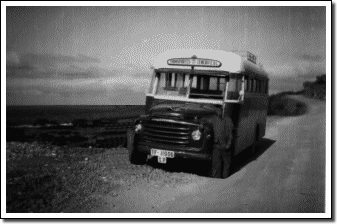
The
first bus (Guagua) service to run in Tenerife
belonged to the Camacho Hotel Company and it was
inaugurated on 1st June 1902. The oldest bus
service in Tenerife ran between La Laguna and La Orotava.
It was decided not to run it into Santa Cruz, because it
would have to much competition from the tram. The first
bus service was introduced several months before the first car
arrived in Tenerife. By 1911 car registrations had
reached 43 and in 1912 four municipal bans were
published regulating the circulation of these mechanical
devices, the speed limit was 12 klm per hour
Many different
bus (Guagua) companies
were in operation by 1927 and in 1928 after a meeting of
all the individual companies they agreed to amalgamate and
form one company.
 |
Between
the years 1931 and 32 the island bus services (Guagua)
was split into zones. The south was run by
:
Domingo Figueroa and Alonso Martin Company.
The
services Santa Cruz - La Laguna by Hdez. Franc�s
- Oramas.
Santa Cruz - Pto. de La Cruz by Lorenzo Hdez. and Hnos.
Santa Cruz - La Orotava
and La Laguna -Tacoronte by Salvador Reyes.
|
| On the
19 August 1942 The Transports of Tenerife S.L.
was created. It operated until 12 January 1978,
when Transport Intercity of Tenerife Corp (T.I.T.S.A.)
was formed. The capital to start the new company
85% came from SPANISH NATIONAL RAILWAYS (RENFE)
and 15% from the Excellent Insular town Council
of Tenerife (Cabildo). The national bus service
today is TITSA. The bus (Guagua) time table is
reliable and cheap. There are plenty of bus
terminals they have over 500 vehicles employing
1,200 staff carrying over 50 million passenger a
year. |
 |
Copyright
� 2000, J. Lee. All rights reserved. Text, graphics,
and HTML code are protected by US and International
Copyright Laws, and may not be copied, reprinted,
published, translated, hosted, or otherwise distributed
by any means without explicit permission.
|