|
|
|



CarnivalI
Anyone
wishing to delve into the history of Santa Cruz de
Tenerife’s Carnival has to go back to the 18th
century. According to the testimony of writers and
travellers of the period, well-off families of the
island regularly held fancy dress balls in their homes.
The lower classes also had street carnivals of their
own, despite the prohibition by the authorities and the
church of dances and pranks in disguise in public. The
forerunners of the tradition of Carnival masks were the
women of Santa Cruz who turned up to the grand fiestas
in the Calle Pilar with their faces hidden. Following
the fall of the II Republic, Carnival was banned until
1945, when the people of Tenerife began to secretly
organise masked celebrations in their homes. In 1965 the
growing popularity of the Carnivals led to calls for the
"Winter Fiestas", as they were then known, to
be officially declared of "interest to
tourists", a status achieved two years later. One
result of this bid to attract tourists to the Winter
Fiestas was the exchange set up between representatives
of the Santa Cruz and Puerto de La Cruz Carnivals and
their counterpart in Dusseldorf, Germany. The link
between the Tenerife capital and the German city is
still going strong today. In 1976, once the prohibition
and censure of the Franco dictatorship came to an end,
the Winter Fiestas changed their name officially to
Carnival. On 18 January 1980, the Secretary of State for
Tourism conferred on the Carnival with the highest form
of recognition, declaring it an event of International
Tourism Interest. In 1987 the Tenerife Carnival earned a
place in history when over 200,000 people took part in
an open-air dance, an achievement that merited a mention
in the Guinness Book of Records. On the night in
question the audience revelled in the company of the
queen of salsa music, Celia Cruz, and popular Venezuelan
band Billy’s Caracas Boys. Today, the various Carnival
groups carry the name of Tenerife to all parts of the
world. The island’s celebrations have become the
second most famous Carnival in the world, after Rio de
Janeiro (Brazil).
As
Carnival itself has grown, so too have the numbers and
quality of the participating groups. The colourful
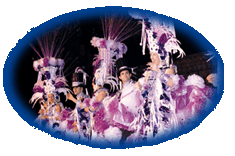
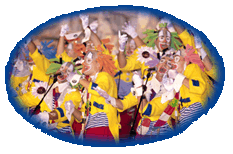
"comparsas" or dancing troupes, the murgas
(satirical singing groups with their cardboard
instruments), and the more classical "rondallas"
or large bands of singers and musicians who perform
Spanish traditional songs and opera pieces, are without
any shadow of a doubt the true protagonists of Carnival
Comparsas
:
References to these dancing troupes date back to the
first third of the 19th century. Several documents
contain references to groups called "comparsas".
They became more common as of the turn of the century,
and came into their own as a separate entity with the
introduction of the competitions for the "rondallas"
in 1910.
Murgas
:
These
satirical bands emerged during the 1920s and 1930s and
were tremendously popular during the Winter Fiestas.
Initially sporting painted faces and playing reed and
cardboard instruments, they have evolved considerably
and now wear highly elaborate fancy dress uniforms.
The words to their stingingly critical songs are
full of satire and irony, and convey to the audience the
bands’ views on current political and social issues.
The amazing success of the bands led to the creation of
female and children’s versions. 1972 saw the birth of
"Las Desconfiadas", the first all-girl "murga".
Mention should also be made of the pioneer "murga"
band, the Ni Fu-Ni Fa, founded by a splinter group from
another one, Los Bigotudos. As of 1961, the Fufa, as the
band is popularly known, lifted the top award five years
in a row and became the standard bearers in the
category.
Rondallas
:
These
bands of street musicians originally dressed similar to
the "murgas" and sang witty songs also.
However, unlike the latter they have always used string
instruments (guitars, lutes etc) to accompany their
songs. Although during the 1960s there were
so many rondall as that competitions were introduced to
Carnival, they fell into decline after this period.
Nowadays they are overshadowed by the spectacular
increase in the number of "murgas" and "comparsas".
Copyright
© 2000, J. Lee. All rights reserved. Text, graphics, and HTML
code are protected by US and International Copyright Laws, and may
not be copied, reprinted, published, translated, hosted, or
otherwise distributed by any means without explicit permission.
|