|
|
|
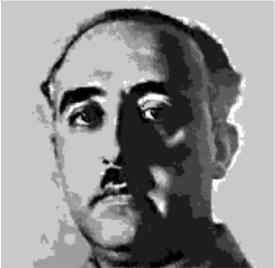
Francisco
Franco Bahamonde
(1892-1975),
Spanish general and authoritarian leader (caudillo), who
governed Spain from 1939 to 1975. Francisco Franco Bahamonde was
born in 1892 in Spain's north-western naval town of El Ferrol.
After an insecure childhood, in 1907 he entered the Military
Academy in Toledo. The army would be his great formative, and
brutalizing, experience. Hungry for promotion, he sought a
posting in Morocco in 1912. In a savage colonial war, his
bravery and competence won him rapid promotions and by 1920, he
was a second-in-command of the ruthless Foreign Legion. In 1926,
he was promoted to Brigadier General, the youngest in Europe.
His exploits made him a national hero and a favourite of King
Alfonso XIII and, in 1927, he was made Director of the General
Military Academy in Zaragoza.
Franco was devastated by the fall of the
monarchy on April 14, 1931. The arrival of the antimilitarist
Second Republic saw the closure of the Academy. After his bitter
farewell speech, the Minister of War, Manuel Azaña, left him
for eight months without a posting. Despite Franco's resentment,
his merits saw Azaña, in February 1932, make him Military
Commander first of La Coruña and then of the Balearic Islands.
Under more right-wing governments, Franco again found
preferment, being promoted to Major General on March 27, 1934
and, in October 1934, entrusted with the repression of a leftist
insurrection in the northern mining valleys of Asturias. He was
rewarded in February 1935 by being made commander-in-chief of
the Spanish armed forces in Morocco, and in May, chief of
general staff. He purged the army of progressive officers, and
promoted right-wingers. After the Popular Front election victory
on February 19, 1936, he vainly tried to prevent the left taking
power, and was sent to the Canary Islands as military commander.
Before leaving Spain, he joined a group of senior generals
plotting a rising but dithered before finally joining the
military coup of July 18, 1936.
Franco
flew to Morocco to command the rebel colonial army. After a
mutiny in the fleet gave control of the Straits to the Republic,
he persuaded Nazi Germany and Fascist Italy to supply transport
aircraft for a large-scale airlift. Once on the mainland, he
deployed the ruthless Army of Africa as an instrument of terror,
its march on Madrid leaving a trail of slaughter. His contacts
with Hitler and Mussolini and his progress towards Madrid made
him the natural choice to be overall rebel commander. In late
September 1936, he made certain by diverting his troops away
from Madrid to relieve the besieged Alcázar of Toledo and so
inflate his own political position with an emotional victory. On
October 1, 1936, he became the Head of State. Having been thus
permitted to organize its defences, Madrid held out in November
and he then tried vainly in December 1936 and early 1937 to
encircle the city albeit at great loss to the Republic.
Thereafter, his strategy was dogged, conquering territory slowly
to permit thorough political purges.
In April 1937, he united the forces of his
coalition into the fascist Falange party. In mid-1937, he took
the industrial north and in 1938 split the Republic in half. He
annihilated the Republican army at the strategically irrelevant
Battle of the Ebro in late 1938, and seized Barcelona in early
1939. After final victory on April 1, 1939 he created an
impregnable dictatorship, coldly presiding over the repression
of the defeated Left with nearly 1,000,000 prisoners and 200,000
executed.
Franco
now cherished hopes of rebuilding the Spanish empire. During
World War II, he pinned his hopes on an Axis victory, offering
in June 1940 to fight at Hitler's side. Initially, the Führer
was not interested. On October 23, 1940, Franco met Hitler at
Hendaye near the Franco-Spanish border. Hitler was not prepared
to feed and arm Spain, or to give Franco a North African empire.
British and American supplies of food and fuel kept him neutral,
although he did substantial service for Hitler by providing
submarine refuelling bases, reconnaissance facilities, and
strategic raw materials.
When
the 1945 Potsdam Conference excluded Spain from the United
Nations, Franco was confident that, in the Cold War, Spain's
geostrategic position would eventually save him from the
consequences of his pro-Axis policies. His propaganda apparatus
presented him as having saved Spain from war. The Berlin
Blockade and the Korean War ensured that he survived with his
position strengthened. In September 1953 a treaty with the
United States brought him into the Western fold, and in 1959 he
received President Eisenhower in Madrid.
In
1957, he began to hand over daily administration to his
confidant, Admiral Luis Carrero Blanco, and the technocrats
associated with the religious fraternity Opus Dei. Franco
himself was occupied giving innumerable audiences, inaugurating
public works, chairing cabinet meetings, and making arrangements
for the succession after his death. He also indulged his passion
for hunting, deep-sea fishing, and golf, and spent considerable
time playing cards and dominoes with his inner circle of
military friends. On December 24, 1961 he was injured in a
hunting accident, which intensified concern about the
post-Franco future. However, perennially slow, he waited until
July 21, 1969 before naming Prince Juan Carlos de Borbón as his
successor. He ruled on for a further six years, plagued by
Parkinson's Disease. On December 20, 1973, he was devastated
when Carrero Blanco was assassinated by Basque terrorists. He
was henceforth in evident decline. Long hours spent watching the
1974 World Cup were a contributing factor to the attack of
thrombophlebitis which led to his withdrawal from power in July
of that year. He recovered, but within twelve months his final
illness began. Franco died on November 20, 1975.
Copyright
© 2000, J. Lee. All rights reserved. Text, graphics, and HTML
code are protected by US and International Copyright Laws, and
may not be copied, reprinted, published, translated, hosted, or
otherwise distributed by any means without explicit permission.
|