www.jacklee.net
Home
Activities
Birds of the Islands
Bus Journeys
Canary Islands
Carnival
Darker Side
Day to Day
Employment
Francisco Franco
Funny Side
History of Transport
History
Interesting Info
Legends
Night Life
Photo 1.
Photo 2.
Photo 3.
Pyramids
Real Estate
Recommended
Restaurants
Scruffy Boy
Services
Shopping
Sightseeing
Spain 1.
Spain 2.
Spain 3.
Tel Numbers
Tenerife
Theme Parks
Towns
Guest Book
Search Page
|
|
|
|
Information Canary Islands - Canaries(Spanish, Islas Canarias), group of islands and autonomous region, Spain, in the Atlantic Ocean, off the north-western coast of Africa, comprising the provinces of Las Palmas and Santa Cruz de Tenerife. Their capitals are, respectively, Las Palmas on Grand Canary and Santa Cruz de Tenerife on Tenerife Island; the cities also serve as dual and alternative capitals of the region. The chief islands of the group, in descending order of size, are Tenerife; Fuerteventura, the nearest to the African mainland; Grand Canary (Gran Canaria); Lanzarote; La Palma; Gomera; and Hierro. In addition, several barren islets are included in the group. The total land area of the islands is 7,273 sq km (2,808 sq mi). The islands are of volcanic origin. Of the volcanic peaks, the highest is the dormant Pico de Teide, or Pico de Tenerife (3,718 m/12,198 ft). The Canaries are noted for their scenery and mild, dry climate, which makes them an ideal site for astronomical observation. The observatory sited at 2,423 m (7,950 ft) on Roque de los Muchachos, La Palma, is the home of some of the world's most important telescopes, including the 4 m (165 in) William Herschel telescope. Precipitation occurs mainly during the winter season. In areas below about 400 m (1,300 ft) elevation, the vegetation is typically northern African; characteristic varieties are the date palm, dragon tree, and cactus. Growing at higher levels are laurels, holly, myrtle, eucalyptus, pine, and a variety of flowering plants. Farming and fishing are the principal industries. The volcanic soil of the Canaries is extremely fertile. The islands have no rivers, however, and severe droughts are common; artificial irrigation is therefore a necessity in most cultivable areas. Among important crops are bananas, citrus fruits, sugar cane, peaches, figs, wine grapes, grain, tomatoes, onions, and potatoes. Manufactured products include textiles and fine embroideries. Tourism is also important, and the islands are a popular winter-resort area. The population of the islands (1991) is 1,493,784. In the view of some authorities, the Canaries are the Fortunatae Insulae of antiquity. The islands were probably known to the Phoenicians and Carthaginians. As described by the Roman scholar Pliny, large numbers of wild dogs (Latin, canes), roamed the islands, which he therefore named Canaria. Arab mariners reached the group in the 12th century, and it was visited in 1334 by French navigators. Pope Clement VI awarded the islands to Castile in 1344. The French mariner Jean de Beth�ncourt began the conquest of the islands in 1402 and was made king of the Canaries in 1404 by the Castilian ruler Henry III. Claimed by Portugal, the islands were recognized as Spanish possessions by a treaty negotiated in 1479. Spanish conquest of the islands was completed by the late 1490s. The indigenous population, the Guanche, a Berber people, eventually became extinct.
The Canaries, previously a single province, were divided
into two provinces in 1927. Hamite, group of
peoples, originally of northern and north-eastern Africa and the
Canary Islands. Anthropologists are in dispute about the precise
ethnological definition of the Hamite; they generally define the
group as including the following: the Berber of North Africa; the
Fula, Tuareg, and Tibbu of the Sudan; the ancient Egyptians; the
major Ethiopian peoples; and the Guanche, an extinct people of the
Canary Islands. Traditionally,
the Hamite were agricultural peoples. They are credited with
originating the oldest extant writing in the world, the
hieroglyphic inscriptions of the ancient Egyptians, and were the
earliest engineers and architects to work in massive stone.
Copyright
� 2000, J. Lee. All rights reserved. Text, graphics, and HTML
code are protected by US and International Copyright Laws, and may
not be copied, reprinted, published, translated, hosted, or
otherwise distributed by any means without explicit permission.
|
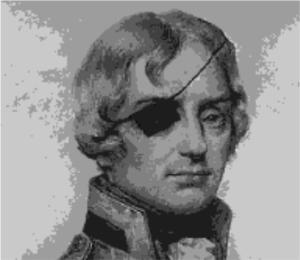 Nelson
led a rash attack by small boats on the town of Santa Cruz de
Tenerife in the Canary Islands, a Spanish possession; the attack
failed, and Nelson received a wound in the right arm that resulted
in its amputation.
Nelson
led a rash attack by small boats on the town of Santa Cruz de
Tenerife in the Canary Islands, a Spanish possession; the attack
failed, and Nelson received a wound in the right arm that resulted
in its amputation.
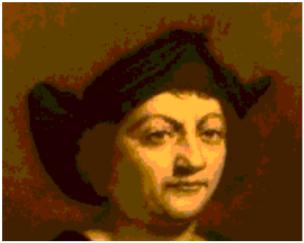 The
modest expedition consisted of the Santa Mar�a, a decked
ship about 35 m (115 ft) long under his command, and the Pinta
and the Ni�a, two small caravels, each about 15 m (50 ft)
long, which were commanded by Mart�n Alonzo Pinz�n
and his brother Vicente Y��ez Pinz�n. The fleet sailed from
Palos, Spain, on August 3, 1492, carrying perhaps 90 men. Three
days out, the mast of the Pinta was damaged, forcing a
brief stop at the Canary
Islands.
The
modest expedition consisted of the Santa Mar�a, a decked
ship about 35 m (115 ft) long under his command, and the Pinta
and the Ni�a, two small caravels, each about 15 m (50 ft)
long, which were commanded by Mart�n Alonzo Pinz�n
and his brother Vicente Y��ez Pinz�n. The fleet sailed from
Palos, Spain, on August 3, 1492, carrying perhaps 90 men. Three
days out, the mast of the Pinta was damaged, forcing a
brief stop at the Canary
Islands.
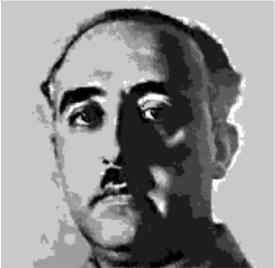 After
the Popular Front election victory on February 19, 1936, he vainly
tried to prevent the left taking power, and was sent to the Canary
Islands as military commander. Before leaving Spain, he joined a
group of senior generals plotting a rising but dithered before
finally joining the military coup of July 18, 1936.
After
the Popular Front election victory on February 19, 1936, he vainly
tried to prevent the left taking power, and was sent to the Canary
Islands as military commander. Before leaving Spain, he joined a
group of senior generals plotting a rising but dithered before
finally joining the military coup of July 18, 1936.