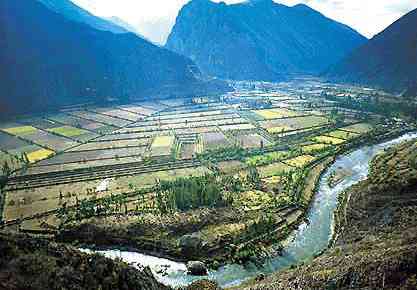
The Sacred Valley of the Incas was undoubtedly a key area of settlement to the Incas. Its agreeable climate and fertile plains make a rare and fruitful combination for the high Andes. It was also the route to the jungle and therefore an area with access to the fruits and plants of the tropical lowlands. The Sacred Valley served as a buffer zone, protecting Cusco from incursions of the Antis, the fierce jungle tribes who from time to time raided the highlands.
Today the Sacred Valley remains a lush agricultural region supplying the city of Cusco with much of its produce such as maize, fruit and vegetables.
Geographic location
Yucay, was the name with which the Incas named to this fertile valley, one of fecund of Peru, its Sacred Valley. They were territories of the Inca and their descendants. Later were possessions recognized by the Spaniards through the Mercedes real who granted the incaica nobility. As testimony of that time has remained the palace of Sayri Túpac, indeed in the locality of Yucay.
The Sacred Valley of the Incas extends along the Vilcanota river (he himself that waters down takes the name from Urubamba or Willcamayu). It includes the area between the towns of Písac and Ollantaytambo.
HISTORY
Climate
Its altitude is of 2.800 msnm, which confers a benign climate to him. As it happens in earth located to this height, its climate is marked by two stations: rains and drought. The humid season happens between the months of November to April. Time at which a heavy shower can untie in second and, unfortunately, not always is enjoyed a blue sky. But the time of rains also has its advantages, because the hills are covered with green an intense one and the temperatures usually are tempered.
During the period of drought the colors of the sky are shining, but the air usually is so dry that the skin seems to become broken. The night is generally very cold and can freeze at dawn. The starred sky is a true spectacle during this season. The Sacred Valley is, climatically speaking, an ideal place. Thus the Peruvians recognized old that went up to here to cure itself of some diseases. In spite of reaching high temperatures and of being a full zone of vegetation, the valley is free of mosquitos by the altitude in which it is. In addition, it is difficult to choke, because a fresh breeze always blows.
The way
If one chooses to go in automobile, it will serve as reference to know to him that leaving by the Saphi street it will find the Faucet San Carlos, where will be able to be supplied of gasoline and to review the state of his automobile with comfort.
Following the route it will arrive at San Cristóbal and, if it counts on a little time, it can take a break in the church and visit one of the more popular protective saints of the Cusco. The way to the Sacred Valley is he himself who leads to Sacsayhuamán, so that if it wishes it and the time is allowed it will be able to visit the ruins of that complex: Quenco, Puca Pucara and Tambomachay.
The impressive thing of the way is that the exit implies to ascend by the hills that dominate the Cusco, which allows to enjoy impressive views of the city, specially at the time of the dusk or at night. If the time and the light are favorable, splendid photographies can be taken. From these points it is possible to observe with thoroughness the structure of the city. When the days are cleared, the resistance between the red ceilings and the blue sky is spectacular.
The viewpoint of Taray
It is the first point from where the valley is really descried. Its landscape, as he is habitual in Cuzco, surprises the traveller, because after long curves and ascents, suddenly the hills are opened and the valley is in all its amplitude. Down, the waters of the river Vilcanota or Urubamba run. From magnificent photographies can here be taken. He is frequent to find children who hope anxious the arrival of tourists to offer the catalogues to them “that they themselves make” and of that feel extremely proud. The way continues, and if luck is had, the Huancalle and Pitusiray will be able to be descried snowed.
The sines of the Ñusta
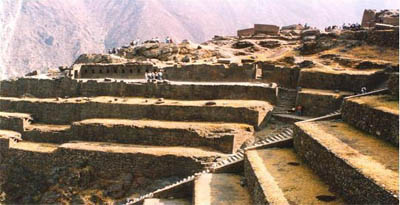
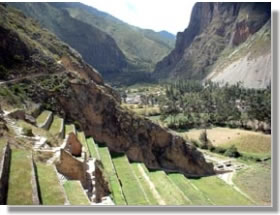
The first place that is visited after lowering hills and crossing Corao and Taray is Písac. To average hill a fantastic Vista of the town is obtained. If it has of time and particular car we advised to him to stop it then from are possible to be taken good photographies and to be observed the structure of the town here. Alongside left of Písac, on the foot of mountains, “Sines of the Ñusta” are descried to the calls, four rows of platforms that simulate the sines of a woman. According to they say, this one could have been a tribute to the fertility. Even though which these platforms so close are the town, they have remained intact until today
INFORMATION
Most people visit the Sacred Valley as part of an organized one-day tour. The tour includes a visit to the market at Pisac, a stop for lunch in Urubamba, a visit to the beautiful Inca village and fortress of Ollantaytamboand a quick stop at the quechua village of Chincheroon the way back to Cusco. Some companies also include a visit to the ruins at Pisac but you'll have less time at the market if you do this. You'll find plenty of tour companies in and around the Plaza de Armas in Cusco offering these tours costing between US$15 and US$20 for a pooled service (up to 30 persons in a group). This price doesn't include your meals or entrance fees to the ruins. Entrance fees are included in the tourist ticket ('boleto turistica') which can be purchased in Cusco for US$10 adults and US$5 students. Departures are usually on the market days of Tuesday, Thursday and Sunday. If you only have one day to visit the Sacred Valley you'll find the convenience of the tour well worth while since the entire circuit is over 170km in length. If you want to do it in a small group you can hire a taxi for the day (approx US$60) and take a guide (approx US$60). Alternatively you can also visit the Sacred Valley on your own, travelling by local bus. It can be quite tiring to try and see Pisac, Ollantaytambo and Chinchero all in one day by local transport so we suggest visiting Pisac ruins and the market on one day and then visiting Chinchero and Ollantaytambo on another day, using Cusco as your base from which to explore.