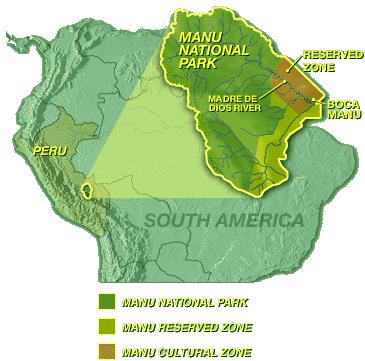
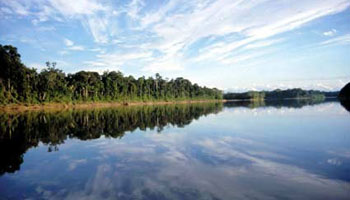
Manu National Park, located in southeastern Peru, is one of the largest parks in South America. The area of the park encompasses parts of the Andean department of Cusco and the jungle department of Madre de Dios. Manu protects over 2 million hectares (4.5 million acres) of territory rich in flora and fauna species in a variety of habitats including high Andes, cloud forests, and lowland tropical rain forests.
UNESCO officially recognizes this natural paradise as a world heritage site. In 1977 they designated Manu as a World Biosphere Reserve because it contains the best existing example of biodiversity in protected areas of rain forest, as well as endemic areas of cloud forest.
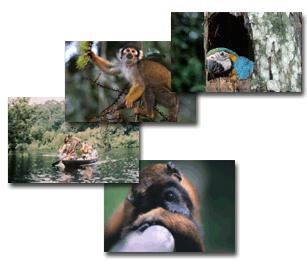
Humans have altered the majority of forests in the world. Fortunately, Manu has remained intact and untouched by civilization. Thus, we can observe a variety of animals in their natural habitats, including: Giant Otters (Pteronura brasiliensis), Black Caiman (Melanosuchus niger), the majestic Jaguar (Panthera onca), the strange Spectacled Bear (Tremarctos ornatus), the Tapir (Tapirus terrestris), the Ocelot (Felis pardalis), 13 species of primates, and an estimated one thousand species of birds including seven species of Macaws
Manu also contains 10% of the world’s vascular plant species, including several species of figs and palms, as well as countless species of medicinal plants that scientists are currently cataloguing. A single hectare of forest in Manu can have up to 220 species of trees, while a hectare of temperate forest in Europe or North America may only have 20 tree species.
INFORMATION
Day 1: Cusco/Manu Cloud forest (Thursday)
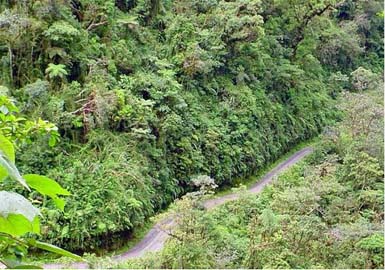
We pick you up by bus from your hotel, after your breakfast, and set off for the cloud forest. We pass over two Andean chains of almost 13,100 feet elevation through a steppe-likelandscape, or Puna. On the way we pass stone Chullpas, or burial chambers,of the Pre-Inca people and will hope to catch sight of
some of the bird species of the high Andes, including the Giant Hummingbird and Mountain Caracara. We plan on a delicious boxed lunch at the edge of the cloud forest, Ajanaco, which if clear, affords views over the cloud forest and the vast sprawling expanse of the lowland rain forest. From here the road suddenly descends the eastern slope of the Andes. We plunge downwards, past remnant patches of elfin forest, through swirling mist and cloud, to emerge in a forest of
stunted, evergreen trees, festooned with mosses, lichens, bromeliads and other epiphytes. Nestled in this forest within a 2-minute walk of the road, and within earshot of a rushing mountain stream, lies the Cock-of-the-Rock Lodge, if there is time available, we will have a chance to briefly begin our exploration of the surrounding forest before dinner.
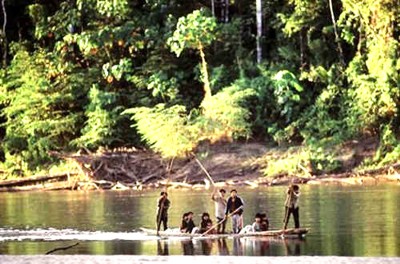
Day 2: Manu Cloud forest/Boca Manu (Friday) Observe Cocks-of-the-Rock displaying and calling at down, and then enjoy breakfast back at the lodge. Explore the cool, moist, mosquito-free cloud forest and search for the confiding Brown Capuchin Monkeys. Travel by bus for 2-3 more hours to the riverside hamlet of Atalaya, where we board our motor canoes to travel down the Alto Madre de Dios River towards the mouth of the Manu River. Depending on the road and river conditions on this day, we either sleep in a simple tented camp (with small tents) or in a rustic local lodge near the mouth of the Manu River.
Day 3: Boca Manu/Manu wildlife Tented camps at park (Saturday) Dawn in the forest or on the riverbank, Visit Boca Manu town. That day we will join the group that comes from Cusco by plane and together we will travel by motor canoe up the Manu River for 5-6 hours to the Wildlife Tented Camp near Cocha Salvador. We will stop at the Guard park station to be registered. On the way we will have the chance to observe beaches with different birds, black caimans, capybaras, turtles, etc. Afternoon arrival at Manu Wildlife Tented camp. Then we will explore some trails of primary forest searching for monkeys. After dinner, the visitors with enough energy will explore other trails looking for different species including insects and frogs.
Day 4: Manu National Park (Sunday)
Visit Cocha Salvador and take a canoe or catamaran outing on the lake to look for the famous endangered Giant Otters and observe some birds and monkeys searching for food. The rest of the day we will explore other trails through different forest types, with excellent chances to observe monkeys.
Day 5: Manu National Park/Boca Manu/Cusco (Monday) Leave very early to motor
down the Manu River and catch the flight to Cusco (airfare included). Transfer to your hotel in Cusco.