Archaeological findings indicate the fertile valley in which Arequipa
is situated has been occupied back to 5000 - 6000 BCE. In the 15th
century, the region, then occupied by Aymara Indians, was conquered
by the Inca and served as an important supplier of agrarian products
to the Inca Empire. The modern city of Arequipa was founded on 15
August 1540, by Garcí Manuel de Carbajal, an emissary of Spanish
conquistador Francisco Pizarro. One year later, King Charles V of
Spain gave it the rank of 'city' and the coat of arms that it still
keeps. The arrival of Spanish influence left many relics and colonial
architecture, which reminds the visitor of the city's colonial past,
when it was the city with the highest proportion of Spanish population
in the whole Viceroyalty of Peru.
This led Arequipa to develop a large
Peruvian Mestizo population as its demographics changed and grew over
the centuries. Since the late 1940's, however, there has been a huge
and increasing immigration from the Peruvian sierra, thus changing
the demographic and cultural character of the city.Throughout history
Arequipa remained relatively isolated during colonial and early republican
times, but that changed in 1870 when a Southern railroad to the coastal
port of Mollendo was inaugurated, opening trade via the Pacific Ocean.
HISTORY
The building and expansion of more
roads in the 1930s also led to a direct connection with the Pan-American
Highway, strengthening Arequipa's links to the rest of the Americas.
Since then, the city has remained the center of commerce between Lima
and all of Southern Peru. Arequipa served as a bastion of nationalism
during Peru's struggle for independence from Spain in the early 19th
century. Later, it served as a rallying point during the War of the
Pacific (1879 - 1883) with Chile.
The city has two principal universities - the Universidad Nacional
de San Agustín de Arequipa, the local state university (founded
1828), and the Universidad Católica de Santa María (founded
in 1961), a private institution.
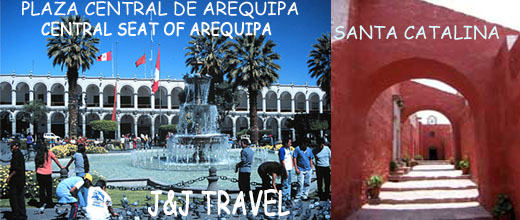
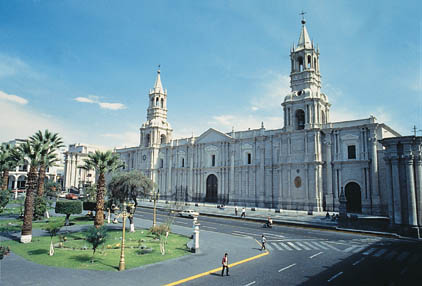
Arequipa, surrounded by spectacular
volcanos, capital of the region of the same name, call also WHITE
CITY by the use of tufo volcanic (to sillar) in its constructions,
is located in the heart of the south of Peru, to 2,325 meters on the
level of the sea. This surrounded by an extensive countryside where
ranges of green shine all giving him to colorful vitality and exceptional
beauty. Its historical center to monumental helmet is beautiful and
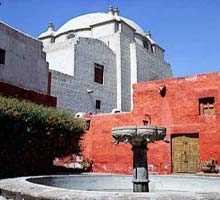
valuable and extraordinary. Their but old constructions are important
temples, convents like the convent of Santa Catherine and large houses
constructed completely with sillar of a matchless blanquiperlada appearance.
Misti volcano (5,825 msnm) is the emblematic mountain of Arequipa.
Its ascent implies, more than a scaling, a long walk of two days by
loose lands and great slope.
To little more than four hours of
Arequipa by hard road will arrive at one from the deepest tubes of
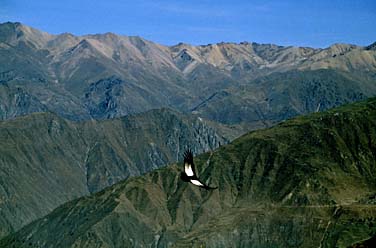
the world, where they fly the cóndores and they pastan the
alpacas and the flames. The Valley of the Colca seems inlaid in the
middle of mountains and desert and to arrive until it will have there
to cross Pampas of Cañahua and Tocra, between flocks of vicunas
and impressive landscapes. Kind Manténgase because in the route
it will find a deflection towards the stone forest of Sumbay, that
has interesting cave paintings. This circuit, one of those of greater
tourist interest in Peru, begins in Chivay and continues throughout
60 km through diverse towns towards the Cross of the Cóndor,
in the neighborhoods of Cabanaconde, where it will be able to descry
volcanos Ampato and Coropuna.