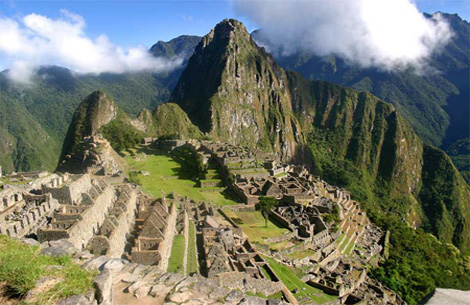
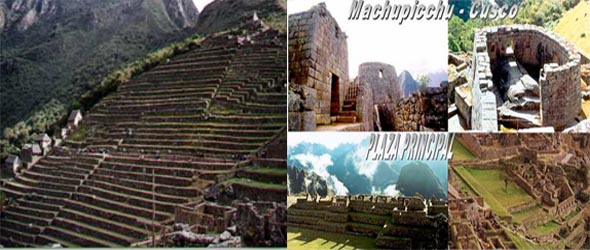
Machu Picchu is probably the most familiar symbol of the Inca Empire. Machu Picchu also commonly to referred to as "The Lost City of the Incas". Since 1983 the site has been designated as a United Nations Educational World Heritage Site and has been the subject of concern about damage caused by tourism.
The Intihuatana ("tie the sun") is believed to have been designed as an astronomic clock by the Incas, while some have speculated about the site's possible astrological role
It is thought that the city was built by the Sapa Inca Pachacuti, starting in about 1440, and was inhabited until the Spanish conquest of Peru in 1532. Archaeological evidence (together with recent work on early colonial documents) shows that Machu Picchu was not a conventional city, but a country retreat town for Inca nobility (similar to the Roman villas). The site has a large palace and temples dedicated to Inca deities around a courtyard, with other buildings for support staff. It is estimated that a maximum of only about 750 people resided in Machu Picchu at any one time, and probably only a small fraction of that number lived in the town during the rainy season and when none of the nobility were visiting.
It is thought that the site was chosen for its unique location and geological features. It is said that the silhouette of the mountain range behind Machu Picchu represents the face of the Inca looking upward towards the sky, with the largest peak, Huayna Picchu (meaning Young Peak), representing his nose.
In 1913, the site received significant publicity after the National Geographic Society devoted their entire April 1913 issue to Machu Picchu.
In 2000, some 400,000 people visited Machu Picchu, and UNESCO has expressed concern about the damage this volume of tourism is causing to the site. Peruvian authorities insist that there is no problem, and that the remoteness of the site will impose natural limits on tourism [2]. Periodically, proposals are made to install a cable car to the site, but such proposals have so far always been rejected
INFORMATION
CLASSIC INCA TRAIL TO MACHUPICCHU 4DAYS / NIGHTS
Cusco is Peru’s main tourist destination and one of the most important destinations in the Americas. Known by the Incas as the “Home of the Gods,” Cusco became the capital of one of the largest pre-Columbian empires: the Tawantinsuyo. Its name in Quechua means “Navel of the World”.
Day 01: Cusco – Wayllabamba
Between 7:00 and 7:30 am, we pick you up at your hotel in our own private bus. We then drive to Piskacuchu (2700 masl), a community located on the 82nd kilometer of the Cusco –Machu Picchu railroad. Starting at this point, we cross the bridge and walk along the left shore of the Urubamba River as it flows north-west along the Sacred Valley. Following the trail along a flat terrain, we arrive in Miskay (2800 masl), to then ascend and finally see, from the tallest part of an overlook, the Inca city of Patallacta (2750 masl). We continue trekking along the valley created by the Kusichaca River, gradually climbing for about five hours until we reach our first campsite in the Wayllabamba village (3000 masl). All along the way we will see spectacular views of the Vilcanota ridge on the opposite side of the Urubamba River, where the impressive Veronica peak reigns at 5832 meters above sea level. Not to mention the diversity of wild flora and fauna that can be found all along the valley.
Day 02: Wayllabamba – Pacaymayo
We wake up at around 6:00 am, and after breakfast we leave Wayllabamba behind to begin the most difficult part of the trek, which consists of an abrupt and steep ascent that stretches for 9 km. Along this climb, the landscape changes from sierra to puna (a dry and high area with little vegetation). On the way to the first mountain pass, the Abra Warmihuañusca (Dead Woman´s Pass), we see domesticated llamas and alpacas grazing on ichu, one of the few plants that grow at that altitude. We also cross an area of the so called cloud forest, which is the habitat for many different kinds of birds like hummingbirds and sparrows and the Andean bear, which is also called the Spectacled Bear (Tremarctus Ornatus). We advise that on this day specially, your day pack is well stocked with candies, chocolates and coca leaves that will keep your sugar level high, and help with altitude sickness. Immediately after the pass, we descend into the Pacaymayo valley (3600 masl), where we camp after approximately 6h of hiking.
Day 03: Pacaymayo – WiñaywaynaThis day is the longest but also the most impressive and the most interesting, due the number of archaeological sites that we visit and learn about from our guide. From Pacaymayo we climb to the second pass, the Abra de Runkurakay (3970 masl). Half way up, we visit the archaeological complex with the same name. This site, located at 3800 masl, consists of a small oval structure that is believed to have served the purpose of a watchtower. After going over the pass, we descend towards Yanacocha (Black Lagoon) and enter the cloud-forest to finally arrive at Sayacmarca (3624 masl). This is a beautiful complex made up of a semicircular construction, enclosures at different levels, narrow streets, liturgical fountains, patios and irrigation canals.
Day 04: Wiñaywayna – Machupicchu On this fourth and last day we get up at 4.00 am to leave Wiñaywayna an hour later and climb to Intipunku, or The Sun Gate. This will take an hour of hiking along a trail of flat stones on the edges of cliffs in highland jungle. From this fabulous spot, we may see the sunrise over the sacred citadel of Machu Picchu. From Intipunku we descend into Machu Picchu, and 40 minutes later we enter the citadel from the highest point through the ¨House of the Guardians¨. We then descend to the control point where we register ourselves and leave our backpacks. We immediately begin a complete guided tour of the Inca citadel that will take approximately two hours. You will then have free time to walk around, climb the Huaynapicchu Mountain, where one can experience spectacular views of all of Machu Picchu, the valleys and mountains that surround it, or visit the Temple of the Moon and the fabulous Inca Bridge. In the afternoon, we meet in the town of Aguas Calientes where, if you like, you can visit and relax in the thermal baths. From here we take the train to the city of Cusco, where we will arrive after nightfall
What is included:
• Collection from your hotel in the morning and transfer in private bus to km.82 (starting point of the trail).
• Entrance tickets The Inca Trail and Machu Picchu
• Professional Guide English speaking, 2 guides for groups over 9 people
• Cook In charge of meal preparation
• General porters (to carry tents, food and cooking equipment)
• Meals 3 Breakfasts / 3Lunches / 3 Dinners
• Train ticket (Backpacker service) from Aguas Calientes to Cusco
• Gear:
• Double occupancy tents
• Rolling mattres
• Dinner tent
• Kitchen tent
• Tables & seats
• Table set
• First aid kit including emergency oxygen bottle
What is not included:
• Lunch and dinner on the last day: after the guided tour at Machu Picchu, you can enjoy free time to further visit the ruins and choose to have lunch either in Machu Picchu or in Aguas Calientes at your own expense. Arrival in Cusco is estimated around 9.00pm, dinner being at your own expense too.
• Visit to the hot springs in Aguas Calientes: a relaxing way to end-up the 4-day trek while you’re awaiting the return train to Cusco, only 10 minutes from the village center, entrance fee is S/. 5.00 Towels can be hired in Aguas Calientes.
• Sleeping Bag.
• Bus ticket from Machu Picchu ruins down to the village of Aguas Calientes