The essence of Trujillo. Trujillo,
Peru - Peru's most important northern city, is summed up each year
during the floral Spring Festival. Barefoot women wearing white lace
skirts and blouses, with ornate gold filigree ornaments dangling from
their earlobes, spin and whirl through the streets in the traditional
marinera dance. Charming, simple, formal and delicate - all are characteristics
of this coastal city, making it the perfect spot to explore Peru's
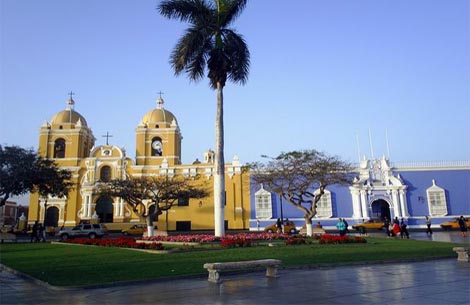
gentle but fiercely patriotic north. Trujillo is also noted for its
colorful colonial architecture, with building painted in bright blues,
yellows, reds and oranges. A circular street called Espana encloses
the center of town, and most of the fascinating city sites are within
this ring. Trujillo is an excellent place to sample ceviche ( a mixture
of raw fishes marinated in a lime juice marinade) and other local
seafood. On the fringe of Trujillo are the ruins of Chan Chan, possible
the world's largest adobe city that was, at one time, home to the
Chimu Indian tribe.
Nearby Huanchaco Beach is a great
spot for surfers, and an outgoing, friendly fishing village. The fisherman
still utilize the handmade totora reed boats, called caballitos (little
horses) because of the way they are ridden: riders do not sit on the
boats, but straddle them on their knees. The design of these curved,
peapod-shaped boats has changed little from the craft used by pre-Inca
fishing tribes.
Further north is Piura, Peru, a
hot commercial city best known for its folk dance, the tondero, and
the black magic practiced by the descendents of black slaves. The
tondero is a lively, barefoot Afro-Peruvian dance accompanied by strong
rhythmic music and dancers in multicolored outfids. Many Lima business
executives travel to this region every year to consult with the area's
brujos - witches, folk healers and fortune tellers.
MORE ON TRUJILLO
September, the International Festival
of Springtime and of the Marinera takes place in Trujillo; the city
dresses up with rejoice, taking on a festive air that fills it with
attraction.
During the Festival, the famous Corso de las Flores (Parade of the
Flowers) is held along with a variety of artistic and folklore shows
which are enjoyed by thousands of local and foreign tourists; yet,
that is not all, it is also ideal for enjoying the Marinera in all
its splendor; the leading dance of Peru, an amorous pursuit full of
elegance and gallantry. If you cannot visit Trujillo in September,
there's no need to worry for, throughout the year, the capital of
the department of La Libertad has a mild and dry climate (average
temperature for the whole year is 19ºC), and for which reason
it has been named the "City of Eternal Springtime".
CHAN CHAN
When most people think of mud, they
think of rainy weather, or mud wrestling; they may even think of a
mud bath. But it is not often that many people associate mud with
a great city.
The vast, desert city of Chan Chan on the northern seacoast of Peru
in South America is the largest adobe, or mud, city in the world.
Adobe is a heavy mixture of clay, sand, and silt used to make sun-dried
bricks. Adobe was used as a building material in the arid desert city
of Chan Chan for three main reasons: mud and clay were abundant in
the desert; adobe was flexible and easy to mold; and adobe insulated
from both the heat and the cold. Wood also was an important building
material, used extensively for the posts and roofs of adobe buildings.
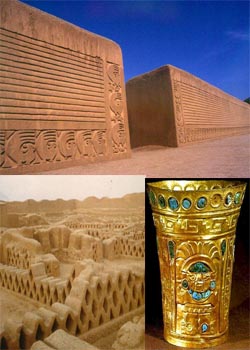
Although adobe is a plain, earth-toned
material, its flexibility allows for elaborate decoration. Chan Chan's
exterior and interior adobe walls were decorated with friezes, designs
molded into the walls, representing all forms of sea life, as well
as human beings, land and forest animals, layered symbols, geometric
shapes, and many other creative designs. The most important areas
were layered with precious metals demonstrating the wealth and importance
of the city and its most powerful inhabitants.
Covering nine square miles, Chan Chan was the largest city in South
America before the Spanish arrived. Built between the 9th and the
15th centuries, the city was the seat of power of the Chimor Kingdom,
which made remarkable technological and artistic achievements and
eventually stretched some 600 miles along the Pacific coast. At the
height of its power, the Chimor Empire encompassed over two-thirds
of the coast and controlled a complex irrigation system.
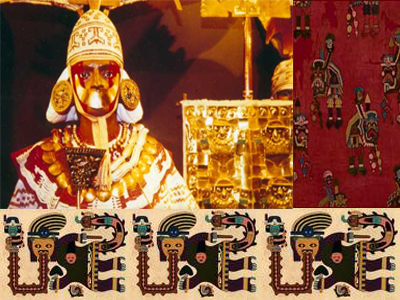
Chan Chan was the center of the kingdom's craft production, and thus
produced, stored and displayed great wealth. In the late fifteenth
century, highland Inca conquered the valuable city and transferred
much of its wealth and many of its skilled craftsmen to their own
capital, Cuzco.
Because the Chimu people left behind no written records, the ruins
of their vast capital and the artifacts that remain there provide
invaluable insight into their culture. To protect this important site
from decay, as well as from plundering and development pressure, Chan
Chan was placed on the World Heritage List in 1986. That same year,
the site was also placed on the World Heritage List in Danger to guarantee
immediate, emergency action against the serious conditions that threatened
it.
Because the Chimu people left behind no written records, the ruins
of their vast capital and the artifacts that remain there provide
invaluable insight into their culture. To protect this important site
from decay, as well as from plundering and development pressure, Chan
Chan was placed on the World Heritage List in 1986. That same year,
the site was also placed on the World Heritage List in Danger to guarantee
immediate, emergency action against the serious conditions that threatened
it.
Located in one of the world's driest
climates, the adobe walls of Chan Chan are melting and crumbling away.
The torrential rains from El Niño, however, have caused the
greatest deterioration of Chan Chan, causing entire structures to
collapse. As a result, UNESCO is working hard to guarantee the protection
of this extraordinary relic of the vanished Chimu civilization.