WELCOME TO SACSAYHUAMAN
J&J TRAVEL AGENCY
SACSAYHUAMAN AND CUSCO
This site is located north of the city of Cusco, at an altitude of about 3555 meters above sea level, between the districts of Cusco and San Sebastian, both of them within in the province and department of Cusco. The archaeological park covers an area of 3094 Hectares and contains more than 200 archaeological sites. Leading to Saqsaywaman there are two paved roads, one starts in the old and traditional neighbourhood of San Cristobal and is about 1.5 kilometers long and the other road begins at Avenida Collasuyo and is 4 kilometers long.
When the Spanish conquerors arrived first to these lands; they could not explain themselves how Peruvian "Indians" (ignorant, wild, without any ability of logical reasoning, one more animal species according to conquerors) could have built such a greatness. Their religious fanaticism led them to believe that all that was simply work of demons or malign spirits. Still today, many people believe in the inability of ancient Quechuas to create such a wonder, so they suggest that they were made by beings of some other worlds, extraterrestrial beings with superior technology that made all that possible. However, our history and archaeology demonstrate that those objects of admiration are an undeniable work of the Incas, Quechuas, Andean people or however pre-Hispanic inhabitants of this corner of the world would be named.
The imperial city Cusco, meaning ‘navel of the earth,’ was laid out in the form of a puma, the animal that symbolized the Inca dynasty. The belly of the puma was the main plaza, the river Tullumayo formed its spine, and the hill of Sacsayhuaman its head.
One of the most imposing architectonic complexes inherited from the Incan Society is Sacsayhuaman, which because of several of its qualities is considered as one of the best monuments that mankind built on the earth's surface.
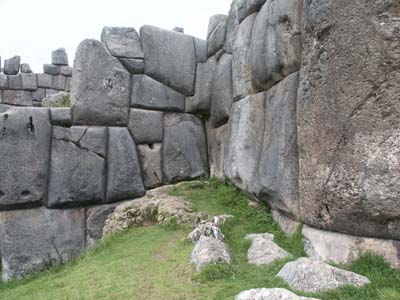
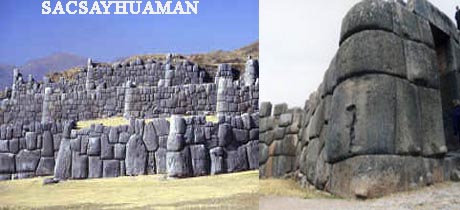
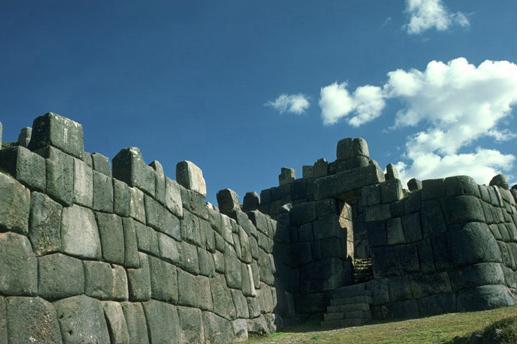
The wall or rampart is the most impressive section, built with enormous carved limestone boulders, this construction has a broken line that faces to the main plaza called Chuquipampa which is a slope with 25 angles and 60 walls.The biggest carved boulder of the first wall weighs about 70 tons and like all of the other rocks was brought from a quarry called Sisicancha, three kilometers away and where there are still rocks that were transported part of the way. Each wall is made up of 10 fronts with the most important ones known as Rumipunco, tiupunku, Achuanpunku and Viracocha punku.
Originally there were three "walls" or "bulwarks" which foundations are still seen today; they are the most spectacular remains of that fabulous building that according to chroniclers did not have any comparison in the old world. They are three parallel walls built in different levels with lime-stones of enormous sizes; zigzagging walls that because of their appearance it is suggested that they represent the "teeth" of the puma's head that the complex represented. The boulders used for the first or lower levels are the biggest; there is one that is 8.5 m high (28 ft.) and weights about 140 metric tons. Those boulders classify the walls as being of cyclopean or megalithic architecture. Some authors believe that the three walls represent the three levels of the Andean Religious World: beginning from the bottom would be the Ukju Pacha (underground stage), the Kay Pacha (earth's surface stage) in the middle, and the Hanan Pacha (sky stage) on the top. Besides; those levels are identified with their three sacred animals: the Amaru or Mach'aqway (snake), the Puma (Cougar or Mountain Lion), and the Kuntur (Andean condor). Because of the zigzagging shape of the walls, some authors suggest that they represented the Illapa god (thunder, lightning and thunderbolt). It is possible that all the previous elements related to their religion would not be excluding, because there are divine interactions, and as it is known "three" was a key number among Quechuas.
There are no other walls like these. They are different from Stonehenge, different from the Pyramids of the Egyptians and the Maya, different from any of the other ancient monolithic stone-works.
INFORMATION
TRADITIONAL TOURS
Cusco has become the highlight of most people traveling to Peru and South America. The ancient capital of the Inca Empire and its surroundings has a combination of history, mysticism and authenticity that is rarely equaled by any other city in the continent. This magical touch has drawn the interest of artists, photographers, shamans and thousands of travelers every year.
The city offers innumerable attractions, from wandering along its well-preserved colonial streets, to visiting Inca archeological sites, attending Quechua masses in the Sacred Valley, visiting the very interesting Inca Museum, or just enjoying its rich gastronomy and always-active nightlife. We have selected the following tours in Cusco and its surroundings:
CITY TOUR:
Duration: 02.00pm – 06.30pm
The traditional visit of the city is the first recommended tour as an introduction that will allow a better understanding of what you might visit afterwards. It covers the visit of the Sun Temple (Koricancha) and the Cathedral in Cusco, to then continue on to visit 4 archaeological sites in the city surroundings: the impressive Sacsayhuaman, Q’enqo, Pucapucara and Tambomachay.
What is included:
• Private transportation
• Guided service by an official tourist guide
• English or Spanish service available
What is not included:
• Meals
• Tourist Ticket (BTG)
• Entrance Ticket to the Cathedral and Koricancha (Temple of the Sun)
Departures: Daily