Founded: 1985. Members: Over 1,000.
Companies and individuals engaged in the marketing of licensed properties,
both as agents and as property owners; manufacturers, consultants,
publications, lawyers, accountants, retailers, etc. in the licensing
business. Objectives are: Establish a standard reflecting a professional
and ethical management approach to the marketing of licensed properties;
The leading source of information in the industry; Communicate this
information to members and others in the industry through exhibits,
publishing, public speaking, seminars, and electronically; Represent
the industry in trade and consumer media and in relationships with
retailers, manufacturers, other trade associations, and the public.
Compile statistics; bestow awards; maintain Hall of Fame and job-placement
service. Publications: (1) annual LIMA's Who's Who Licensing Resource
Directory; (2) LIMA's BottomLine Newsletter (3 per year). Formed by
merger of: Licensing Industry Association (founded March 1980) and
Licensed Merchandisers' Association (founded April 1983). Convention/Meeting:
Official sponsors of annual L!censing International trade show with
exhibits and producers of L!censing University seminars held at the
show; hold Annual Meeting and Members-Only Reception, Awards Ceremony
and Gala every June in conjunction with L!censing International. Members'
receptions and regional get-togethers 6-7 times a year in various
areas of the country.
From a beginning of 12 original
members prior to its merger, it now consists of more than 1,000 members
from around the world with offices in New York, London, Munich, Tokyo,
and Shanghai. Through regional and national events, seminars, exhibits,
and publishing, this not-for-profit corporation is the international
rallying point for organizations interested in learning about and
participating in the business of licensing.
ATTRACTIONS IN LIMA
Plaza
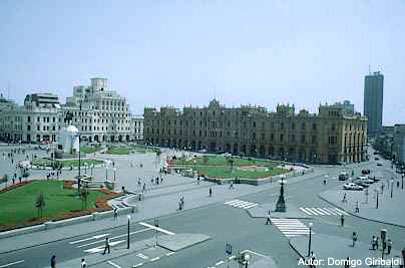
de Armas or Plaza Mayor (Main Square)
The very centre of the capital and the home of government, the impressive
Plaza de Armas or Plaza Mayor is the logical starting point for any
visit to the historic centre. With its gardens, old street lamps and
bronze fountain, the square is a picture of colonial elegance and
testimony to the money lavished upon its restoration over the last
five years. Dominating the north side of the square is the opulent
Palacio de Gobierno (Government Palace), which stands on the site
of the original palace built by the Conquistadors. During the days
when Peru was a Spanish colony, the Palacio de Gobierno was the official
residency of the king's representative. These days, the president
of the republic occupies it. The building was completely rebuilt in
1938. The main attraction is the changing of the guard, which takes
place at 1145 and 1745, when palace guards, dressed in scarlet and
blue uniforms, goosestep round the main courtyard.
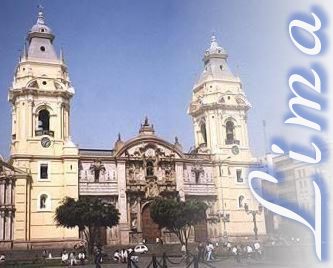
The Cathedral, an example of Spanish
Baroque, stands on the site of two previous churches. The first was
built in 1550, although was replaced nearly a hundred years later,
when a larger church was required. A massive earthquake then destroyed
this building in 1746. The present cathedral, built a few years later,
is a perfect copy of its predecessor. The interior is distinguished
by its high nave, three aisles and carved wooden stalls. The walls
bear the coats of arms of Lima and Pizarro. The Museo de Arte Religioso
(Religious Art Museum) in the Cathedral contains icons and woodcarvings.
Guided tours in English are available.
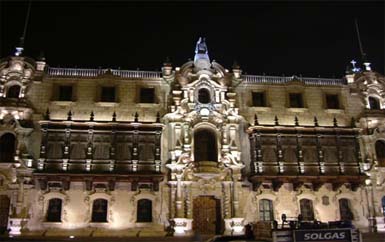
To the left side of the Cathedral
stands the beautiful modern replica of the Archbishop's Palace, with
its Moorish wooden balcony. Also on the square is the impressive Municipalidad
de Lima (Town Hall), which houses a selection of Peruvian paintings.
Palacio Torre Tagle
Two blocks east of Plaza Mayor stands the jewel of the city's colonial
architecture, the Palacio Torre Tagle. The mansion was built in 1735,
for Don José Torre Tagle y Bracho, who received the title First
Marquis of Torre Tagle, from King Charles V of Spain. The façade
boasts two carved wooden balconies. The family house has beautiful
staterooms and opulent staircases, while the decorative azulejos (tiling)
shows a mixture of Spanish and Moorish influences. The highlight,
however, is a gilded 16th-century carriage. The government took the
house over in 1918 and it remains the home of the Foreign Ministry.
Visitors can only enter the courtyards.
Spanish
Inquisition Museum
The Museo de la Inquisicion (Spanish Inquisition Museum) faces Plaza
Bolivar, near the Congress building. In the main hall, the ceiling
is made of mahogany carved into beautiful abstract forms. The infamous
Court of the Inquisition was first held here in the late 16th century.
In the basement are examples of the torture instruments used by the
Inquisitors. Behind the museum is Lima's Chinatown, a maze of grubby
streets dominated by exotic sights and smells. The zone is entered
through a decorative Chinese-style gateway. Here are some of Lima's
best and cheapest Chifas (Chinese restaurants). Peru's Chinese community
is now well established, a century or more after the first Chinese
immigrants arrived as economic refugees to seek farm work on the coast.
El Convento
de los Descalzos (The Convent of the Shoeless)
Behind the Palacio de Gobierno is the rundown Rimac area. Here visitors
can stroll along the Alameda de los Descalzos, a walkway designed
by the city's 'Fathers' in the 17th century. At the end of the Almeda
is a Franciscan monastery, El Convento de los Descalzos (The Convent
of the Shoeless Ones), which gets its name from the Franciscan friars'
habit of going about barefoot. The Convent was founded in 1592 and
its cloisters contain hundreds of Peruvian religious paintings
National
Museum
The Museo de la Nacion, a large
concrete building in the suburb of San Borja, is the country's main
anthropological and archaeological museum with exhibits that highlight
Peru's history stretching back to its earliest tribal cultures. Exhibits
have explanations in English and include displays of traditional peasant
costumes from around Peru.
Gold
Museum
The highly recommended Museo de
Oro is housed in a Fort Knox-like building, set back from the street
and surrounded by trees, in the Monterrico suburb. Here, the loot
that made Peru famous and Spain fabulously wealthy is on display.
Upstairs are weapons and uniforms to remind the visitor of Peru's
violent past. Downstairs are hundreds of dazzling gold and silver
artefacts from pre-Conquest to colonial times, including a yellow-feathered
Inca poncho and a skull sporting teeth made of pink quartz.