It is a National Archaeological Park located toward the east of Qosqo City; covering a territory of about 2200 hectares (5436 acres) in the Oropesa district, province of Quispicanchis. In order to get the main archaeological monument there is a 5 Km. (3 mile) dusty road from kilometer 18 (mile 11.2) of the road Cusco-Puno, towards the north and crossing the "Watanay" rivulet. A half kilometer away from the paved road is the small village of Tipón where an extraordinary colonial abode stands out. The abode is part of the Qespikancha hamlet that was property of the De San Lorenzo de Valle Umbroso Marquises (1650 -1802).
It is without any doubt, the most important countryside monument inherited from colonial times but nowadays is completely a
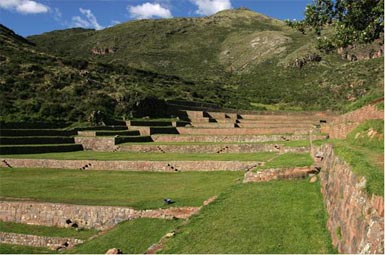
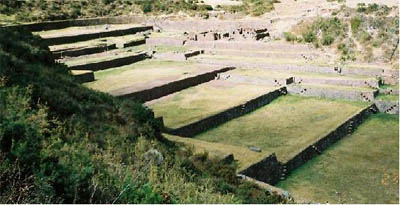
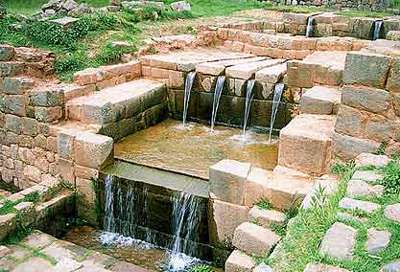
bandoned. The original Quechua name of the whole Park is lost, and today it has diverse groups, standing out the sector where some Inkan "royal inclosures" are found. According to Victor Angles those inclosures were made built by Inka Wiraqocha as a dwelling and refuge for his father Yawar Wakaq after his flight in the war against the Chankas. That group is found in a slight and warm ravine at an altitude of 3500 mts. (11480 Ft.). Besides, the terracing found over here is very impressive, it contains 12 very fertile terraces that are still cultivated, and their retaining walls were built with well carved stones. Even more impressive is the irrigation system that is still serving agriculture and was made taking advantage of the water spring existing in the spot. It has carved stone channels, precisely calculated and sometimes with almost vertical falls that all together constitute a hydraulic engineering master work. Likewise, there are some fountains that must had ceremonial duties.
Because of its location and the presence of a surrounding wall Tipón must have been a very exclusive site, interdependent with some other sectors that today have divers names, among which are "Intiwatana" toward the West, "Pukutuyoq", "Pukara", "Hatun Wayk'o", etc. Towards the group's southwest, in the almost vertical mountain surface is the cemetery named "Pitopuqyo" that today has rows of looted tombs. It is worth mentioning that all over the park there is a huge amount of different cultural vestiges, including thousands of surface broken ceramic pieces.
INFORMATION
Duration 9.00am a 5.00pm
During the dry season, which corresponds with the tourist high season, the villagers of Raqchi make beautiful pottery. The ruins of Raqchi are known as the Temple of Wiracocha. Legend has it that the temple was erected to propitiate the creator god after the area was devastated by a volcanic eruption. The stone of the district is predominantly volcanic. The inhabitants of Raqchi are dedicated to the production of traditional pottery, made by hand and available for visitors to purchase.
What is included:
• Private transportation
• Guided service by an official tourist guide
• English or Spanish service available What is not included:
• Meals
• Tourist Ticket (BTG)
• Entrance Ticket to the church of Andahuaylillas.