Located in the southeastern part of the Andes, Cusco is Peru
s main tourist destination and one of the most important in
the Americas. Known by the Incas as the "home of gods
Cusco became the capital of one of the largest pre-Columbian
empires: the Tawantinsuyo. Its name in Quechua, Qosqo means
"Navel of the world , which derives from when the city
served as a hub for a vast network of roads interconnecting
virtually the whole of South America, from the southern part
of present-day Colombia to the northern part of what is now
Argentina.
Furthermore, Cusco is also both a mestizo and colonial city,
with splendid churches and manors built on foundations of
elaborately carved stone. The local cuisine is also something
for the traveler to look forward to, including superb combinations
of typical Andean foods, such as corn, potatoes and chili
pepper, with pork and mutton introduced by the Spanish. With
its vast landscapes, rich history and fascinating geography,
Cusco is, without a doubt, something all travelers long to
experience.
LEGEND AND HISTORY
Although it was settled centuries before the Incas arrived,
it was only during the period of Inca control (1438-1532 AD)
that the Huatanay River basin, upon which Cusco is built,
reached its peak as an administrative, religious and military
center. The origins 0f the city are shrouded in myth and legends
which tell the tale of how the Inca empire came into being.
One of the most popular myths, from the chronicles kept by
the Inca Garcilaso de la Vega, is that of a mythical couple,
Manco Cápac and Mama Ocllo, who emerged from the waters
of Lake Titicaca to found the city of Cusco and teach its
people how to cultivate the land. The city was divided into
two sectors: an upper area, or Hanan, and a lower-lying area,
or Hurin, references to both the geographical position of
each area and the hierarchical position of their inhabitants.
Moreover, it is also said that the outline of the first city
had the shape of a puma with a falcon’s head.
When the Spaniards arrived in 1533, many pre-Hispanic structures
were destroyed or used as foundations for new structures,
which included churches, convents and mansions built in Baroque
or Renaissance styles. Since then, Cusco has become one of
the most representative expressions of mestizo culture anywhere
in the Americas.
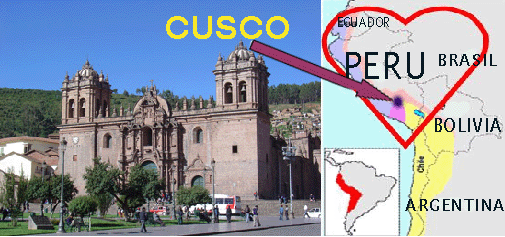
LOCATION AND SURFAC The city of Cusco is located at the central and south-eastern
zone of Peru, exactly at the western part of the valley of
the Watanay River. The department has an area of 76,225 Km2,
and the area of the Province of Cusco amounts to 523 km2.
Compared to the Peruvian territory (1'285,215 Km2), Cusco
represents the 5,9% of the territory.
Cusco comprises three large territory units that can be read
following the North-West-South-East orientatiothe department, and its borders are only
fixed by an interpretation of general physiologic and climatin of the department.
These great territory sections encompass High-Andean zones,
jungle areas within c
variables, which are useful to understand the great diversity
of the Cusco space.
BORDERS
To the North, it is bounded by the jungle areas of
Junín and Ucayali; to the South, it is bounded by the
Southern area of Arequipa and Puno; to the East, it borders
on the large Amazonian plain of Madre de Dios; and to the
West, it is bounded by the mountains of Apurímac and
Ayacucho's jungle. Recently, with the regionalization process
carried out in 1988, it constitutes, together with the departments
of Madre de Dios and a part of Apurímac, the Inca Region.