Venus Information 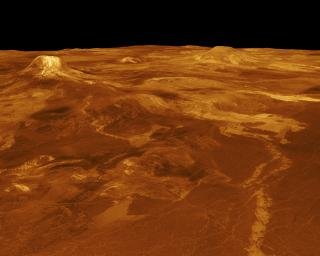 Venus, the second planet from the Sun, is named after the Roman goddess Venus. A terrestrial planet, it is sometimes called Earth's "sister planet", as the two are very similar in size and bulk composition. Although all planets' orbits are elliptical, Venus's orbit is the closest to circular, with an eccentricity of less than 1%. As Venus is closer to the Sun than the Earth, it always appears in roughly the same direction from Earth as the Sun (the greatest elongation is 47.8�), so on Earth it can usually only be seen a few hours before sunrise or a few hours after sunset. However, when at its brightest, Venus may be seen during the daytime, making it one of only two heavenly bodies that can be seen both day and night (the other being the Moon). It is sometimes referred to as the "Morning Star" or the "Evening Star", and when it is visible in dark skies it is by far the brightest star-like object in the sky. Venus, the second planet from the Sun, is named after the Roman goddess Venus. A terrestrial planet, it is sometimes called Earth's "sister planet", as the two are very similar in size and bulk composition. Although all planets' orbits are elliptical, Venus's orbit is the closest to circular, with an eccentricity of less than 1%. As Venus is closer to the Sun than the Earth, it always appears in roughly the same direction from Earth as the Sun (the greatest elongation is 47.8�), so on Earth it can usually only be seen a few hours before sunrise or a few hours after sunset. However, when at its brightest, Venus may be seen during the daytime, making it one of only two heavenly bodies that can be seen both day and night (the other being the Moon). It is sometimes referred to as the "Morning Star" or the "Evening Star", and when it is visible in dark skies it is by far the brightest star-like object in the sky.
The cycle between one maximum elongation and the next lasts 584 days. After these 584 days Venus is visible in a position 72 degrees away from the previous one. Since 5 * 584 = 2920, which is equivalent to 8 * 365 Venus returns to the same point in the sky every 8 years (minus two leap days). This was known as the Sothis cycle in ancient Egypt, and was familiar to the Maya as well. Another association is with the Moon, because 2920 days equal almost exactly 99 lunations (29.5 * 99 = 2920.5).
Venus has a very slow retrograde rotation, meaning that, unlike with most planets, the direction of rotation on its axis is the opposite of its orbital revolution around the Sun. The very slow rotation means that the distinction between its Sidereal day (rotation relative to the stars) and Solar day (relative to the Sun) is very significant.
The pentagram has long been associated with the planet Venus and the worship of the goddess Venus, or her equivalent. It is most likely to have originated from the observations of prehistoric astronomers. When viewed from Earth, the successive conjunctions of Venus plot the points of a pentagram around the Sun every eight years, returning to its starting point after a forty year cycle.
Venus was known to ancient Babylonians around 1600 BC, and to the Mayan civilization (the Mayans developed a religious calendar based on Venus's motion) and must have been known long before in prehistoric times, given that it is the third brightest object in the sky after the Sun and Moon. The Maasai people in Africa named the planet Kileken, and have a myth about it called "The Orphan Boy." The Morning Star was called the Bearer of Light ("phōsphoros" or "eōsphoros" in Greek and "Lucifer" in Latin, a term later used of the fallen angel cast out of heaven). To the Jews it was known as Noga ("shining") and it was used in rabbinic literature as a symbol of beauty and purity.
Its symbol is the sign also used in biology for the female sex, a stylized representation of the goddess Venus's hand mirror: a circle with a small cross underneath (Unicode: ♀). The Venus symbol also represents femininity, and in ancient alchemy stood for copper. Alchemists constructed the symbol from a circle (representing spirit) above a cross (representing matter).
The association with sex and femininity is supposed to relate to the period of 266 days between the conjunction and maximum elongation of Venus, which corresponds more or less to the length of human pregnancy.
The adjective Venusian is commonly used for Venus, but it is etymologically incorrect. The true adjective coming from Latin, Venereal, is avoided because of its modern association with sexually transmitted diseases. Some astronomers use Cytherean, which comes from Cythera. Other less common adjectives include Venerean, Venerian, and Veneran.
The Chinese, Korean, Japanese and Vietnamese cultures refer to the planet as the metal star, based on the Five Elements.
Physical Characteristics Atmosphere 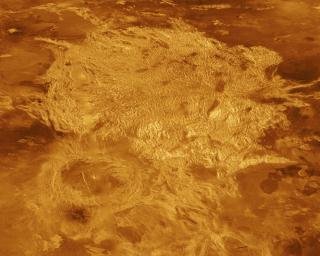 Venus has an atmosphere consisting mainly of carbon dioxide and a small amount of nitrogen, with a pressure at the surface about 90 times that of Earth (a pressure equivalent to a depth of 1 kilometer under Earth's oceans); its atmosphere is also roughly 90 times more massive than ours. This enormously CO2-rich atmosphere results in a strong greenhouse effect that raises the surface temperature more than 400 �C (750 �F) above what it would be otherwise, causing temperatures at the surface to reach extremes as great as 500 �C (930 �F) in low elevation regions near the planet's equator. This makes Venus's surface hotter than Mercury's, even though Venus is nearly twice as distant from the Sun and only receives 25% of the solar irradiance (2613.9 W/m� in the upper atmosphere, and just 1071.1 W/m� at the surface). Owing to the thermal inertia and convection of its dense atmosphere, the temperature does not vary significantly between the night and day sides of Venus despite its extremely slow rotation of less than one rotation per Venusian year, meaning that, at the equator, Venus' surface rotates at a mere 6.5 km/h (4 MPH). Upper atmosphere winds circling the planet approximately every 4 days help distribute the heat to other areas on the surface. Venus has an atmosphere consisting mainly of carbon dioxide and a small amount of nitrogen, with a pressure at the surface about 90 times that of Earth (a pressure equivalent to a depth of 1 kilometer under Earth's oceans); its atmosphere is also roughly 90 times more massive than ours. This enormously CO2-rich atmosphere results in a strong greenhouse effect that raises the surface temperature more than 400 �C (750 �F) above what it would be otherwise, causing temperatures at the surface to reach extremes as great as 500 �C (930 �F) in low elevation regions near the planet's equator. This makes Venus's surface hotter than Mercury's, even though Venus is nearly twice as distant from the Sun and only receives 25% of the solar irradiance (2613.9 W/m� in the upper atmosphere, and just 1071.1 W/m� at the surface). Owing to the thermal inertia and convection of its dense atmosphere, the temperature does not vary significantly between the night and day sides of Venus despite its extremely slow rotation of less than one rotation per Venusian year, meaning that, at the equator, Venus' surface rotates at a mere 6.5 km/h (4 MPH). Upper atmosphere winds circling the planet approximately every 4 days help distribute the heat to other areas on the surface.
The solar irradiance is so much lower at the surface of Venus because the planet's thick cloud cover reflects the majority of the sunlight back into space. This prevents most of the sunlight from ever heating the surface. Venus's bolometric albedo is approximately 60%, and its visual light albedo is even greater. Thus, despite being closer to the Sun than Earth, the surface of Venus is not as well heated and even less well lit by the Sun. In the absence of any greenhouse effect, the temperature at the surface of Venus would be quite similar to Earth. A common conceptual misunderstanding regarding Venus is the mistaken belief that its thick cloud cover traps heat, as the opposite is actually true. The cloud cover keeps the planet much cooler than it would be otherwise. The immense quantity of CO2 in the atmosphere is what traps the heat by the greenhouse mechanism.
There are strong 300 km/h (200 mph) winds at the cloud tops, but winds at the surface are very slow, no more than a few miles per hour. However, owing to the high density of the atmosphere at Venus's surface, even such slow winds exert a significant amount of force against obstructions. The clouds are mainly composed of sulfur dioxide and sulfuric acid droplets and cover the planet completely, obscuring any surface details from the human eye. The temperature at the tops of these clouds is approximately −45 �C (−50 �F). The mean surface temperature of Venus, as given by NASA, is 464 �C (864 �F). The minimal value of the temperature, listed in the table, refers to cloud tops �the surface temperature is never below 400 �C (750 �F). (This makes the surface temperature hot enough to melt lead.)
The atmosphere also contains hydrogen sulfide (H2S) and carbonyl sulfide (SCO). Hydrogen sulfide reacts with sulfur dioxide, which implies that some process must be creating these components. It is unclear how the carbonyl sulfide could be formed--it is often a sign of biological activity. Some have suggested that microbes exist in the clouds (which also contain droplets of water), and produce these components from water, carbon monoxide and sulfur dioxide. New Scientist, Sept. 28, 2002, p. 16
Surface Features Venus has slow retrograde rotation, meaning it rotates from east to west, instead of west to east as most of the other major planets do. (Pluto and Uranus also have retrograde rotation, though Uranus's axis, tilted at 97.86 degrees, almost lies in its orbital plane.) It is not known why Venus is different in this manner, although it may be the result of a collision with a very large asteroid at some time in the distant past. If the Sun could be seen from Venus' surface, it would appear to rise and set in a 116.75 day cycle (Venus' synodic rotation period), and a Venusian year would thus last 1.92 Venusian "days".
In addition to this unusual retrograde rotation, the periods of Venus' rotation and of its orbit are synchronized in such a way that it always presents the same face toward Earth when the two planets are at their closest approach (5.001 Venusian days between each inferior conjunction). This may simply be a coincidence, but there is some speculation that this may be the result of tidal locking, with tidal forces affecting Venus' rotation whenever the planets get close enough together �although the tides raised by Earth on Venus are vanishingly small.
Venus has two major continent-like highlands on its surface, rising over vast plains. The northern highland is named Ishtar Terra and has Venus's highest mountains, named the Maxwell Montes (roughly 2 km taller than Mount Everest) after James Clerk Maxwell, which surround the plateau Lakshmi Planum. Ishtar Terra is about the size of Australia. In the southern hemisphere is the larger Aphrodite Terra, about the size of South America. Between these highlands are a number of broad depressions, including Atalanta Planitia, Guinevere Planitia, and Lavinia Planitia. With only the exception of Maxwell Montes, all surface features on Venus are named after real or mythological females. Venus' thick atmosphere causes meteors to decelerate as they fall toward the surface, and even large meteors will strike the surface at too low a speed to form an impact crater if they have less than a certain threshold kinetic energy. Because of this, no impact crater smaller than about 3 km (2 mi) in diameter can form.
Nearly 90% of Venus's surface appears to consist of recently (in the geological sense) solidified basaltic lava, with very few meteorite craters. The oldest features present on Venus seem to be only around 800 million years old, with most of the terrain being considerably younger (though still not less than several hundred million years for the most part). This suggests that Venus underwent a major resurfacing event in the not too distant geological past. The interior of Venus is probably similar to that of Earth: an iron core about 3000 km in radius, with a molten rocky mantle making up the majority of the planet. Recent results from the Magellan gravity data indicate that Venus's crust is stronger and thicker than had previously been assumed. It is theorized that Venus does not have mobile plate tectonics as Earth does, but instead undergoes massive volcanic upwellings at regular intervals that inundate its surface with fresh lava. Other recent findings suggest that Venus is still volcanically active in isolated geological hotspots.
Venus's intrinsic magnetic field has been found very weak compared to other planets in the solar system. This may be due to its slow rotation being insufficient to drive an internal dynamo of liquid iron. As a result, solar wind strikes Venus's upper atmosphere without mediation. It is thought that Venus originally had as much water as Earth, but that under the Sun's assault water vapor in the upper atmosphere was split into hydrogen and oxygen, with the hydrogen escaping into space owing to its low molecular mass; the ratio of hydrogen to deuterium (a heavier isotope of hydrogen which doesn't escape as quickly) in Venus's atmosphere seems to support this theory. Molecular oxygen is thought to have combined with atoms in the crust (large amounts of oxygen, however, remain in the atmosphere in the form of carbon dioxide). Because of their dryness, Venus's rocks are much harder than Earth's, which leads to steeper mountains, cliffs and other features. Venus' Moon Venus was once thought to possess a moon, named Neith after the chief goddess of Sais, Egypt (whose veil no mortal raised), first observed by Giovanni Domenico Cassini in 1672. German astronomers called the moon Kleinchen (literally "tiny"), and sporadic sightings by astronomers continued until 1892. These sightings have since been discredited, and are thought to have been either spurious internal reflections, mostly faint stars that happened to be in the right place at the right time, or maybe even asteroids passing by the planet. Venus is now known to be moonless. Specifications Orbital Characteristics Semi-Major Axis 108,208,926 km (0.723 331 99 AU)
Orbital Circumference 0.680 Tm (4.545 AU)
Eccentricity 0.006 773 23
Perihelion 107,476,002 km (0.718 432 70 AU)
Aphelion 108,941,849 km (0.728 231 28 AU)
Orbital Period 224.700 69 days (0.615 197 0 a)
Synodic Period 583.92 days
Avg. Orbital Speed 35.020 km/s
Max. Orbital Speed 35.259 km/s
Min. Orbital Speed 34.784 km/s
Inclination 3.394 71� (3.86� to Sun's equator)
Longitude of the Ascending Node 76.680 69�
Argument of the Perihelion 54.852 29�
Number of Satellites 0 Physical Characteristics Equatorial Diameter 12,103.7 km (0.949 Earths)
Surface Area 4.60�108 km2 (0.902 Earths)
Volume 9.28�1011 km� (0.857 Earths)
Mass 4.8685�1024 kg (0.815 Earths)
Mean Density 5.204 g/cm3
Equatorial Gravity 8.87 m/s2 (0.904 gee)
Escape Velocity 10.36 km/s
Rotation Period -243.0185 days
Rotation Velocity 6.52 km/h (at the equator)
Axial Tilt 2.64�
Right Ascension of North Pole 272.76� (18 h 11 min 2 s) 1
Declination 67.16�
Albedo 0.65
Min Surface* Temp. 228 K
Mean Surface Temp. 737 KMax Surface Temp. 773 K
Adjective Venusian or (rarely) Cytherean
(*Min temperature refers to cloud tops only)
Atmospheric Characteristics Atmospheric Pressure 9.3 MPa
Carbon Dioxide ~96.5%
Nitrogen ~3.5%
Sulfur Dioxide 0.015%
Argon 0.007%
Water Vapor 0.002%
Carbon Monoxide 0.0017%
Helium 0.0012%
Neon 0.0007%
Carbonyl Sulfide Trace
Hydrogen Chloride Trace
Hydrogen Fluoride Trace ** Information provided by Wikipedia, the free online encyclopedia. **
Permission is granted to copy, distribute and/or modify this document
under the terms of the GNU Free Documentation License, Version 1.2
or any later version published by the Free Software Foundation;
with no Invariant Sections, no Front-Cover Texts, and no Back-Cover Texts.
A copy of the license is included in the section entitled "GNU
Free Documentation License". |